
Dark kitchens used to feel like a design dare, but they’ve become a practical favorite for 2027. The trick is balancing deep cabinetry, stone, and tile so the room stays dramatic without turning into a cave.
Here are 37 ways to make a dark moody kitchen work with your own space, from rich green tile to black lacquer and brass hardware.
Dramatic Dark Green Tile Backsplash
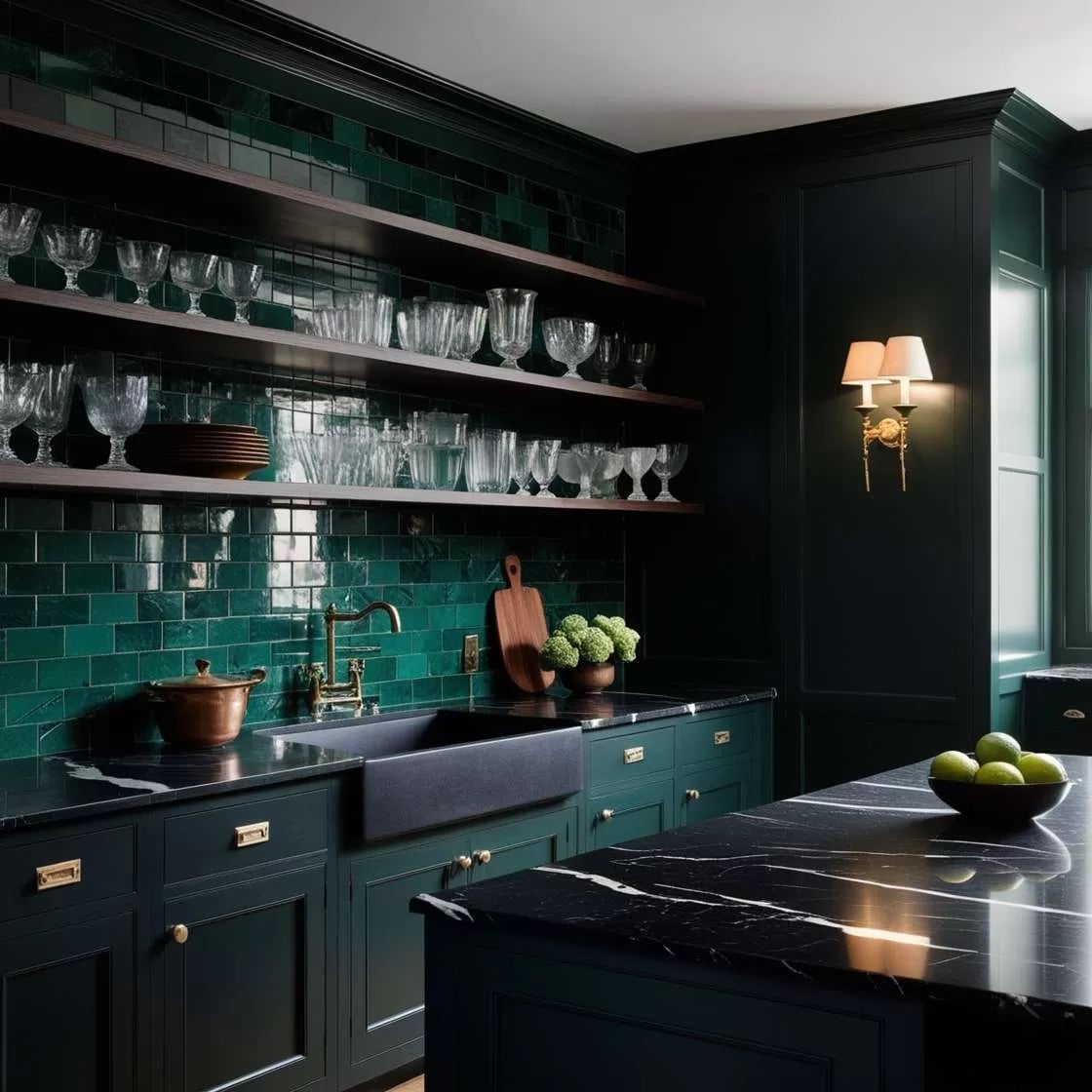
A dark green tile backsplash running the full length of a galley kitchen sets the stage for the whole room. The glossy finish bounces light from wall sconces and a nearby window, so the color stays rich without making the space feel closed in. Paired with black countertops and a brass faucet, the tile becomes the focal point. Open shelving keeps the look airy, while dark cabinets below anchor it. The palette works because it sticks to three main notes: green, black, and brass. A roomy island offers prep space without competing with the backsplash. For a similar result, let one material carry the weight and keep everything else restrained.
Industrial Black Cabinetry and Exposed Brick
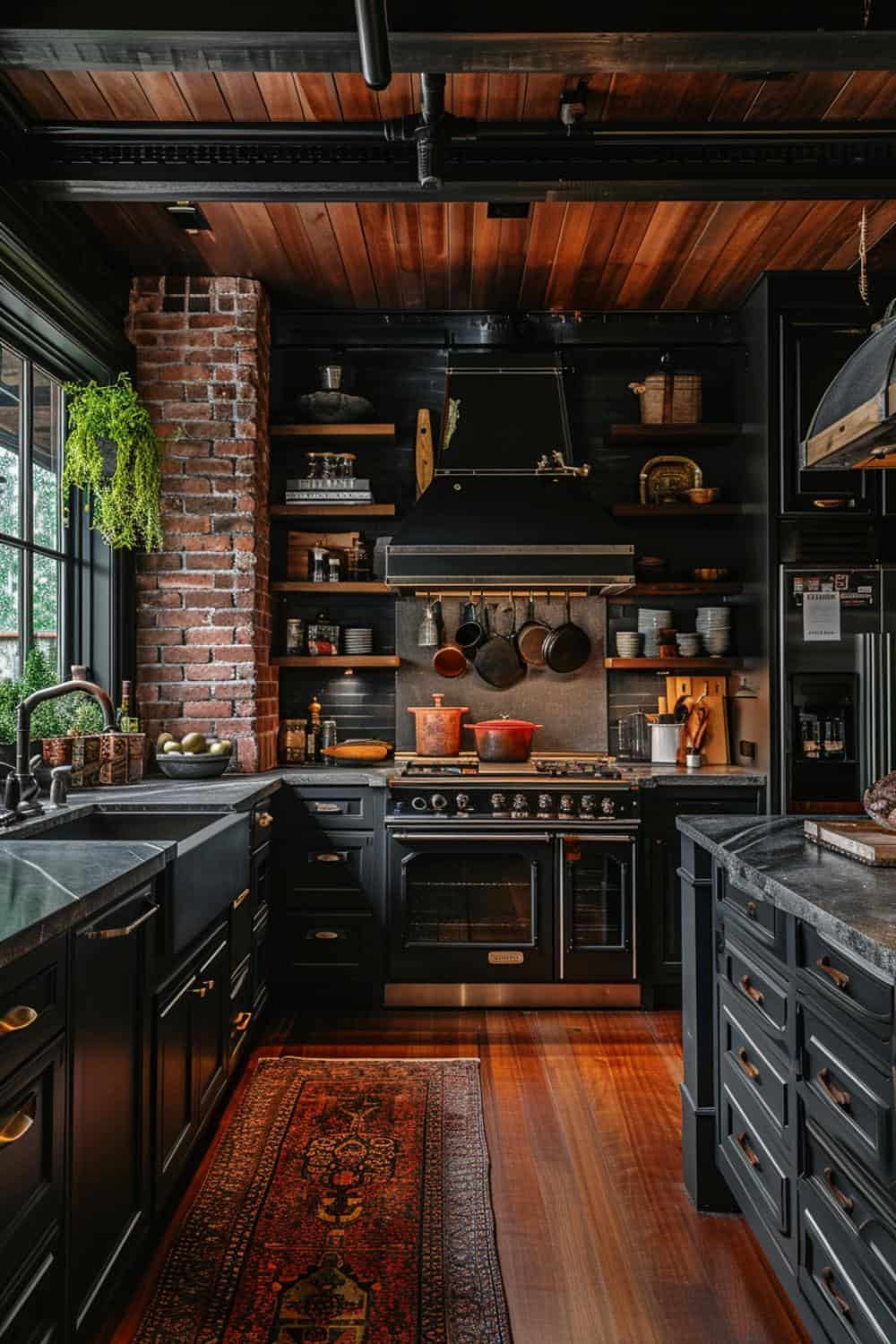
This kitchen does not need much to make an impression. Black cabinetry wraps a U-shaped layout, and an exposed brick wall adds warmth and texture that dark paint alone cannot match. A black range and open shelving reinforce the industrial feel, while wood tones on the countertops and floor keep the room from turning flat. The palette reads as deliberate: black, brick red, and natural wood. Low ambient light from a pendant softens the hard edges. When working with dark cabinets in an industrial setting, let the brick do the talking. The mix of raw and finished surfaces creates depth without clutter.
Gothic Moody Black Marble Countertop
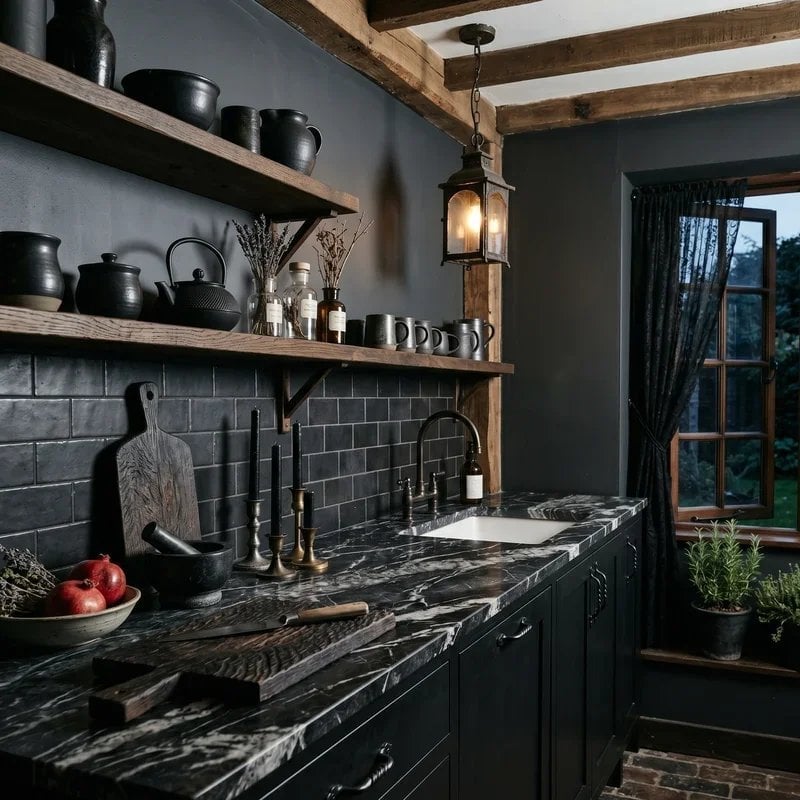
Can a black marble countertop make a compact kitchen feel deliberate rather than cramped? It can, when the room follows its lead. The stone sits on an L-shaped counter with wooden shelves above and black subway tile behind. A lantern pendant casts a warm glow, and daylight keeps the mood from going too heavy. The palette stays tight: black marble and wood tones. The wooden shelves break the darkness and provide practical storage for everyday dishes. In a smaller kitchen, a single dramatic surface like black marble sets the tone. Keep the surrounding materials simple so the stone remains the event.
Rustic Industrial Dark Blue Cabinets and Brick Fireplace
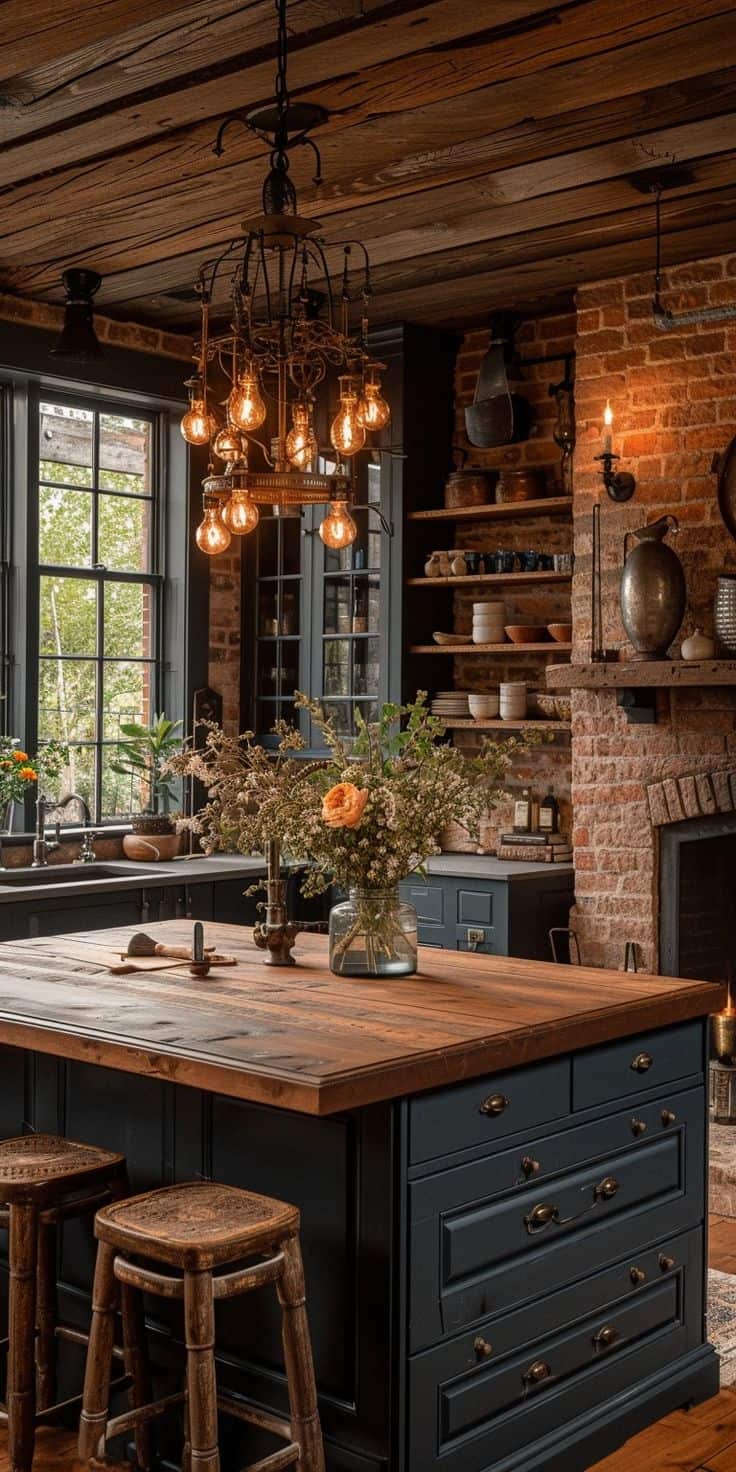
A brick fireplace in a kitchen is an unexpected anchor, but here it works. Dark blue cabinets frame the room, while a wood island adds warmth. The brick brings texture and a rustic edge that balances the industrial feel of the metal hardware and chandelier. The palette stays grounded in dark blue, brick red, and wood tones. Low ambient light from the chandelier keeps the room intimate. When adding a fireplace to a kitchen, treat it as the visual center. Let the cabinets recede slightly so the brick remains the main event. The contrast between smooth painted wood and rough brick gives the space its character.
Traditional Deep Red Cabinetry and Marble Countertops
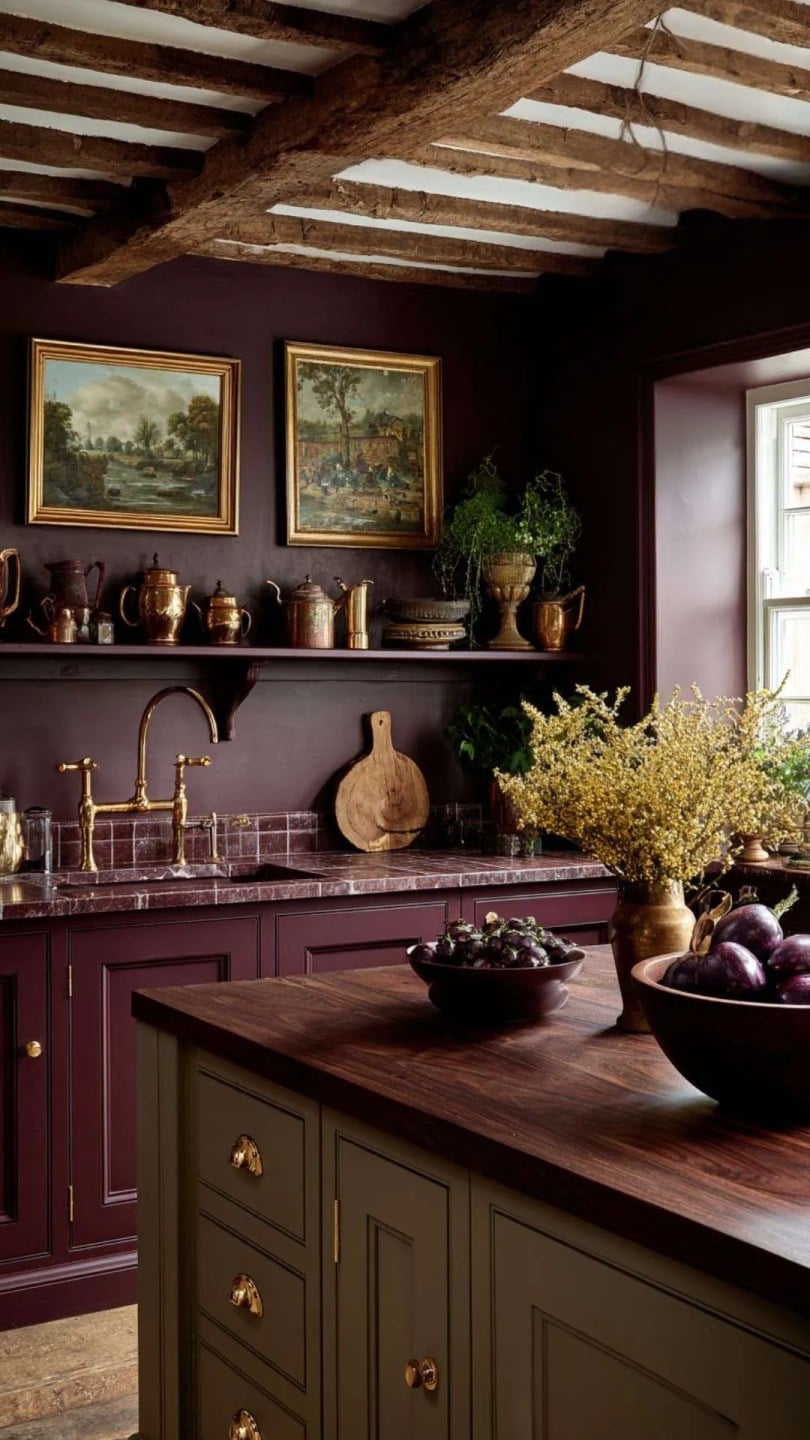
Deep red cabinets anchor the room, while marble countertops and a wooden island lighten the feel. Gold hardware adds a traditional touch. Natural light from a window and a pendant over the island keep the space bright enough to balance the strong wall color. The palette works because it pairs deep red with warm wood and white marble. When using a bold cabinet color, keep the countertops neutral and the island in a natural tone. This approach lets the cabinetry define the room without overwhelming it.
Modern U-Shaped Kitchen with Brass Range Hood
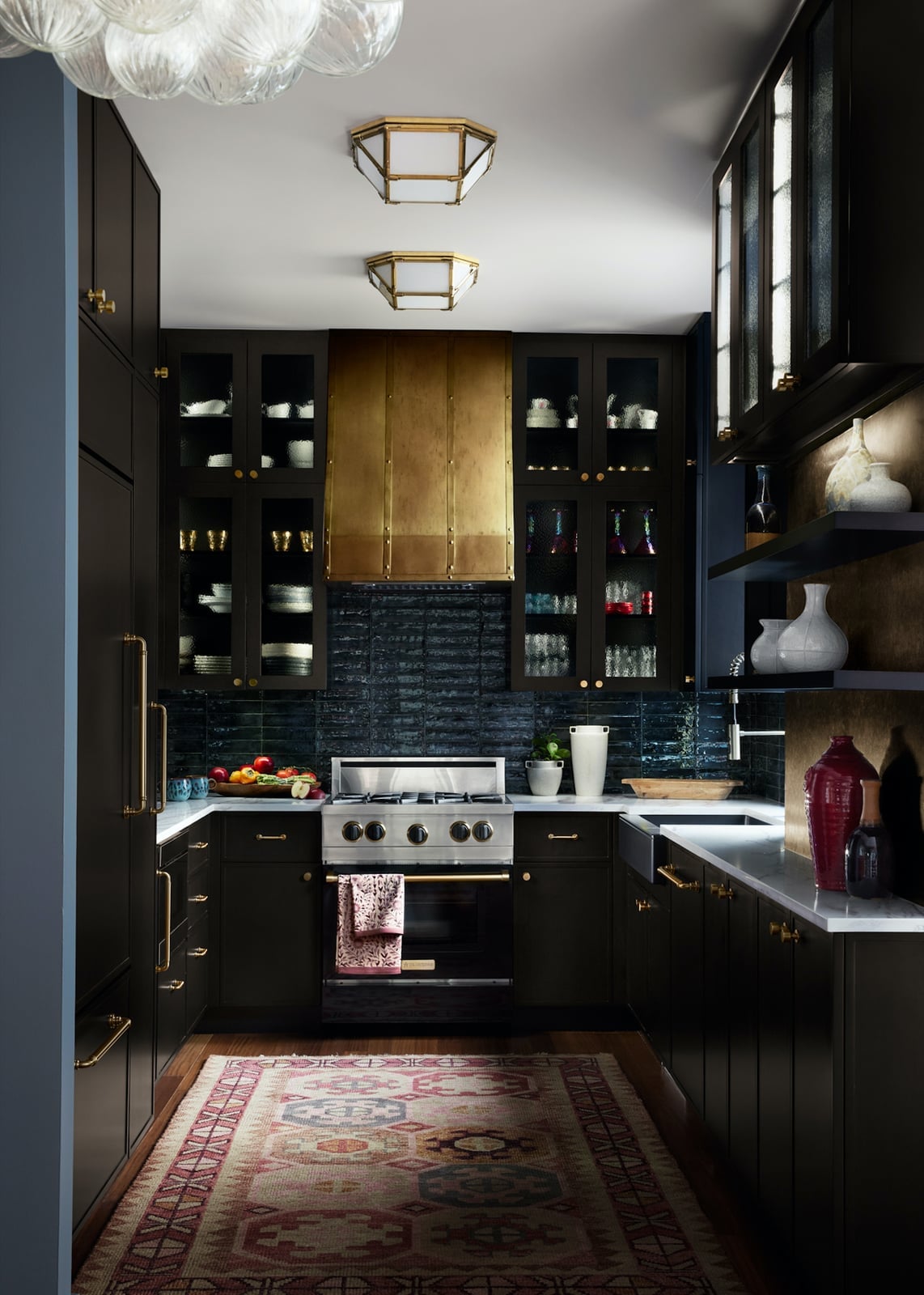
A compact U-shaped layout with dark brown cabinets might read as heavy, but the brass range hood changes the math. The warm metal pulls the eye up and breaks the wood’s mass without asking for a full renovation. A patterned rug on the floor adds a soft layer that keeps the room from feeling like a tunnel. The takeaway here is that a single metallic focal point can shift a dark kitchen from cramped to collected.
Modern Black Stone Island and Range Hood
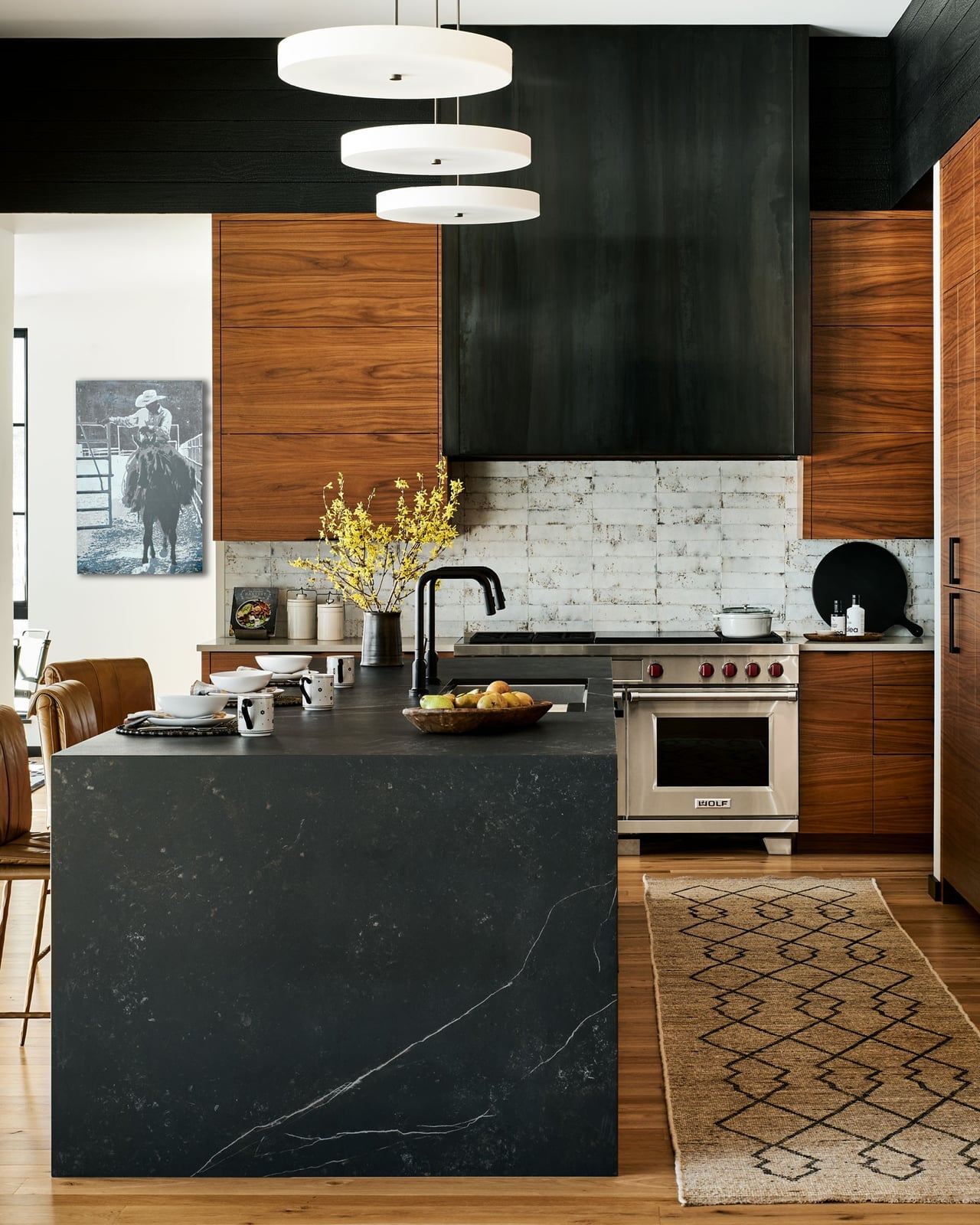
A black stone island paired with a matching black range hood creates a strong visual line through the center of the room. Wood cabinetry and exposed brick keep the look from turning monolithic. For renters, the same effect works with peel-and-stick stone-look paper on an existing island and a temporary hood cover in matte black film. It is a weekend project that gives the kitchen a custom feel without touching the landlord’s finishes.
Dark Gray Cabinetry with Glass Doors
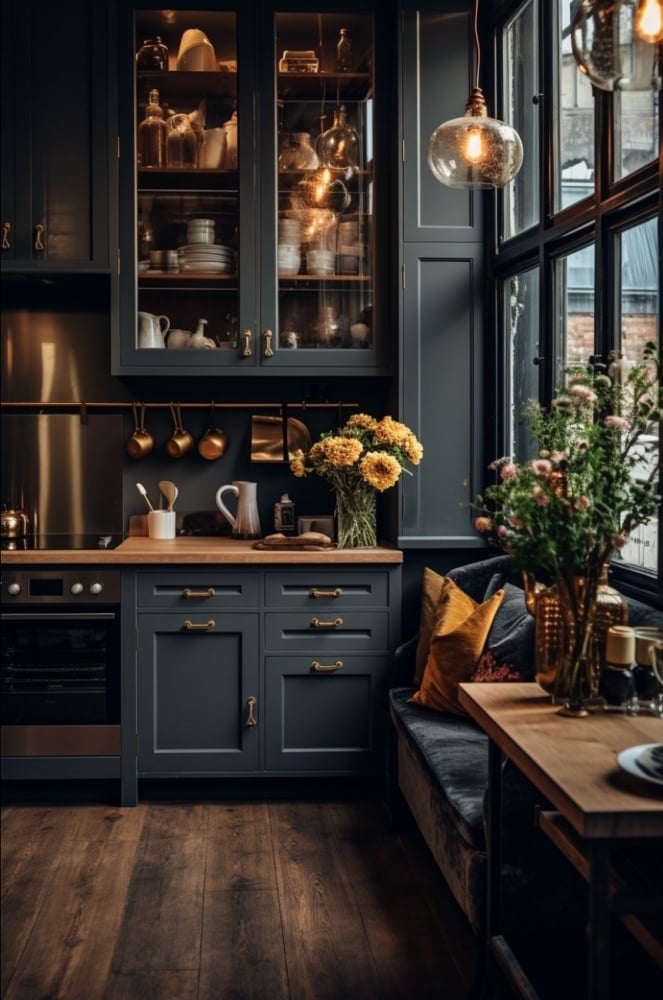
Dark gray cabinets with glass display doors are a smart storage move. The glass breaks up the solid color and gives you a place to show off matching dishware or glassware, which keeps the room from feeling like a dark box. Brass hardware and warm pendant lights add contrast, and interior cabinet lights make the contents visible even at night. This setup works best if you keep the shelves inside edited rather than packed.
Sophisticated Dark Wood Cabinetry with Marble Accents
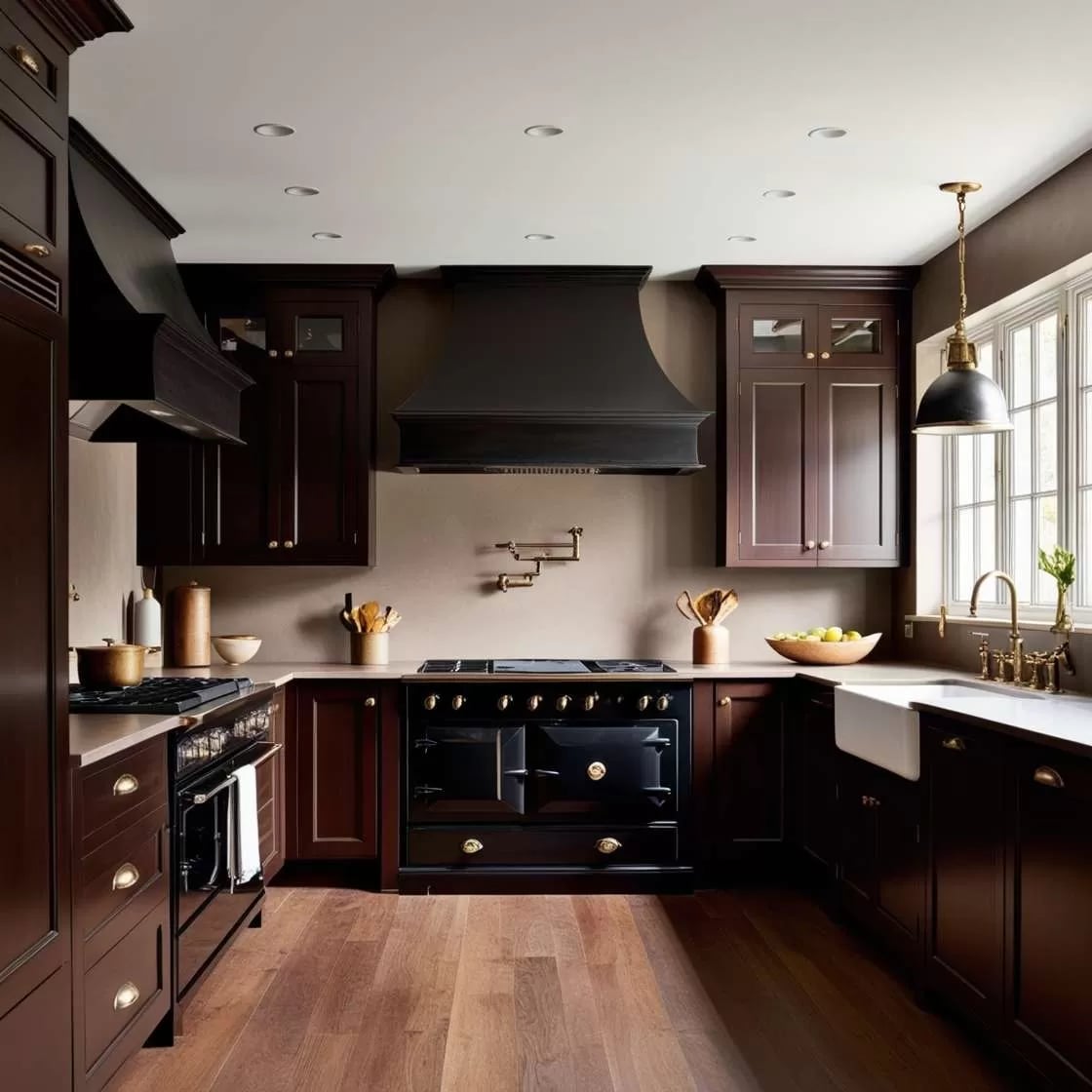
Can dark wood cabinets hold up in a compact galley kitchen without making it feel smaller? Yes, if you pair them with the right materials. Marble countertops and a black range add contrast, while brass hardware gives the eye a light point to land on. The wood reads as rich rather than heavy because the marble and brass reflect light back into the room. Low ambient lighting from a window and soft overhead fixtures keeps the space from going flat.
Art Deco Black Lacquer Cabinetry and Brass Hardware
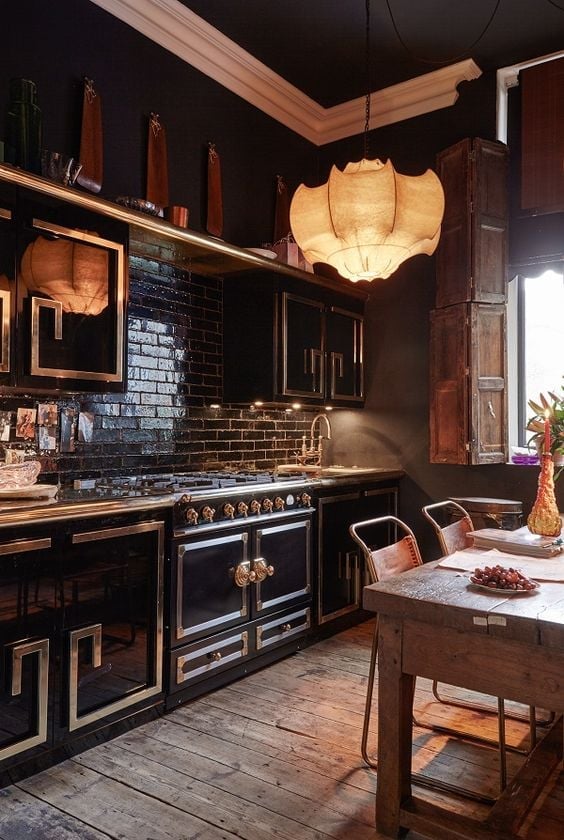
Black lacquer cabinets with ornate brass hardware define the art deco look in this kitchen. The high-gloss finish reflects light, which keeps the room from feeling dark, and the brass details add a geometric rhythm along the cabinet fronts. A white tile backsplash and wood accents prevent the black from overwhelming the space. The style works best when the lacquer is a true black with a mirror-like shine, and the brass stays polished to maintain the contrast.
Traditional Dark Blue Cabinets with Contrasting Oak Drawers
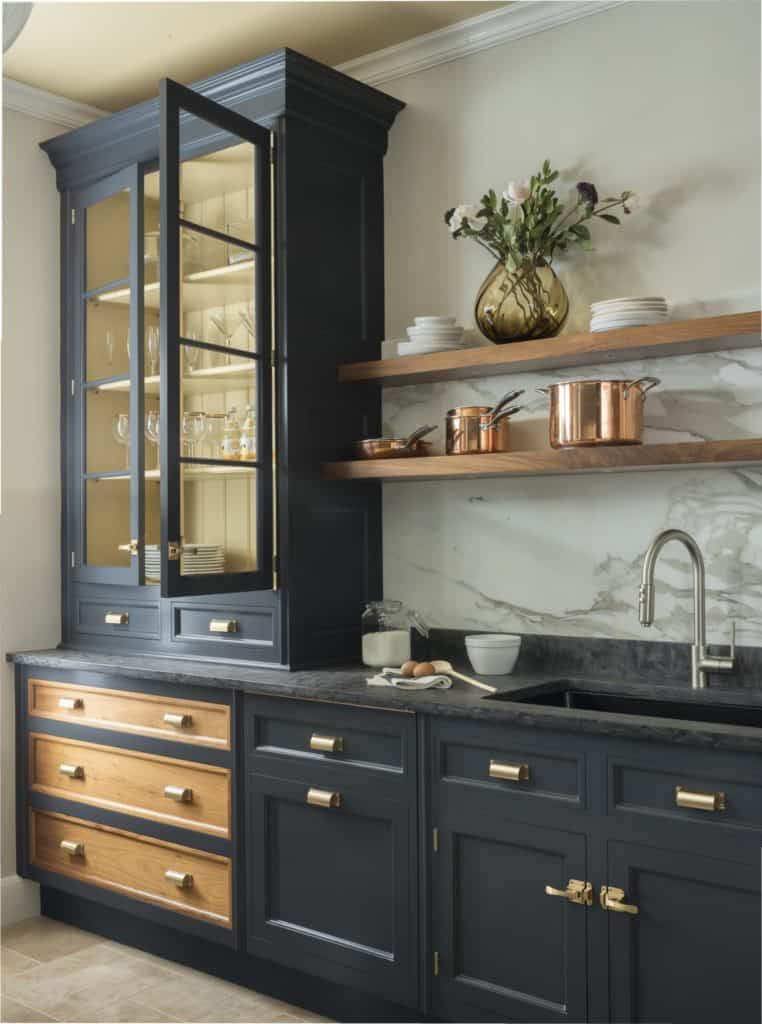
To break up a kitchen with extensive cabinetry, use a secondary finish. Dark blue cabinets line the perimeter and form a glass-front hutch, while the island drawers shift to natural oak. This material swap prevents the room from appearing as one solid block of color. The marble countertop and brass hardware stay consistent across both finishes, so the contrast feels deliberate. White walls and natural light keep the dark blue from feeling too heavy, and the interior cabinet lighting inside the glass-front hutch adds a layer of depth at eye level.
Farmhouse Dark Green Cabinetry and Open Shelves
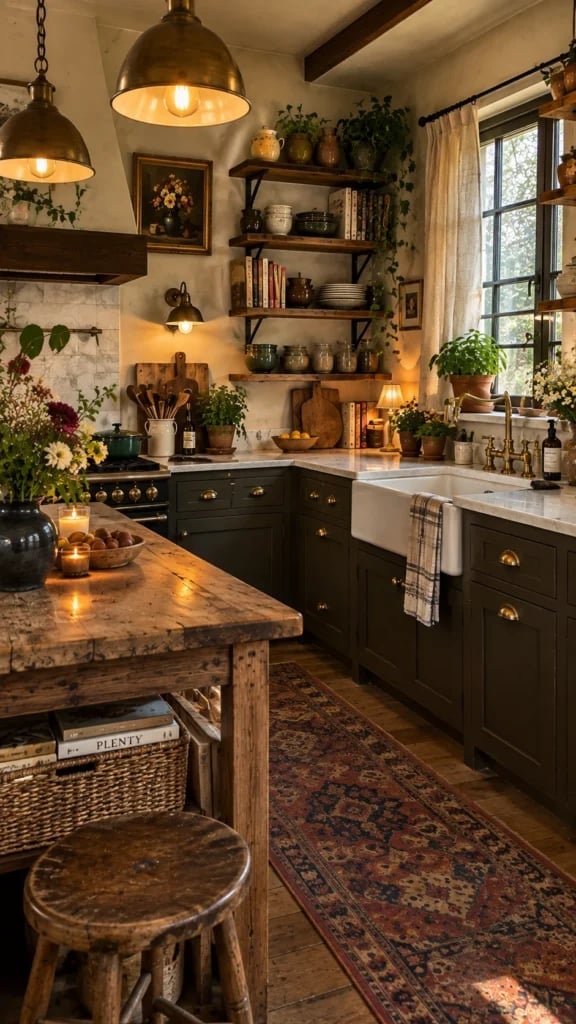
Farmhouse kitchens often default to white or cream, but dark green cabinetry offers a moodier take without losing the warmth. The key is pairing it with the right wood tones and cream accents so the green stays grounded rather than stark. Here, a dark green island anchors the center of the room, while open shelves above provide easy access to everyday dishes and keep the wall from feeling closed off. A farmhouse sink sits into the counter, and warm pendant lights hang low over the island to balance the cooler green with a soft glow.
For storage, open shelves work best when you commit to editing what goes on them. Reserve them for items you use weekly, like mixing bowls, plates, or glassware, and keep the rest behind closed cabinet doors. The natural light from the room helps the wood tones and cream finishes stand out against the deeper green.
Traditional Dark Blue Cabinetry with Glass-Front Uppers
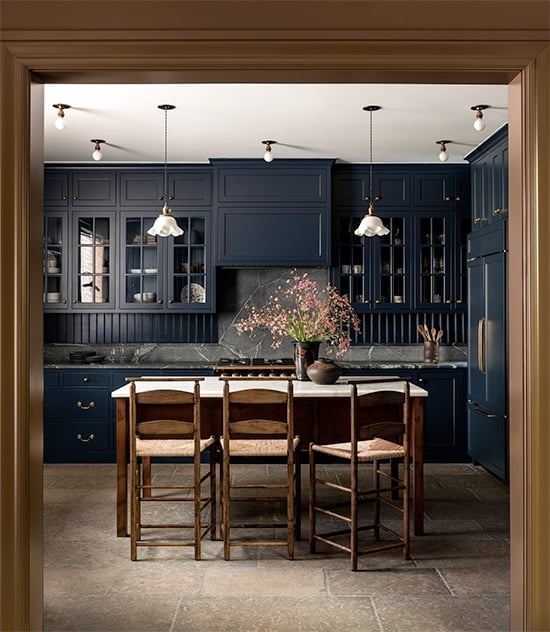
Glass-front upper cabinets let dark blue cabinetry feel open rather than imposing. The glass panels reflect the pendant lights and natural light, breaking up the darker color at eye level. Below, the marble island anchors the room with a lighter stone surface that contrasts the deeper blue. A mix of recessed ceiling lights and pendants over the island provides layered illumination, making the glass fronts glow without washing out the dark blue finish.
Transitional Charcoal Cabinetry and Terracotta Floor
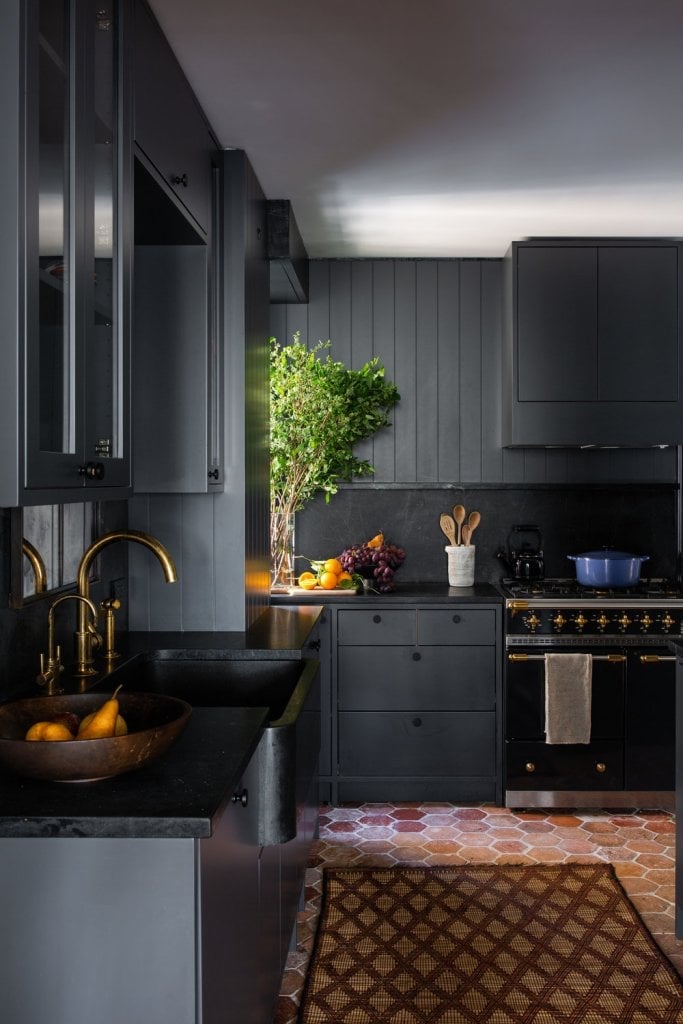
This kitchen makes a clear case for letting the floor set the temperature. Charcoal cabinetry and dark wood paneling could read as cold, but the hexagonal terracotta tile floor brings warmth and a reddish undertone that softens the whole room. The black range and brass faucet act as functional focal points, while ambient overhead lighting and targeted task lighting over the sink and stove keep the compact layout usable. For renters, a terracotta-style peel-and-stick tile can introduce the same warm contrast without replacing existing flooring.
Modern Dark Teal Cabinetry and White Subway Tile
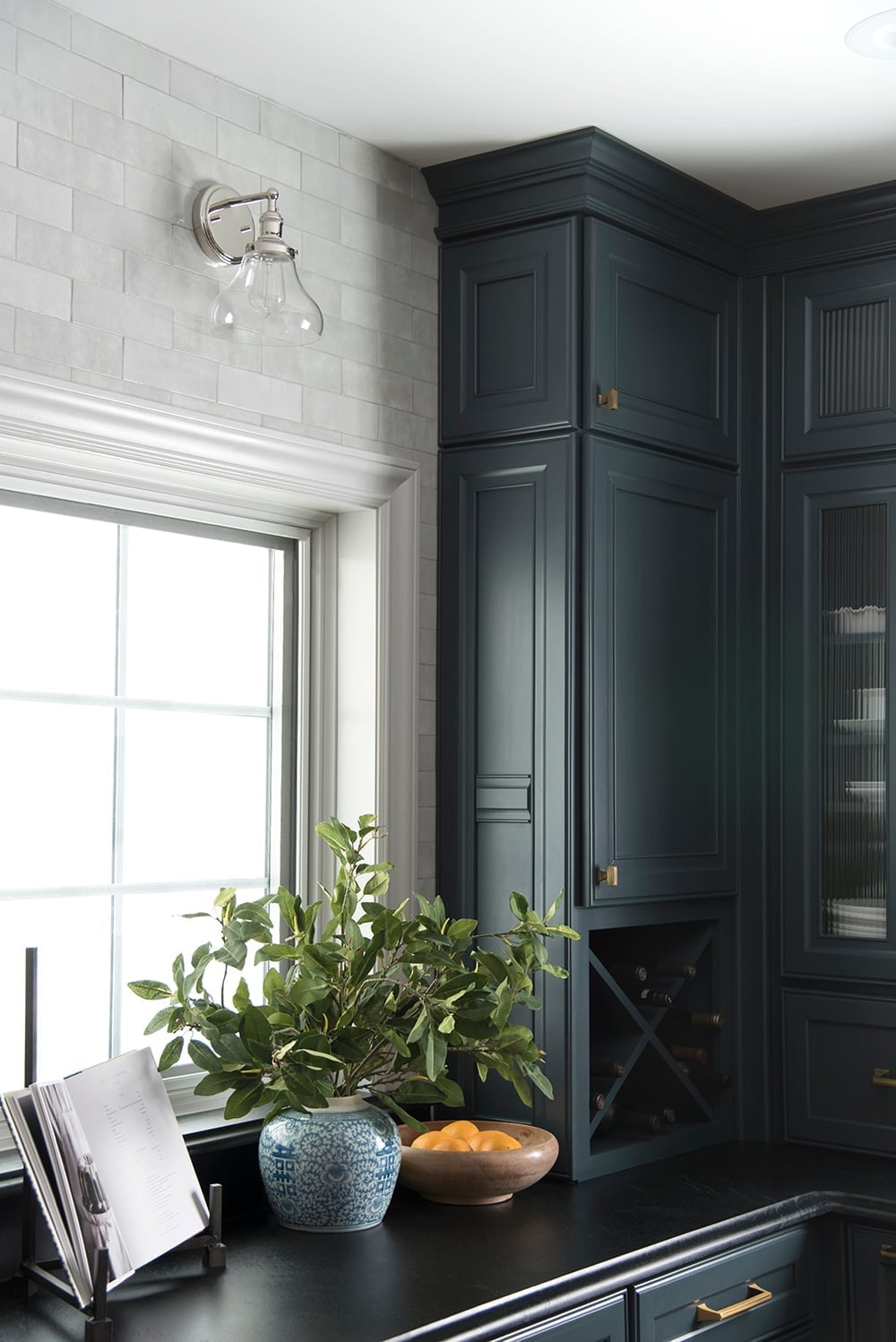
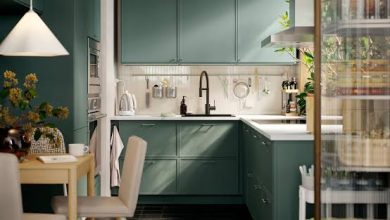
Introducing a bold cabinet color works well when offset with a classic, light backdrop. Here, dark teal upper and lower cabinets sit against white subway tile that runs from counter to ceiling. The white tile keeps the room bright and prevents the teal from dominating the space, while the window helps the color shift throughout the day. A stone countertop in a neutral tone ties the two sides together without competing.
For palette balance, the ratio of dark to light matters. Roughly a third of the visible wall is teal cabinetry, while the remaining two-thirds are white tile and light stone. That split gives the dark teal enough presence to feel grounded without overwhelming the room. Brass or chrome hardware can tip the look warmer or cooler depending on your preference, but the subway tile does the real work of keeping the palette balanced.
Moody Cottagecore Dark Green Cabinets and Floral, Close-Up Take
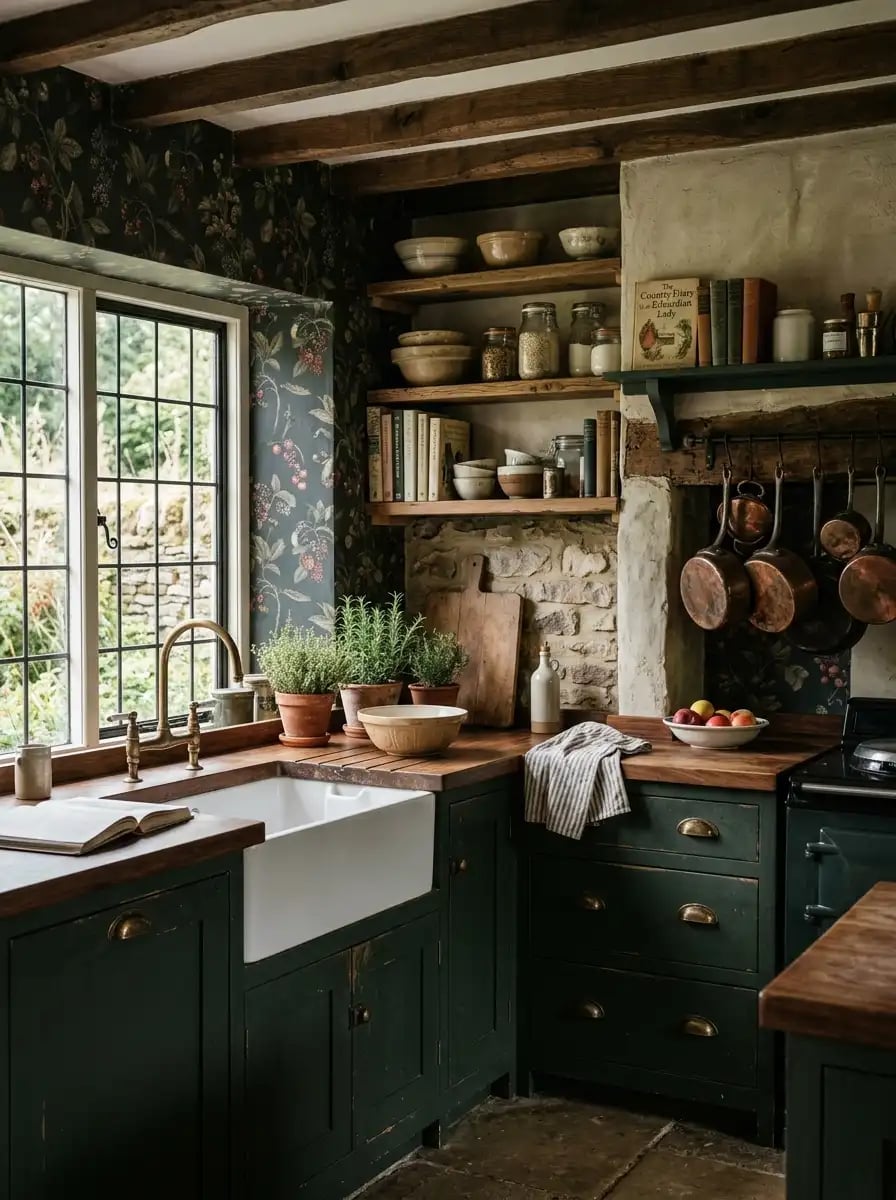
The floral wallpaper in this corner kitchen does not compete with the dark green cabinets because both share a similar depth of color. The wallpaper pattern is busy, but the green is dark enough to hold its own, so the room reads as layered rather than chaotic. A farmhouse sink and copper pots reinforce the cottagecore feel, while open shelves keep the compact layout from feeling closed in. The stone countertops add a natural contrast that keeps the palette from going too sweet. The principle here is palette temperature: when pairing a bold pattern with dark cabinetry, match the color intensity so one does not wash the other out.
Modern Dark Teal Cabinetry and White Subway Tile, Low-Key Version
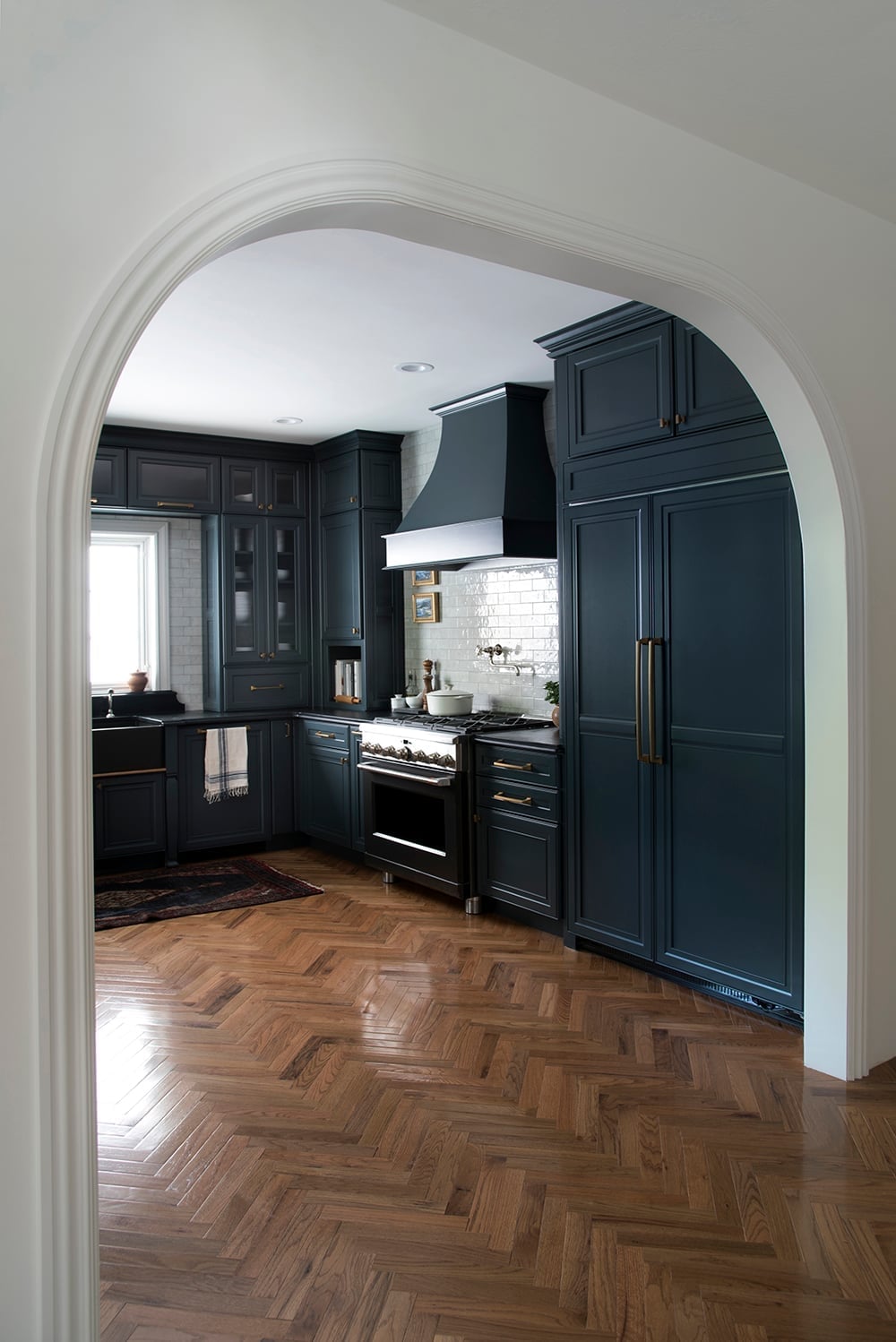
In a roomy kitchen with dark teal cabinets, the white backsplash keeps the space open. Here, the white subway tile runs from counter to ceiling, and its bright surface reflects natural light from the window, which prevents the dark teal from narrowing the room. The brass hardware on the cabinets adds a warm accent that ties the green tone to the soft ambient light. The layout places the sink and range in a standard corner setup, which makes the morning routine flow without crossing paths. For renters, painting existing cabinets a dark teal is a weekend project that transforms the room, and the white subway tile can be a peel-and-stick option that comes off clean when the lease ends.
Modern Dark Gray Shaker Cabinets and Large Wooden, Close-Up Take
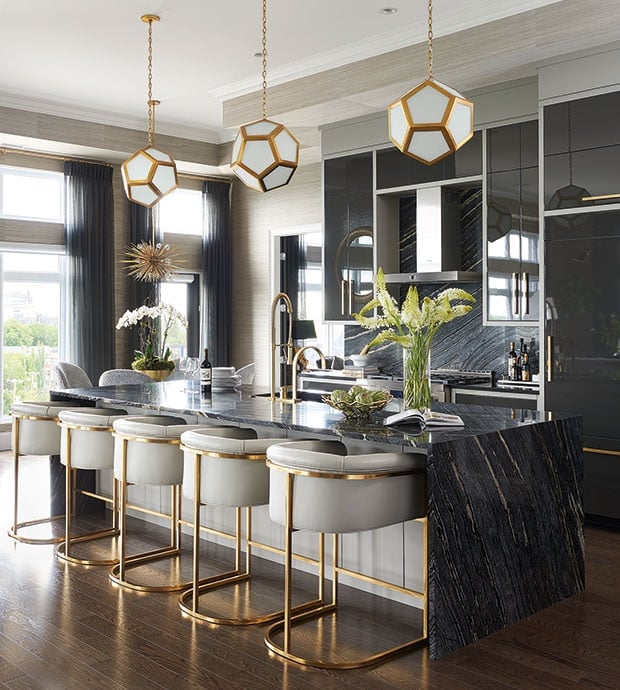
A white kitchen can feel airy but generic, while a dark gray shaker cabinet kitchen feels grounded. The large wooden island balances the gray perimeter, and its warm tone prevents the room from feeling cold. The pendant lights above the island provide task lighting for prep work, while natural window light softens the gray during the day.
The palette breaks down to about sixty percent dark gray, thirty percent wood, and ten percent white from the countertops and tile. That ratio gives the room a modern edge without losing warmth. The shaker cabinet style adds a traditional line that keeps the dark gray from feeling overly industrial, and the white stone countertops offer a clean surface that contrasts the darker elements.
Modern Dark Blue Shaker Cabinets and Contrasting Island, Close-Up Take
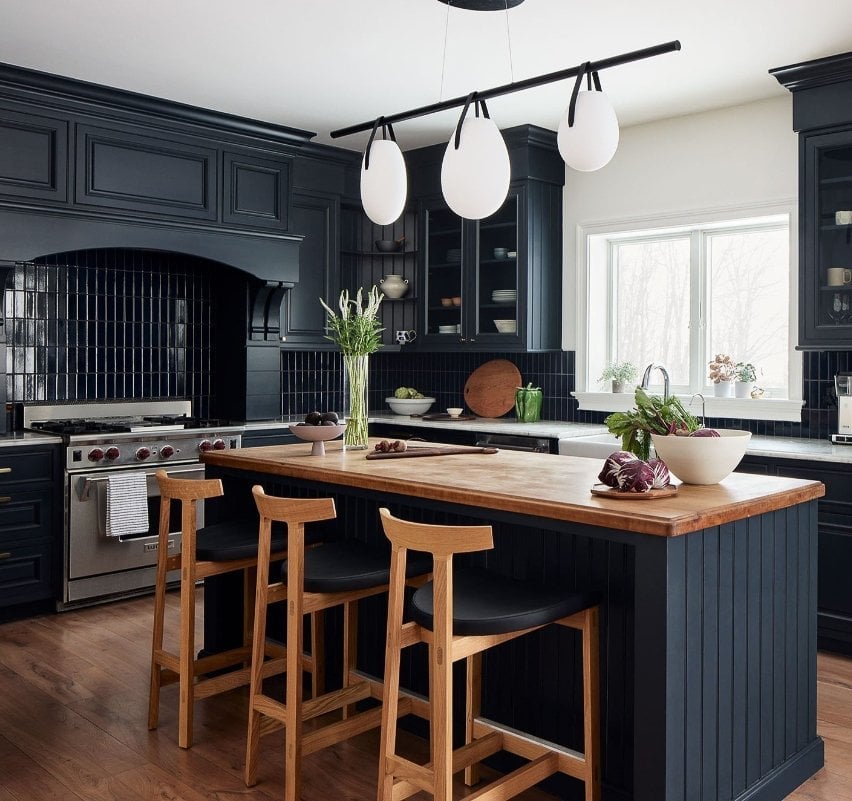
Dark blue shaker cabinets line the perimeter of this roomy kitchen, and the large central island shifts to a contrasting finish that keeps the layout from reading as one solid color block. White countertops and a black tile backsplash provide clean visual breaks against the dark blue, so the room feels balanced rather than heavy. Overhead pendant lights and natural window light keep the deep shade from closing the space in, which matters in a kitchen with ample counter space where you need clear sightlines across the work zone.
Dark Green Cabinets with Copper Pots and Low Lighting
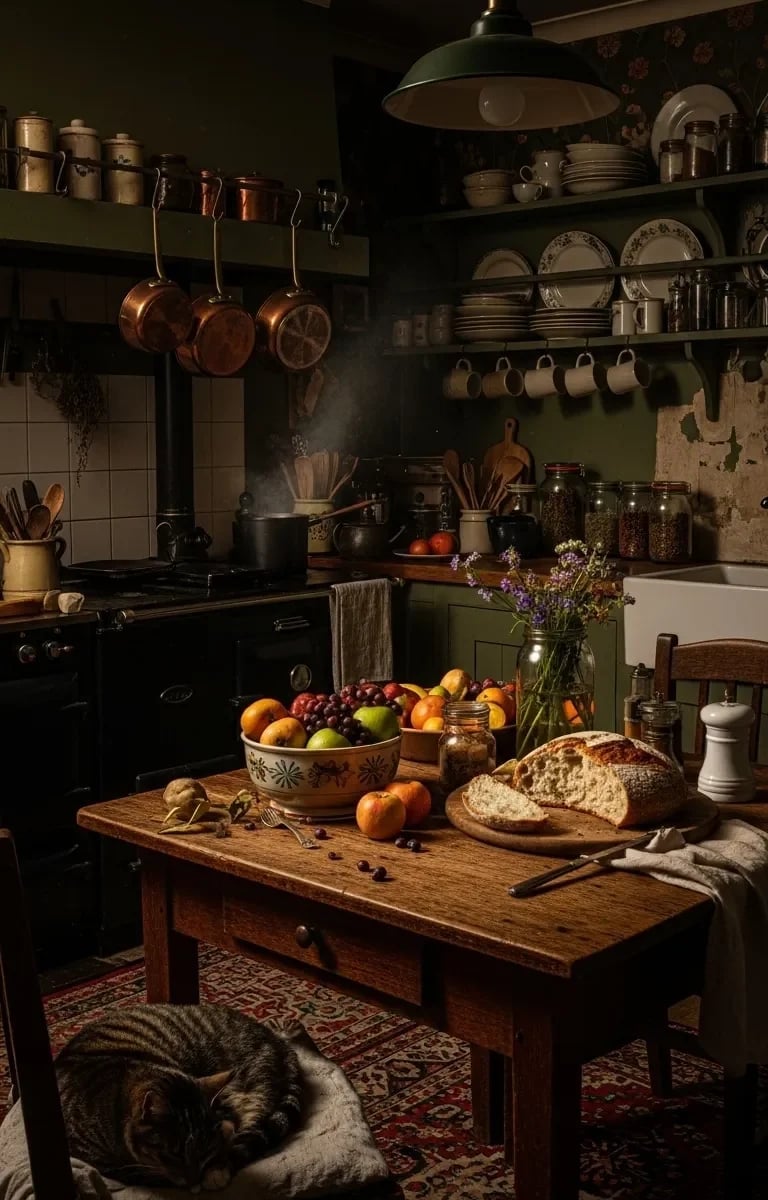
Copper pots hanging above a farmhouse sink are a detail that makes dark green cabinets feel lived-in. In this compact corner kitchen, the deep green cabinetry anchors the room, while the warm copper tones and open shelving add a cottagecore layer that softens the moody palette. Low lighting and natural light let the copper catch the eye. Brick and stone surfaces around the room keep the look grounded, so the copper is an extension of the materials. For a similar feel, hanging copper cookware on a wall rack shifts the weight from the cabinets to the cookware itself.
Traditional Dark Green Cabinetry with Copper Accents
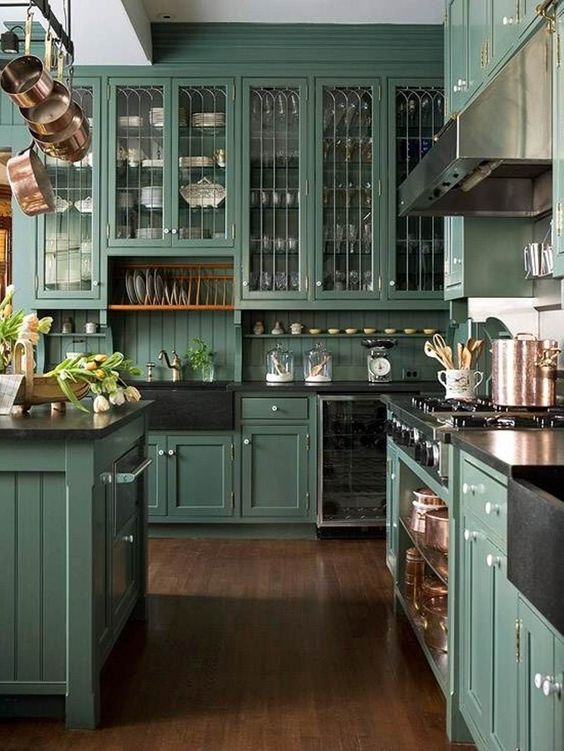
In a galley kitchen with an island, the trick to making dark green cabinets feel intentional is to treat the copper as a connecting thread rather than a single accent. Here, the deep green cabinetry lines both walls and the island, while copper pots hang from a rack above, their warm metallic finish picking up the wood tones in the countertop and the black sink below. Glass-front upper cabinets break up the green mass and let the copper catch the natural light from the room. The result is a layout where every material has a job: the wood and copper warm the green, and the black sink grounds it.
Luxurious Floor-to-Ceiling Black Cabinetry
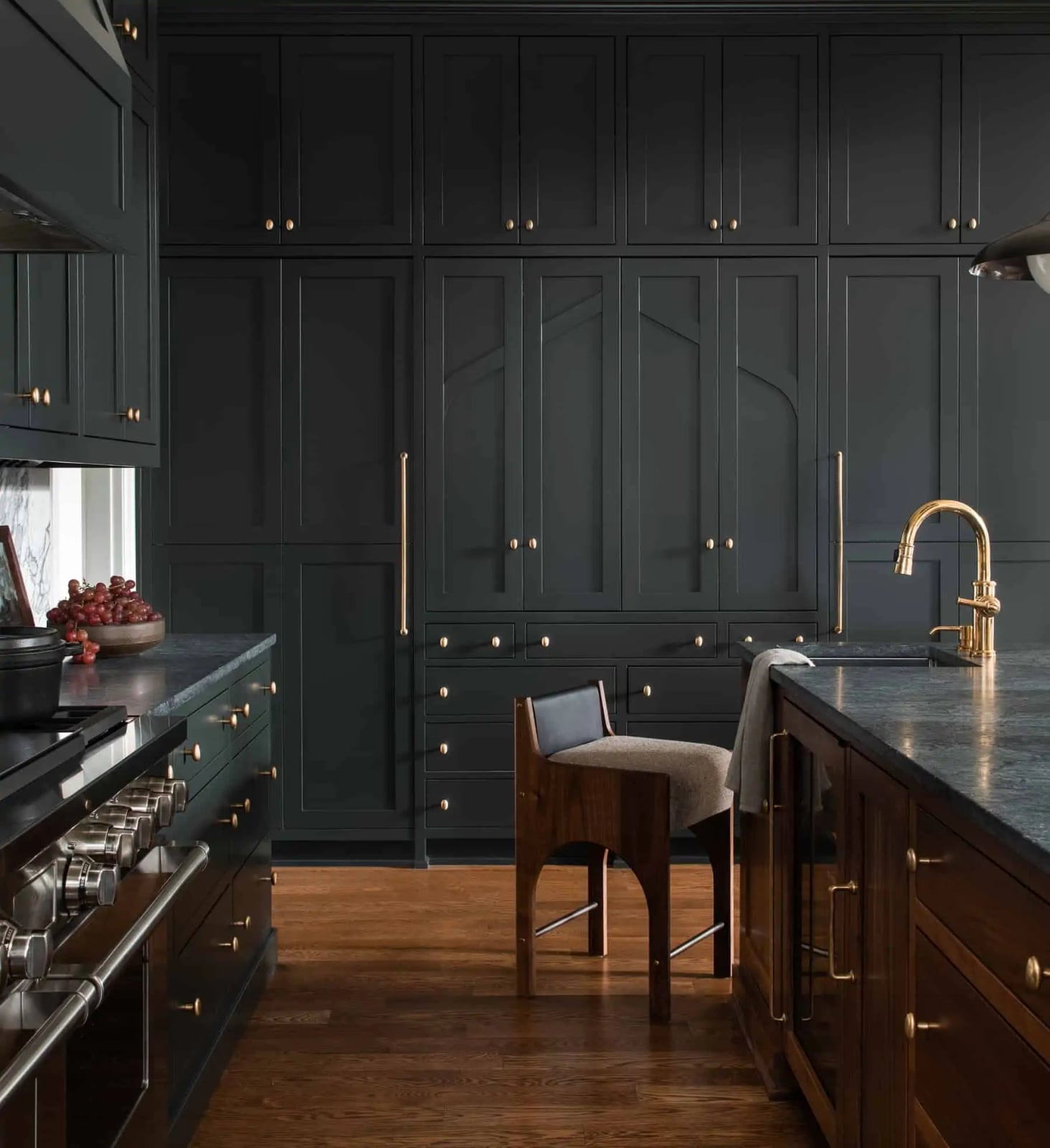
Floor-to-ceiling black cabinetry in a galley-with-island layout turns the entire wall into a storage statement. Marble counters and a wooden island break the black field, while brass hardware adds a warm gleam under the pendant lights. The payoff is a kitchen that hides almost everything behind closed doors, leaving only the stone and wood to read as decor.
Edgy Cottagecore Burgundy Cabinetry
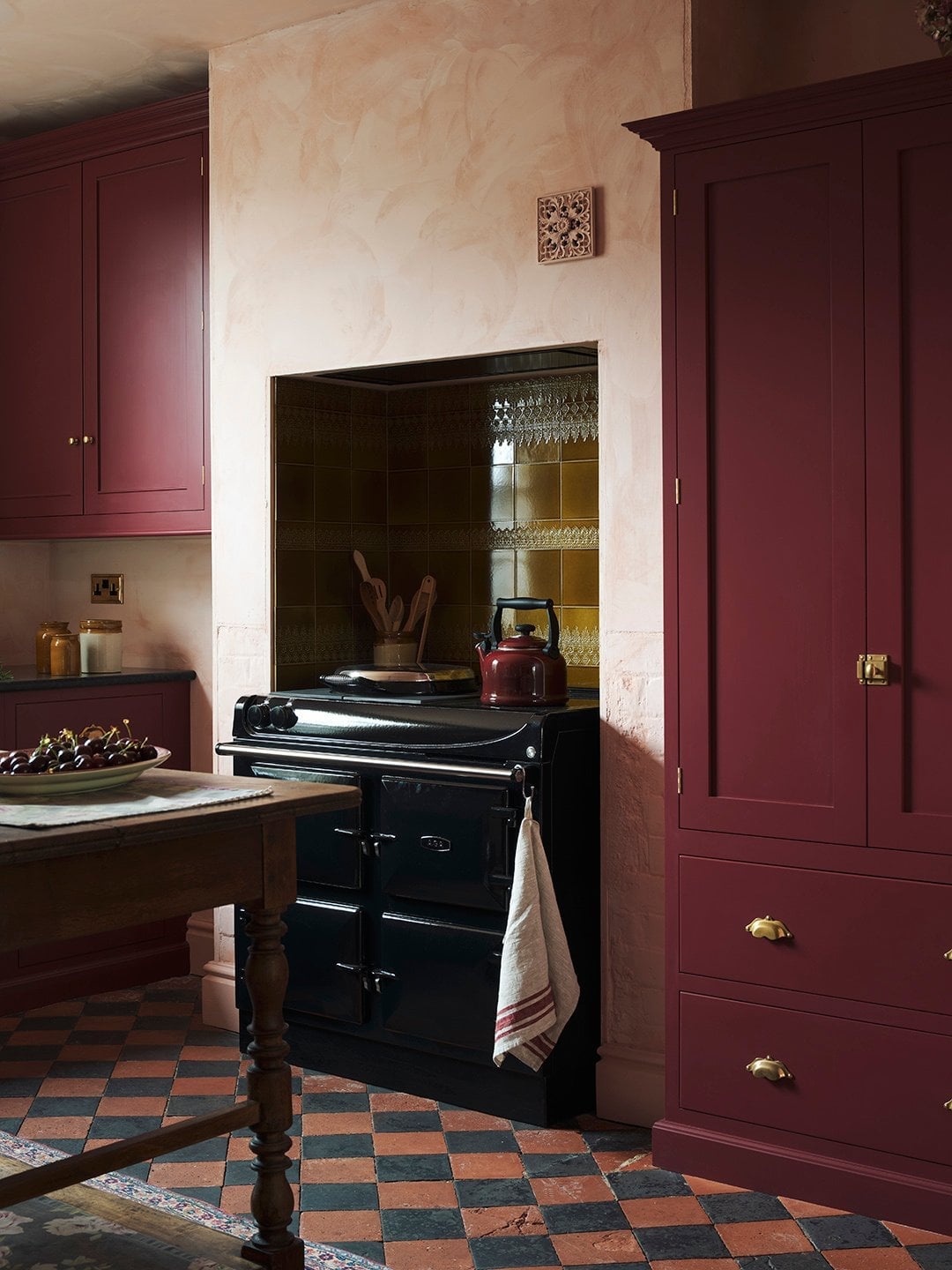
When burgundy cabinets meet a black range cooker and a patterned tile floor, the palette breaks cottagecore sweetness with a dark edge. The burgundy reads as the anchor, warm enough to pair with cream walls but deep enough to hold its own against the black range. A tiled floor adds pattern without competing, and the compact corner layout keeps the look from spreading too thin. For a similar effect, keep the burgundy as the dominant color and let the black act as a secondary accent, not an equal partner.
Traditional Dark Gray Cabinetry and Large Brass Pendant Light
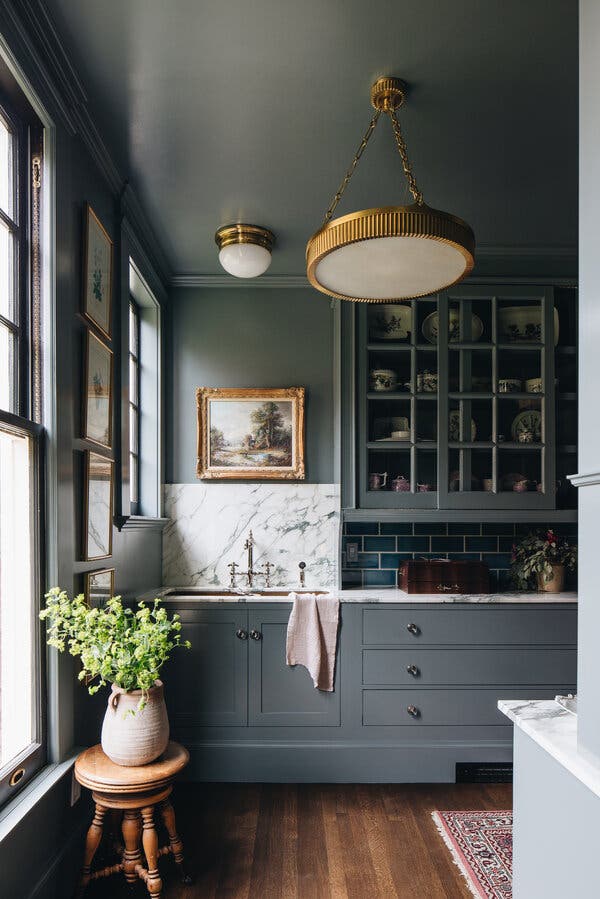
A brass pendant light can change how a dark gray kitchen feels, but the scale has to be right. Here, a large brass pendant hangs over the sink, and its warm glow balances the cool gray of the cabinetry and the white marble backsplash. The natural light from the window keeps the gray from going flat, while the pendant creates a focal point above the work zone. If a smaller fixture would disappear against dark cabinets, consider one that is visibly oversized. The marble backsplash adds enough reflection to keep the gray from swallowing the light, and the brass ties the whole wall together.
Eclectic Dark Blue Walls and Wood Plank Ceiling
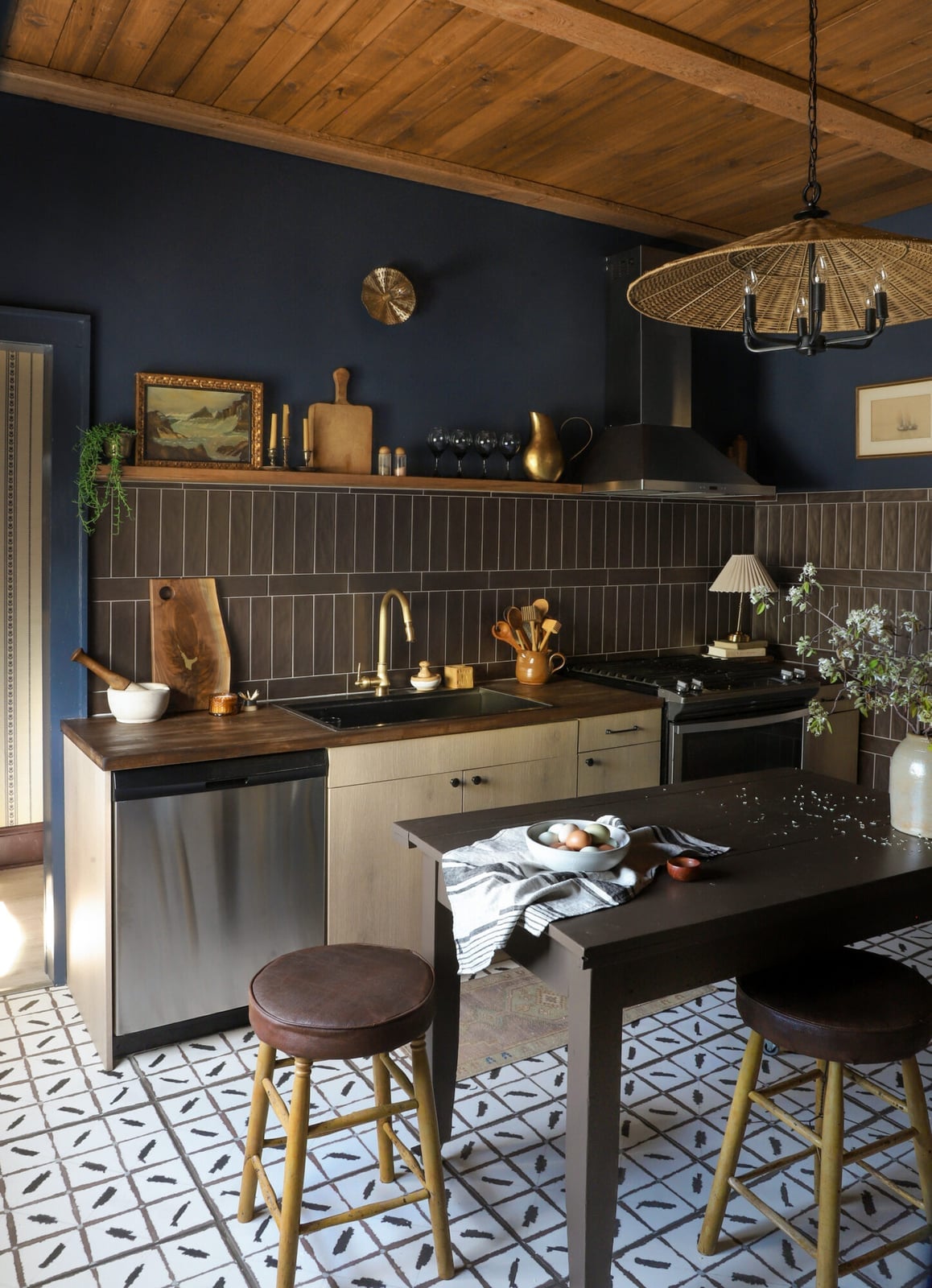
A wood plank ceiling in an eclectic kitchen with dark blue walls does more than add texture: it changes the room’s proportions. The warm brown of the ceiling draws the eye up, making the roomy kitchen feel even taller despite the deep blue on the walls. The dark cabinets and island echo the blue, while the pendant light and stools keep the space from feeling too heavy. The ceiling becomes the unexpected anchor, letting the blue read as moody rather than cave-like.
Modern Black Cabinetry with Veined Stone Backsplash
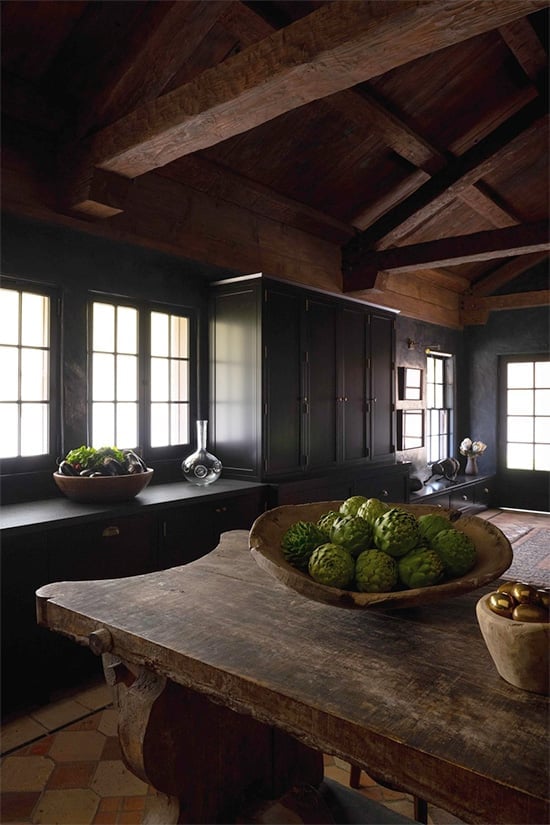
Compact galley kitchens benefit from a single bold material choice, and this one uses a veined stone backsplash to give the whole room its texture. Black cabinetry and warm wooden accents keep the palette grounded, while the stone runs behind the cooking zone as a natural focal point. Recessed lighting keeps the ceiling clear so the backsplash reads as the main event. Room mode here means the layout stays simple: one clean line of cabinets, one statement surface. If you want the drama of stone without committing to full slabs, look for large-format tile with a matching veined pattern.
Traditional Black Cabinetry with Large Stone Island
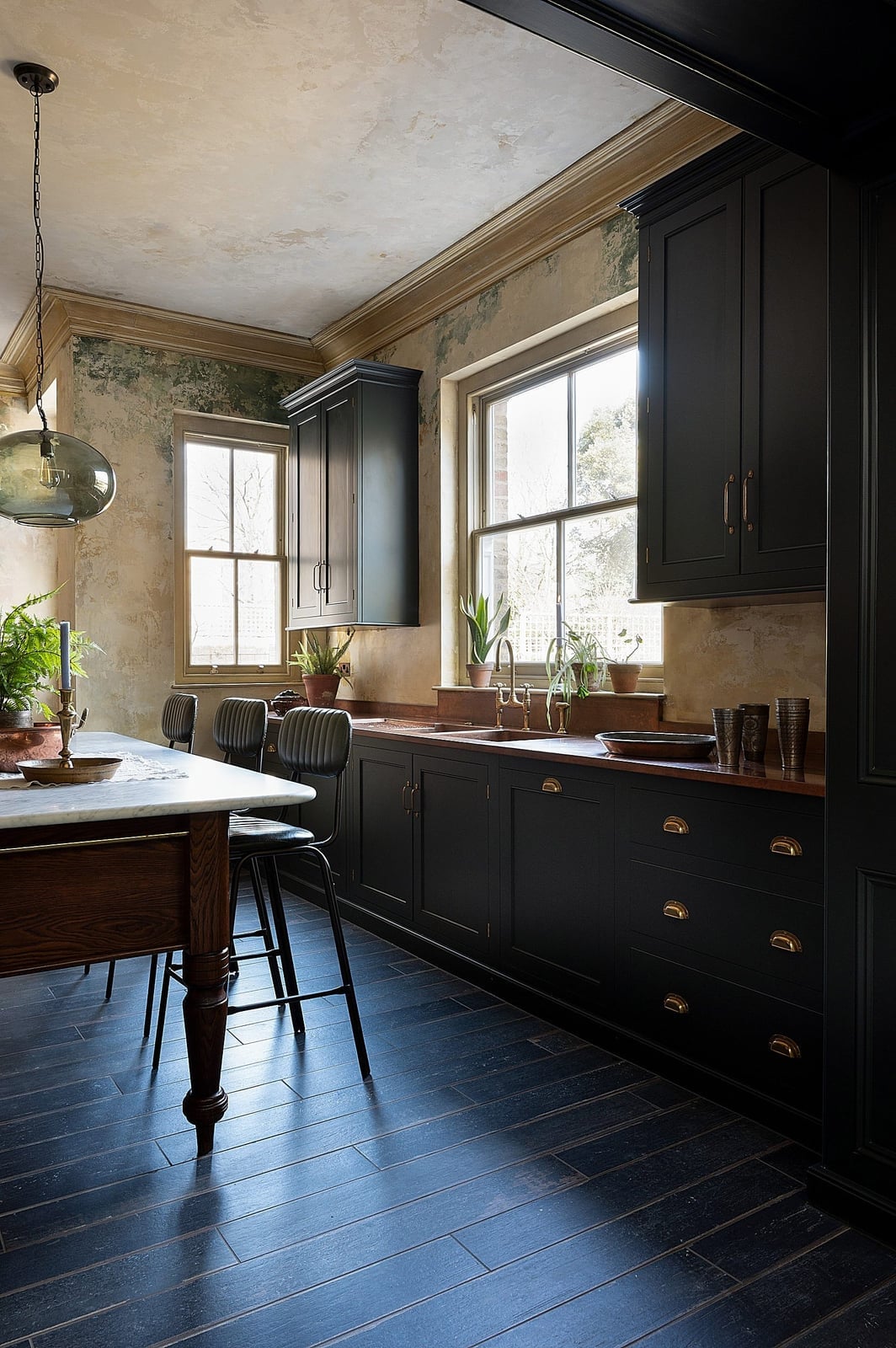
A practical rule for a roomy kitchen with a central island: anchor the perimeter in dark cabinetry and let the island act as the counterpoint. Here, black cabinets with brass hardware line the walls, while a large stone island sits under a pendant light, creating a natural work zone. The traditional feel comes from the mix of wood, stone, and brass, with plaster walls softening the darker tones. Natural light from nearby windows keeps the space from feeling closed in. For a renter-friendly take on this setup, consider peel-and-stick backsplash tile in a stone look and battery-operated brass sconces to add warmth without wiring. The island can stay as is, but if you cannot paint cabinets, focus on swapping hardware and adding a runner.
Dramatic Dark Kitchen with Deep Red Island
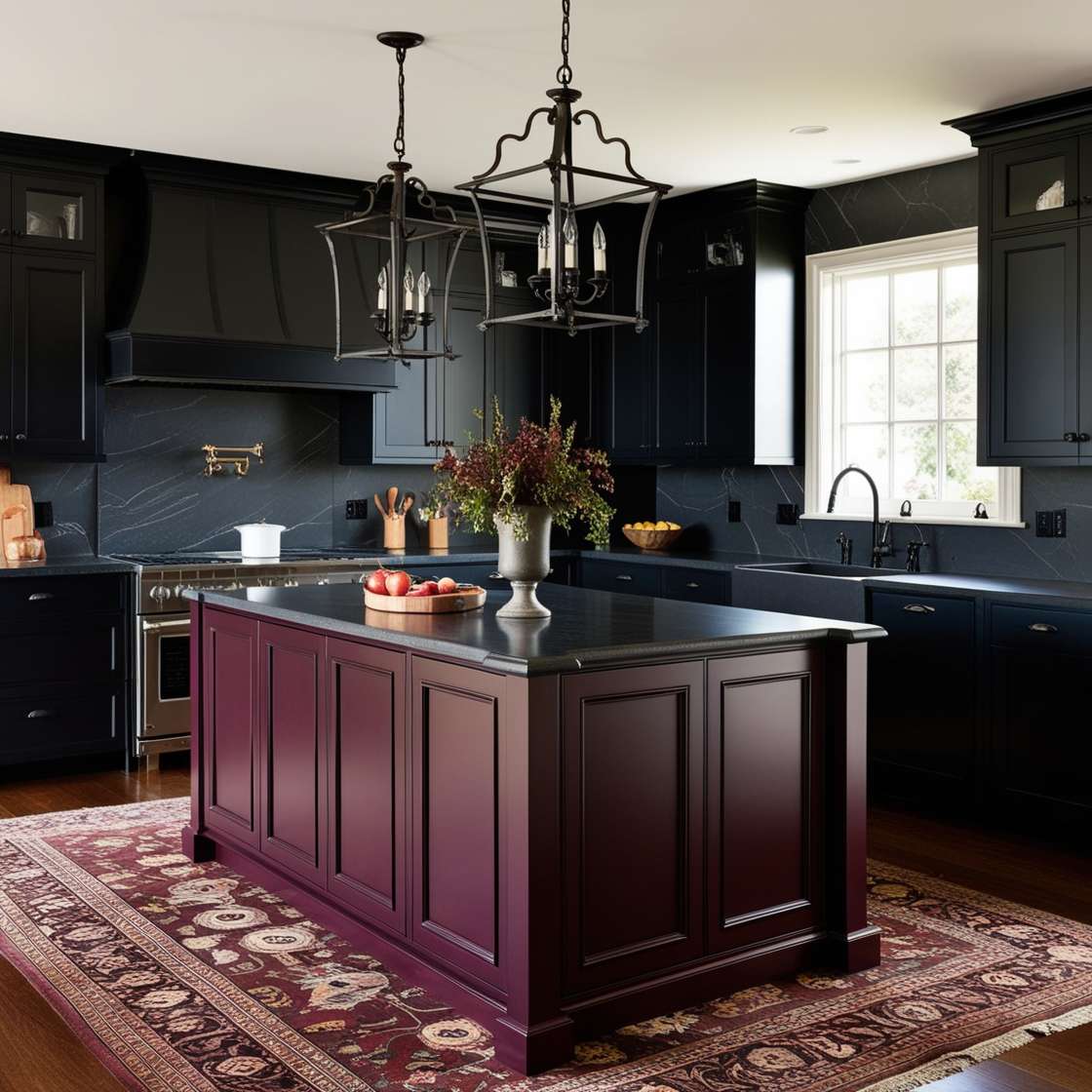
A deep red island changes the energy of the room without asking the whole kitchen to follow. Black cabinetry and cream marble keep the backdrop calm. Lantern pendants above the island echo the traditional lines, and a patterned rug underfoot adds a layer of softness. Natural window light balances the darker palette. This layout works well for a galley with an island: the dark perimeter recedes, and the red draws the eye to the prep area.
Modern Dark Wood Cabinetry with Brass Hardware
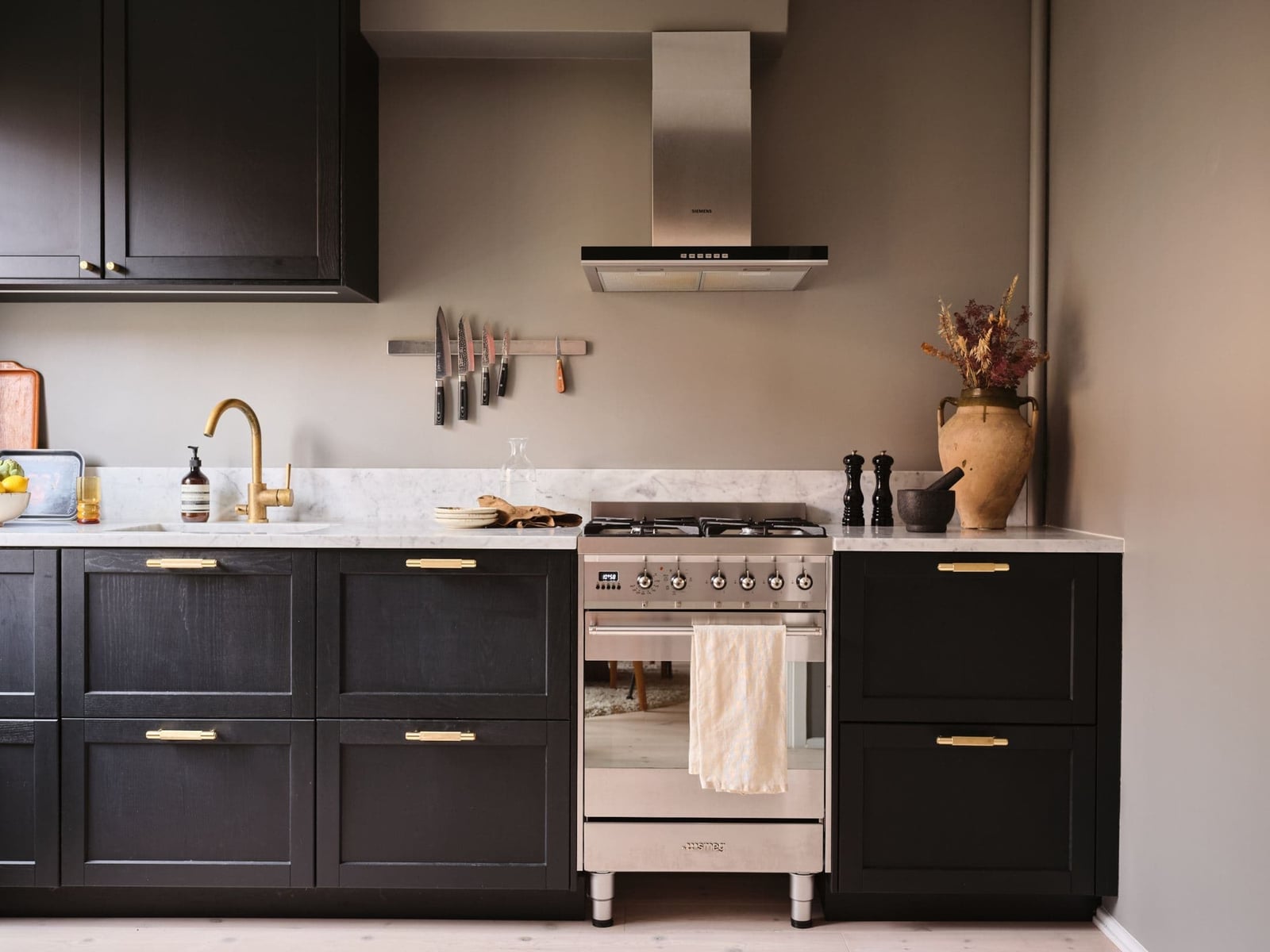
A practical rule for choosing dark wood cabinets in a modern kitchen: pick a finish with visible grain so the surface does not read as flat black. Here, the warm wood tone pairs with a marble countertop and brass hardware, giving the room a layered look that feels finished rather than stark. The galley layout with an island keeps the work triangle efficient, and the range cooker sits as a natural anchor. Task lighting above the counter and ambient light from a window make sure the darker cabinets do not swallow the light. Brass hardware here does more than open doors: it catches the eye and breaks up the expanse of dark wood.
Traditional Burgundy Cabinets and Ornate Range
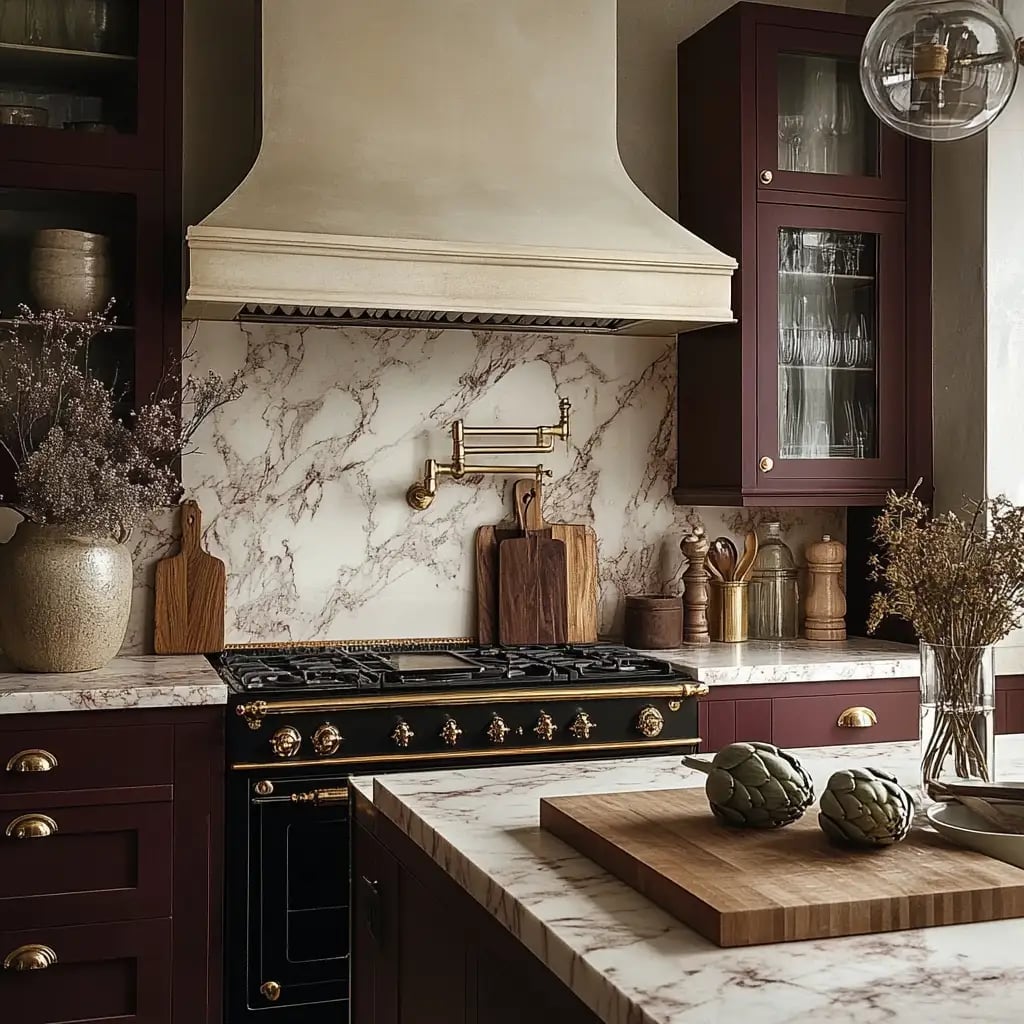
Where a standard black range might blend into dark cabinetry, an ornate black and gold range becomes the room’s centerpiece. Burgundy cabinets and a cream marble backsplash frame the cooking zone without competing for attention. The traditional style leans into the richness of the materials: wood cabinetry, brass accents, and a marble surface that reflects ambient light. A medium shot of the cooking area shows how the range hood, with its decorative detailing, anchors the whole wall. If you are working with a similar layout but a simpler range, consider adding a brass pot filler or a decorative hood surround to create a similar focal point.
Farmhouse Charcoal Cabinetry and Wooden Beams
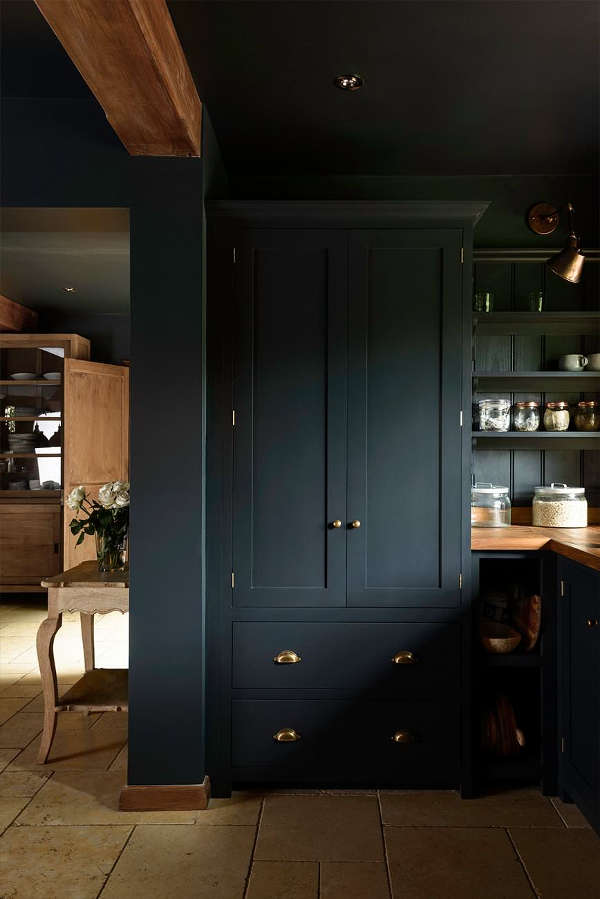
The ceiling beams here do more than add character; they set the whole room’s scale. In this open plan kitchen, the dark gray cabinets and stone floor anchor the space, while the wooden beams above draw the eye upward, making the room feel larger without adding square footage. The cream plaster walls soften the contrast, keeping the look from tipping into cave territory. When you have tall ceilings, dark beams are a practical way to define the volume without closing it in.
Transitional U-Shaped Kitchen with Dark Charcoal Cabinetry
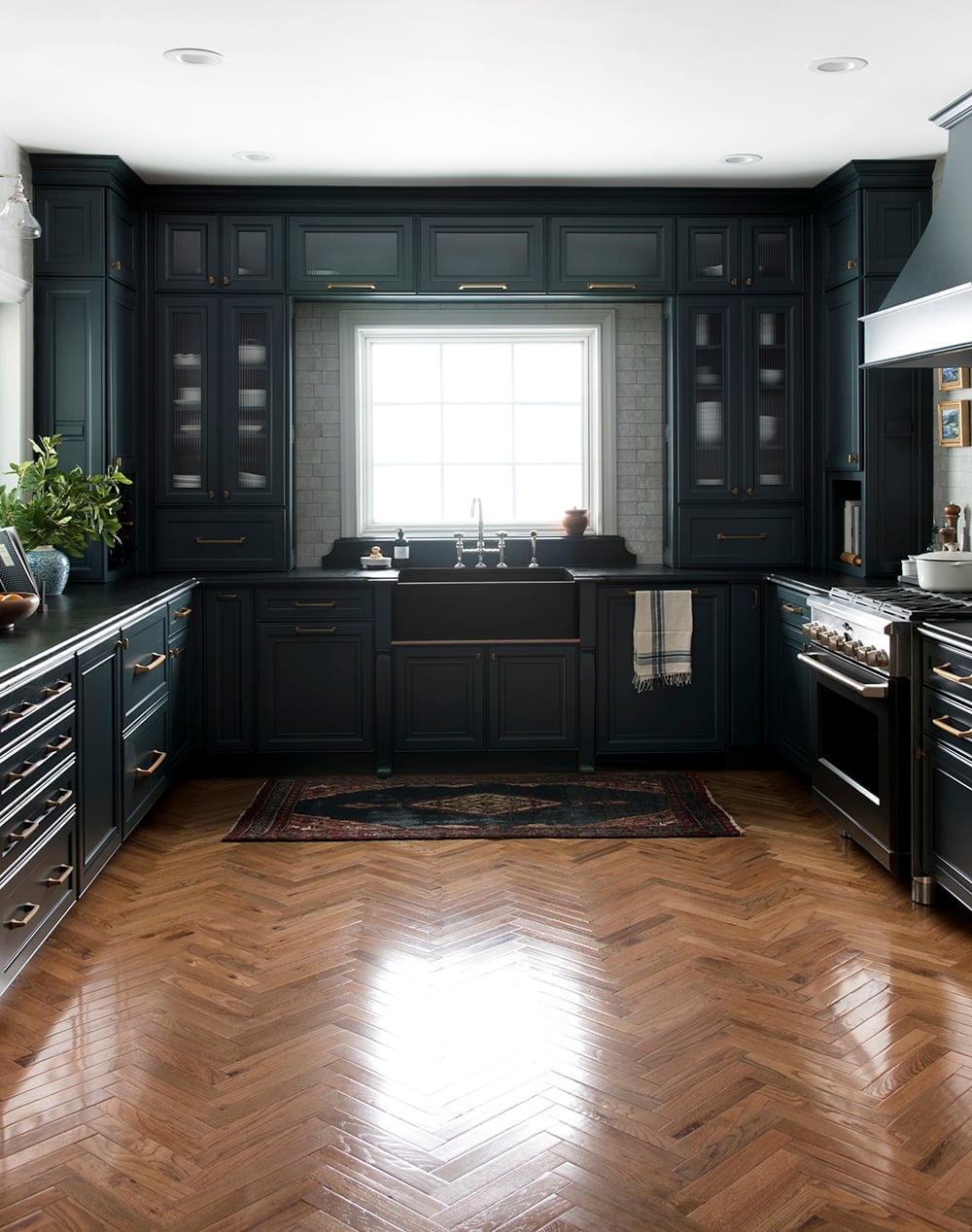
This kitchen proves that a dark palette can feel balanced, not heavy. The dark charcoal cabinets dominate the U-shaped layout, but the white subway tile backsplash and wood floor break up the mass. Brass hardware adds just enough warmth to keep the room from reading as flat. Light from the window hits the tile first, bouncing brightness into the deeper corners of the room. When you choose a dark color for a whole wall of cabinetry, pair it with a light, reflective surface nearby to keep the space from feeling smaller than it is.
Traditional Black Range and Ornate Marble Hood
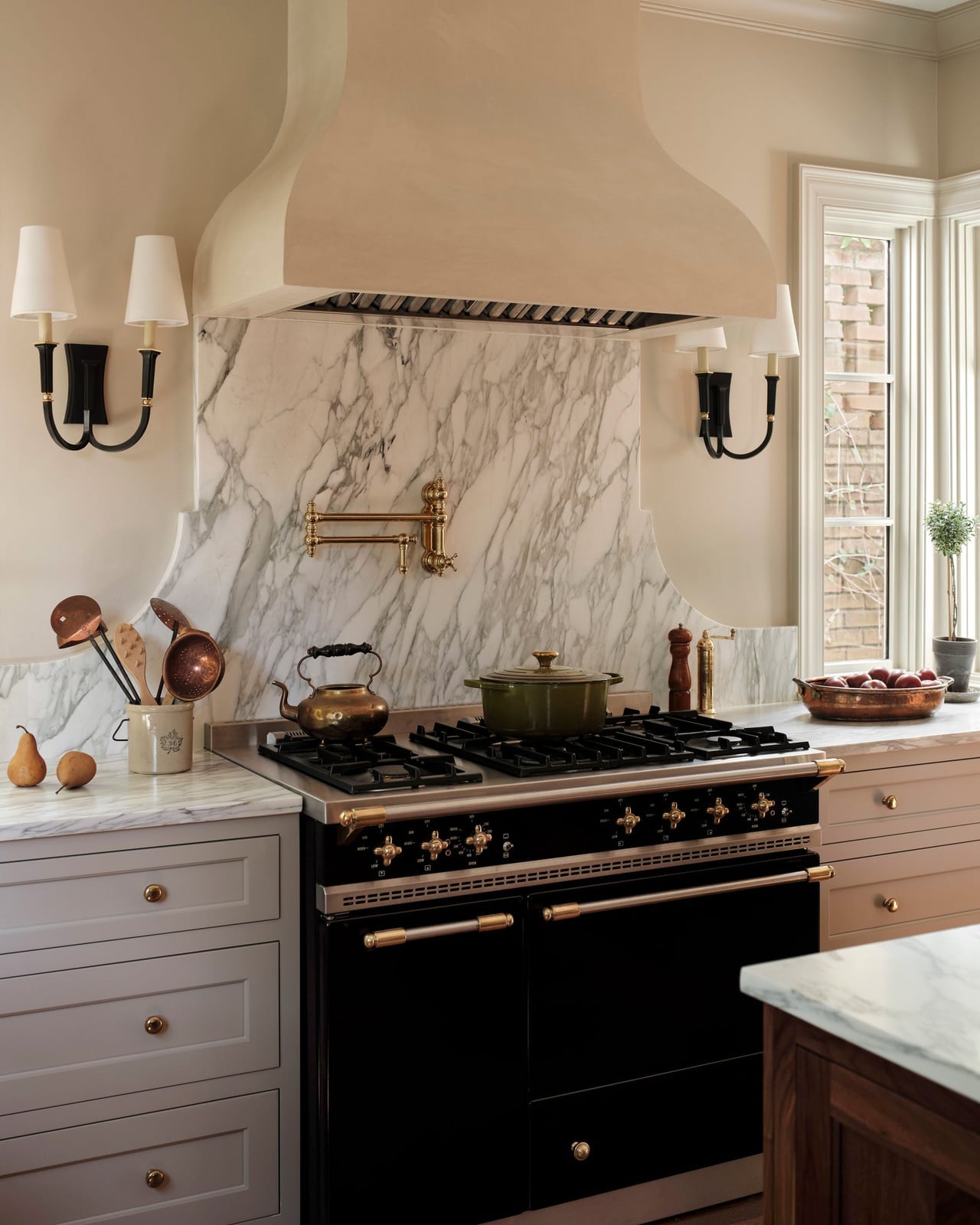
A black range can disappear into a dark kitchen, but this one takes the opposite approach by making itself the focal point alongside the ornate marble hood. The marble hood is carved with detail that is traditional, not fussy, and the cream veining in the stone ties back to the lighter walls. Brass hardware on the surrounding cabinetry picks up the warm glow from the wall sconces, creating a triangle of light across the room.
Natural light keeps the black and cream palette from going flat. If you want a traditional kitchen that still feels current, the trick is to let one element the range or the hood carry the ornate weight, and keep everything else clean lined. That way the room looks designed.
Transitional Dark Blue Cabinetry with Gray Subway Tile
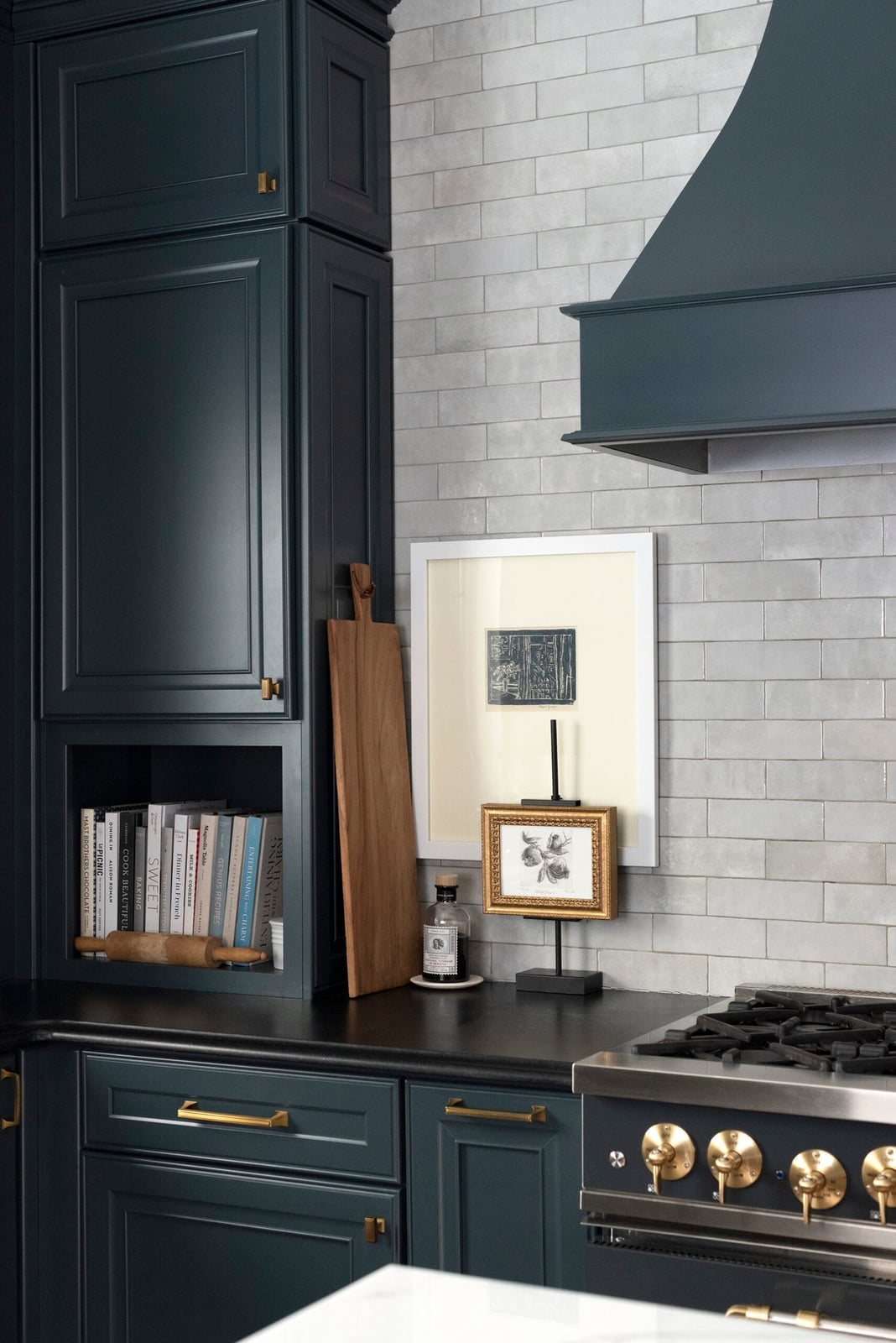
Dark blue cabinetry reads as rich rather than heavy when it sits next to a lighter neutral like gray subway tile. This corner layout makes the most of a compact footprint by keeping the darker color on the cabinets and using the tile as a visual breather. The framed art on the counter adds a personal note that breaks up the grid of the backsplash. Ambient lighting is the practical piece here: in a smaller kitchen with dark paint, a single overhead fixture may not be enough, so layered light from under-cabinet or task sources keeps the room usable.
Modern Dark Gray Cabinetry with Green Marble Countertops
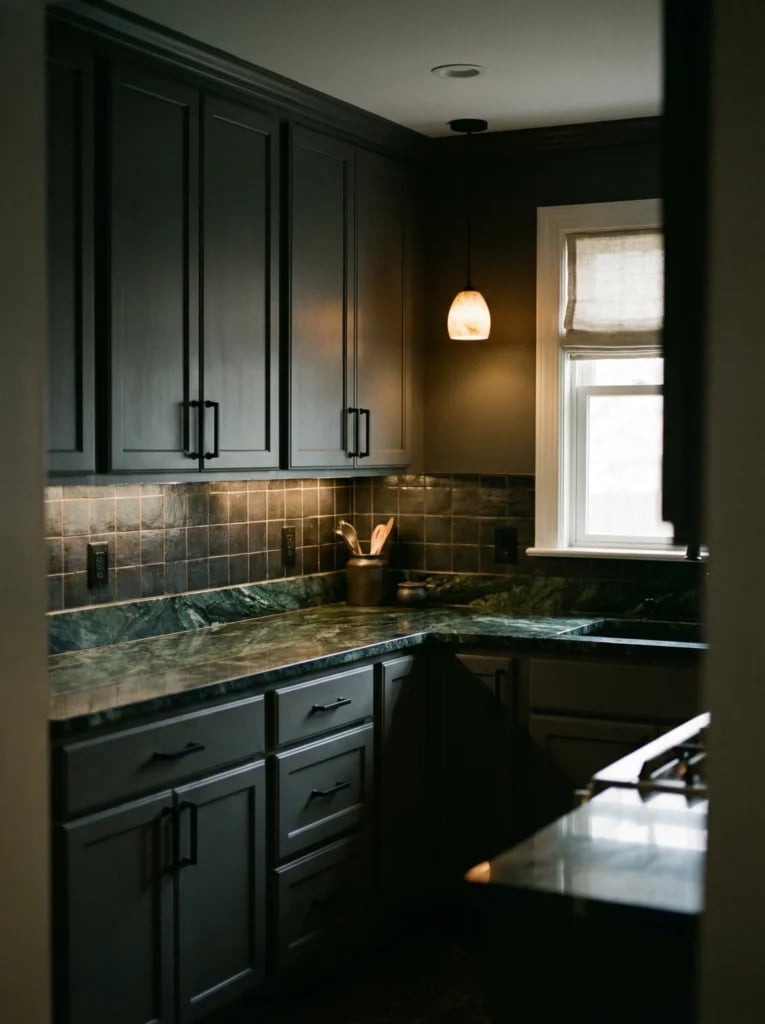
The green marble countertops are the reason this kitchen works. Against the dark gray cabinets, the stone reads as a saturated accent rather than a neutral, and the tile backsplash keeps the wall surface clean so the countertops stay the focus. Under-cabinet lighting is essential here: it hits the marble directly, making the green veining visible even when the pendant light is off. This is a modern kitchen that uses storage logic well the upper cabinets go to the ceiling, eliminating the gap that collects dust, and the linear layout groups everything within reach. If you choose a bold countertop material, keep the cabinets simple and let the stone do the talking.
Modern Dark Teal Cabinetry and White Subway Tile (Office-Safe), Wood
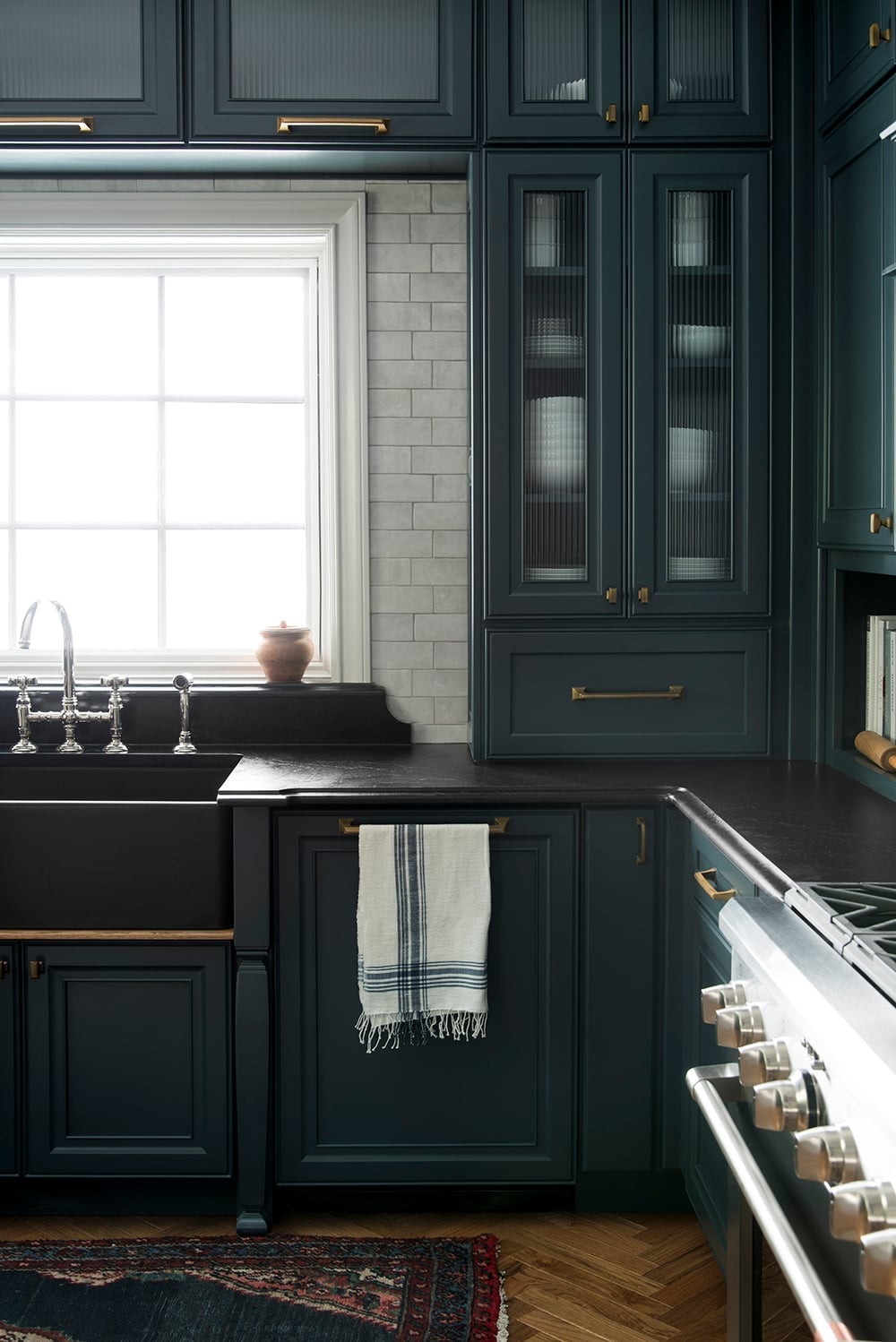
A dark teal kitchen does not require a full renovation to feel cohesive, but the palette needs a light anchor. Here, the dark teal cabinets run the full perimeter, and the white subway tile backsplash keeps the room open and airy. Natural light from a window and soft ambient glow from the fixtures bounce off the white tile, so the teal never feels too heavy. Brass hardware on the cabinets adds a warm metallic thread that ties the whole look together. For a budget-friendly swap, paint existing cabinets in a deep teal and install a standard white tile backsplash. The result looks custom without the cost of new cabinetry.
Modern Dark Blue Cabinetry with Brass Hardware, Indoor
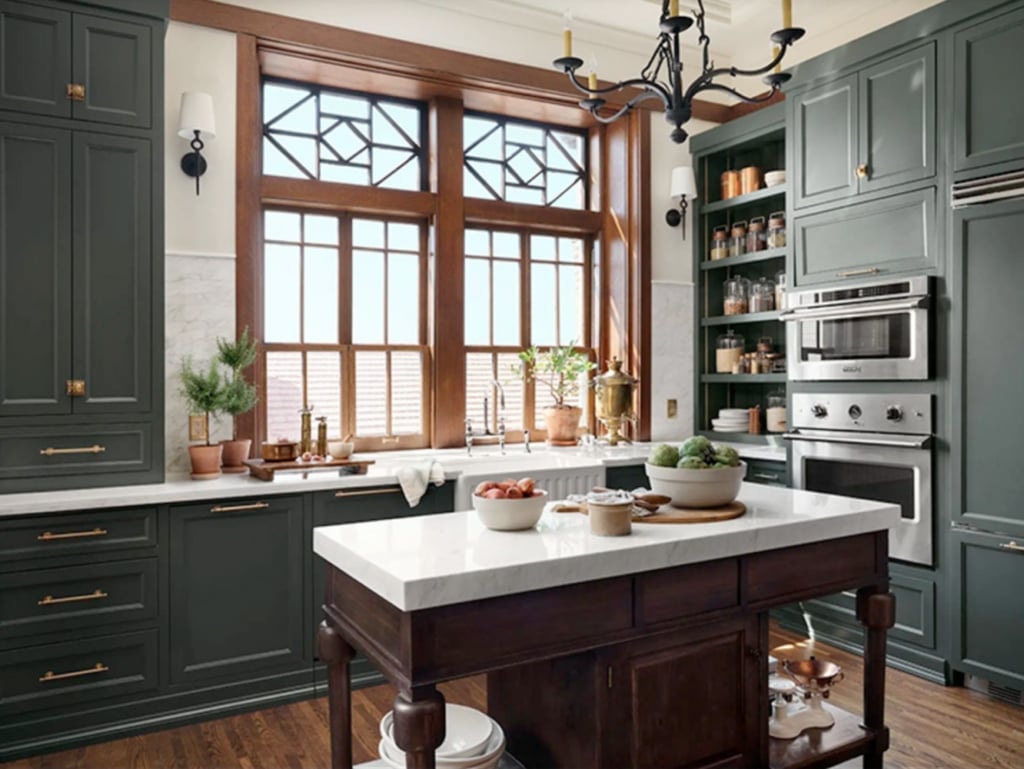
The U-shaped layout here uses dark blue cabinetry as the main color block, and the brass hardware acts as the fine detail that adds visual interest. The central sink sits in the middle of the U, which makes the work triangle efficient for daily cooking. Natural light and accent lighting under the cabinets keep the dark blue from overwhelming the space. For renters, swapping standard knobs for brass pulls on existing cabinets achieves a similar look without any permanent change.
Final Thoughts
A dark moody kitchen works when the layers balance out. Dark paint needs good task lighting under cabinets and a bright countertop or tile to keep the room from feeling closed in. Matte finishes hide fingerprints better than gloss, and warm metals like brass or copper add a glow that stops the space from going flat. If you rent, try peel-and-stick wallpaper or a tile backsplash that can reverse later. Keep counters clear of clutter so the dark surfaces stay the focal point. The best version of this look is one that fits how you actually cook and live.