31 Dreamy Slanted Ceiling Bedroom Ideas 2026 That Will Make Your Room a Cozy Sanctuary

You know that feeling when you finally discover the slanted ceiling bedroom idea that looks exactly right for your space? It’s a mix of relief and pure excitement. Those angled walls that once felt like a design puzzle suddenly become the most captivating feature in the room. Many guides show generic, uninspired spaces, but a slanted ceiling is a chance to do something truly special.
We spent serious time filtering through hundreds of real homes to bring you only what’s worth your attention this year. Inside this guide, you’ll find 31 curated ideas that actually deliver, covering everything from cozy minimalist nooks to rustic A-frames and playful kids’ rooms. In 2026, it’s all about making these ‘awkward’ spaces feel intentional and hyper-personal. And stay until the end — we break down the most common mistakes that can ruin these looks. 📌 Save this to Pinterest for later — you’ll want to revisit these ideas.
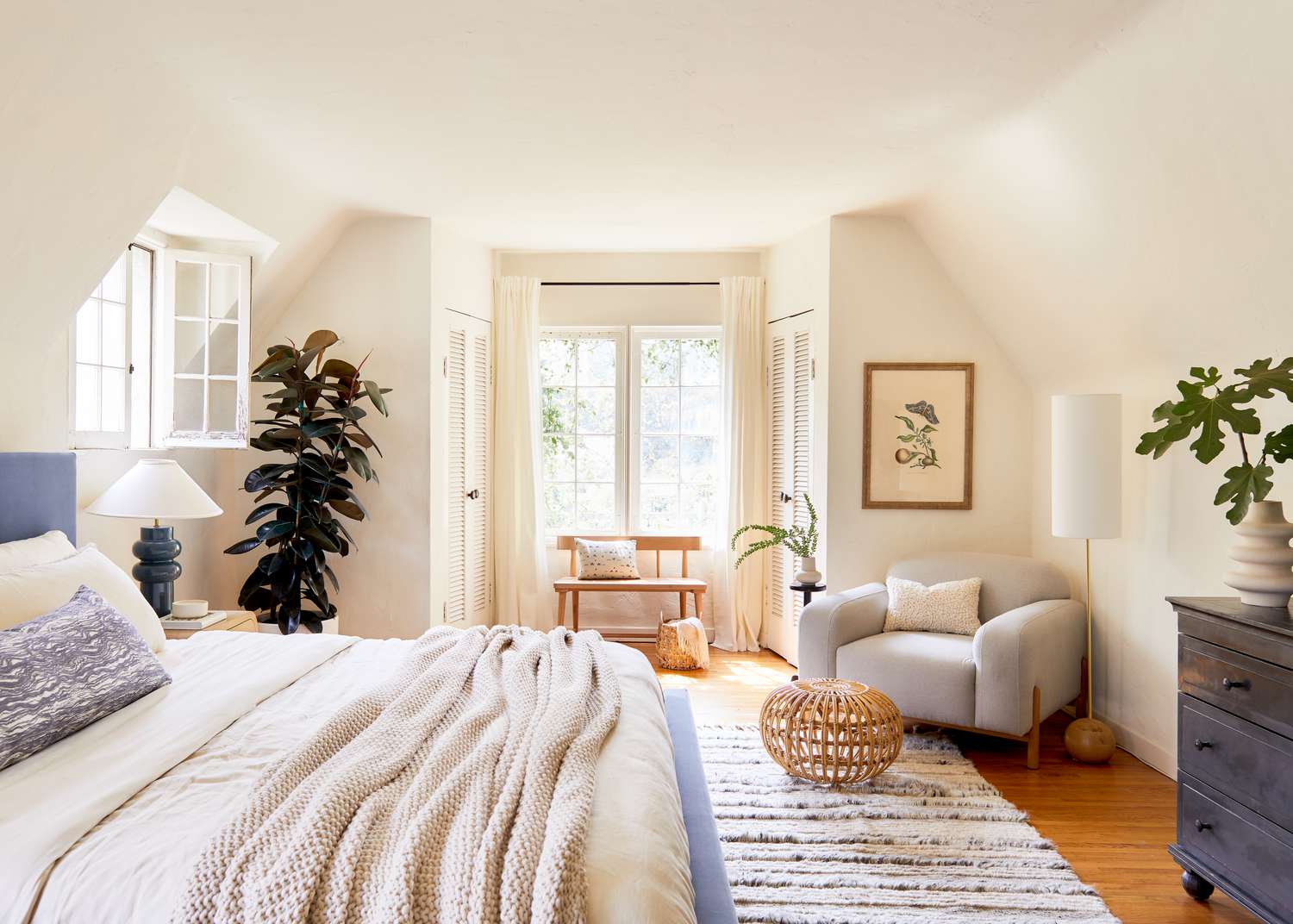
1. Embrace an Airy Feel with Natural Light and Woven Textures
This design nails the balance between cozy and airy. The success here comes from a principle called tonal layering. Instead of high-contrast colors, the room uses various shades of white, cream, and beige, from the walls to the rug and pouf. This creates a sense of calm continuity. The second element is the repetition of natural materials. The light wood flooring speaks to the wooden bench, which connects to the woven texture of the pouf and the fibers in the rug. This repetition makes the space feel cohesive and thoughtfully designed, not just thrown together.
|
📋 Copy HEX 🔗 Share |
To keep a light-filled room with a slanted ceiling from feeling washed out, you need to anchor the space. The easiest way to do this is with living greenery. Aim for at least three plants of varying heights. A small potted plant on a dresser, a medium-sized one on a bench or floor, and a larger floor plant create a visual triangle that draws the eye around the room. This touch of vibrant green provides just enough contrast against the neutral backdrop to make the entire design pop. It’s a simple trick that adds life and dimension instantly.
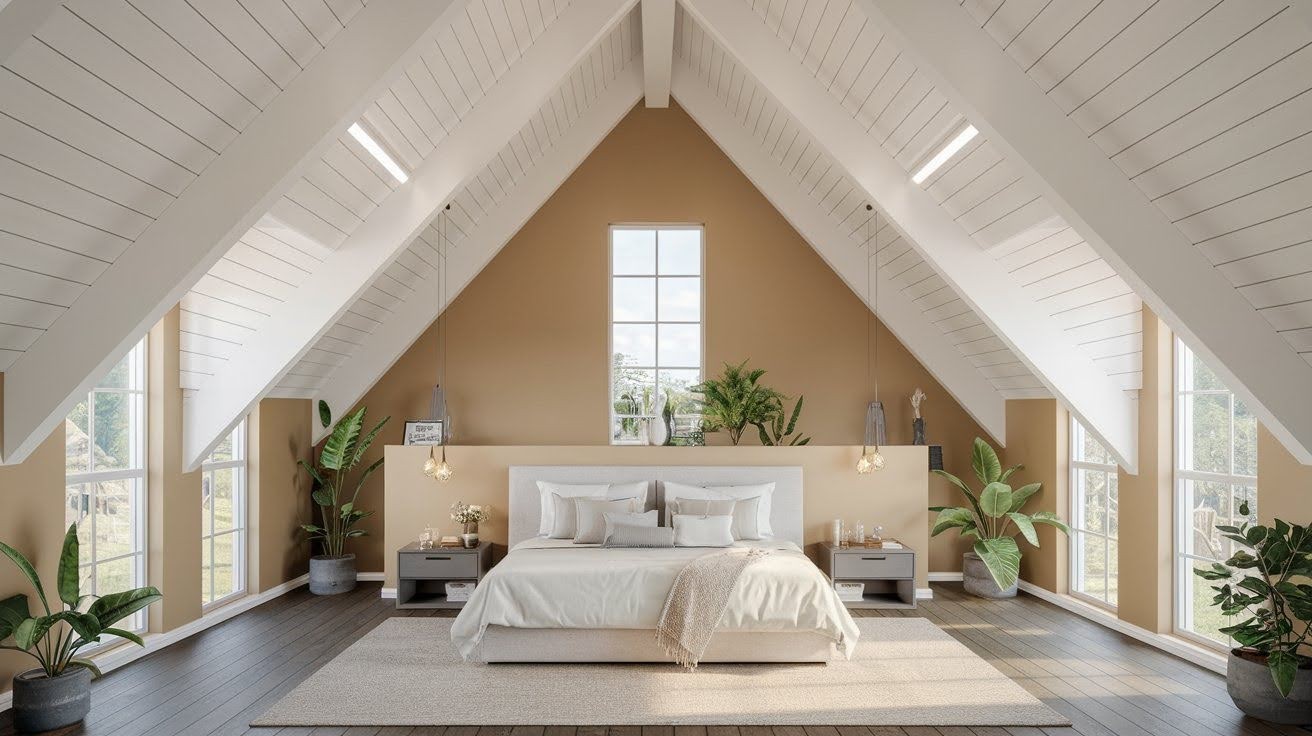
2. Frame a Vaulted Ceiling with Warm, Earthy Tan Walls
Think of this room as a simple but powerful formula: 50% architectural feature + 40% warm color + 10% natural accents. The vaulted, white wood-paneled ceiling is the undeniable star, making up half the room’s visual impact. The warm, earthy tan on the walls provides a cozy, grounding contrast without competing. The final 10% comes from the dark wood floor and the scattering of green plants, which add organic texture and life. You could swap the tan for a deep olive green or a muted terracotta, and the formula would still hold perfectly.
|
📋 Copy HEX 🔗 Share |
A room with this much wood and a strong wall color can easily feel heavy or dated if the lighting isn’t right. While those large windows are a giant asset, this look is highly dependent on them. In a room with less natural light, these same tan walls could look muddy and drab. Before you commit to a warm, earthy paint color, observe how the light moves through your room throughout the day. If you don’t get consistent, bright light, consider using the color on just one accent wall and keeping the others a soft, warm white.
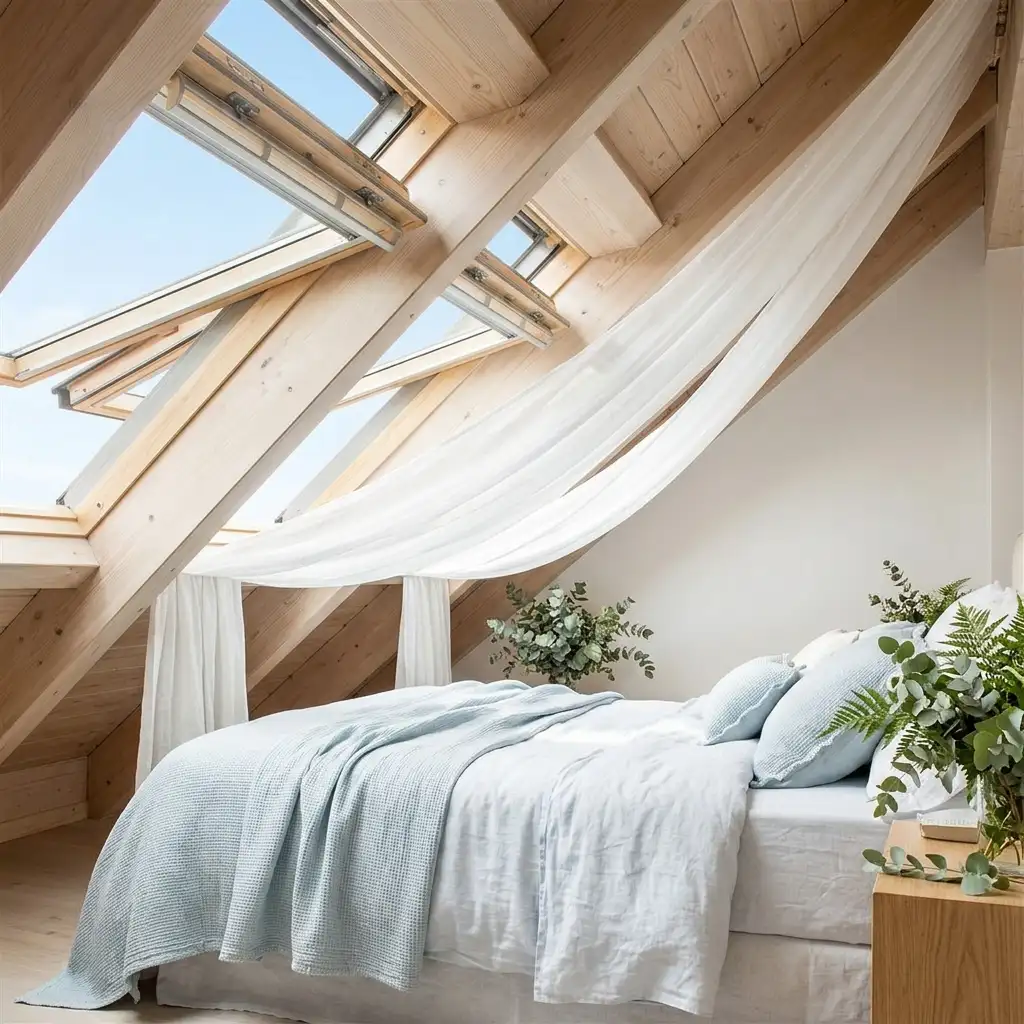
3. Create a Soft Canopy Effect with Sheer Fabric and Skylights
The single element that elevates this attic room from simple to serene is the sheer white fabric draped from the ceiling peak. Without it, you’d have a lovely bedroom with a wood ceiling. With it, you have a dreamy, canopy-like sanctuary. It softens the pronounced lines of the wood beams and diffuses the light from the skylights, casting a gentle glow over the entire space. It’s a touch of ethereal elegance that costs very little but completely transforms the room’s emotional feel, making it feel like a protective, calming escape.
|
📋 Copy HEX 🔗 Share |
You don’t need a custom canopy to get this vibe. A similar look can be achieved for under $100. Head to a fabric store (or even IKEA) and buy 10-15 yards of inexpensive sheer white cotton or voile fabric. Use a staple gun or small, discreet hooks to attach the fabric along the apex of your ceiling, letting it drape down naturally. The key is to use more fabric than you think you need to create those soft, generous folds. It’s a high-impact, low-cost project that feels incredibly luxurious. This is a much more affordable take on the custom fabric installations seen in Idea #15.
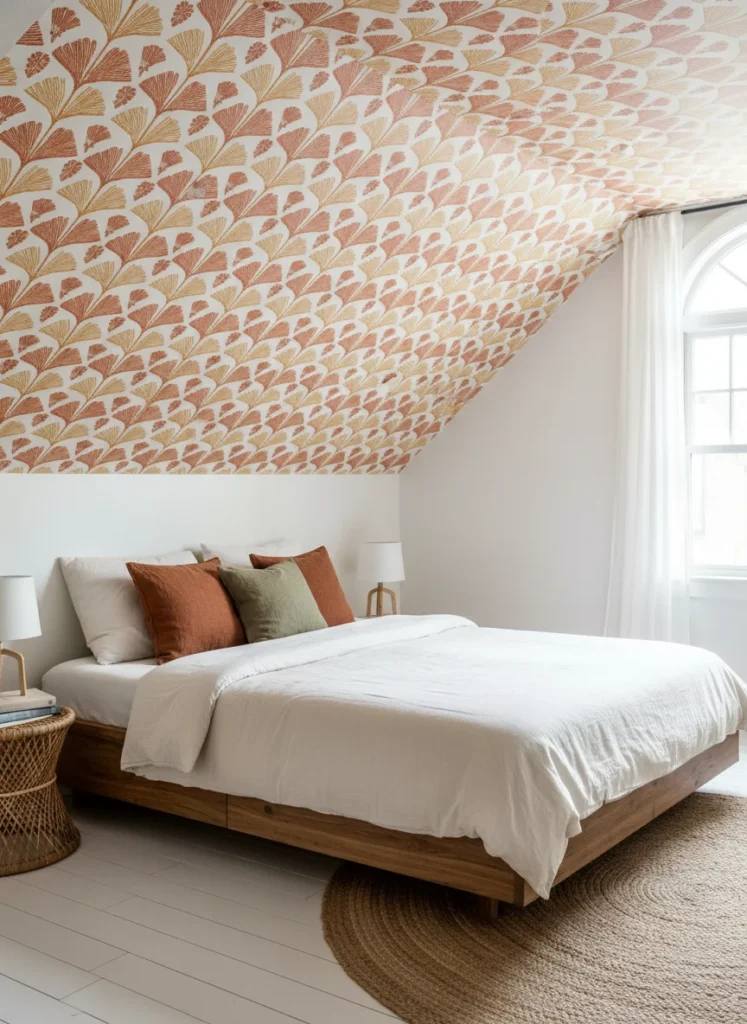
4. Define a Slant with Rich Ginkgo Leaf Wallpaper
Wallpapering a slanted ceiling can feel intimidating, but it’s manageable with a bit of prep. This is a two-person job. Time Estimate: 4-6 hours. Material Cost: $150-$400 (for wallpaper and supplies).
- First, clean the ceiling surface and prime it if necessary.
- Measure the ceiling area and cut your first wallpaper strip, adding 4 inches of excess.
- Starting at the top peak, apply the strip, using a wallpaper brush to smooth out bubbles as you work your way down the slant.
- Have your partner hold the bottom of the strip to keep it from pulling.
- Use a sharp utility knife to trim the excess along the wall and ceiling edges.
- Line up the pattern for the next strip and repeat.
|
📋 Copy HEX 🔗 Share |
This room works because of a smart use of contrast and balance. The ginkgo leaf wallpaper is visually ‘heavy’ and detailed, so keeping the main walls and all the bedding crisp white prevents the pattern from overwhelming the space. The light wood of the platform bed and the natural fibers of the jute rug act as a bridge between the warm tones in the wallpaper and the stark white, adding warmth without adding more clutter. It’s a masterclass in letting one bold choice be the hero.
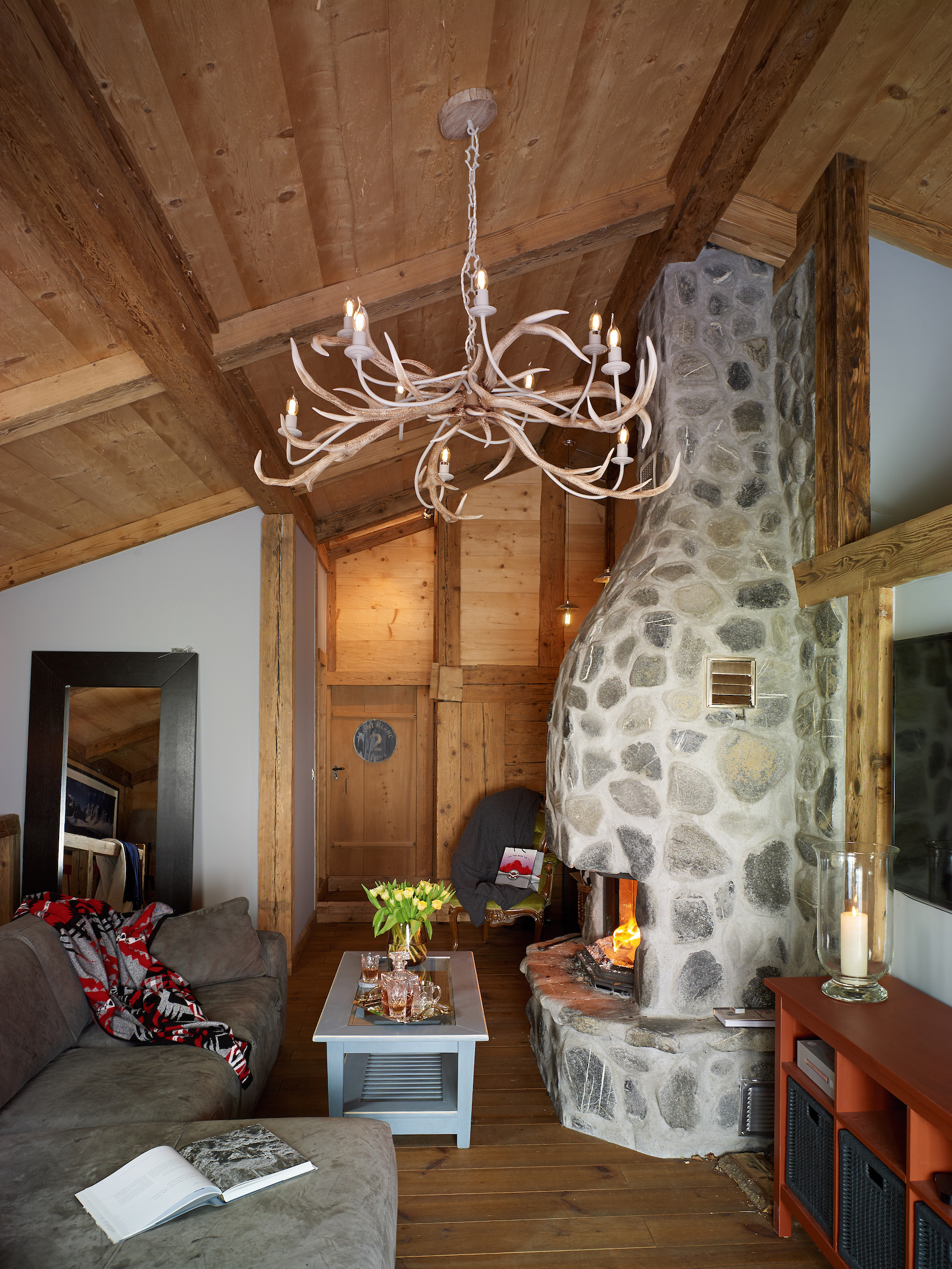
5. Anchor a Rustic Great Room with a Stone Fireplace
Recreating this cozy, lodge-like great room is a significant investment, primarily because of the architectural elements like the stone and wood.
|
📋 Copy HEX 🔗 Share |
- Main Furniture (Sofa, Coffee Table): $4,000 – $9,000
- Lighting (Antler Chandelier): $1,500 – $5,000
- Textiles (Rug, Throws): $500 – $1,500
- Decor/Accessories: $300 – $800
- Architectural (Stone Fireplace & Wood Paneling): $15,000 – $30,000+
- TOTAL: $21,300 – $46,300+
Budget alternative: Achieve a similar vibe for around $8,000 – $12,000 by using faux stone panels for the fireplace, finding a faux antler chandelier on Wayfair or Overstock, and sourcing a comfortable sectional from a more affordable retailer.
This idea is best suited for a larger space. To do justice to the scale of the fireplace, the exposed beams, and the antler chandelier, you’ll need a room with a minimum footprint of 20 feet by 25 feet (500 sq ft). More importantly, the ceiling height is critical. The central peak should be at least 15-18 feet high to prevent that incredible antler chandelier from feeling cramped and overbearing. For smaller rooms with a rustic feel, refer to the more contained approach in Idea #24.
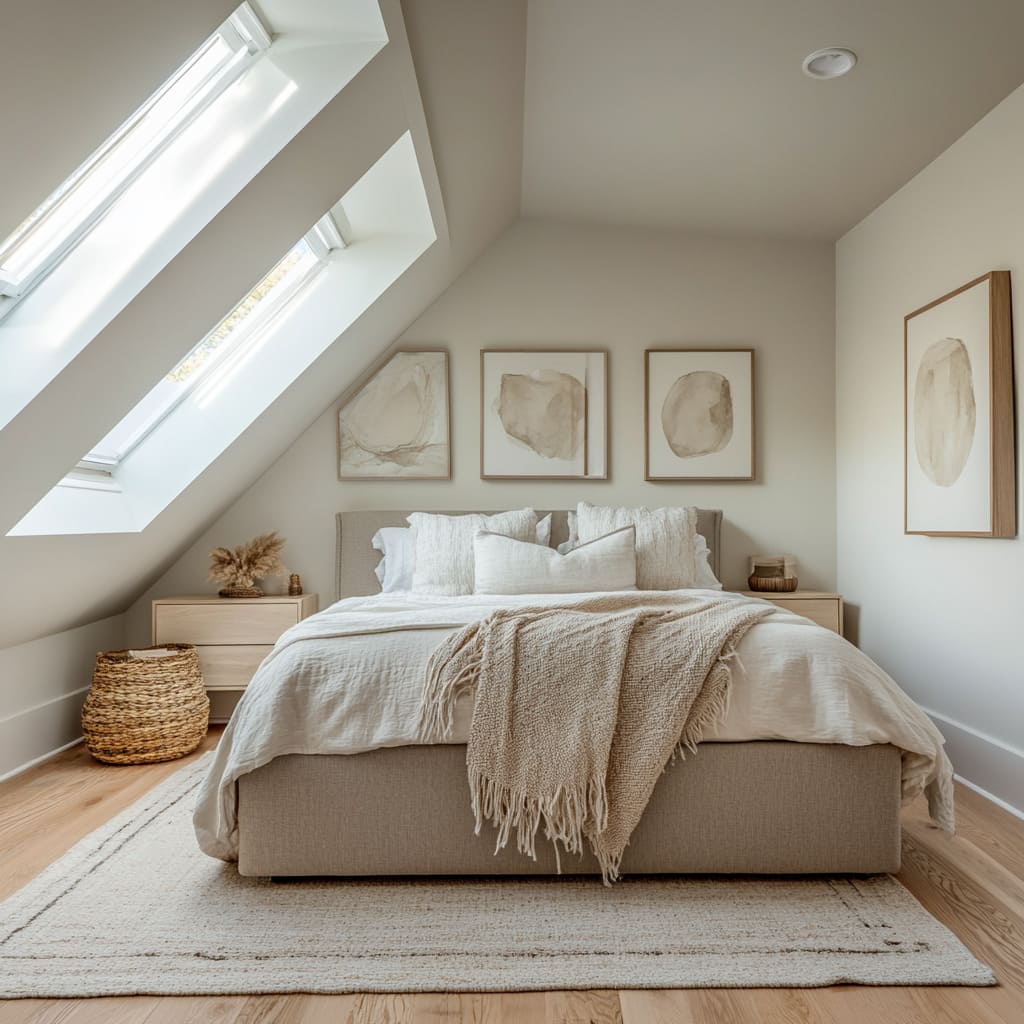
6. Layer Soft Textures in a Neutral Attic with Skylights
The magic of this room lies in its masterful use of texture to create warmth in a strictly neutral palette. The painted ceiling is smooth, which makes a nice contrast with the rough weave of the basket and the soft headboard. The nubby texture of the area rug adds another layer underfoot, while the crisp cotton of the bedding feels clean and inviting. This textural conversation is what keeps the beige-and-white scheme from feeling boring; it provides sensory detail that is just as engaging as bright color.
|
📋 Copy HEX 🔗 Share |
A room this light and neutral is beautiful, but it’s not without its challenges. That light-colored upholstered headboard will act as a magnet for oils from hair and hands. Plan on professionally cleaning it at least once a year, or twice if you often lean against it while reading. The light-colored rug will also show dirt more easily, requiring regular vacuuming and prompt attention to any spills. Skylights, while glorious, can be prone to leaks if not installed perfectly and may need their seals checked every 5-7 years.
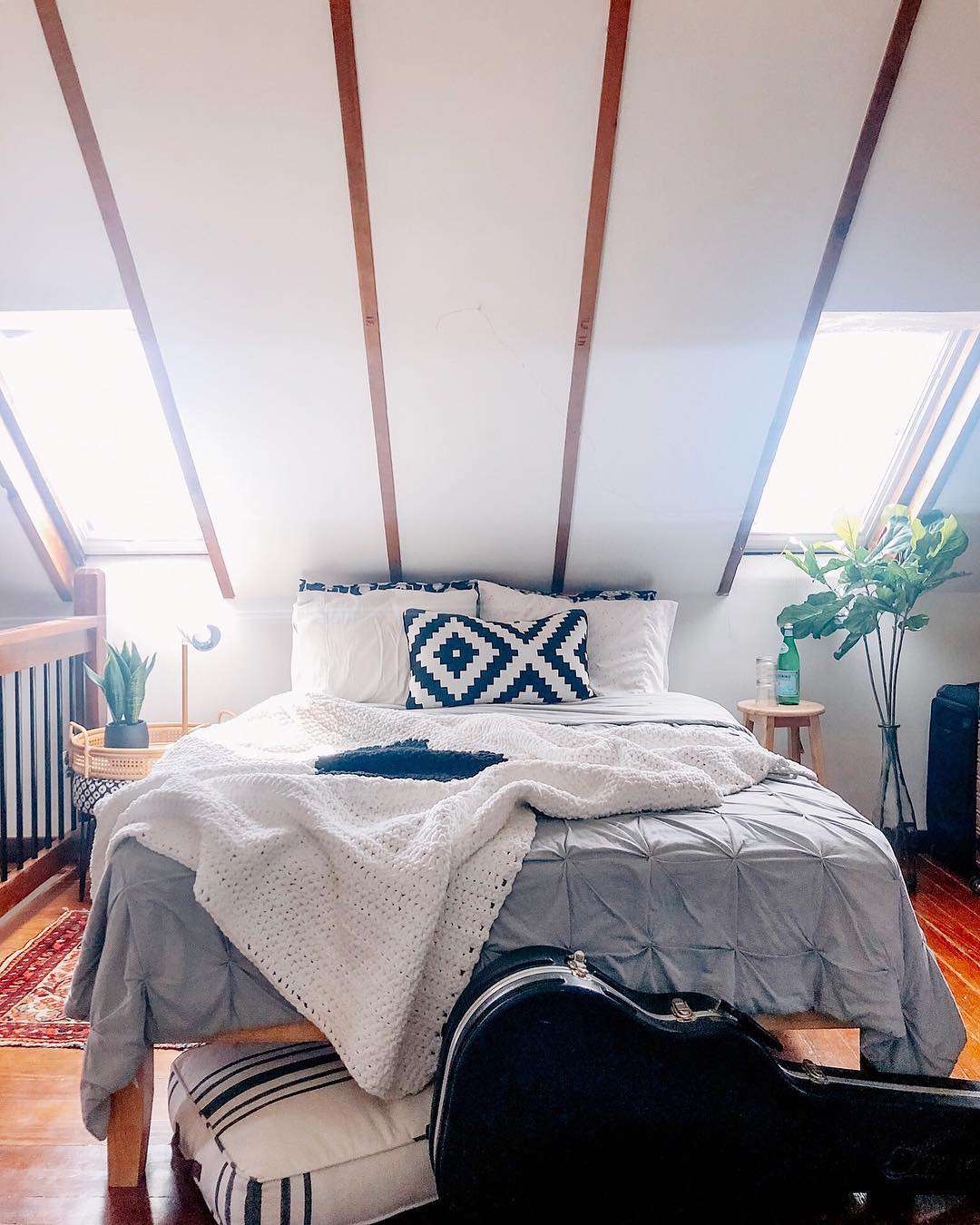
7. Juxtapose White Slants and Exposed Wood Beams
When you have beautiful architectural features like exposed wood beams, don’t paint them to match the ceiling. The contrast between the crisp white slanted planks and the warm, natural wood beams is what gives this room its character. By painting the ceiling white, you make the room feel taller and brighter, while leaving the beams exposed adds rustic warmth and draws the eye upward, celebrating the room’s unique geometry. It’s the best of both worlds: airy and cozy at the same time.
|
📋 Copy HEX 🔗 Share |
What makes this bedroom feel effortlessly cool is its asymmetry. Instead of perfectly matched nightstands and lamps, there’s a proper table and lamp on one side and a simple wooden stool with a floor plant on the other. This subtle imbalance makes the room feel more personal and lived-in, not like a stiff hotel room. It adds a layer of casual confidence to the design, proving that you don’t always need perfect symmetry to create a beautiful, balanced space. This is a great tip for anyone who wants a relaxed, natural feel, similar to the one in Idea #1.
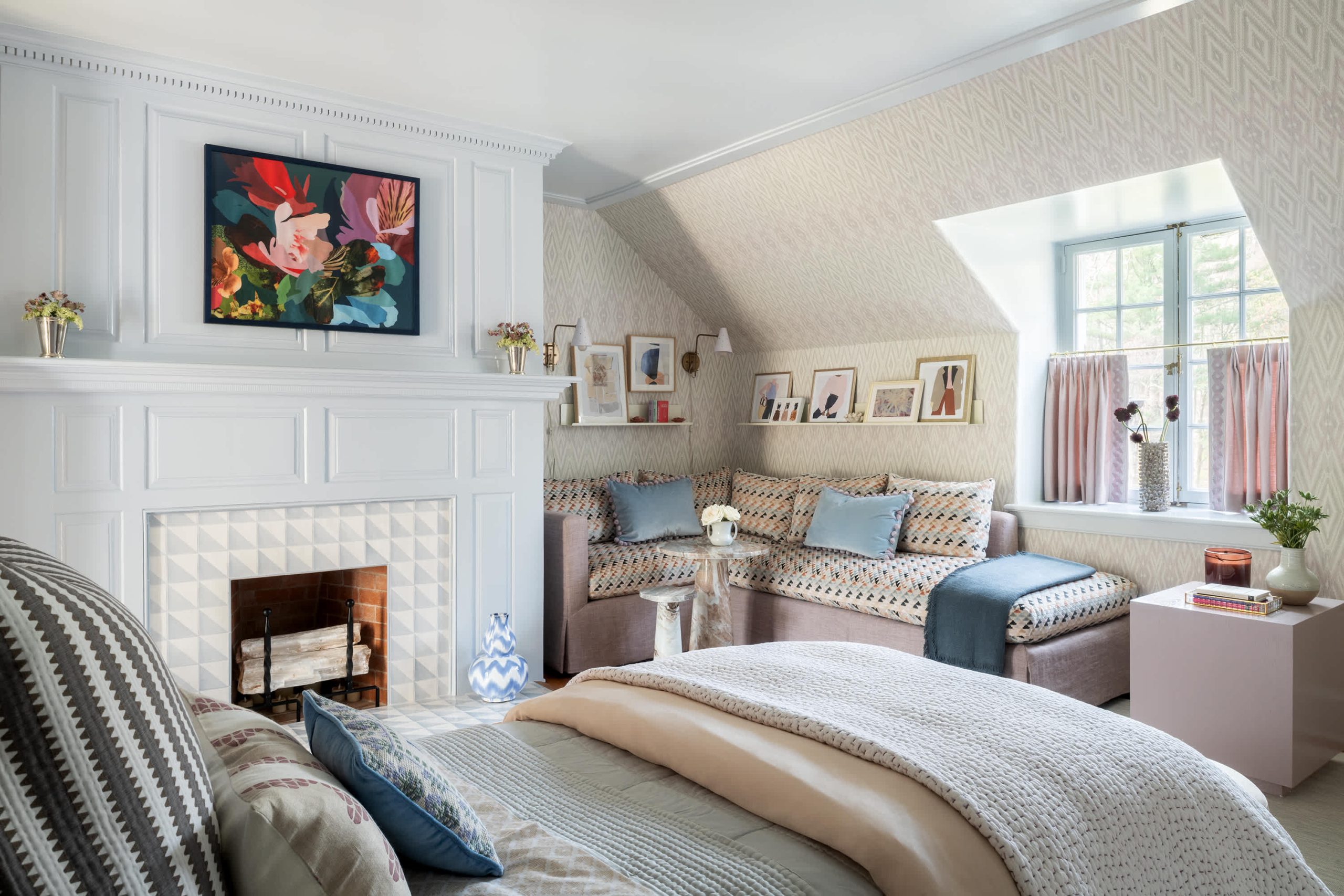
8. Combine Geometric Wallpaper with a Paneled Fireplace
This room’s eclectic charm is a careful mix: 40% soft geometrics + 30% traditional millwork + 20% bold color pops + 10% quirky accents. The light geometric wallpaper on the slanted ceiling sets a playful but gentle backdrop. The classic white-paneled fireplace provides a sturdy, traditional anchor. The design gets its energy from pops of light blue, pink, and the vibrant floral artwork. Finally, the pom-pom trim on the pillows adds that extra 10% of pure fun. It’s a formula that proves you can mix patterns and styles if you keep the proportions in check.
|
📋 Copy HEX 🔗 Share |
A built-in sofa like this is a fantastic use of an awkward corner under a slant, but it’s a major commitment. Unlike a freestanding sofa, you can’t move it, and reupholstering it is a significant job. Before you build something custom, be absolutely certain you love the fabric and that you’ll be delighted with that room layout for years to come. Furthermore, consider the resale implications; a highly specific, built-in piece might not appeal to all potential buyers down the line. A less permanent option is a low-profile L-shaped sectional that tucks neatly into the corner.
9. Mix Bohemian and Industrial with Warm, Cozy Layers
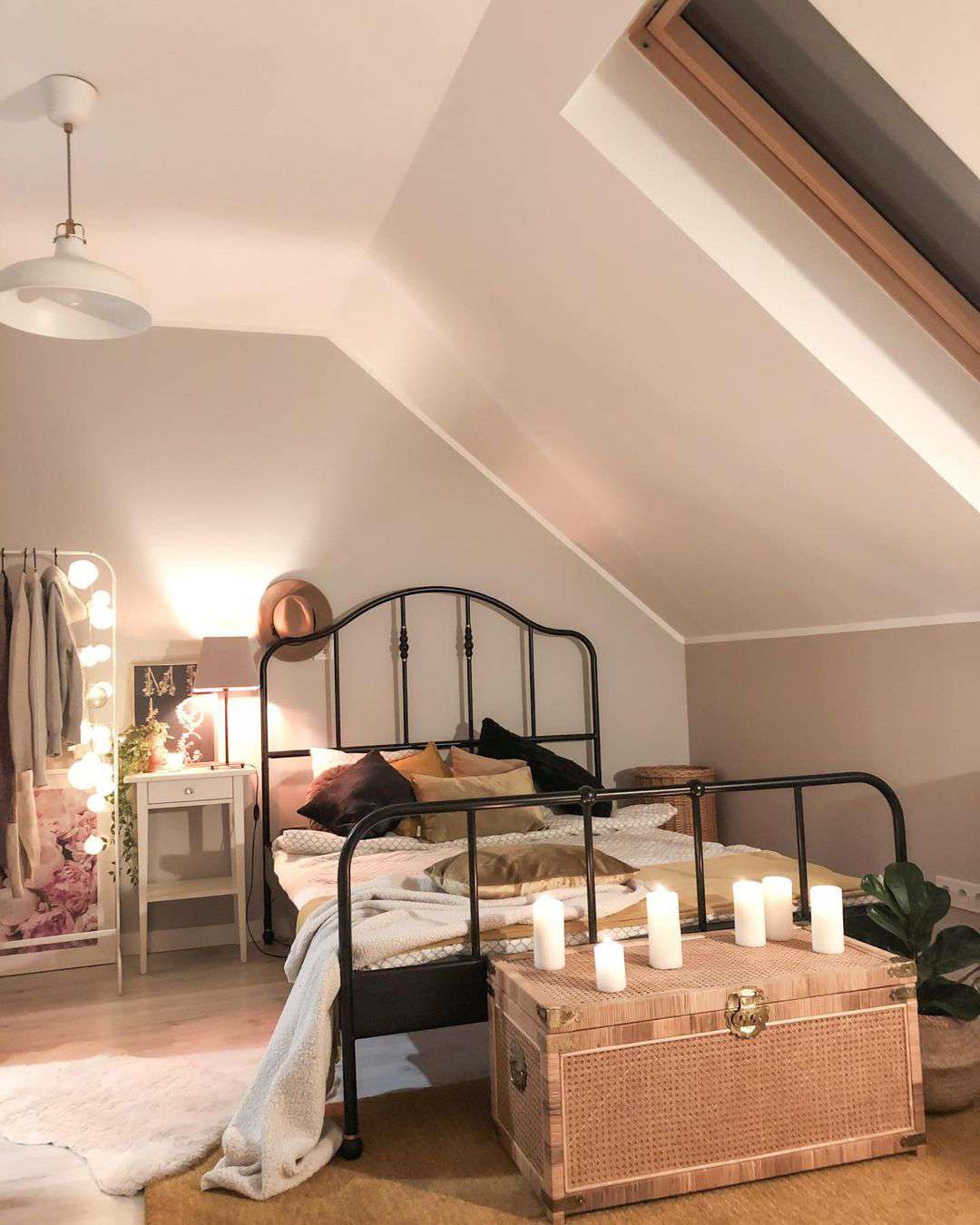
You can get this warm, eclectic look without splurging on high-end pieces. The black metal bed frame is a classic that you can find at IKEA (like the NEIDEN or TARVA stained black) for under $200. Hunt for a vintage wooden chest on Facebook Marketplace or at a thrift store; even if it doesn’t have a rattan front, the warm wood tone is the key. Target’s Casaluna line and H&M Home are your best friends for affordable, textured bedding and pillows to create that cozy, layered look. The goal is a curated, collected vibe, which is often more authentic when it’s not all from one expensive store.
|
📋 Copy HEX 🔗 Share |
This room successfully blends two distinct styles: bohemian and industrial. The industrial side comes from the stark black metal of the bed frame and the functional, almost raw feel of the space under the slanted ceiling. The bohemian half is all about the soft, warm, and natural elements: the rattan chest, the layered textiles, the warm glow from the candles and lights, and the slightly undone feel of the clothing rack. The warm beige walls act as a unifying force, bridging the gap between the hard and soft elements to create a space that feels both edgy and incredibly inviting.
10. Install a Statement Chandelier on a Planked Ceiling
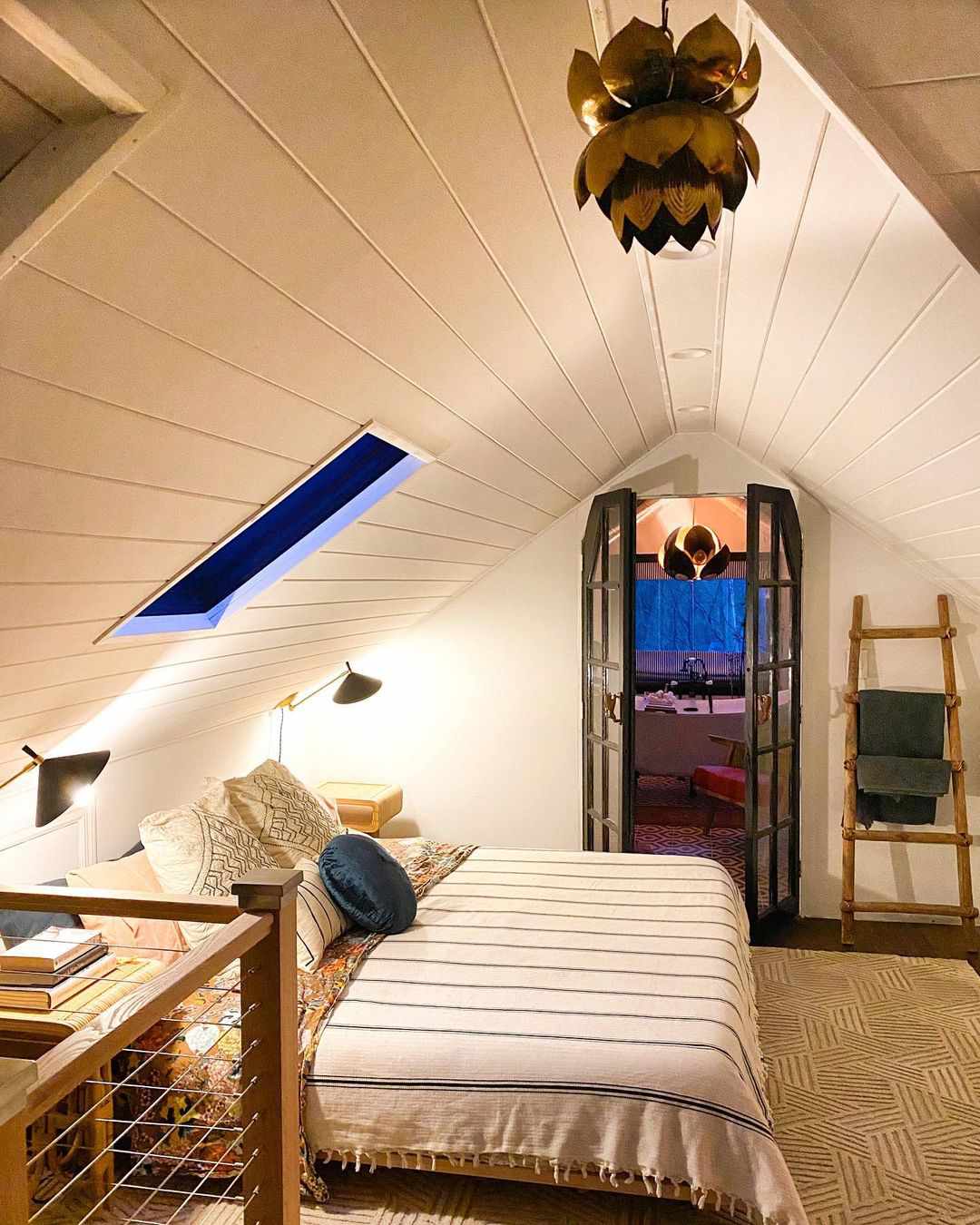
The brass lotus-shaped chandelier is, without a doubt, the element that makes this room sing. On a simple, flat ceiling, it would be pretty. But hung from the peak of a slanted, white-planked ceiling, it becomes a stunning focal point. It’s an unexpected touch of glamour and artistry in a room that is otherwise quite rustic and bohemian. Removing it would leave the room feeling nice, but somewhat generic. This one piece provides the ‘wow’ factor and defines the entire eclectic, curated aesthetic.
|
📋 Copy HEX 🔗 Share |
When hanging a pendant or chandelier on a slanted ceiling, you need a special adapter, called a sloped ceiling canopy kit. Most standard light fixtures come with a flat mount. This adapter has a swivel mechanism that allows the fixture to hang straight down, regardless of the ceiling’s angle. They are inexpensive (usually $15-$30) and can be found at any home improvement store. Make sure the adapter’s finish (e.g., brass, black, nickel) matches your light fixture for a seamless, professional look.
11. Achieve Coziness with Layered Whites and Rust Accents
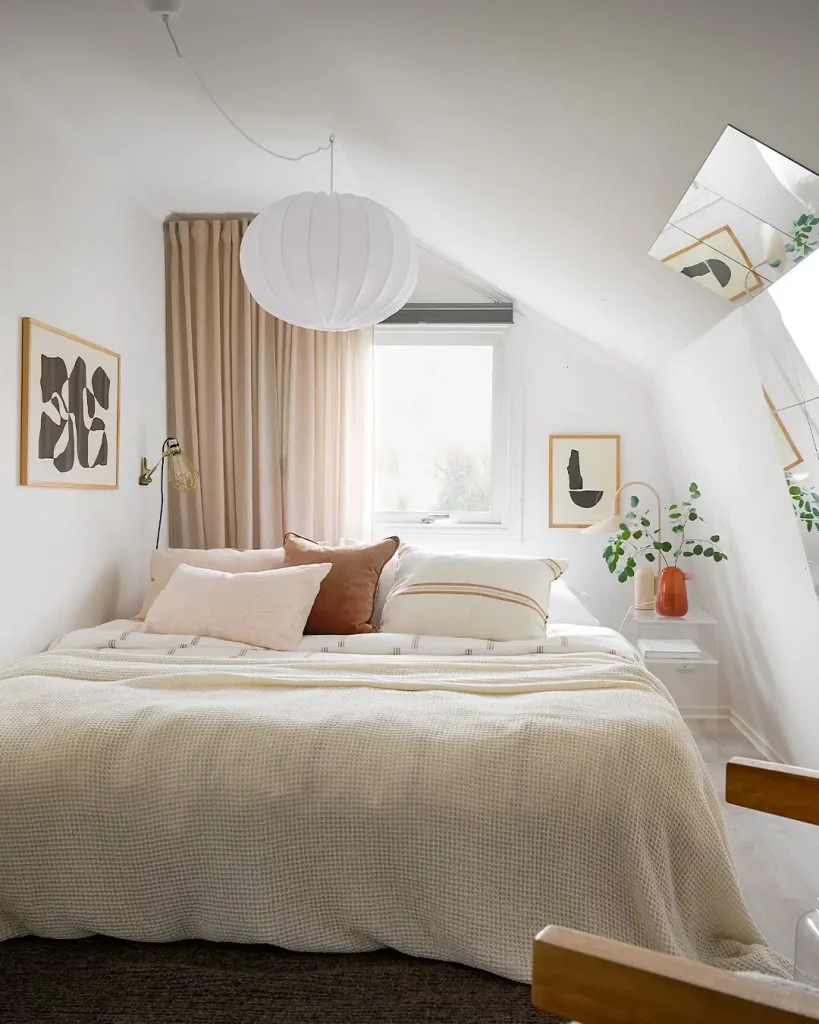
This look is perfect for small to medium-sized attic bedrooms, from about 100 to 180 square feet. The key is the low-profile bed and the monochromatic color scheme. By keeping the walls, ceiling, and major textiles (like the waffle knit blanket) white, you create an unbroken visual line that makes the space feel larger and brighter. A large, dark piece of furniture would chop up the space. This approach works best with a ceiling peak of at least 7.5 feet, allowing enough headroom to comfortably enter and exit in and out of bed.
|
📋 Copy HEX 🔗 Share |
This cozy, minimal aesthetic is incredibly budget-friendly. The paper pendant light is a classic from IKEA that costs less than a pizza. The minimalist artwork can be a DIY project or an affordable print from a site like Society6 or Etsy. The real star, the oversized white waffle knit blanket, can be found at Target or HomeGoods. The beauty of this look is that it’s all about texture and thoughtful layering, not expensive statement pieces. You can create this entire serene retreat for just a few hundred dollars.
12. Brighten a Dark Wood Bed with White Textiles and Woven Accents
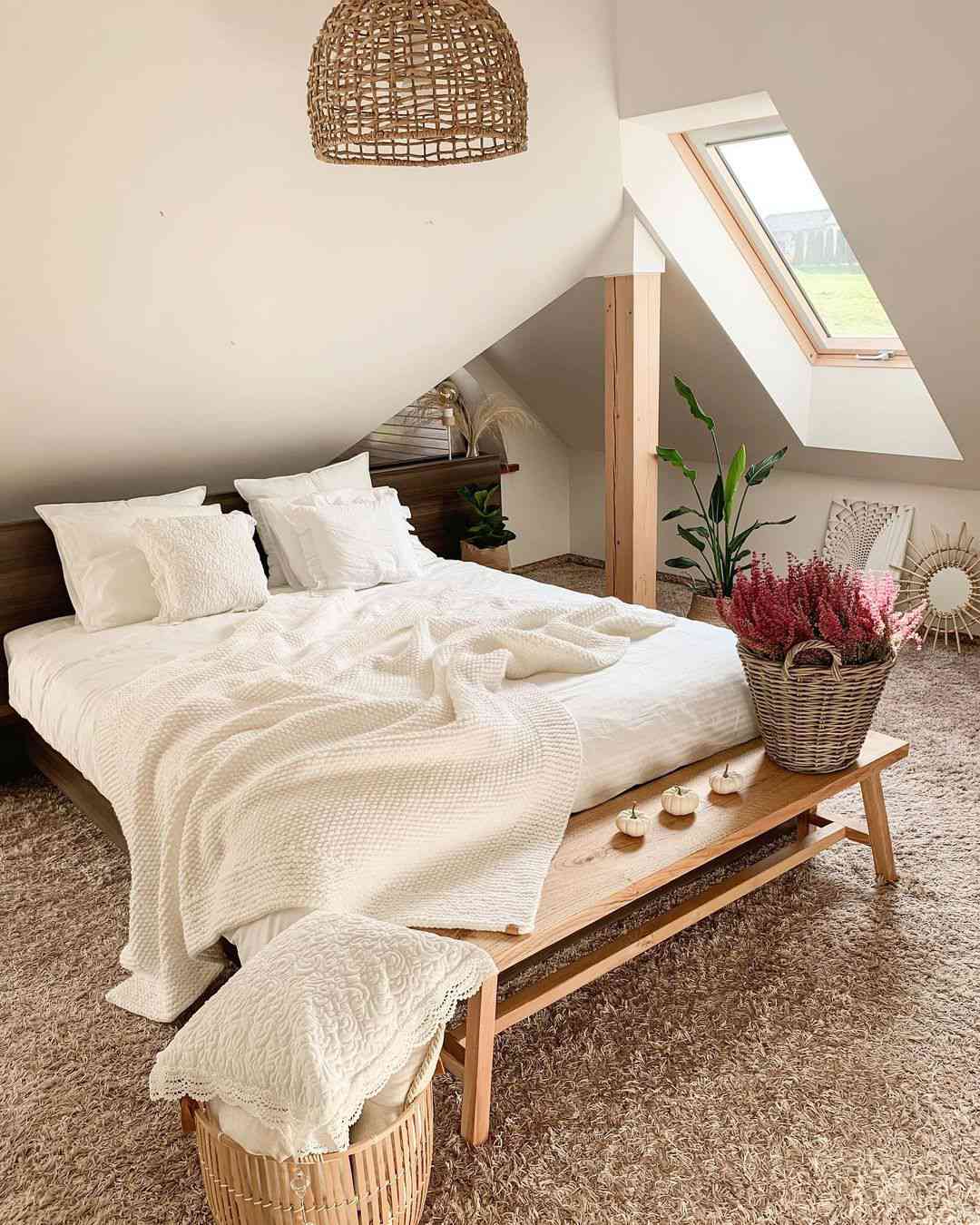
This room is a study in successful contrast. The heavy, dark wood bed frame could easily dominate the space, but it’s balanced by an overwhelming abundance of white and cream. The white walls, white ceilings, shaggy cream carpet, and layers of white bedding effectively push back against the dark wood, creating a dynamic equilibrium. The woven pendant lamp and light wood bench then mediate between the two extremes, adding a mid-tone that ties everything together. It feels balanced because no single element is allowed to win the fight.
|
📋 Copy HEX 🔗 Share |
Hanging a lightweight woven pendant lamp is a quick upgrade. Time Estimate: 1 hour. Material Cost: $50 – $200.
- Turn off the power to the light fixture at the circuit breaker.
- Unscrew and remove the old fixture, disconnecting the wires (usually black, white, and copper).
- Attach the new fixture’s mounting bracket to the electrical box in the ceiling.
- Connect the wires: black to black, white to white, and the copper ground wire to the green screw on the bracket.
- Tuck the wires into the box and secure the new fixture’s canopy to the bracket.
- Install the lightbulb, turn the power back on, and enjoy the glow.
13. Pair a Wicker Headboard with Soothing Sage Green Walls
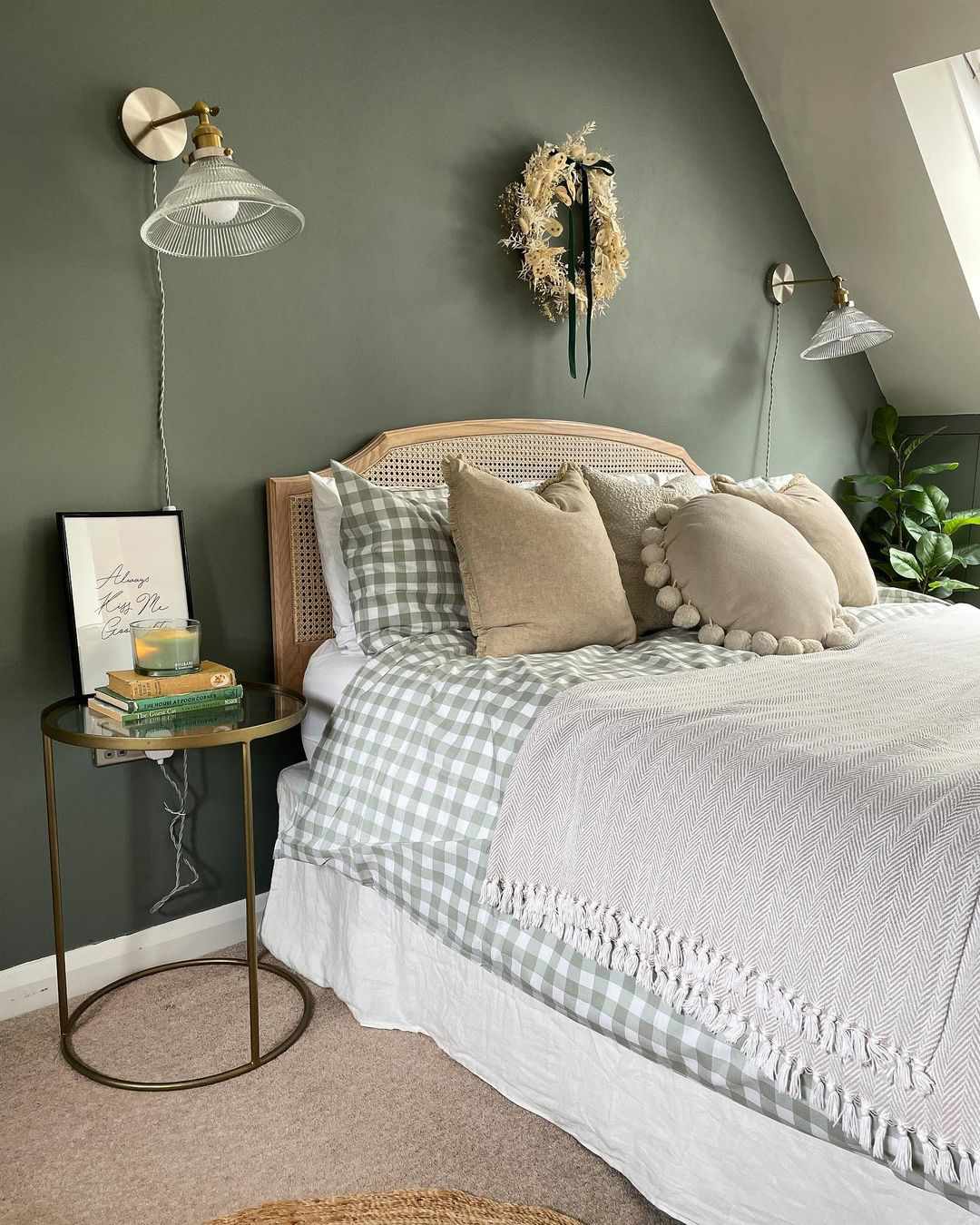
Here’s the recipe for this serene look: 60% soothing base color (the sage green walls) + 30% natural texture (the wicker headboard and wood) + 10% metallic warmth (the brass sconces and table). The sage green creates a calm, earthy foundation. The wicker and light wood add an organic, handcrafted feel that’s very popular right now. The final touch of brass adds a tiny bit of glam and keeps the look from feeling too rustic or plain. You could easily swap the sage green for a dusty blue or a warm terracotta, and the formula would still create a similarly balanced and inviting space.
|
📋 Copy HEX 🔗 Share |
The combination of sage green, natural wicker, and brass accents is at the peak of the ‘modern cottage’ or ‘cottagecore’ trend. This style gained massive popularity as people sought to make their homes feel like calming, nature-inspired retreats. It’s a gentle move away from the cool grays and stark whites of the last decade. This look has staying power because its core components—earthy colors, natural materials, and warm metals—are timeless. It feels current for 2026, but it won’t feel dated in 2036.
14. Go Minimalist in an A-Frame with Big Skylights and Blue Bedding
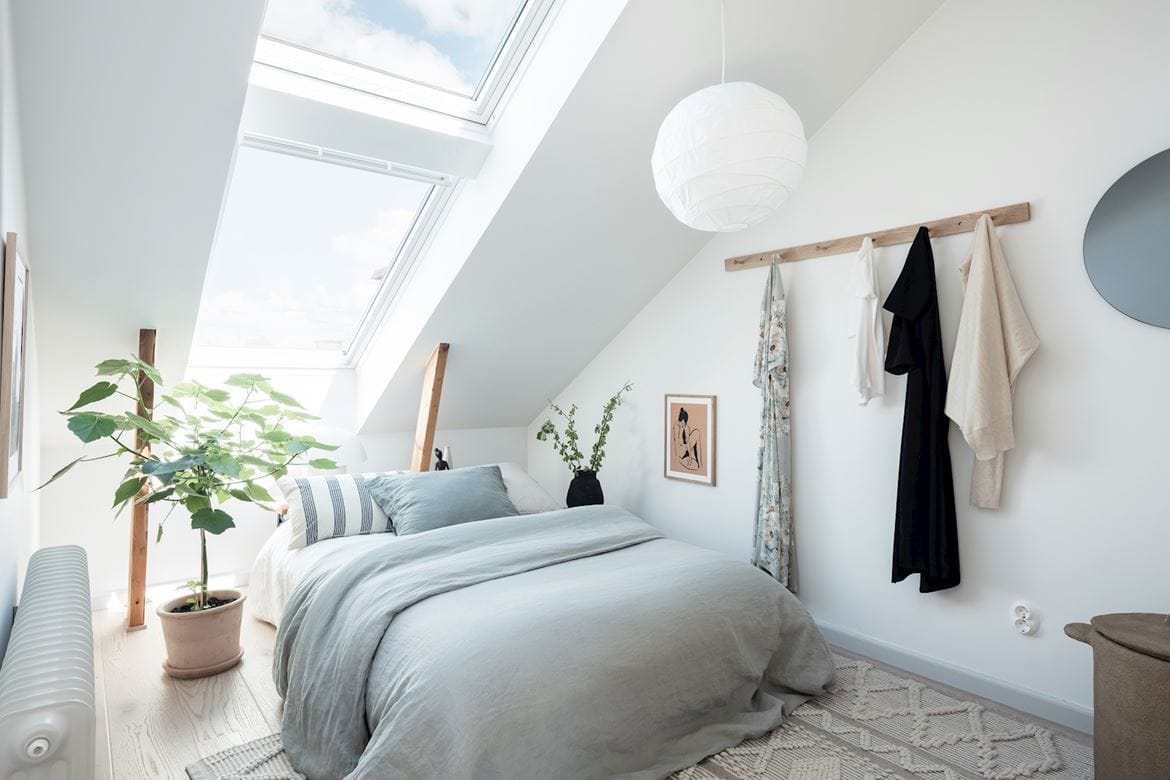
Before you commit to this beautifully stark, minimalist look, run through this quick checklist:
|
📋 Copy HEX 🔗 Share |
- Light Direction: Does your room get enough natural light to support a primarily white palette without it feeling cold? North-facing rooms may struggle.
- Storage Needs: This look relies on having very little clutter. Do you have adequate closet space elsewhere to hide all your stuff? If not, you’ll need to plan for sleek, built-in storage.
- Heating: A-frames with large skylights can lose a lot of heat. Is your insulation up to par? That white radiator is stylish, but it needs to be powerful enough for the space.
- Plant Commitment: That oversized plant is a key part of the decor. Are you prepared for the watering and care it will need?
This idea thrives in a room with generous vertical space, typical of an A-frame structure. You need a ceiling peak of at least 12 feet to prevent the space from feeling like a cramped tent. The footprint itself can be modest—as small as 12 by 14 feet—as the height and the massive skylights create the sense of volume. This minimalist approach is a fantastic solution for making a structurally captivating but potentially small-footprint room feel expansive and serene. It’s a different approach to the cozy density of Idea #24.
15. Combine Rustic Shiplap Walls and Exposed Beams
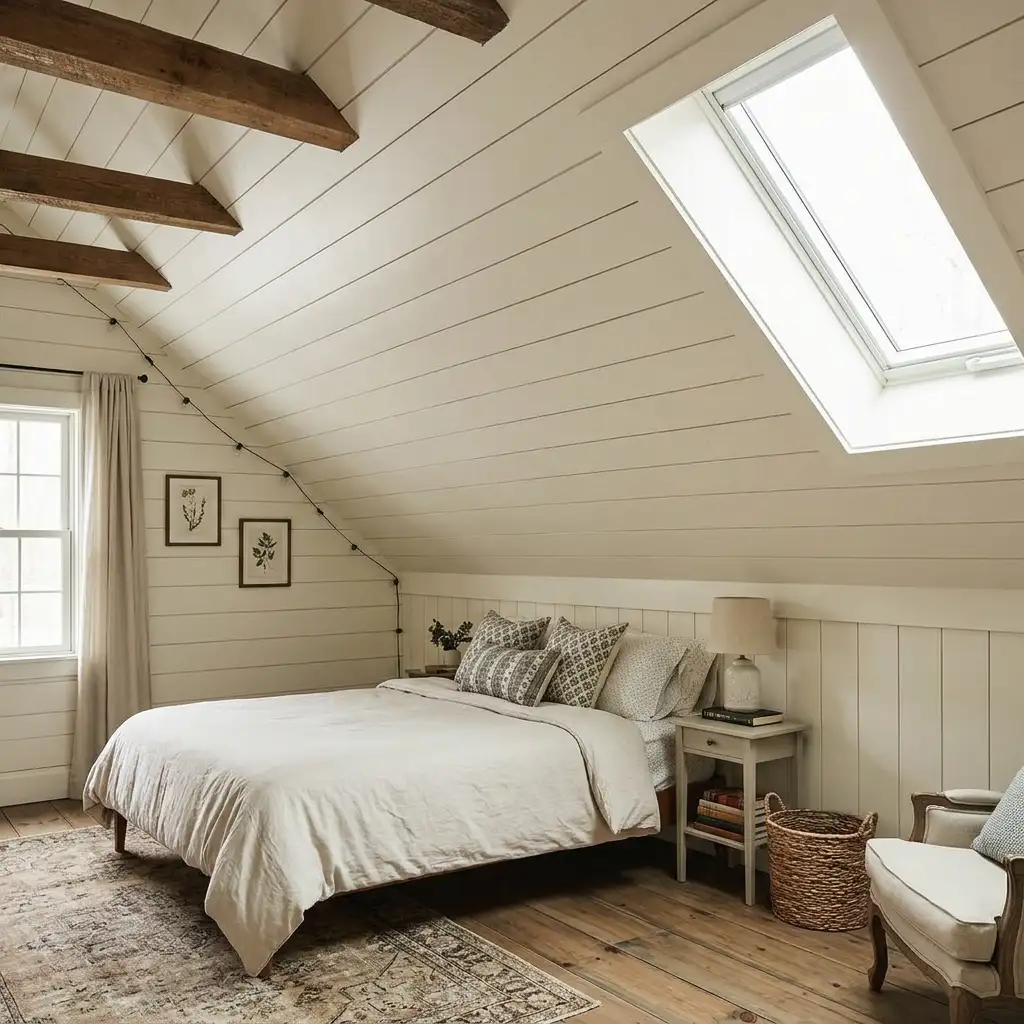
While beautiful, shiplap walls have one downside: they are dust collectors. Those little horizontal ledges need regular attention. Plan to run a microfiber duster or the brush attachment of your vacuum over the walls every other week to keep them looking fresh. For the rough-hewn wooden beams, a simple feather duster is not enough. Use a vacuum with a long-reach attachment to get into the nooks and crannies every month or so. Annually, you might consider wiping the beams down with a wood-safe cleaner to restore their luster.
|
📋 Copy HEX 🔗 Share |
A room with this much wood—on the walls, ceiling, and floor—can feel like a log cabin penalty box if you’re not careful. The key to keeping it from becoming oppressive is the giant skylight and the light-colored bedding and rug. If your attic space doesn’t have the option for a large skylight, you might want to reconsider cladding every single surface in wood. Perhaps limit the shiplap to one accent wall or paint the ceiling a bright white to provide some visual relief and bounce light around the room.
16. Carve Out a Cozy Nook with Botanical Wallpaper
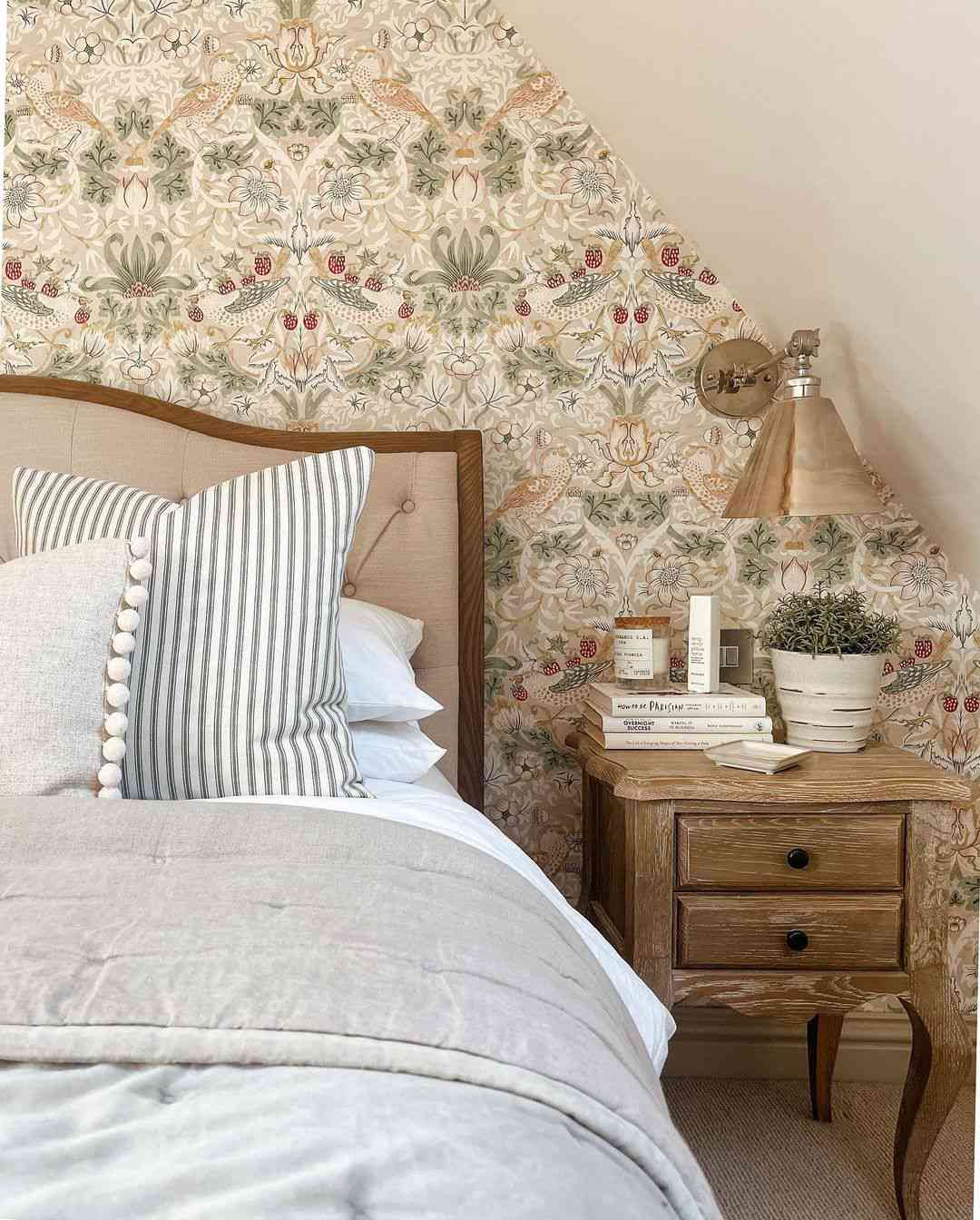
In a small space or a nook under a slant, don’t be afraid of a detailed pattern. A common mistake is to think a small space needs a small, delicate pattern. In reality, a large-scale, confident pattern like this botanical and bird wallpaper can actually make the space feel more intentional and luxurious, not more cramped. It turns an awkward corner into a deliberate, jewel-box-like feature. The key is to contain it to one or two walls and balance it with solid colors elsewhere.
|
📋 Copy HEX 🔗 Share |
The single element that makes this nook so inviting is the thoughtful lighting. It’s not just an afterthought; it’s integral to the design. The metallic sconce with its tapered shade provides warm, focused light perfect for reading in bed. It adds a layer of function and a touch of elegance that a simple table lamp wouldn’t achieve. This dedicated light source turns the nook from just a place with a bed into a cozy, functional retreat, proving that good lighting is never just a detail—it’s everything. This is a perfect example of why you should never rely on a single overhead light, as we discuss in the mistakes section.
17. Add a Playful Dash Pattern Under a Slanted Ceiling
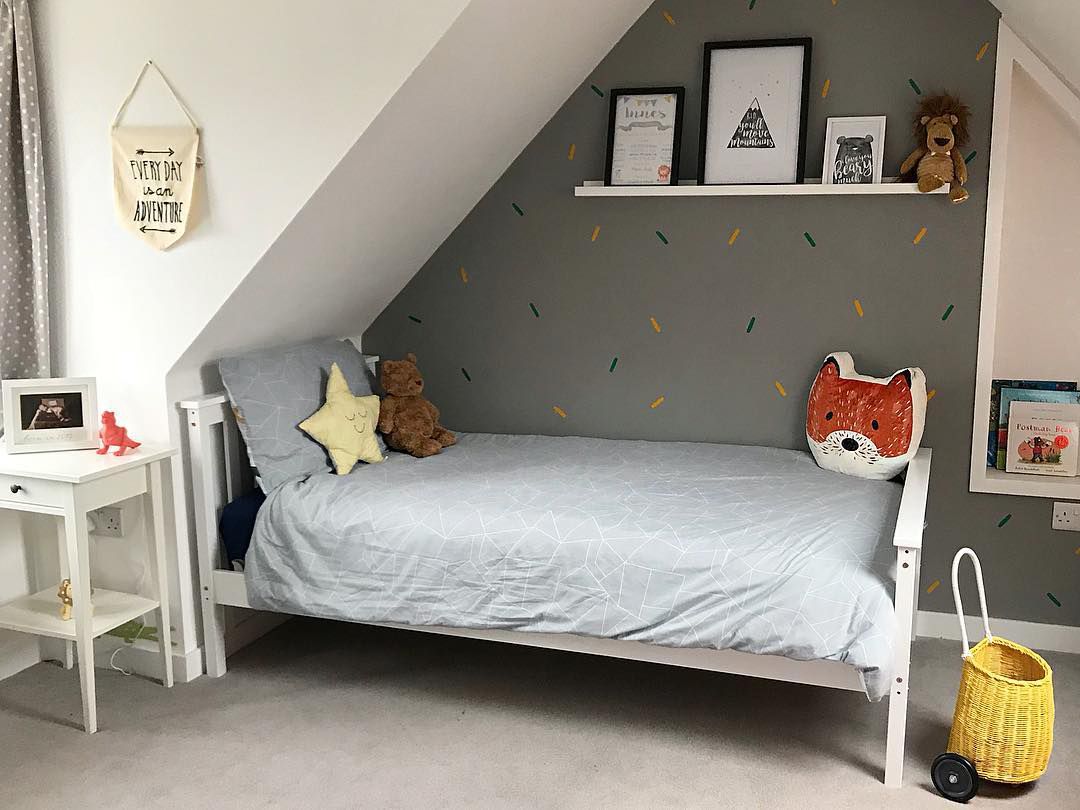
This fun dash pattern is an easy and inexpensive DIY. Time Estimate: 2-3 hours. Material Cost: Under $20.
- Start with a painted and fully cured wall (wait at least 48 hours after painting the base gray).
- You don’t need a stencil for this organic look. Use a small, flat artist’s brush (about 1/2 inch wide).
- Pour a small amount of your accent colors (green and yellow) onto a paper plate.
- Dip the tip of the brush in one color and make short, random dash marks. Vary the angle and spacing to keep it looking playful and not too uniform.
- Alternate between the colors, scattering them across the wall.
- Step back frequently to ensure you’re getting an even-ish distribution. Let it be imperfect!
|
📋 Copy HEX 🔗 Share |
You can put this entire playful and stylish kids’ room together on a serious budget. The simple white bed frame is an IKEA staple. The floating shelf is another inexpensive find from Target or IKEA. The real savings come from the wall treatment: instead of expensive, potentially ‘outgrow-able’ wallpaper, a couple of sample pots of paint and an afternoon are all it takes to create that custom accent wall. This approach allows you to create a high-impact, personalized room for very little money, and it’s simple to paint over when your child is ready for a new look.
18. Hang a Striped Hammock for a Playful Kids’ Room
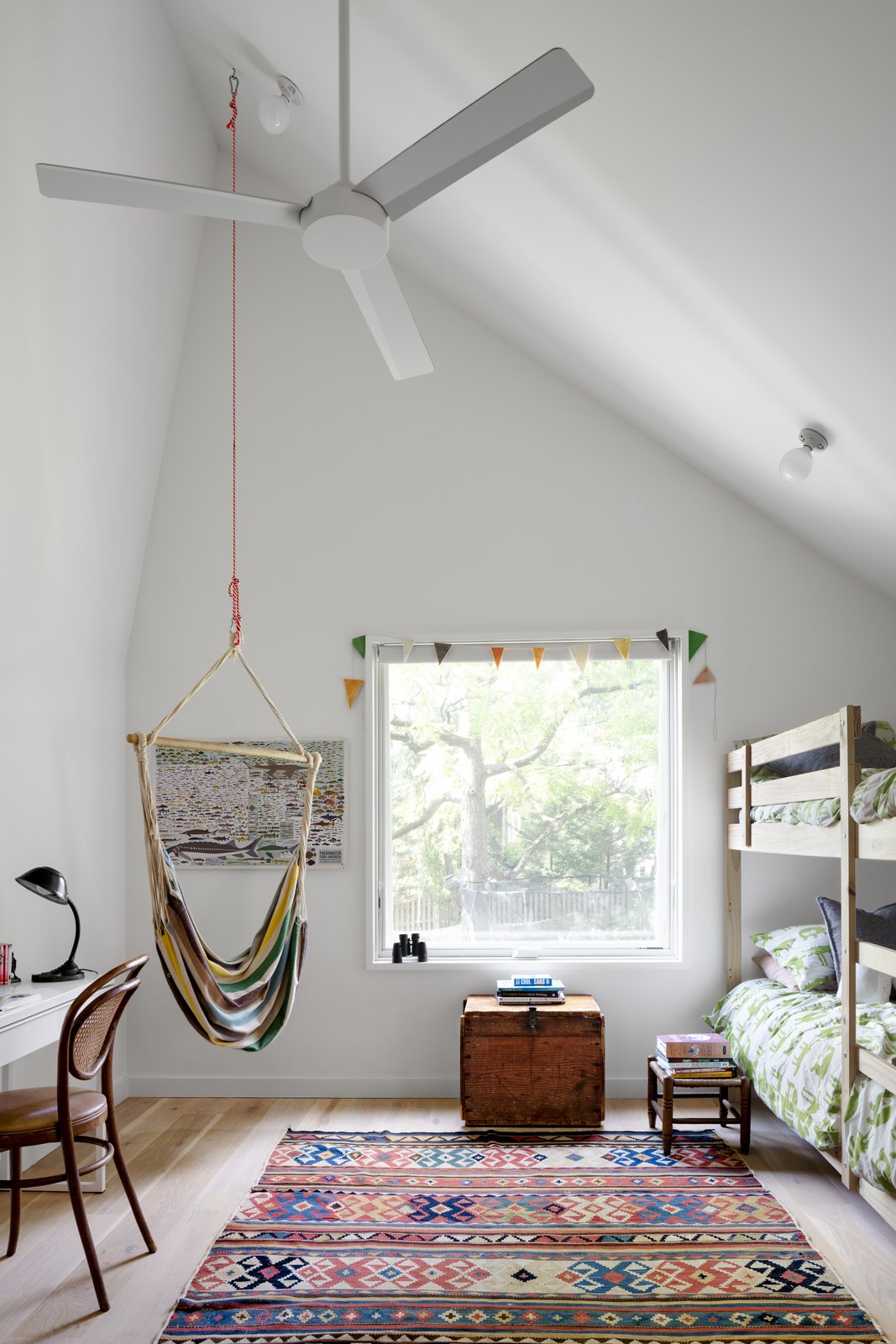
This room radiates fun because it prioritizes play over perfect order. The hammock isn’t just decor; it’s an invitation to relax, read, and swing. The colorful rug isn’t just for softness; its vibrant pattern hides spills and inspires imagination. Even the bunk bed is about more than just sleeping—it’s a fort, a castle, a spaceship. The design works because it understands what a kid’s room is for. The white slanted walls and light wood floors provide a simple, durable canvas for all the color and activity, keeping it from feeling chaotic.
|
📋 Copy HEX 🔗 Share |
To safely install a hanging hammock chair, you need to anchor it directly into a ceiling joist or a substantial beam. This is non-negotiable for safety. A room with exposed beams like the one in Idea #7 is ideal. If you have a finished ceiling, you’ll need to use a stud finder to locate a joist. For an adult to use the hammock, you’ll want at least a 3-foot radius of clear space around it, and for a kid’s room, a 4- to 5- foot radius is even better to accommodate enthusiastic swinging. This idea works best in rooms that are at least 12 by 12 feet.
19. Create a Headboard and Nightstand with a Dark Wood Accent Wall
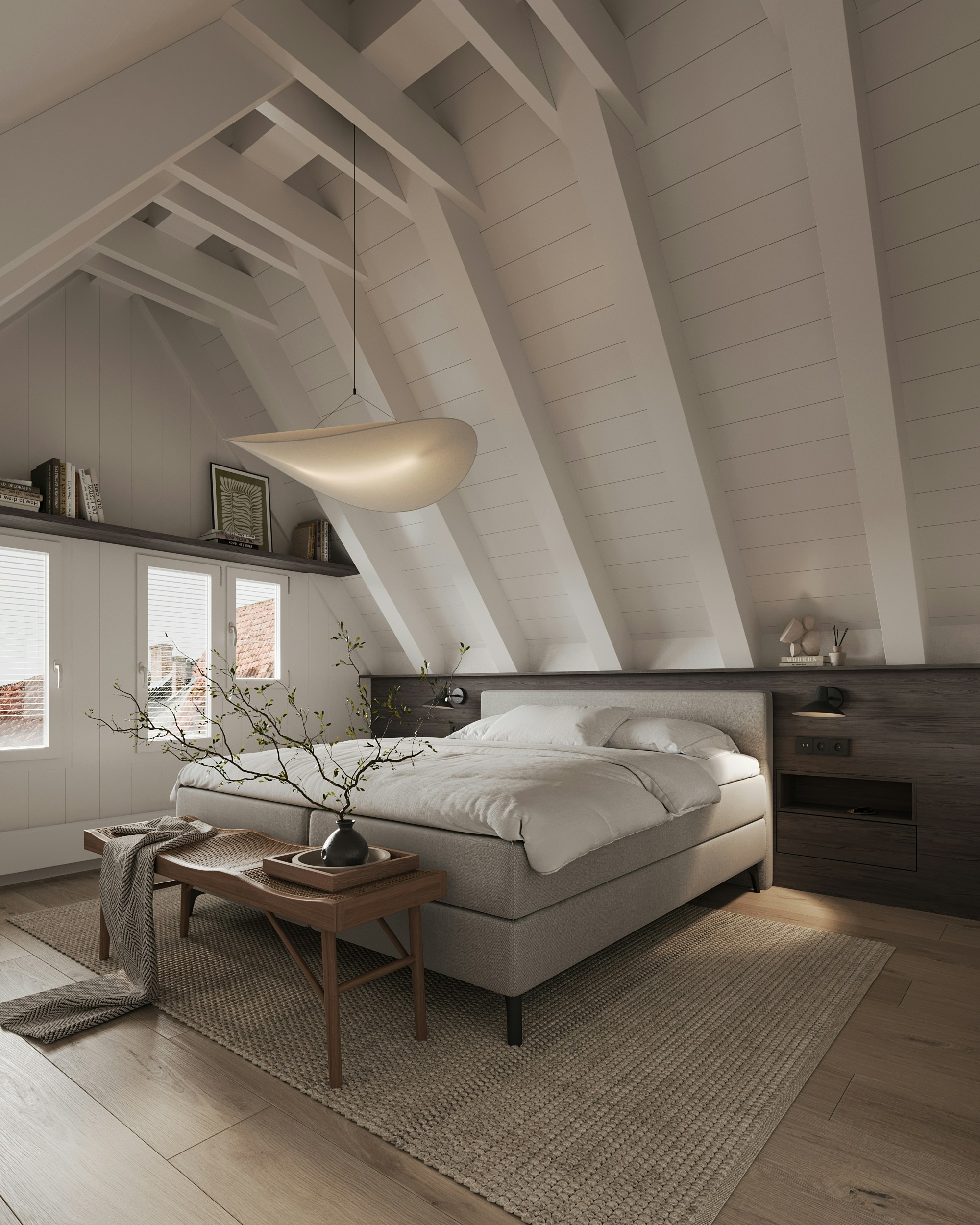
The formula for this serene, modern room is about a 3:1 ratio of light to dark. About 75% of the room—the slanted ceiling, the side walls, the rug, and the flooring—is in a light, airy palette of white and natural wood. This creates a bright, expansive feeling. The other 25% is the dramatic, dark wood accent wall behind the bed. This single, concentrated area of darkness provides a powerful focal point, grounding the bed and adding a dose of sophisticated drama without making the entire room feel heavy or small.
|
📋 Copy HEX 🔗 Share |
Integrating your nightstand into a headboard wall is a brilliant custom look, but you can fake it. To get this look for less, buy two simple, wall-mounted floating shelves that match the color of your accent wall or paint them to match. Mount them on either side of the bed at the same height as the mattress. This creates the illusion of a single, continuous, built-in piece. It gives you the same sleek, modern functionality and frees up floor space, making the room feel cleaner and more open.
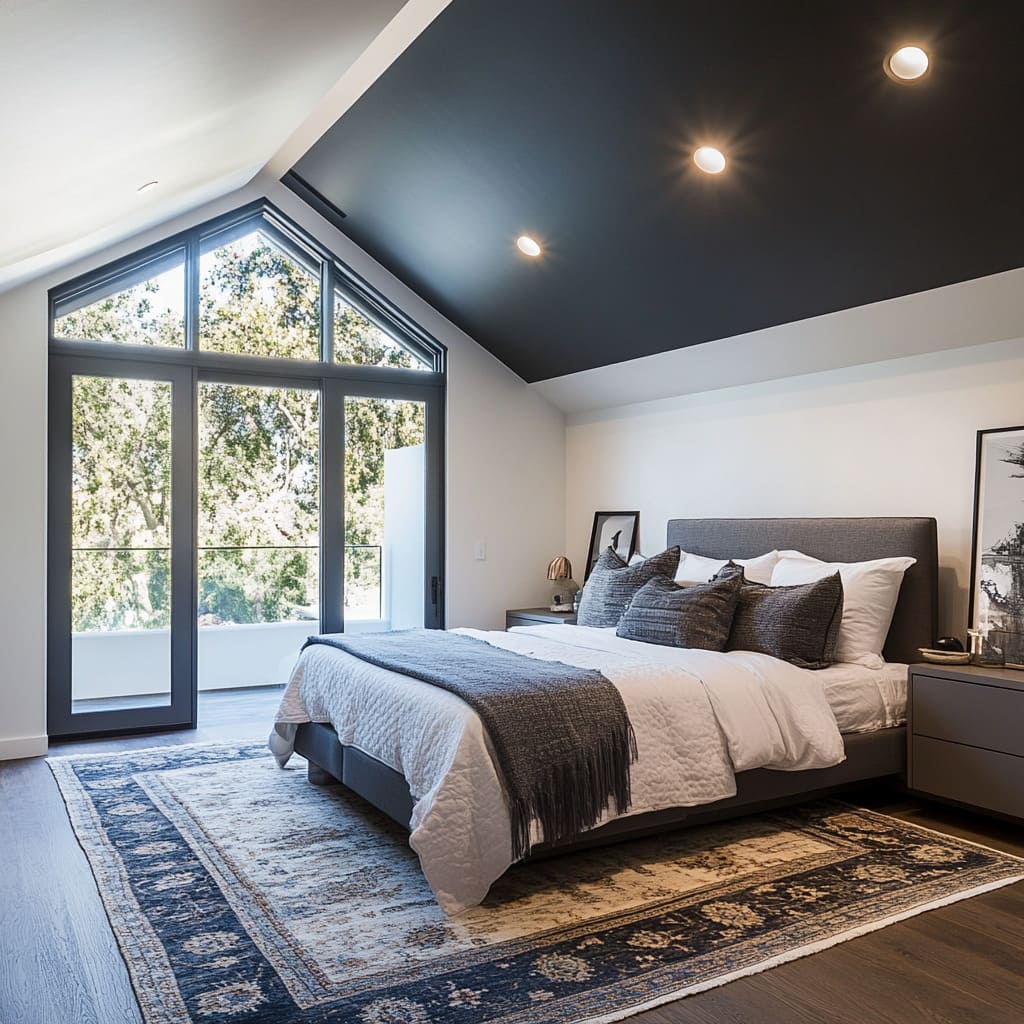
20. Go Dramatic with a Dark Ceiling and Floor-to-Ceiling Windows
A dark, dramatic ceiling is a bold design choice that can be incredibly sophisticated, but it’s not for every room or every person. This look requires high ceilings and massive windows to work. Without that flood of natural light, a dark gray ceiling will make the room feel like a cave. It can also be polarizing for resale. If you love drama and have the architecture to support it, go for it. If you’re cautious or your room is light-challenged, consider a medium gray or use the dark color on an accent wall instead.
|
📋 Copy HEX 🔗 Share |
The single element that defines this room is the floor-to-ceiling window system that follows the slant of the ceiling. It’s more than just a window; it’s a transparent wall that erases the boundary between inside and out. It’s what allows the dark ceiling to feel expansive rather than oppressive. Everything else in the room—the gray bed, the simple nightstands, the recessed lighting—is purposefully understated, designed to play a supporting role to the architectural star of the show: that incredible wall of glass.
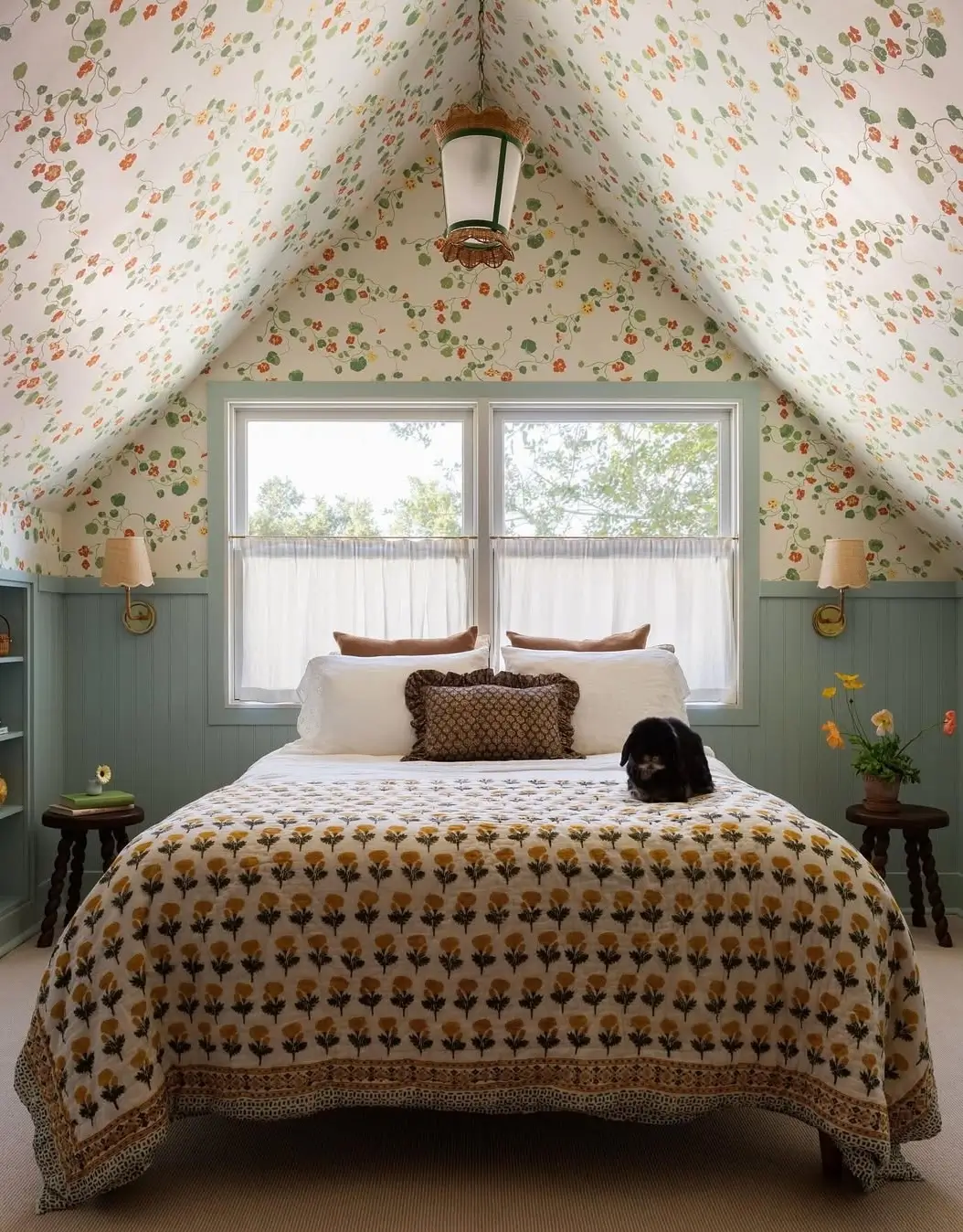
21. Mix Floral Wallpaper and Light Blue Paneling for a Cottage Feel
Getting this charming, layered cottage look requires attention to detail. The wallpaper and paneling are the biggest material costs.
|
📋 Copy HEX 🔗 Share |
- Wall Treatment (Wallpaper & Paint): $400 – $1,200
- Wood Paneling/Wainscoting (Materials & Labor): $800 – $2,500
- Lighting (Brass Sconces): $300 – $700 for a pair
- Textiles (Quilts, Curtains): $200 – $500
- Furniture (Side Tables): $300 – $800
- TOTAL: $2,000 – $5,700
Budget alternative: Find a similar floral quilt on Etsy or at a flea market. Use paintable beadboard paneling and DIY the installation to save on labor. Source vintage side tables from Facebook Marketplace and refresh them with a coat of dark paint.
This design succeeds by breaking the ‘rules’ in a smart way. Mixing multiple patterns and colors could be chaotic, but it works here for two reasons. First, the scale of the patterns is different: the floral wallpaper is dense and detailed, while the quilt has a larger, more open floral pattern. Second, the light blue paneling acts as a wide, solid ‘border’ that separates the wallpaper from the floor and grounds the entire room. It provides the eye a place to rest, preventing the patterns from clashing and creating a feeling of cheerful, organized charm instead of chaos.
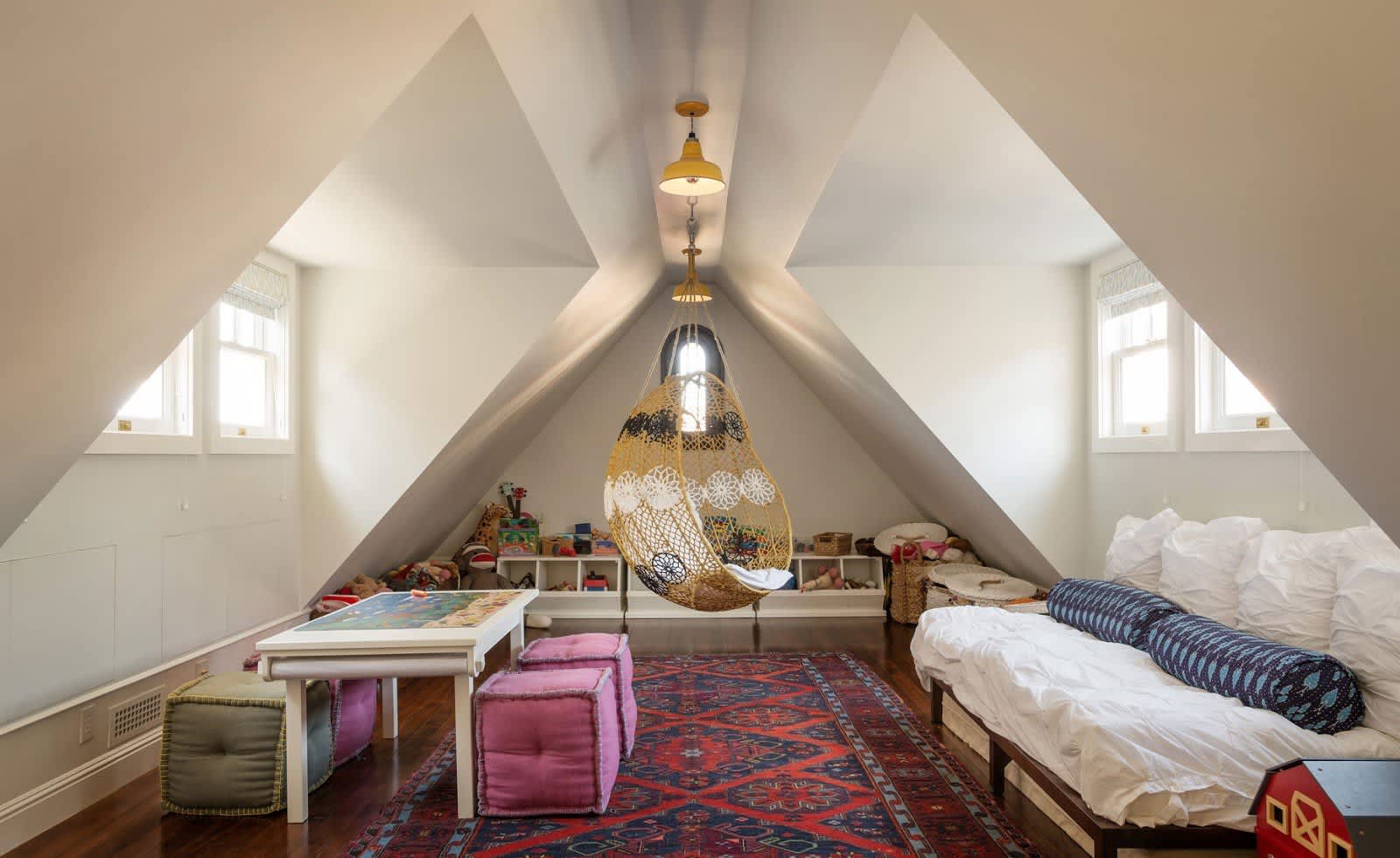
22. Design a Whimsical Attic Playroom with a Hanging Chair
This concept is tailor-made for the unique proportions of an A-frame attic. The steeply slanted ceilings naturally create a central axis, which is the perfect spot for a feature like a hanging chair. The low vertical walls are ideal for built-in shelving and low daybeds, maximizing storage and seating without encroaching on the main play area. This layout requires a room with a floor space of at least 150 square feet and a central peak height of at least 10 feet to allow clearance for the chair and pendants.
|
📋 Copy HEX 🔗 Share |
When designing a playroom under slanted ceilings, keep all the main furniture low to the ground. Notice how the table, ottomans, and daybed are all low-profile. This offers two benefits. First, it makes the ceiling feel much higher than it actually is, creating a greater sense of space. Second, it’s safer and more accessible for children. Tall, tippy furniture is a hazard in any kids’ room, but especially in one with angled walls. Going low maximizes usable space and peace of mind. Compare this layout to the adult-focused high ceilings of Idea #5.
23. Optimize a Compact Attic with a Smart Layout
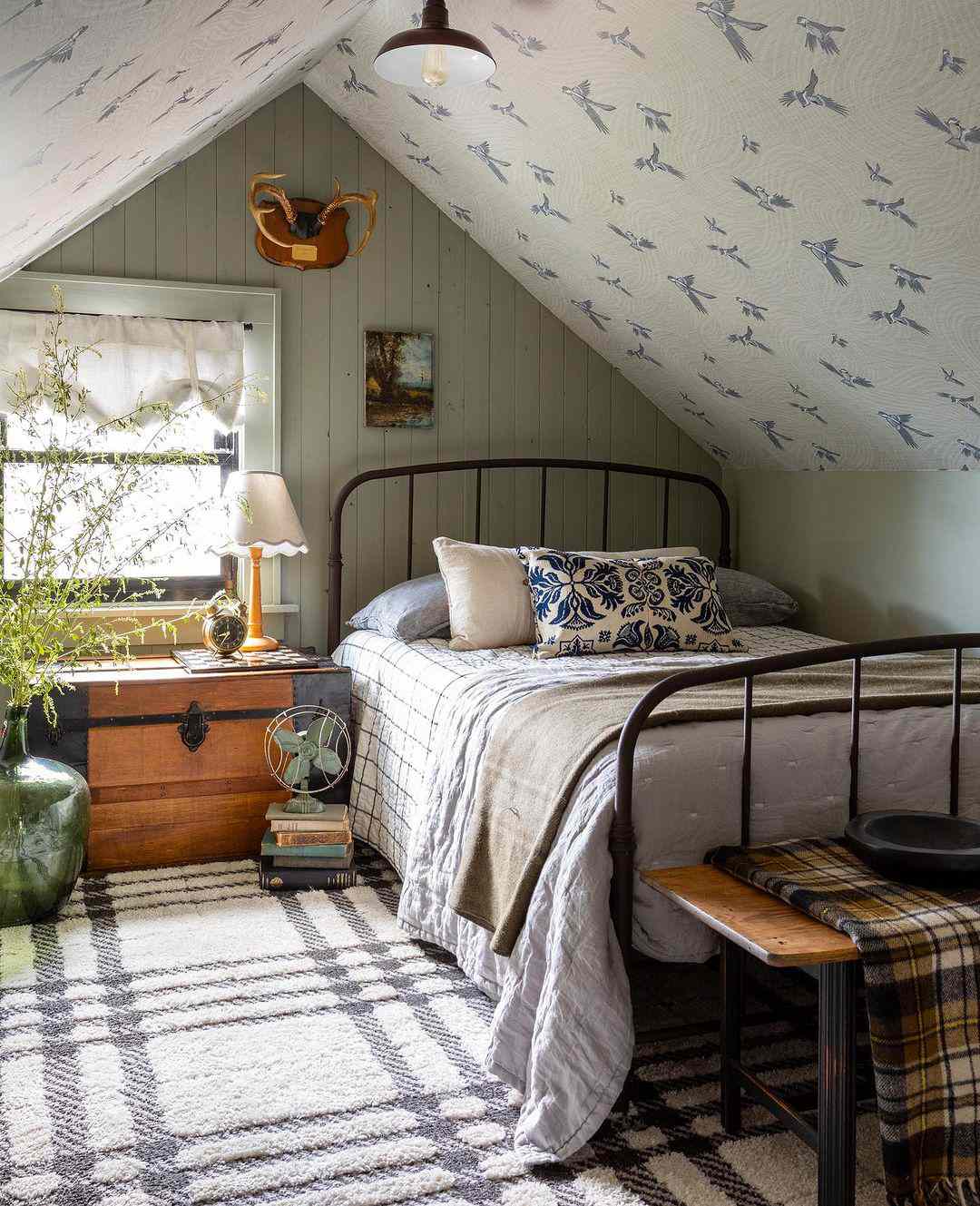
When dealing with a low or slanted ceiling, your first instinct might be to push the bed into a corner. Resist! For the most efficient and comfortable layout, place the head of the bed against the lowest wall. This places your head in the lowest-clearance area (where you’re lying down anyway) and leaves the taller parts of the room free for standing, walking, and placing other furniture like dressers or a small desk. This single move can make a small, awkward attic room feel surprisingly spacious and functional.
|
📋 Copy HEX 🔗 Share |
Let’s be honest: a room with a very low ceiling will never feel vast and open, and that’s okay. Instead of fighting it, lean into the coziness. Use warm colors, soft textiles, and layered lighting to make it feel like an intentional, comforting cocoon. However, be mindful of head-banging potential. If the ceiling is low over the main path into the room, this layout may not work. Furthermore, making the bed can be a bit more of a chore when the head is tucked under an eave, so be prepared for a little extra maneuvering.
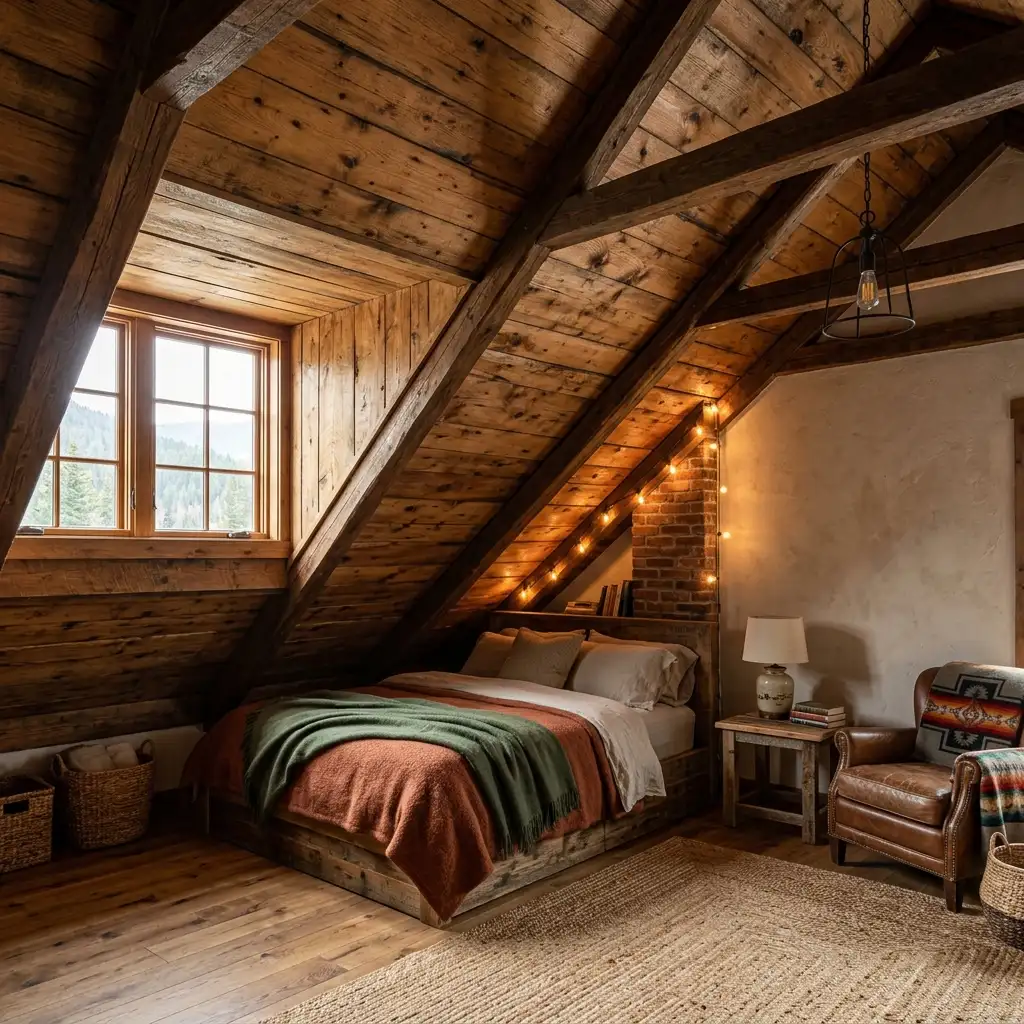
24. Layer a Brick Wall with Wood Planks and String Lights
The element that infuses this rustic room with a sense of magic is the string lights draped over the exposed brick wall. The wood planks and beams provide a heavy, cabin-like foundation. The brick adds gritty, industrial texture. But the delicate, warm glow of the fairy lights softens everything. It’s an effortless, inexpensive addition that completely changes the mood, transforming the space from just a rustic room into a cozy, romantic, and slightly whimsical hideaway. It proves that sometimes the smallest touches have the greatest impact.
|
📋 Copy HEX 🔗 Share |
Exposed brick and raw wood can be a haven for dust and cobwebs. A monthly vacuuming with a brush attachment is essential for both the brick and the wood-paneled walls and ceiling. Be aware that unsealed brick can sometimes shed a fine red dust. If the dust becomes an issue, you can apply a clear matte sealant to the brick wall to contain it. The rough wood beams are also prime real estate for spiders, so keep an eye out. This look is high on character but also requires a bit more diligent cleaning than a standard drywall room.
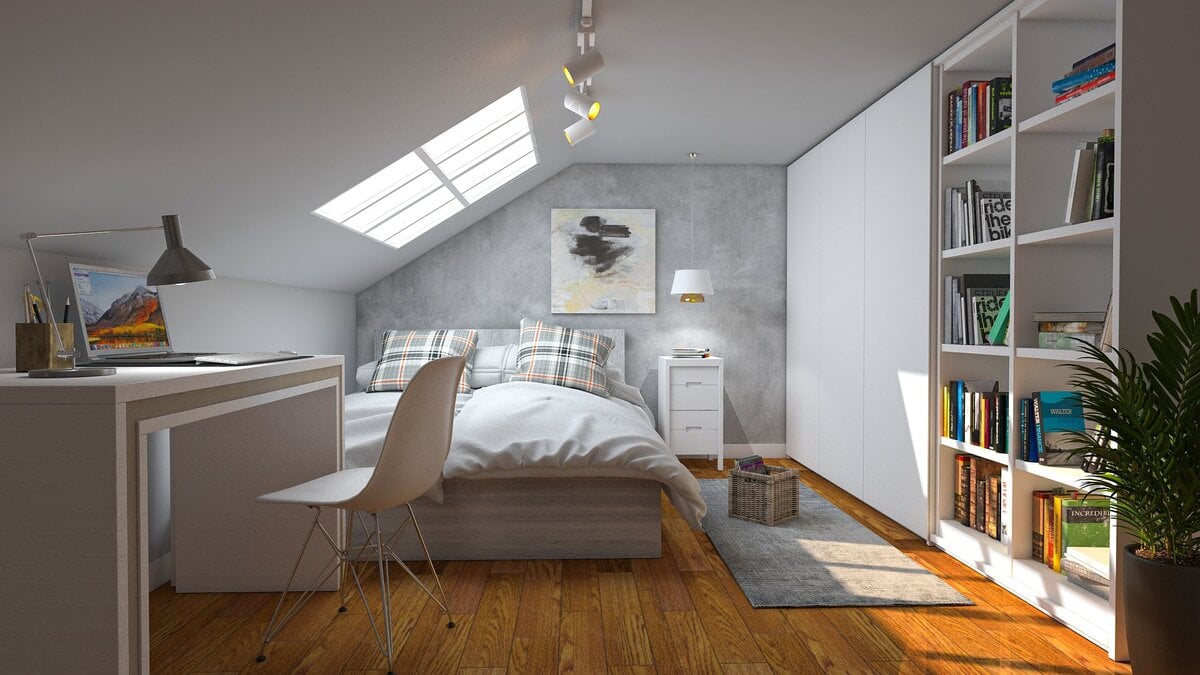
25. Integrate a Desk and Wardrobe in a Modern Loft
You can get the look of a high-end concrete wall with a specialty paint kit or by applying a thin layer of feather-finish concrete. Time Estimate: 5-7 hours (including drying time). Material Cost: $75 – $150.
- Start by protecting your floors and taping off the edges of the wall.
- If using a feather-finish product like Ardex, mix the powder with water to a pancake-batter consistency.
- Apply a thin, uneven layer to the wall with a trowel or a large putty knife. Don’t aim for perfection; variations create the texture.
- Let it dry for a few hours, then use a sander to knock down any rough spots.
- Apply a second, thinner coat to fill in gaps and add depth.
- Once fully dry, seal it with a matte concrete sealer.
|
📋 Copy HEX 🔗 Share |
This room is a masterclass in ‘zoning’ an open space with varied textures and built-ins. The concrete accent wall clearly defines the sleeping zone. The wall of seamless, floor-to-ceiling white wardrobes creates a dedicated ‘dressing zone’ that feels clean and uncluttered. Finally, the built-in desk neatly carves out a ‘work zone’ under the eaves, making smart use of the lower-clearance area. Even though it’s one room, these distinct zones make it feel organized, multi-functional, and intentionally designed.
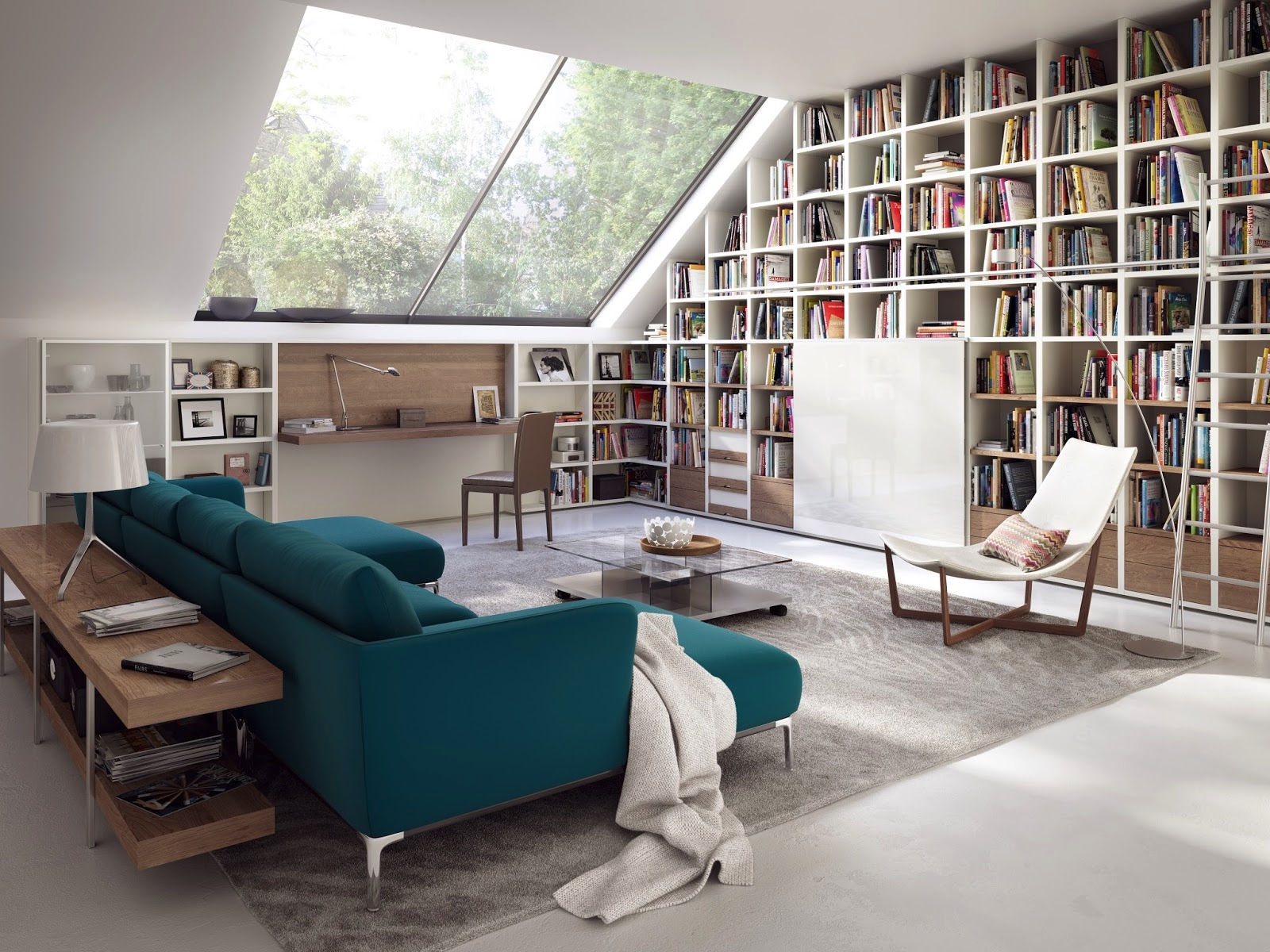
26. Combine a Home Library and Desk Under a Slanted Skylight
This bright, functional space follows a clear formula: 70% neutral architecture + 20% statement furniture + 10% curated objects. The wall-to-wall white shelving, light wood desk, and white walls form a quiet, neutral canvas, letting the massive skylight do the heavy lifting. The bold teal sofa is the 20%—a confident splash of color that anchors the entire seating area. The final 10% is in the details: the carefully arranged books, the sculptural sling chair, and the textured rug. This shows you only need one or two great pieces to bring a neutral space to life.
|
📋 Copy HEX 🔗 Share |
This look is inspiring, but it requires serious planning. Don’t even start before you check these items off your list:
- Measure Everything: Wall-to-wall shelving requires precise measurements. Measure the wall width at the top, middle, and bottom, as old walls are rarely perfectly square.
- Confirm Joist Location: If you’re installing a large, heavy skylight, an engineer or experienced contractor needs to confirm your roof structure can support it.
- Budget for Custom: Off-the-shelf shelving will not fit a slanted wall design perfectly. Budget for custom cabinetry or a high-end modular system like the IKEA PAX system with some clever custom trim work.
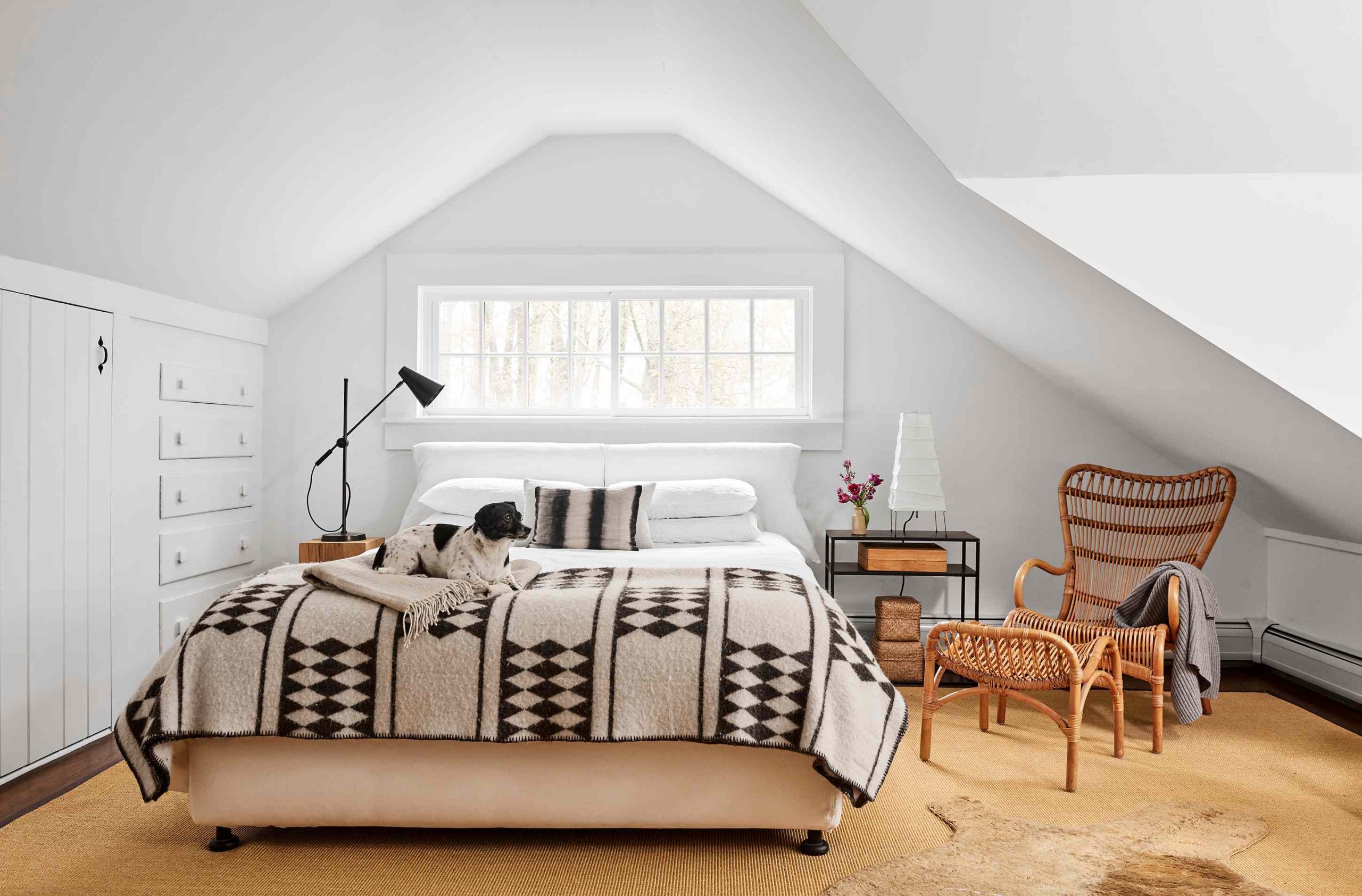
27. Use a Bold Patterned Blanket in a Minimal White Attic
This entire look is incredibly achievable on a tight budget. The key is to start with a simple, inexpensive canvas: white paint. It’s the cheapest, most effective way to make a small attic feel bright and open. A simple platform bed frame can be found for under $200 at places like Walmart or on Amazon. The real personality comes from the accessories. Hunt for a unique, graphic throw blanket and a wicker or rattan chair at places like Target, HomeGoods, or even a local thrift store. The beauty of this design is that one or two striking pieces can carry the entire room.
|
📋 Copy HEX 🔗 Share |
When working with an all-white room, texture is your best friend. But you also need one element of ‘visual punctuation’ to keep it from looking bland. In this case, it’s the black-and-white patterned throw blanket. It’s the loudest thing in the room, and it immediately draws your eye, creating a clear focal point. Without it, the room would still be lovely, but it wouldn’t have the same confidence. In a minimalist space, when in doubt, add one bold, graphic textile.
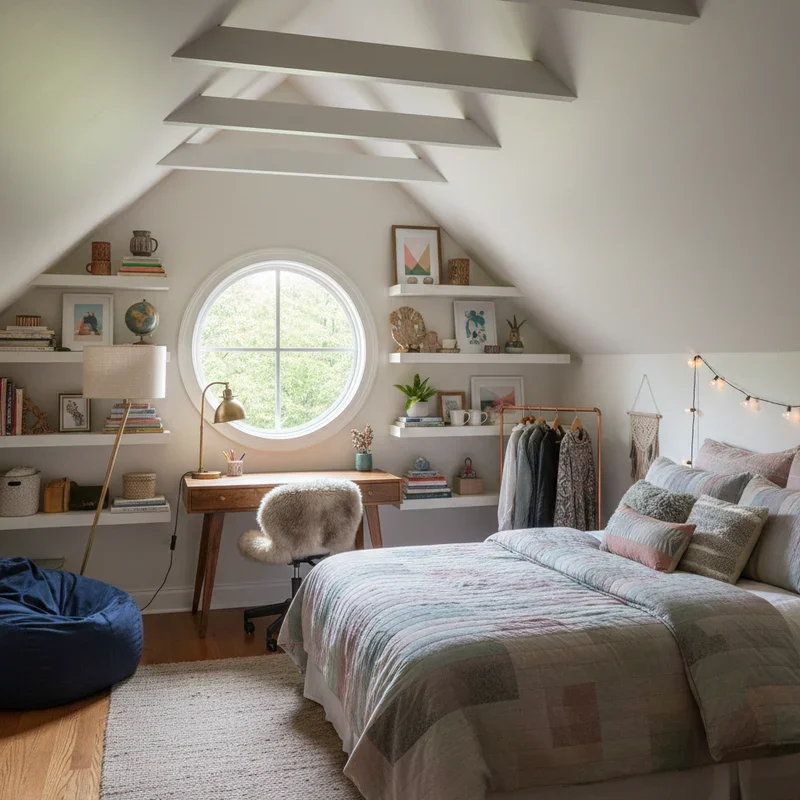
28. Frame a Central Round Window with Built-in Shelving
The round window is undeniably the hero of this attic bedroom. A standard rectangular window would have been fine, but the circular shape transforms the room from a simple bedroom into a whimsical, storybook-like space. It feels special and custom. Placing it at the peak of the wall and surrounding it with shelves turns the entire wall into a beautiful and functional focal point. It’s a perfect example of how a single, thoughtful architectural choice can define the personality of an entire room.
|
📋 Copy HEX 🔗 Share |
This clever use of built-in shelving and a central window works best on a wall that is at least 10 feet wide. This allows for a decent-sized window (3-4 feet in diameter) while still leaving enough room on either side for functional shelving (at least 3 feet on each side). The slant of the ceiling should be gradual enough to allow for several rows of shelves. This idea is all about creating a sense of symmetry and purpose on a single, dominant wall. For a more asymmetrical approach, look at Idea #6.
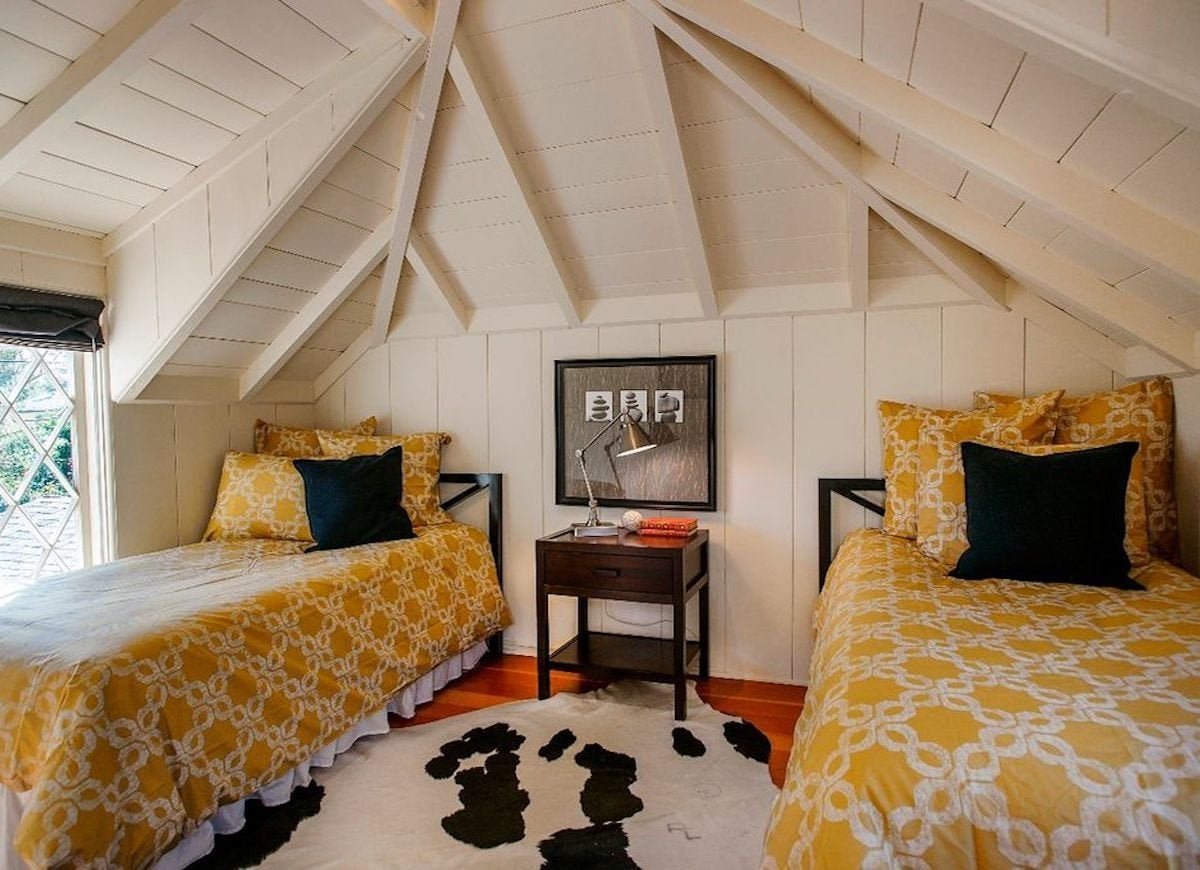
29. Install White Board and Batten on Slanted Twin Room Walls
Applying board and batten to a slanted wall adds incredible architectural detail. Time Estimate: 1-2 weekends. Material Cost: $200 – $500.
- First, plan your layout. Decide on the spacing for your vertical boards (the ‘battens’), which are typically 16-24 inches apart.
- Install the top horizontal board and any mid-rails. On a slanted wall, you’ll need to use a miter saw to cut precise angles where the boards meet the ceiling or other walls.
- Once the horizontal boards are level and nailed into studs, measure and cut your vertical battens to fit snugly between them.
- Nail the battens in place.
- Caulk all the seams and fill the nail holes with wood filler.
- Sand everything smooth, then prime and paint. A paint sprayer will give you the smoothest finish.
|
📋 Copy HEX 🔗 Share |
This shared bedroom feels cohesive and energetic because of its smart use of repetition and contrast. The strong vertical and horizontal lines of the white board and batten repeat in the exposed ceiling beams, creating a satisfying architectural rhythm. This crisp, white structure provides the perfect backdrop for the high-contrast elements: the pop of yellow in the bedding against the dark blue pillows and the dark wood of the nightstand standing out against the white walls. It feels both orderly and full of personality.
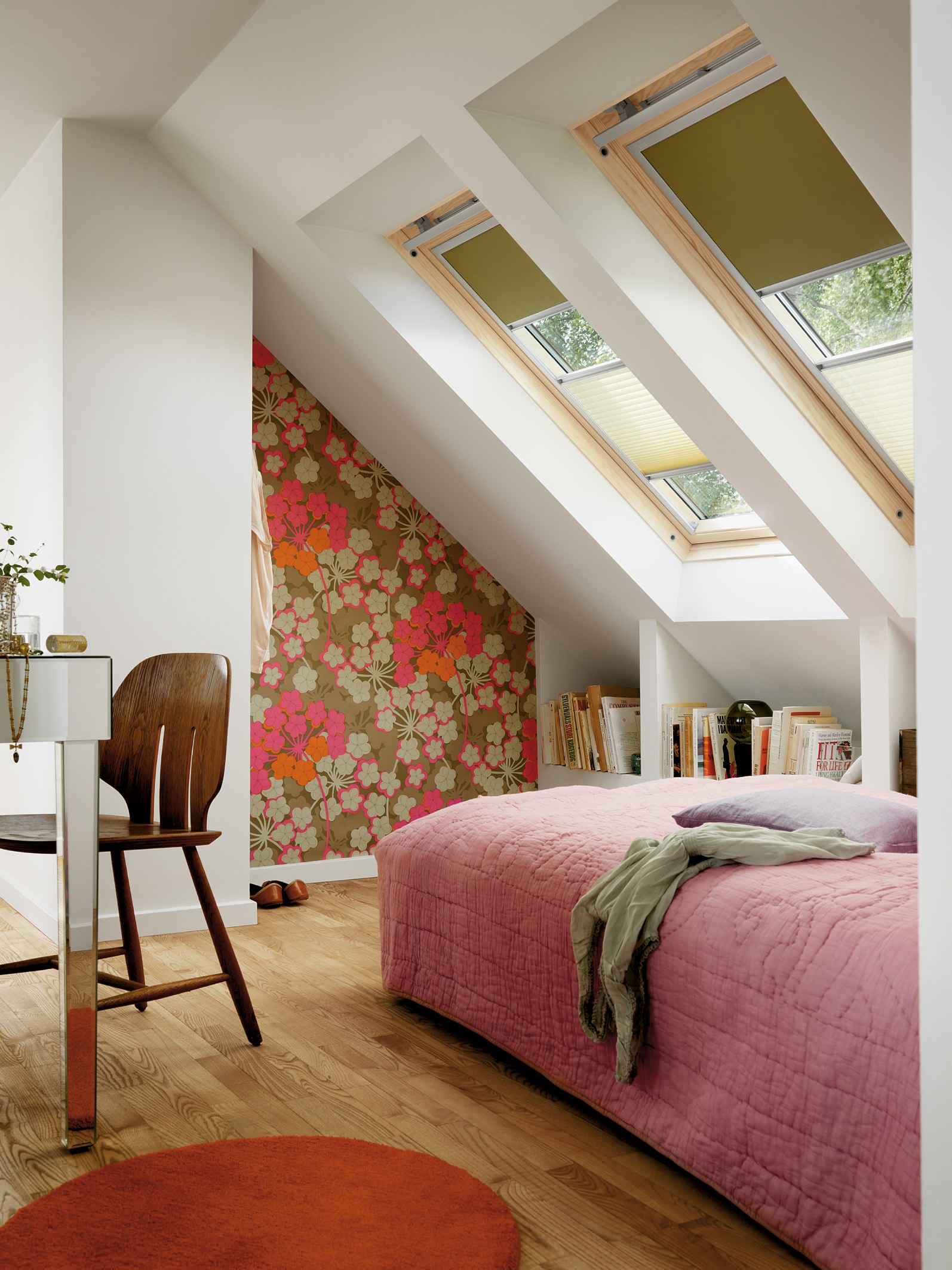
30. Use Floral Wallpaper as an Accent Behind a Bed
This room’s charm comes from a simple recipe: 70% calm neutrals + 30% bold pattern. The majority of the room—the white slanted ceiling, the light wood floors, and the white bedding—is serene and simple. This creates a calm base that can handle a strong statement. The floral wallpaper, contained to just one accent wall, provides that 30% of ‘wow.’ The bright pink bedspread then picks up on the colors in the wallpaper, tying the whole look together. It’s proof that you don’t need to wallpaper a whole room to make a giant impact.
|
📋 Copy HEX 🔗 Share |
Living with skylights is wonderful for natural light but can be a pain for sleeping in. If you’re a light sleeper, investing in good blinds is a must. The green blinds here are a remarkable example of turning a functional necessity into a design element that complements the wallpaper. Furthermore, be aware that skylights, especially older models, can be a source of heat gain in the summer and heat loss in the winter. High-quality, insulated blinds can help mitigate these issues and lower your energy bills.
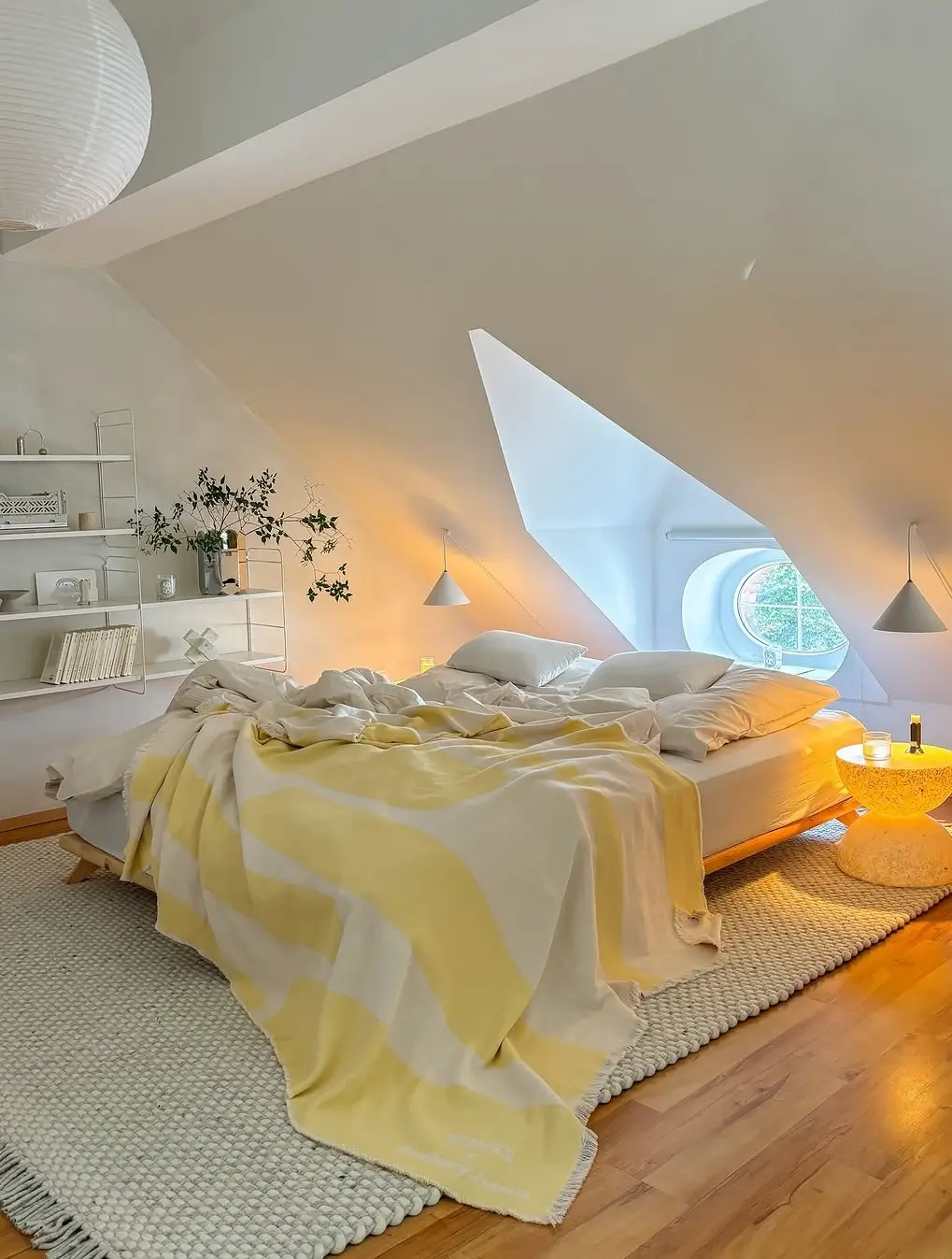
31. Incorporate a Round Window and Yellow Striped Bedding
When you have unique architectural details like a triangular skylight and a round window, keep the rest of the decor simple. The temptation is to add more ‘interesting’ things to the room, but that only creates visual noise. Notice how the walls are plain white, the pendant lights are simple white cones, and the rug is a neutral solid color. This approach allows the unique shapes of the windows to be the stars of the show. Your architecture is the art; the decor should simply serve as a quiet, comfortable supporting cast.
|
📋 Copy HEX 🔗 Share |
The single element that fills this room with joy is the yellow and white striped blanket. The room’s architecture is modern and clean, with a lot of white and light wood. It’s beautiful but could feel a bit sterile. That one splash of sunny, optimistic yellow entirely changes the room’s personality. It adds warmth, energy, and a sense of welcome. If you were to swap it for a plain white or gray blanket, the room would instantly feel more serious and less inviting. It’s a powerful lesson in the impact of a single, vibrant color.
Conclusion
Those tricky angles and low ceilings aren’t a problem—they’re an opportunity to create a truly unique and personal space. We hope these 31 ideas have sparked some inspiration for your own cozy retreat. The most beautiful rooms embrace their quirks, and a slanted ceiling is a powerful one to have.
Now go create a bedroom you can’t wait to come home to, and please remember to show it off on Pinterest!