
You know that feeling when you finally find the deck color that looks exactly right for your space? That perfect shade that pulls the whole backyard together and makes you want to live outside all summer? It feels like unlocking a secret level of homeownership. This isn’t just about slapping on a coat of paint; it’s about creating a true extension of your home.
We get it. That’s why we went deep, curating 26 distinct deck color and style ideas that actually work for real American homes. You’ll find everything from ultra-modern composite decks with sleek cable railings to timeless natural wood porches perfect for a set of rocking chairs. And stay until the end—we break down the most common mistakes that can ruin these looks. This article may contain affiliate links, which means we may earn a commission if you make a purchase.
📌 Save this to Pinterest for later—you’ll want to revisit these ideas.
1. Gray Composite Deck with Integrated Stone Planters
This design succeeds by playing with texture and permanence. The smooth, clean lines of the light grey composite decking create a modern, low-maintenance foundation. This is then beautifully contrasted by the rough, organic texture of the multi-toned stacked stone used for the planters. This juxtaposition makes both materials feel more intentional and visually interesting. The neutral palette allows the vibrant green of the lawn and trees to become the primary ‘color’ in the scene, creating a calm and sophisticated outdoor room.
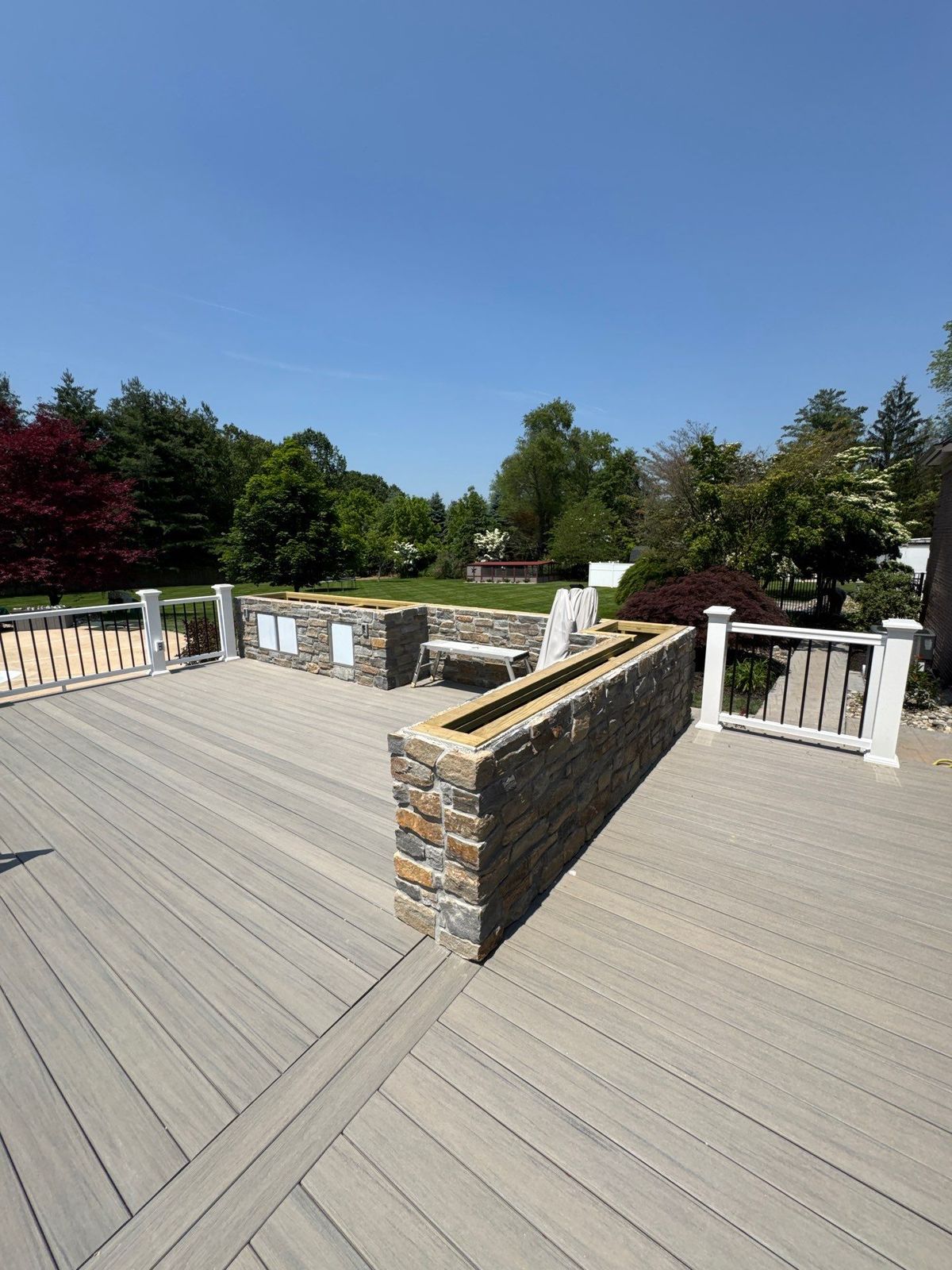
When designing a deck with integrated features like planters or benches, think about electrical access from the start. It’s dramatically cheaper to run low-voltage wiring for landscape lighting or outlets for charging phones before the deck boards go down. Ask your contractor to install conduit (a protective plastic pipe) to key locations, even if you don’t plan to add lights immediately. A 1/2-inch conduit is usually sufficient and gives you the flexibility to add features later without tearing everything apart.
2. Grey Deck with a Black Pergola and Vibrant Orange Accents
This look follows a classic design formula: 80% neutral, 20% pop. The grey composite deck and the bold black pergola create a strong, modern, and versatile base. This neutral canvas accounts for about 80% of the visual space. The magic happens with the remaining 20%, delivered here by the vibrant orange cushions. This calculated burst of color brings energy and personality without overwhelming the serene setting. You could easily swap the orange for a bright turquoise, lime green, or sunny yellow to completely change the mood while keeping the core structure intact.
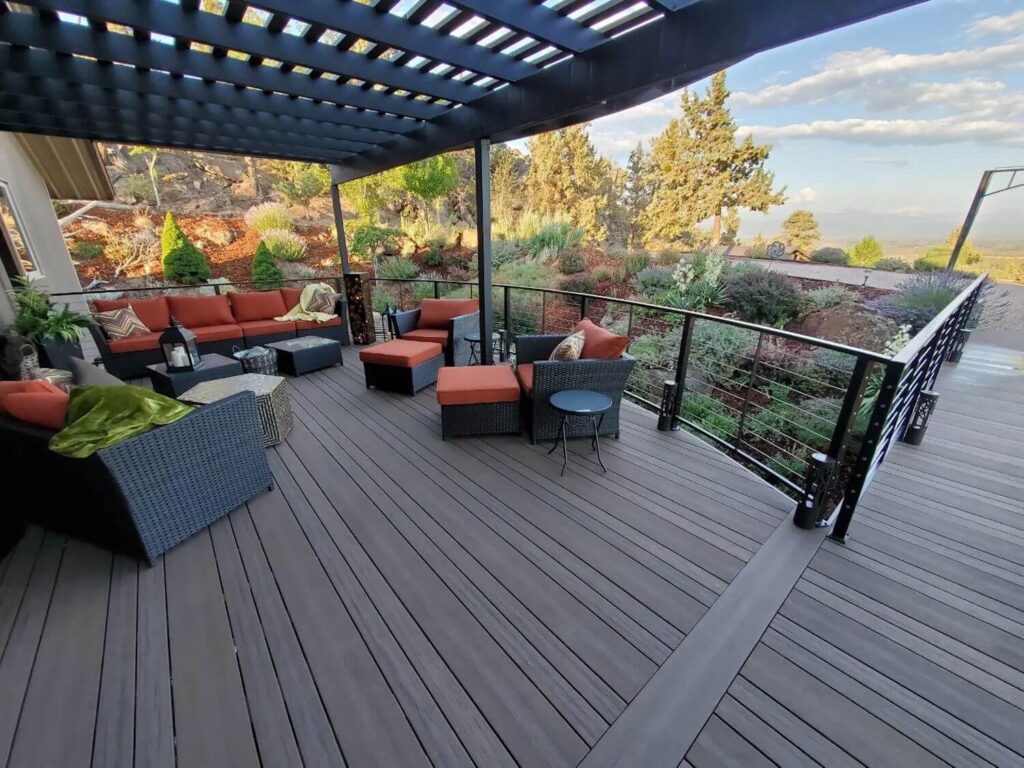
Let’s be honest about those gorgeous, vibrant cushions. If your deck gets a lot of direct sunlight, fabrics will fade. Even high-performance outdoor fabrics with UV-resistant coatings have a lifespan. To keep that orange looking punchy and not like a sad, washed-out peach, you’ll need to be diligent. Plan on storing the cushions in a deck box or bringing them inside when not in use. It’s a small hassle, but it will double or triple the life of their color.
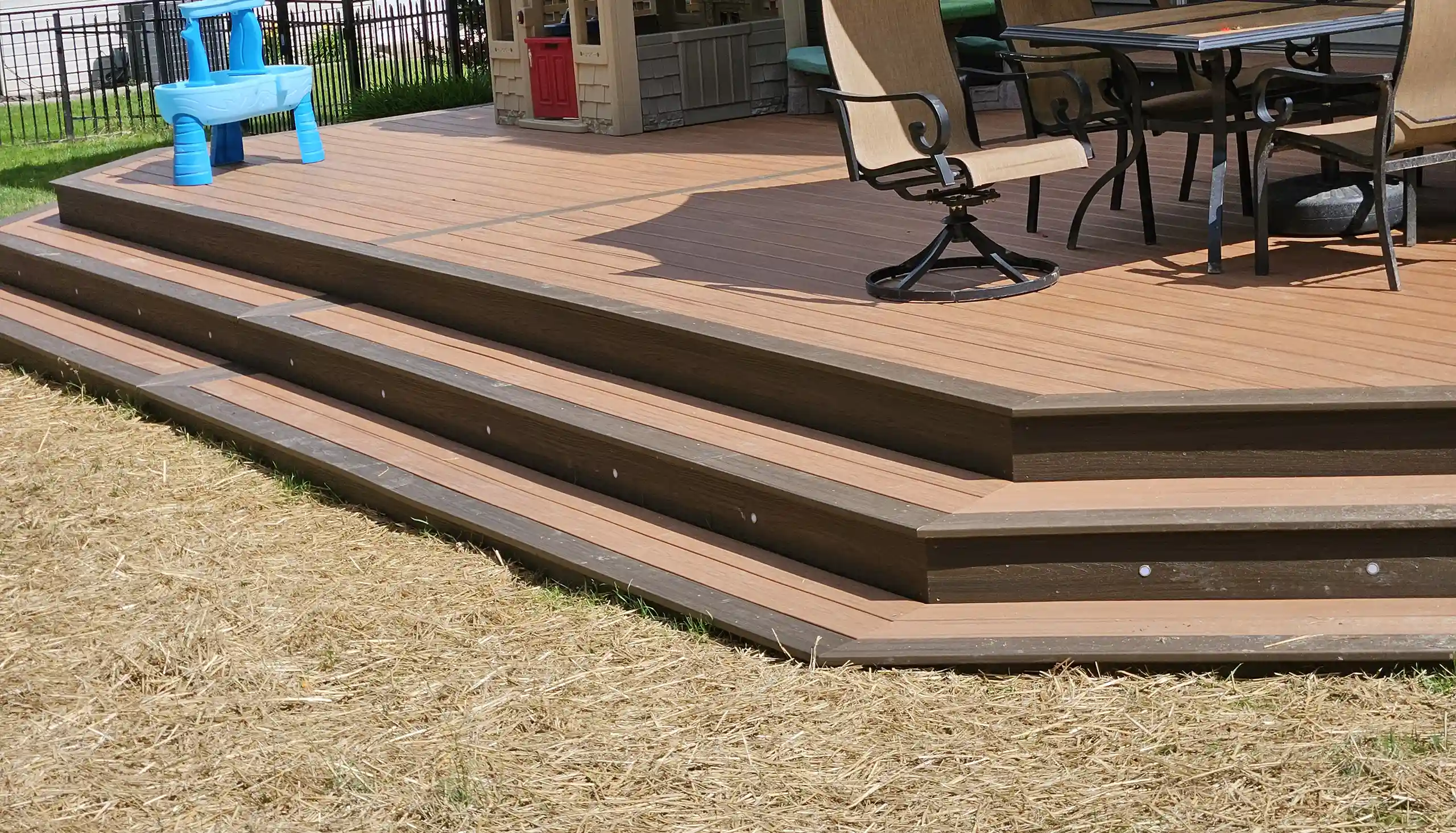
3. Light Gray Deck with Dark Brown Wood-Tone Trim
The single element that makes this deck work is the dark brown ‘picture frame’ border. Without it, you’d have a perfectly nice, but standard, light gray deck. The dark trim accomplishes three things: it adds a crisp, finished edge; it introduces a warm, wood-like tone that adds depth and richness; and it defines the deck’s shape, especially the integrated benches and stairs. This two-tone approach elevates the entire design from basic to custom-designed. It’s a detail that shows real thought went into the composition. Compare this composite version to the stained wood look in Idea #6.
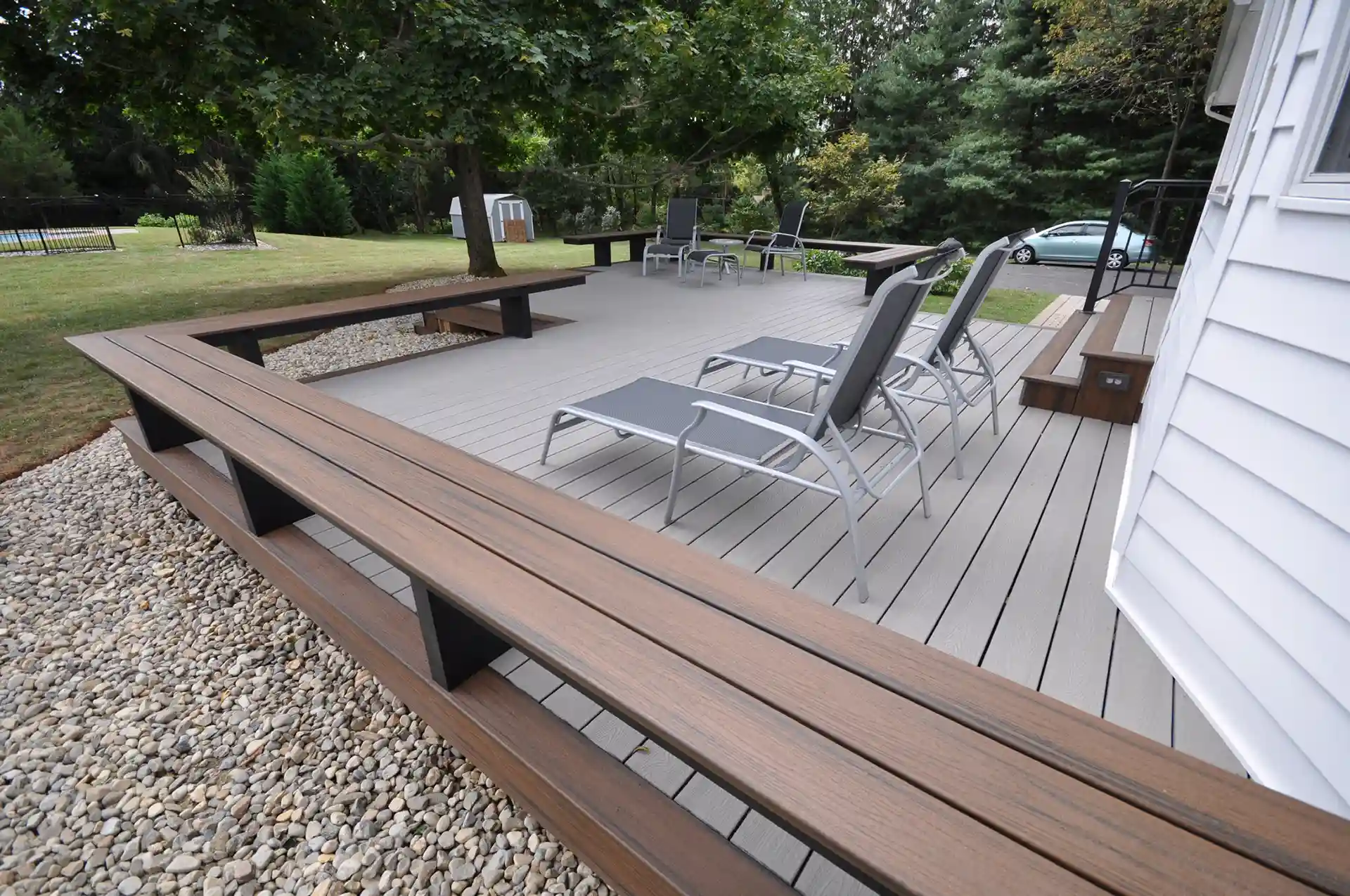
A two-tone composite deck is a premium feature, but you can get this high-contrast look for a fraction of the cost on a traditional wood deck. If you’re working with pressure-treated pine, start with a solid-color stain in a light gray for the main deck boards. For the border and stair risers, use a deep, semi-transparent stain in a rich brown like ‘Cordovan’ or ‘Walnut.’ The materials might cost you $300-$500 in quality stain, versus the thousands extra for two-tone composite materials and the associated labor.
4. Reflective Reddish-Brown Deck with a Black Metal Railing
A rich, reddish-brown wood deck like this is stunning, but it demands commitment. That deep, wet-look color comes from a quality oil-based, semi-transparent stain. To keep it from fading to a sad, splintery gray, you need to clean and re-stain it every 2-3 years, depending on your climate and sun exposure. The annual cost is just a scrub brush and deck cleaner, but the re-staining project is a full weekend of work and about $200-400 in materials for a medium-sized deck. If you neglect it, the wood fibers will break down, and you’ll need to do a much more intensive sanding job to restore it.
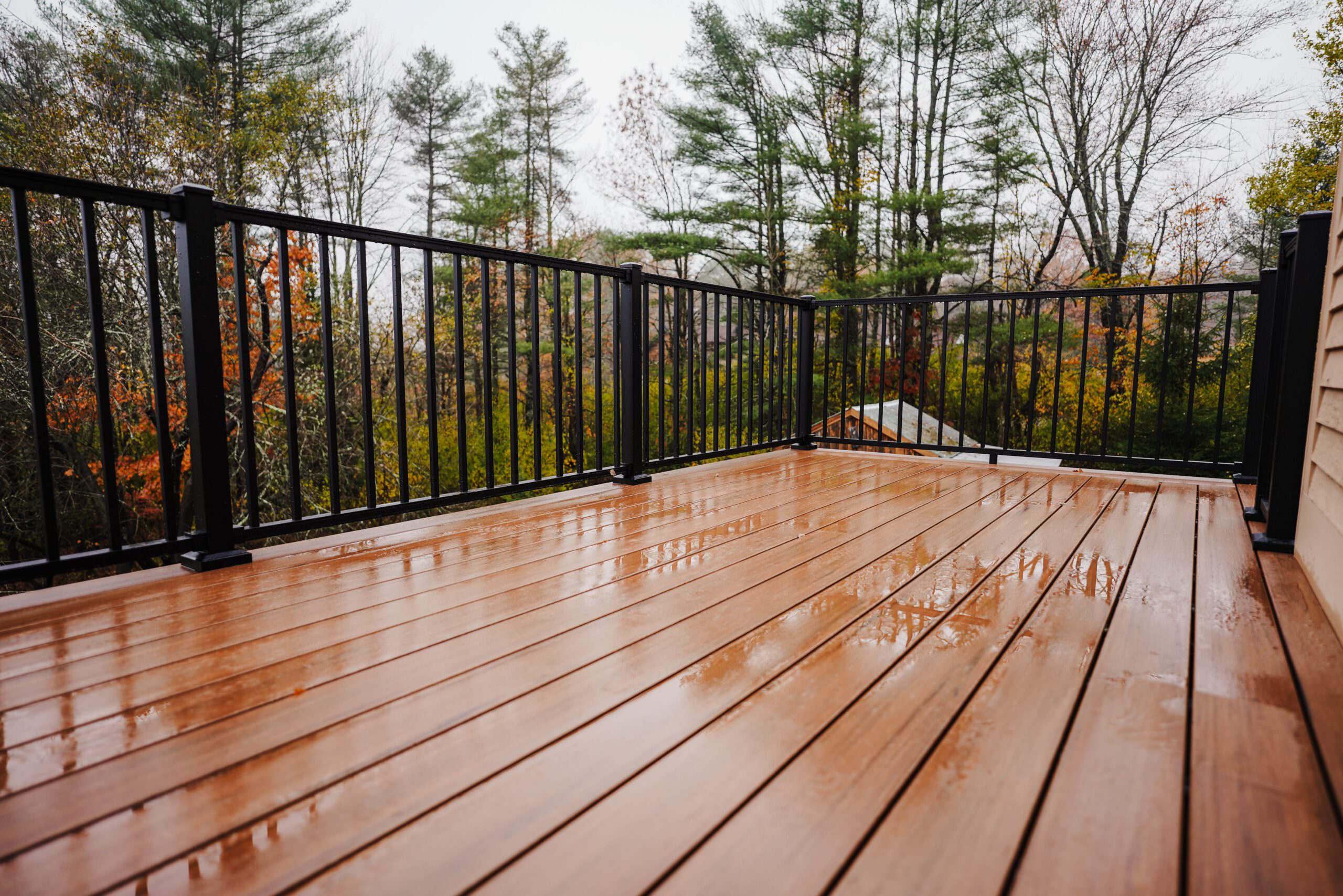
This design is a masterclass in balance. The deck boards themselves are visually busy, with warm, reddish-brown tones and natural grain patterns. The railing’s job is to provide safety without adding to the noise. By choosing a simple, slender black metal railing, the design grounds the entire space. The black provides a strong, graphic outline that contains the warmth of the wood and complements the green foliage in the background without competing for attention. It’s confident, simple, and lets the wood be the star.
5. Light Grey Deck with a Diagonal Layout and Dark Trim
Laying a ‘picture frame’ border is a pro move that makes any deck look more finished. Here’s a quick guide for adding a dark border to a light main field. Estimated time: Adds 4-6 hours to a standard deck build. Material cost: Price of the contrasting boards.
- First, build the deck’s frame as usual.
- Install your two or three rows of dark border boards around the entire perimeter of the frame. Let them hang over the edge slightly.
- Install all of the interior light-colored boards, cutting them to fit snugly inside the border.
- Once all boards are fastened, use a circular saw with a straight-edge guide to trim the overhanging border boards for a perfectly clean, flush edge.
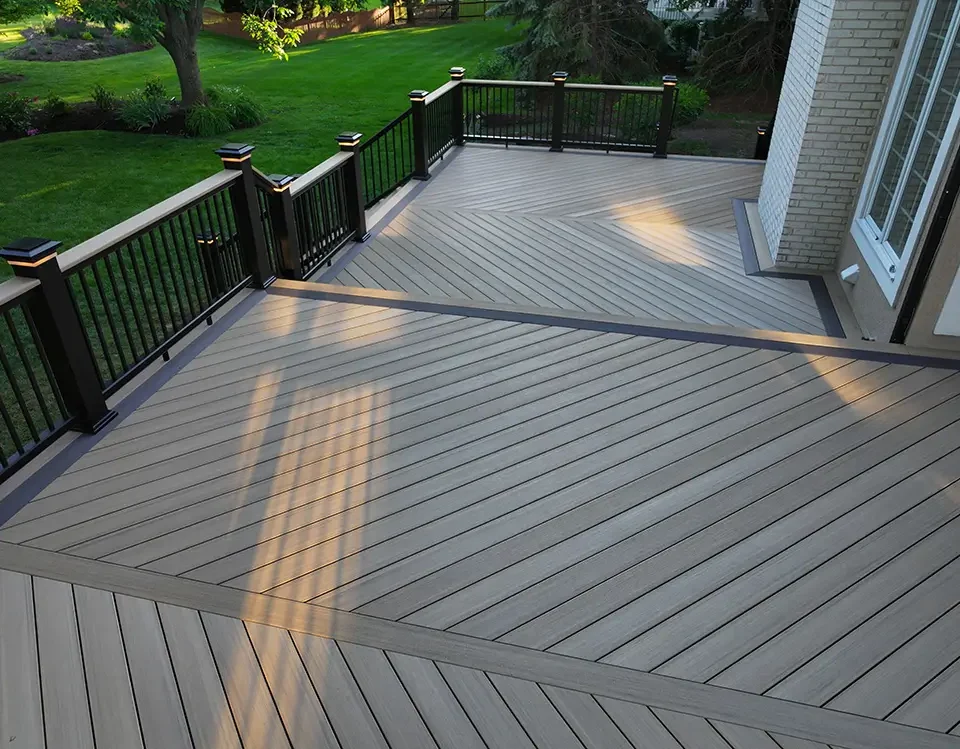
A diagonal board pattern is a fantastic way to add custom flair, but it works best on decks that are at least 12×12 feet. On a smaller deck, the diagonal lines can feel cramped and make the space look even smaller and busier. This idea is ideal for larger, more squarish decks where the 45-degree angle has room to create a sense of movement and visual interest. For long, narrow decks (like 8×20 feet), running the boards perpendicular to the house is usually the best choice to make the space feel wider.
6. Sunlit Natural Hardwood Deck with Dark Wood and Metal Railing
Mixing wood stains can be tricky, but the key is to choose colors with a shared undertone and significant contrast. Here, the deck boards are a warm, reddish-brown. The railing posts and top rail are a much darker, almost espresso-colored brown, but they still carry a hint of warmth. This creates a sophisticated, layered look, not a mismatched mess. A good rule of thumb: your secondary stain color should be at least three shades darker or lighter than your primary color on a sample card. Avoid pairing a warm stain (like cedar) with a cool, ashy gray stain.
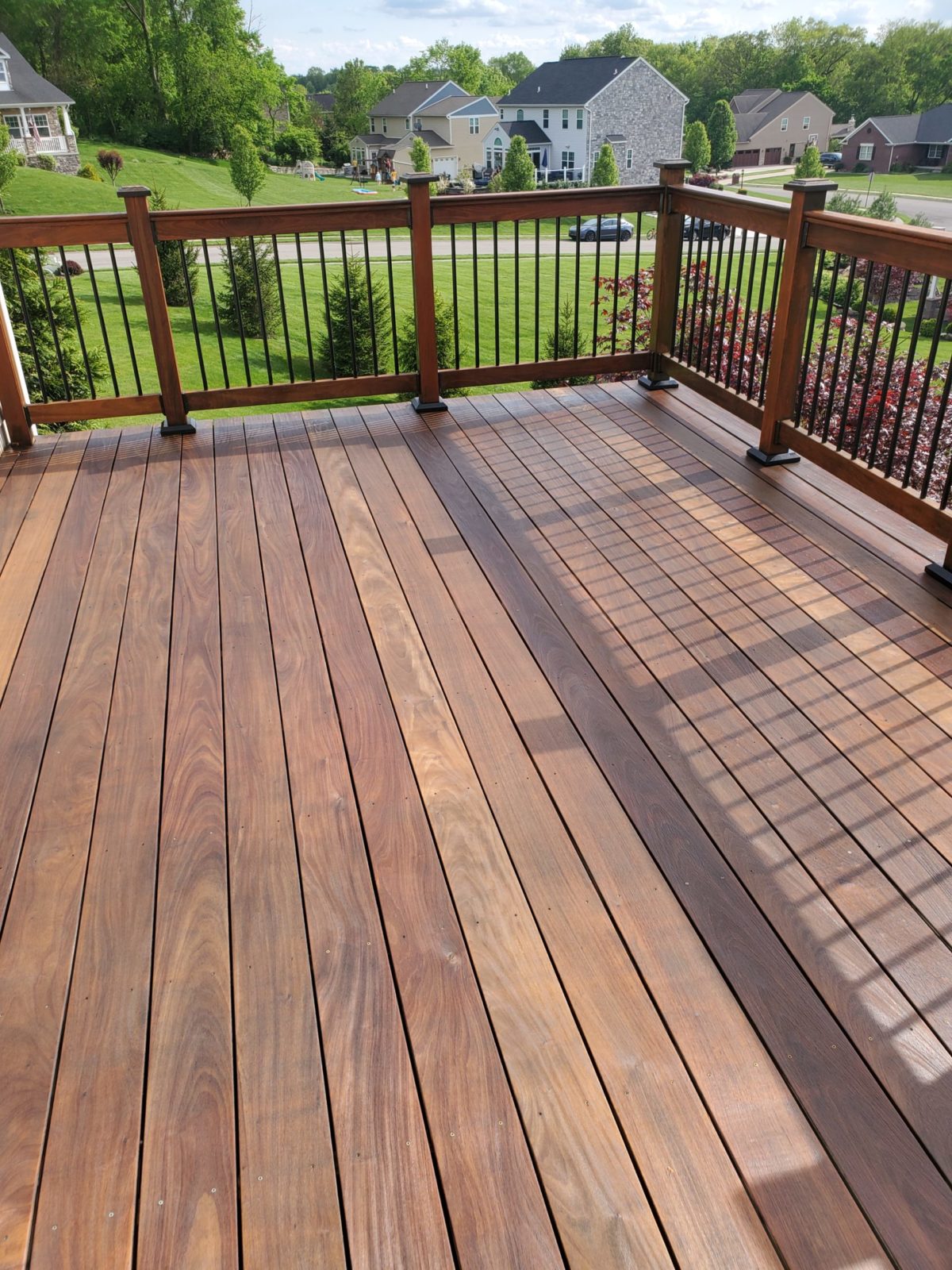
For years, the deck world was dominated by low-maintenance gray composites. But we’re seeing a huge swing back towards natural, warm materials. Driven by design movements like Japandi and a general desire for more authentic, organic spaces, real hardwood is making a major comeback. Homeowners are embracing the unique character and feel of materials like Ipe, Tigerwood, and Cumaru. People are willing to accept the required maintenance in exchange for a look that simply can’t be replicated by a plastic-based product.
7. Multi-Level Light Gray Deck with Dark Gray Railings
This is a perfect example of monochromatic layering. The formula is simple: 60% light gray (the main decking) + 30% medium-dark gray (the railings and trim) + 10% black (the balusters). By staying within the same color family (gray) but using different shades, the design achieves depth and sophistication without feeling busy. The black balusters act like eyeliner, providing a crisp definition that makes the gray tones pop. This creates a cohesive, modern look that feels intentional and very put-together.
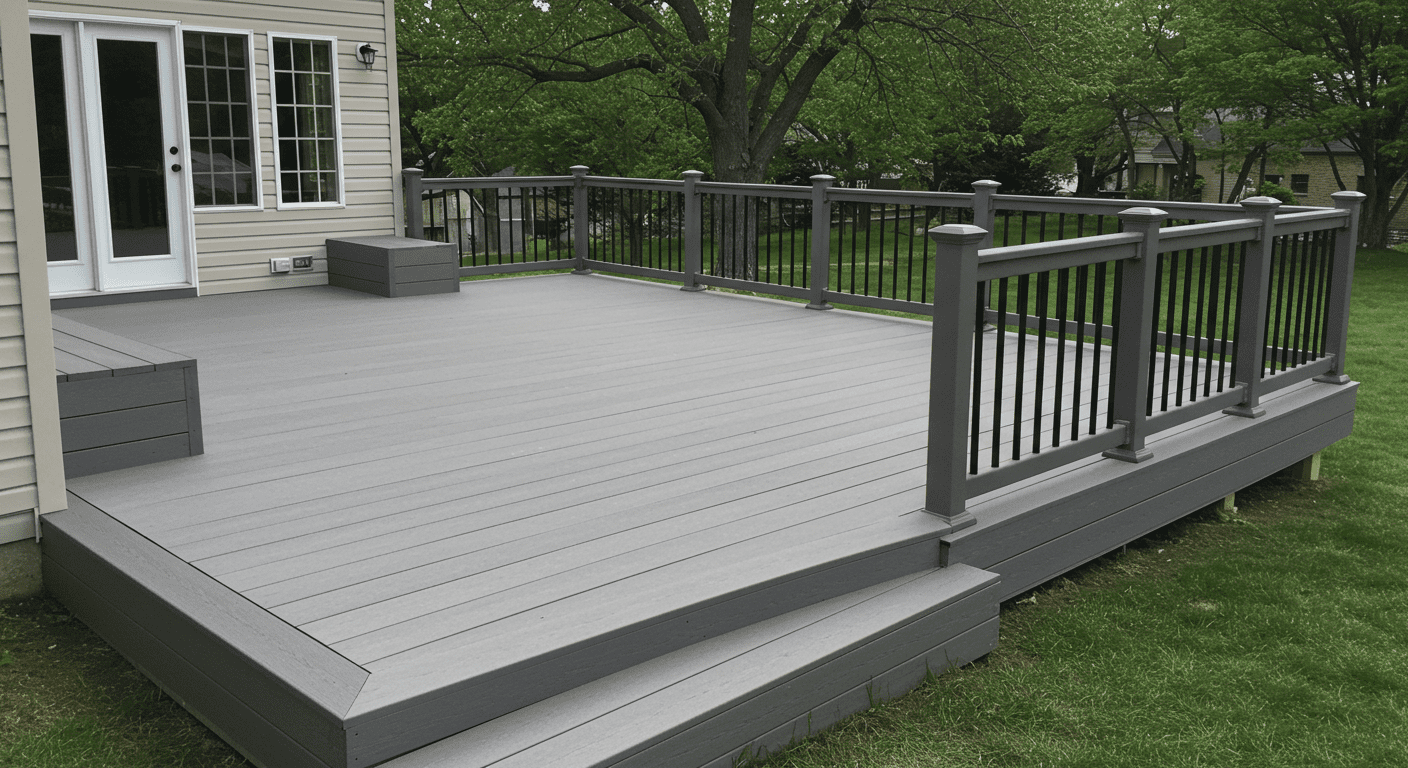
Let’s have some real talk about composite decking, especially in darker shades of gray. It gets hot. Really hot. On a sunny 85-degree day, a light gray composite deck can reach 120°F, but a dark gray or brown one can easily soar to 140°F or more. That’s too hot for bare feet, and it can be uncomfortable even through shoes. If your deck is in full, direct sun with no shade, seriously consider choosing one of the lightest colors available in the product line. Lighter tans and pale grays will be significantly more comfortable underfoot.
8. Muted Greige Painted Wood Deck with Simple Balusters
You don’t need to spend $15,000 on a new composite deck to get a fresh, updated look. If you have an existing wood deck that’s structurally sound but looks tired, paint is your best friend. A high-quality porch and floor paint can completely transform an old deck for a few hundred dollars. This muted greige is a fantastic choice—it’s modern yet timeless, and it hides dirt well. A weekend of prep work (power washing, sanding rough spots) and painting can give you 80% of the look of a new deck for 5% of the cost. It’s the ultimate budget-friendly deck makeover.
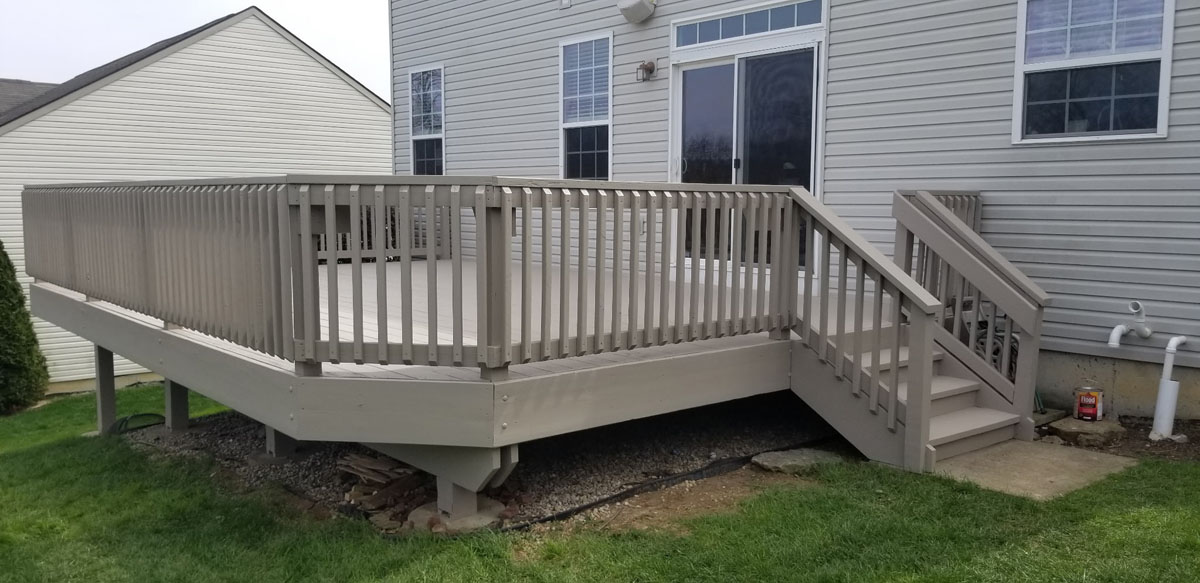
Before you commit to painting your wood deck, run through this checklist to make sure you’re ready for success:
- Check for Rot: Use a screwdriver to poke any suspicious-looking spots, especially where boards meet the house or around posts. If the wood is soft and spongy, it needs to be replaced, not painted.
- Assess the Previous Finish: Is the deck currently stained or painted? Paint can go over old paint (with proper prep), but putting it over a failing, peeling stain is a recipe for disaster. It may need to be stripped first.
- Plan for Prep Time: Seriously, don’t skip the prep. Allot 80% of your total project time to cleaning, scraping, and sanding. A clean, sound surface is the only way to get a lasting paint job.
9. Classic Gray Composite Deck with White and Black Railing
This combination of light grey, white, and black is a can’t-miss classic for a reason. It’s the little black dress of deck design. The light grey decking provides a neutral, modern floor that doesn’t show every speck of dirt. The white railing posts and rails create a bright, clean frame that feels traditional and substantial. And the black metal balusters add a touch of modern crispness while visually receding, which helps to preserve the view. It’s a balanced, timeless palette that complements almost any house color, from beige siding to red brick.
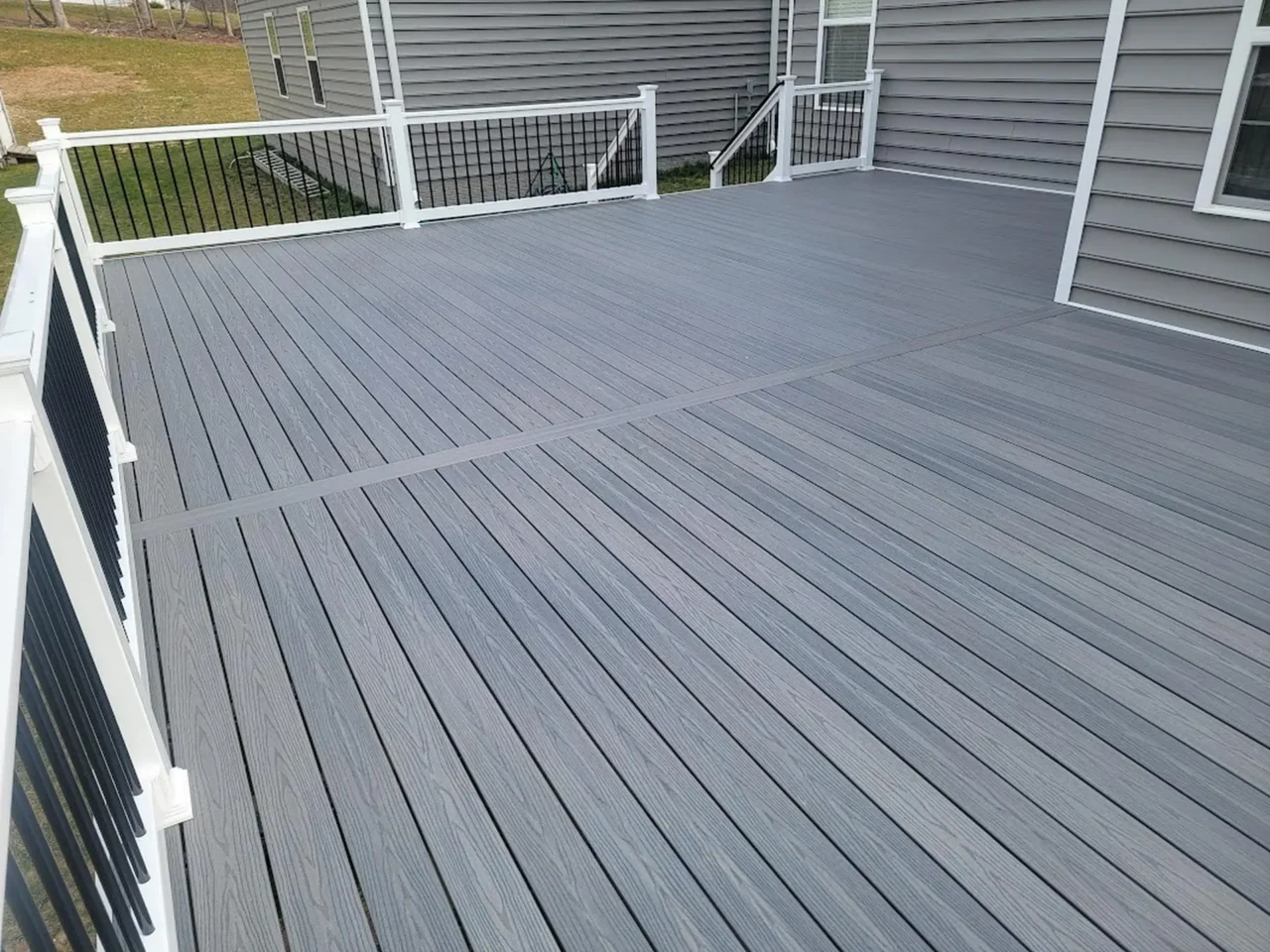
For safety and aesthetics, baluster spacing is non-negotiable. Building code in most of the U.S. mandates that the space between balusters must be less than 4 inches. This is to prevent a small child’s head from fitting through. A good pro tip is to use a 3.5-inch spacer block when you install them. This ensures you meet code everywhere and creates a perfectly consistent, visually pleasing rhythm. Don’t just eyeball it—an inspector will absolutely measure, and you don’t want to have to redo your entire railing.
10. Multi-Level Warm Wood Deck with Corrugated Metal Privacy Wall
The single element that elevates this deck from nice to noteworthy is the corrugated metal wall. It’s an unexpected material choice that injects a dose of modern, industrial cool into the otherwise warm and natural wood setting. It serves a practical purpose as a privacy screen or a backdrop for a seating area, but its real value is textural. The rigid, vertical lines of the metal contrast beautifully with the horizontal lines and organic grain of the wood deck, creating a dynamic and sophisticated focal point.
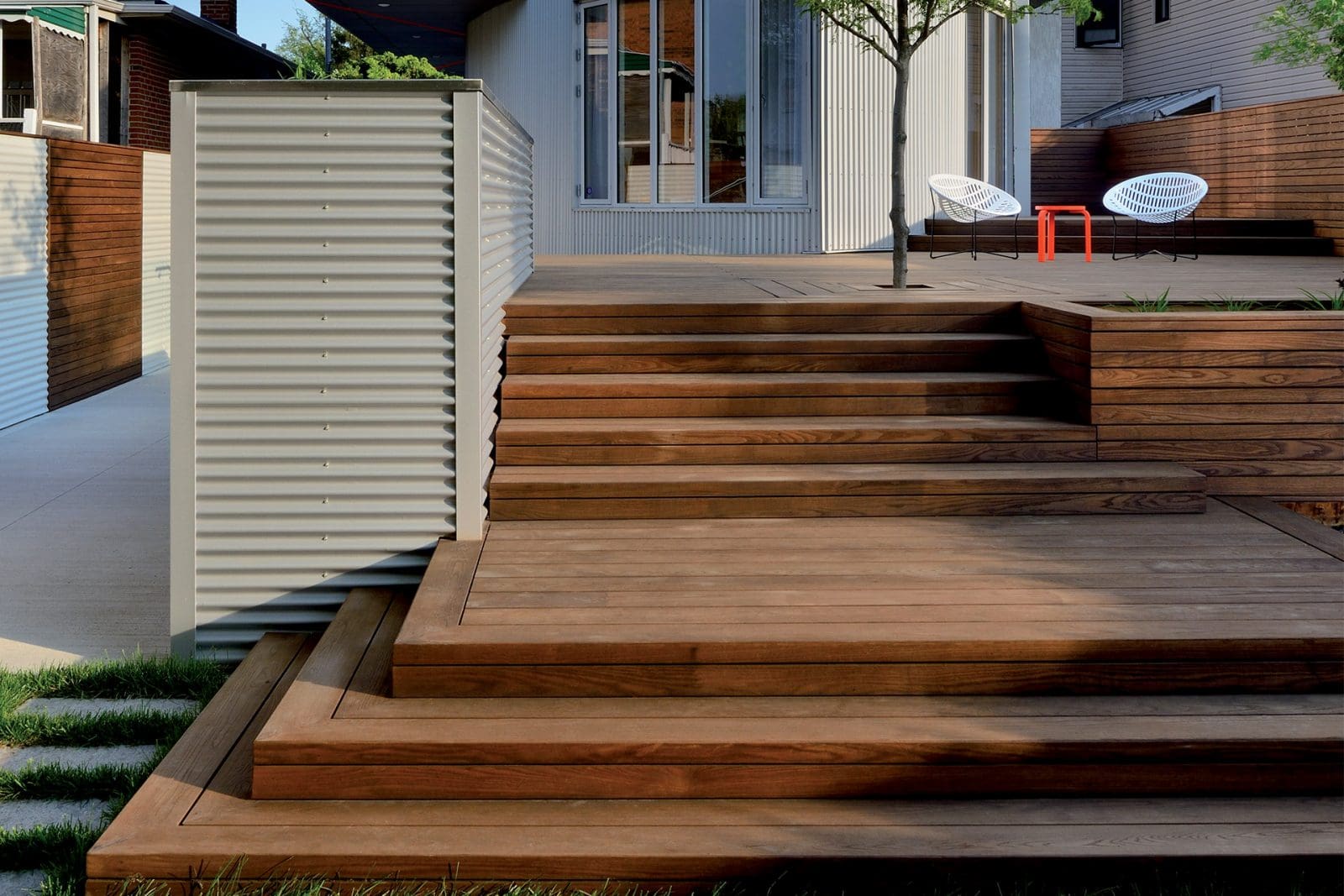
Multi-level decks are the perfect solution for yards with a gentle to moderate slope. Instead of one massive, elevated platform with a towering staircase, breaking the deck into two or more levels that follow the contour of the land creates a more integrated, graceful design. This approach works beautifully for defining different ‘zones’—a dining area on the upper level near the kitchen and a lounging space on the lower level closer to the lawn. For a steep slope, this isn’t practical, but for a yard that drops 2-4 feet, it’s an ideal strategy.
11. Striated Grey Composite Deck Against a Light Stucco House
This look is all about subtle texture. Instead of bold color, the interest comes from the interplay between the surfaces. The composite deck has a linear, striated grain that gives it direction and a modern feel. This is set against the mottled, slightly irregular texture of the light grey stucco wall. Because they are in the same color family (grey/beige), the focus shifts entirely to their different surface qualities. The simple black railing acts as a neutral separator, allowing the two textures to coexist without competing. It’s a sophisticated, minimalist approach to outdoor design.
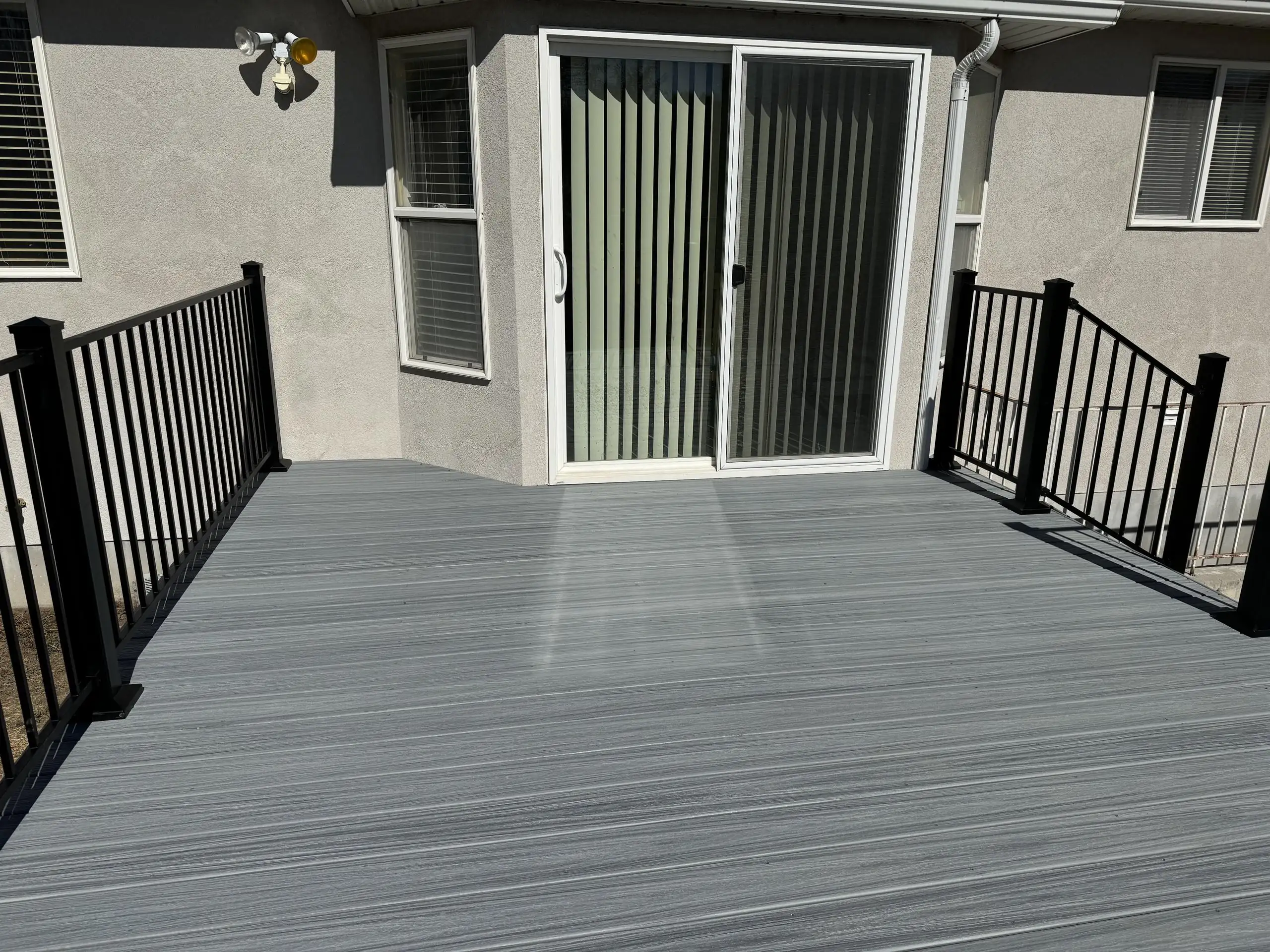
Composite decking is famously low-maintenance, requiring just a seasonal wash-down with soap and water. The stucco, however, can be a dirt magnet, especially lighter colors. In areas with a lot of dust or pollen, or where rain can splash dirt from the ground onto the wall, you may find yourself needing to gently power wash the stucco every year or two to keep it from looking dingy. Be careful with the pressure—too much can damage the finish. Use a wide fan tip and keep the nozzle at least 18 inches from the surface.
12. Two-Tone Brown Curved Deck with Integrated Lighting
When planning for integrated deck lighting, think in ‘zones’ and ‘layers.’ Your stair riser lights are for safety (task lighting). You might add postcap lights for general ambiance (ambient lighting). And you could even include spotlights under a feature tree or bench (accent lighting). A good lighting plan uses all three. Most importantly, put them all on separate dimmer switches. This allows you to dial in the perfect mood—brighter for a party, but soft and low for a quiet evening. Dimmers are a cheap upgrade that makes a huge difference. For a simpler two-tone look, see Idea #2.
Curved decks look incredibly elegant and custom, but you need to be prepared for the price tag. Creating those curves involves a ton of extra labor. Boards have to be heated and bent (for composite) or meticulously cut from wider planks (for wood). The framing underneath is also much more complex. As a general rule, expect a curved deck to cost at least 30-50% more than a rectangular deck of the same square footage. It’s a beautiful, high-impact feature, but it is absolutely a luxury upgrade, not a standard build.
13. Light Greige Composite Deck with Gray Siding and White Railings
This is the ultimate neutral-on-neutral palette, and it works because of the subtle shifts in tone. The formula is 50% Light Greige Deck + 40% Light Gray Siding + 10% Crisp White Trim. The ‘greige’ (a mix of grey and beige) of the deck has a slight warmth that keeps it from feeling cold, while the siding has a cooler, cleaner grey tone. The white railings and door trim act as a bright, clean separator that makes both neutral tones look more intentional and less like a mistake. It’s a calm, cohesive, and incredibly versatile combination.
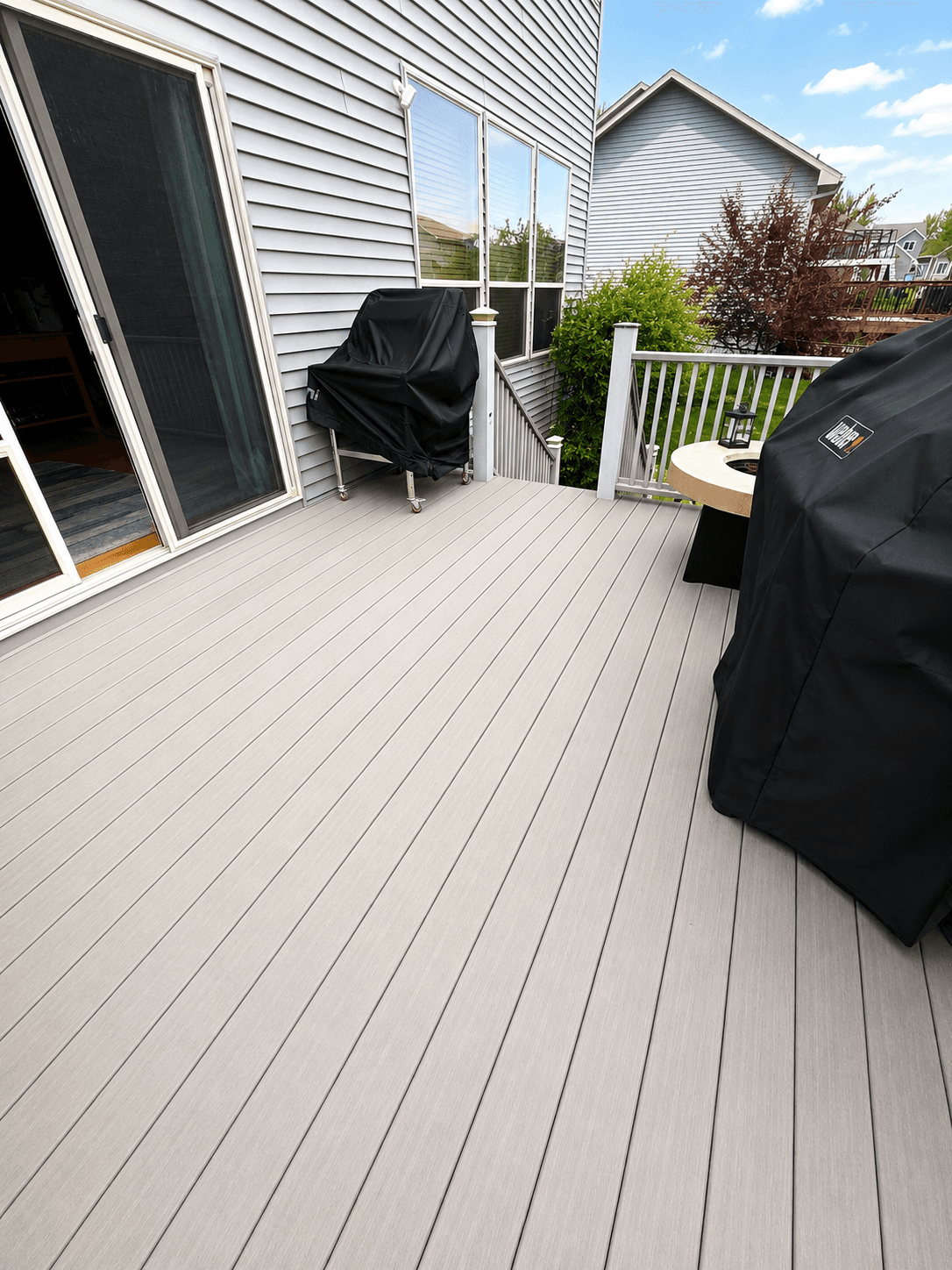
Here’s a sample budget for a standard 12×16 foot composite deck with a basic white vinyl railing, assuming a professional installation. Prices can vary significantly by region.
- Composite Decking & Fasteners: $3,500 – $5,500
- Pressure-Treated Framing Lumber: $1,500 – $2,500
- White Vinyl Railing System: $1,200 – $2,000
- Labor & Permits: $4,000 – $7,000
- TOTAL: $10,200 – $17,000
Budget alternative: A pressure-treated wood deck of the same size, stained or painted, would typically cost $6,000 – $10,000 installed.
14. Shade Sail Over a Natural Wood Deck and Gravel Garden
A shade sail is a stylish and affordable way to add sun protection. Here’s a basic installation guide. Estimated time: 3-4 hours. Material cost: $150-$400.
- Plan your anchor points. You’ll need 3 or 4 strong attachment points on your house, trees, or dedicated posts.
- Install the mounting hardware. Use heavy-duty eye bolts or pad eyes, screwed into structural elements like wall studs or thick tree limbs.
- For ground posts, dig holes at least 3 feet deep, set 4×4 or 6×6 posts in concrete, and angle them slightly away from the center of the sail.
- Lay the sail on the ground and attach turnbuckles to each corner.
- Attach each corner to its anchor point, keeping the turnbuckles loose.
- Systematically tighten the turnbuckles on each corner until the sail is taut with no sagging.
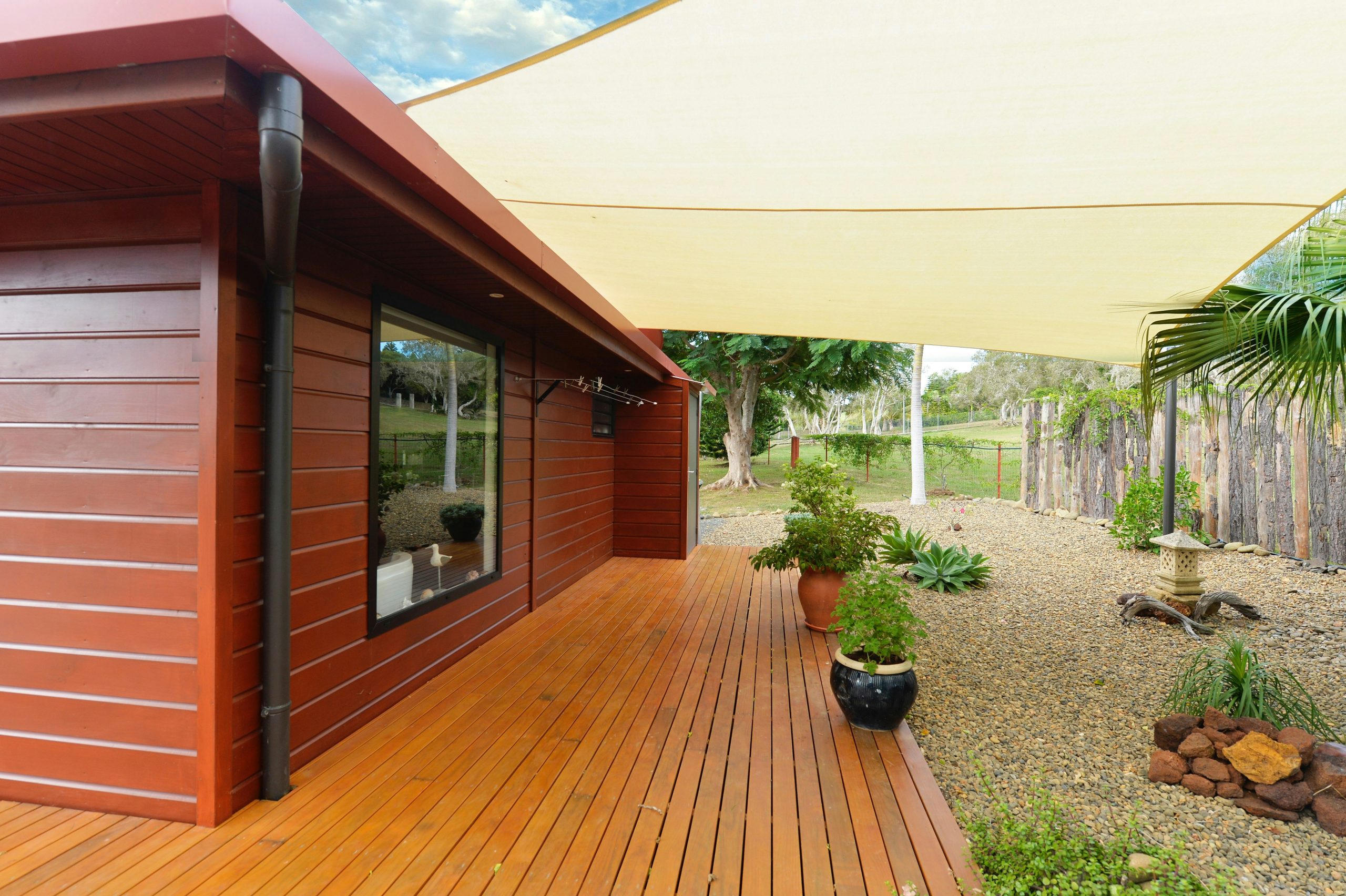
This design masterfully blends different hardscape materials to create a zone-based backyard. The warm, smooth wood of the deck clearly signals ‘living and lounging area.’ The crunchy, light-colored gravel defines a ‘transitional or garden path’ area. By using distinct materials, the design creates separate functional zones without needing walls or railings. The contrast in texture (smooth wood vs. rough gravel) and color (warm brown vs. cool gray) adds a layer of professional-level design sophistication that is both beautiful and practical.
15. Elevated Light Gray Deck with Modern Black Cable Railing
Cable railings look sleek and simple, but they require precise installation to be safe. The key is proper tension. The cables must be tight enough that a 4-inch sphere cannot pass between them. Over time, especially in the first year, cables will stretch and sag due to temperature changes. Plan on re-tightening them once or twice in the first year, and then check them annually. A tell-tale sign they’re loose is if you can easily deflect them more than a couple of inches with your hand. Most systems have simple tensioning nuts at the end posts for easy adjustment.
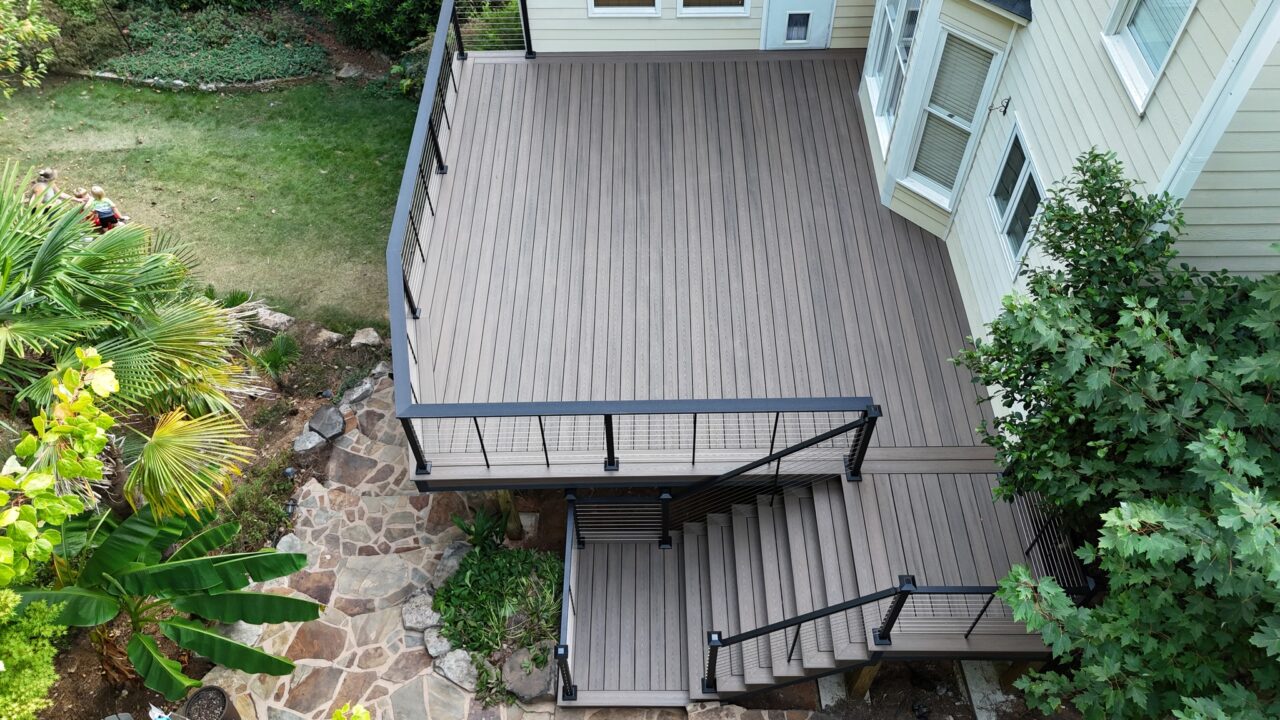
That defines this entire look is the cable railing. If you were to replace it with traditional wood or vinyl balusters, the entire character of the deck would change. It would go from feeling modern, open, and airy to something much more conventional. The thin, almost invisible horizontal cables are specifically chosen to maximize the view and minimize the barrier between the deck and the landscape. It’s a choice that prioritizes view over privacy and makes the entire space feel larger and more connected to its surroundings.
16. Cozy Cottage Deck with Natural Wood Finish
The cozy cottage aesthetic is a carefully balanced recipe. Think of it as 60% natural weathered wood, 30% classic white trim, and 10% lush greenery and simple furnishings. The wood provides the essential warmth and history, even if it’s new wood with a transparent or semi-transparent stain. The crisp white on railings, posts, and window trim provides a clean, bright contrast that keeps the wood from feeling too rustic or heavy. The final 10% comes from potted plants, simple wooden furniture, and maybe a classic welcome mat, adding life and personality. Compare this cozy scale with the expansive modern deck in Idea #16.
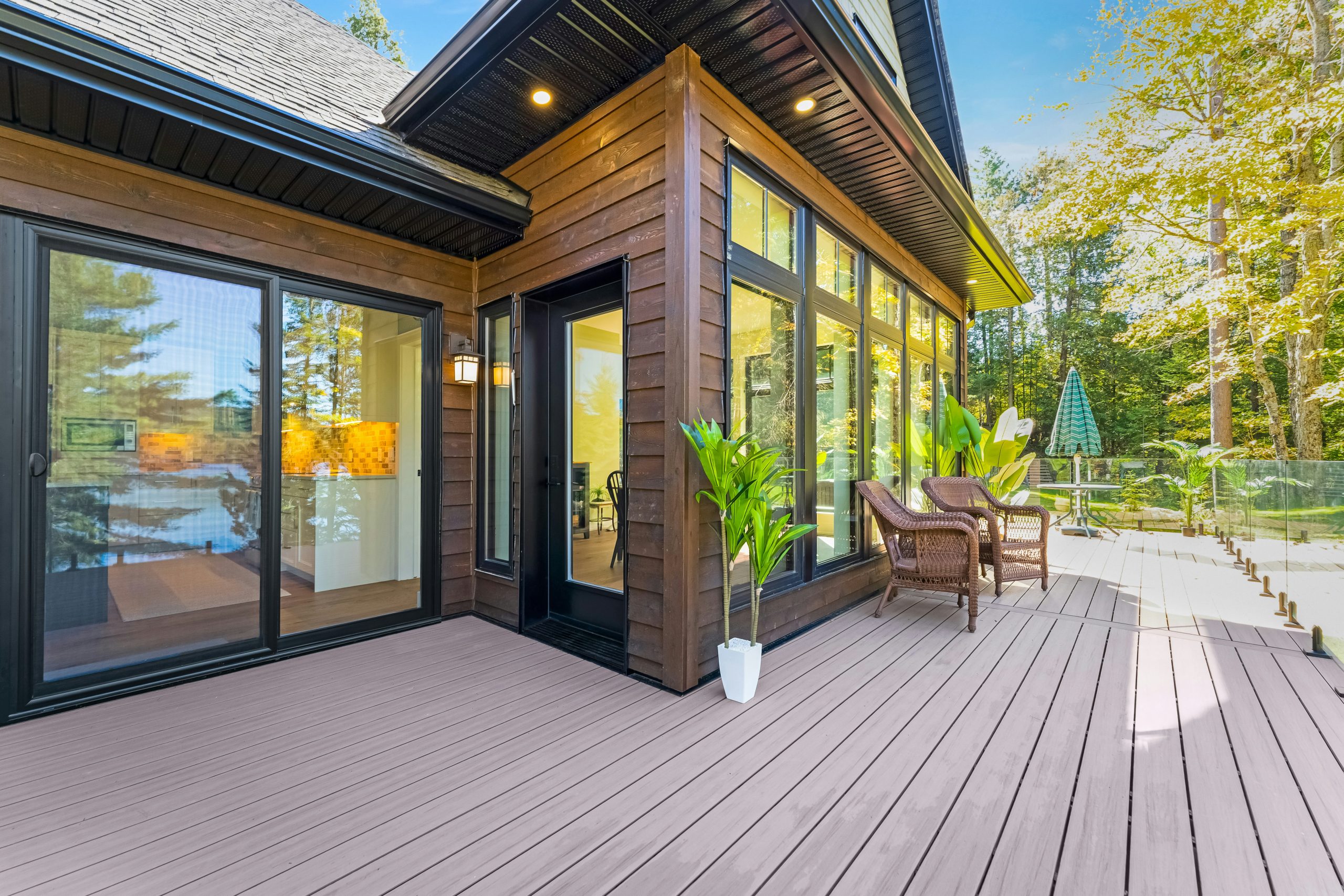
This cozy, intimate deck style is perfectly suited for smaller footprints, typically in the range of 80 to 150 square feet (e.g., 8×10 or 10×15). It’s more of a porch-deck hybrid, designed for a couple of chairs and a small table. The goal isn’t to host a large party but to create a charming spot for morning coffee or evening relaxation. This look can feel a bit lost or underwhelming on a massive, sprawling deck, where its charm and intimacy would be diluted by the sheer scale.
17. Spacious Grey Rooftop Deck with a Clear Glass Railing
Glass railings offer a million-dollar view, but they come with some maintenance realities. They are magnets for dust, pollen, fingerprints, and water spots, especially near a lake or pool. To keep them looking crystal clear, you’ll need to clean them far more often than a standard baluster railing. Squeegeeing them down every week or two during peak season isn’t an exaggeration if you want to maintain that perfectly unobstructed look. It’s a trade-off: you’re swapping the visual clutter of balusters for the cleaning task of a dozen extra windows.
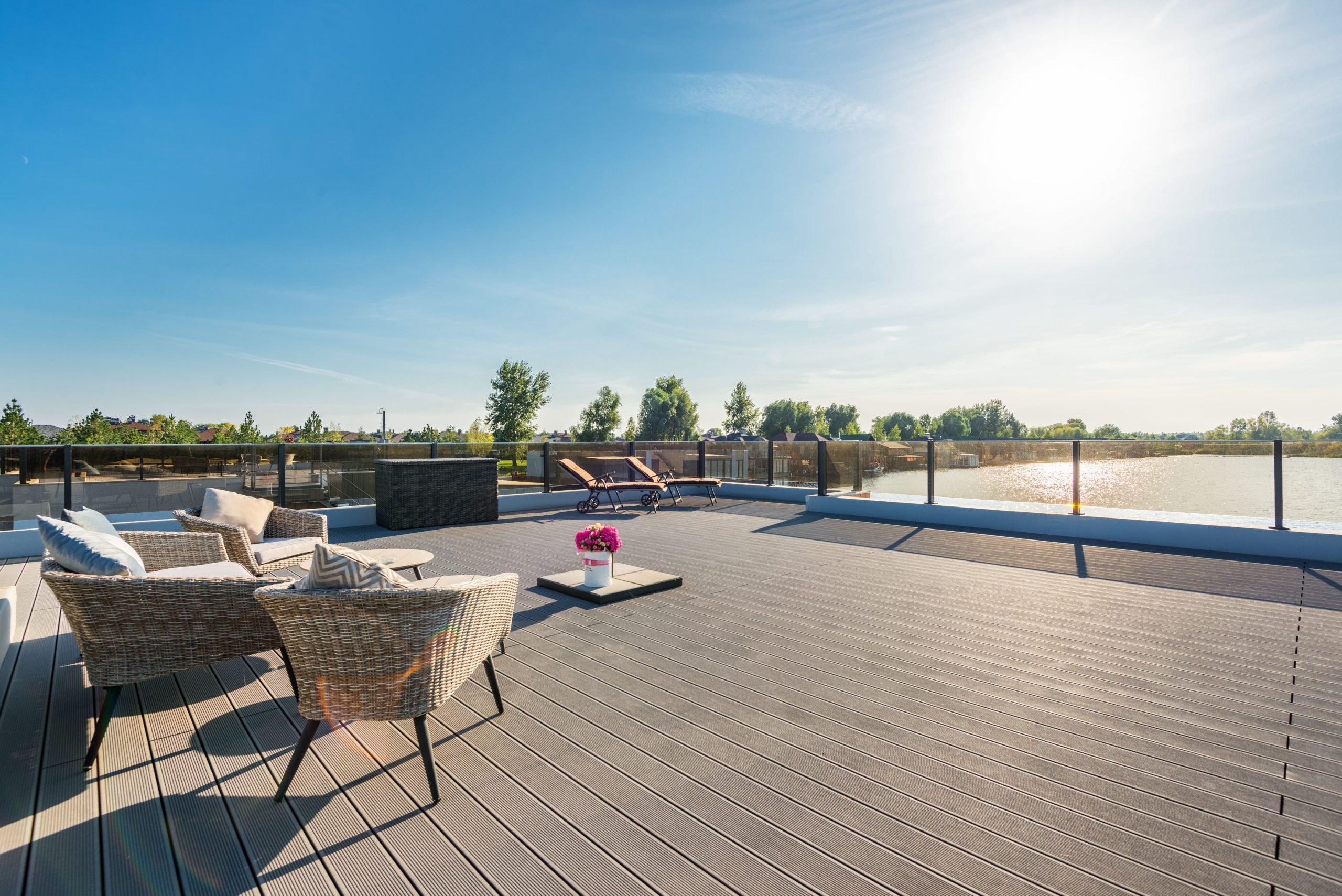
A high-end rooftop deck with premium features like glass railings is a significant investment. This is the top tier of decking. Here is a rough estimate for a 20×20 foot rooftop deck.
- Structural Engineering & Permits: $3,000 – $8,000
- Pedestal Deck System & Premium Composite: $12,000 – $18,000
- Frameless Glass Railing System: $10,000 – $16,000 (at $250+/linear foot)
- Labor & Crane Rental: $15,000 – $25,000
- TOTAL: $40,000 – $67,000+
Budget alternative: The same size deck using standard composite and a black aluminum railing might cost $25,000 – $40,000.
18. Modern Light Gray Deck with a Frameless Glass Railing
The star of this show, without a doubt, is the glass panel railing. It is the single most important design choice here. By using large panes of glass with minimal black posts, the railing almost disappears, creating a completely seamless visual transition from the deck to the lawn and trees beyond. This choice says that the view is the most important feature. Any other railing type—wood, composite, or cable—would have created a stronger visual border and broken up that coveted indoor-outdoor feeling.
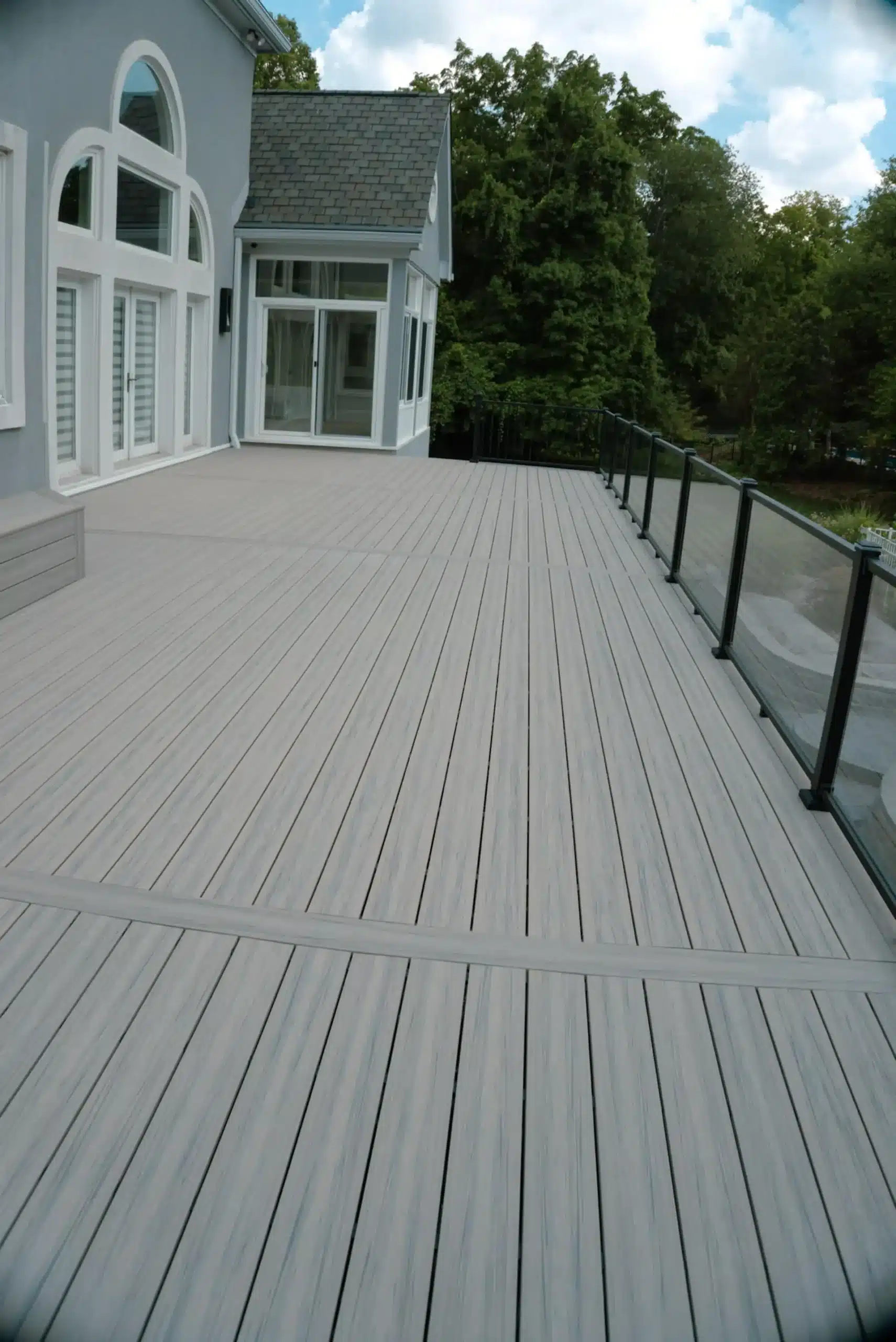
This design is a masterclass in clean lines and cohesion. The light gray of the deck is echoed in the light gray paint of the house siding, creating a unified and expansive feel. The black railing posts pick up on the darker tones in the window frames and roofing, tying the whole color scheme together. Finally, the strong horizontal lines of the decking and the house siding are repeated, creating a calming, harmonious rhythm. The result is a serene, modern space that feels both highly designed and effortlessly simple.
19. Warm Brown Terrace Directly Outside Glass Doors
When building a deck or patio directly outside a doorway, proper water management is critical. The surface of the deck must be at least 2 inches below the bottom of the door’s threshold. This step-down prevents wind-driven rain from seeping under the door and into your home. Furthermore, the deck should be sloped gently away from the house—a drop of 1/4 inch per foot is standard—to ensure water runs off into the yard, not back towards your foundation. It’s a small detail that prevents catastrophic water damage down the road.
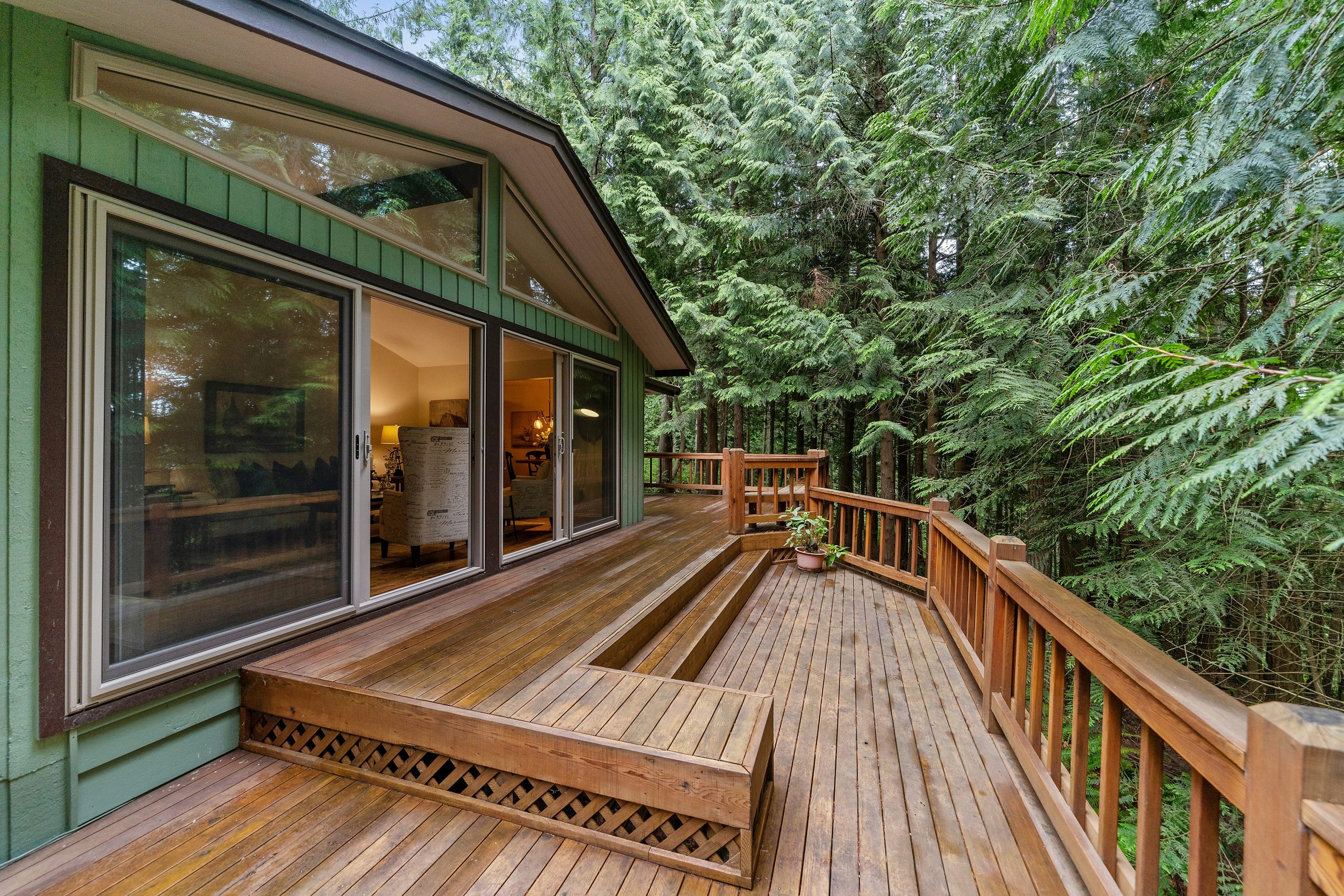
The concept of ‘biophilic design’—incorporating natural elements into our living spaces to increase our connection to the outdoors—is a huge driver behind looks like this. A simple wood terrace that creates a seamless flow from inside to outside is a perfect example of this trend in action. It’s less about a formal ‘deck’ and more about blurring the lines. As we continue to seek wellness and calm in our home environments, these kinds of effortless, nature-connected transitions are becoming more of a priority than ever before.
20. Simple Backyard Wood Deck Design for a DIY Approach
If a $10,000+ contractor bid for a new deck isn’t in the cards, don’t despair. For a simple, ground-level deck (less than 30 inches high), a DIY approach is very achievable for a handy homeowner. Many home improvement stores sell pre-designed deck ‘kits’ or packages that include all the plans and materials. Alternatively, you can explore modular deck systems like deck tiles that snap together over a simple frame or even a flat patio. A simple 10×12 pressure-treated wood deck can be a DIY project for under $2,000 in materials.
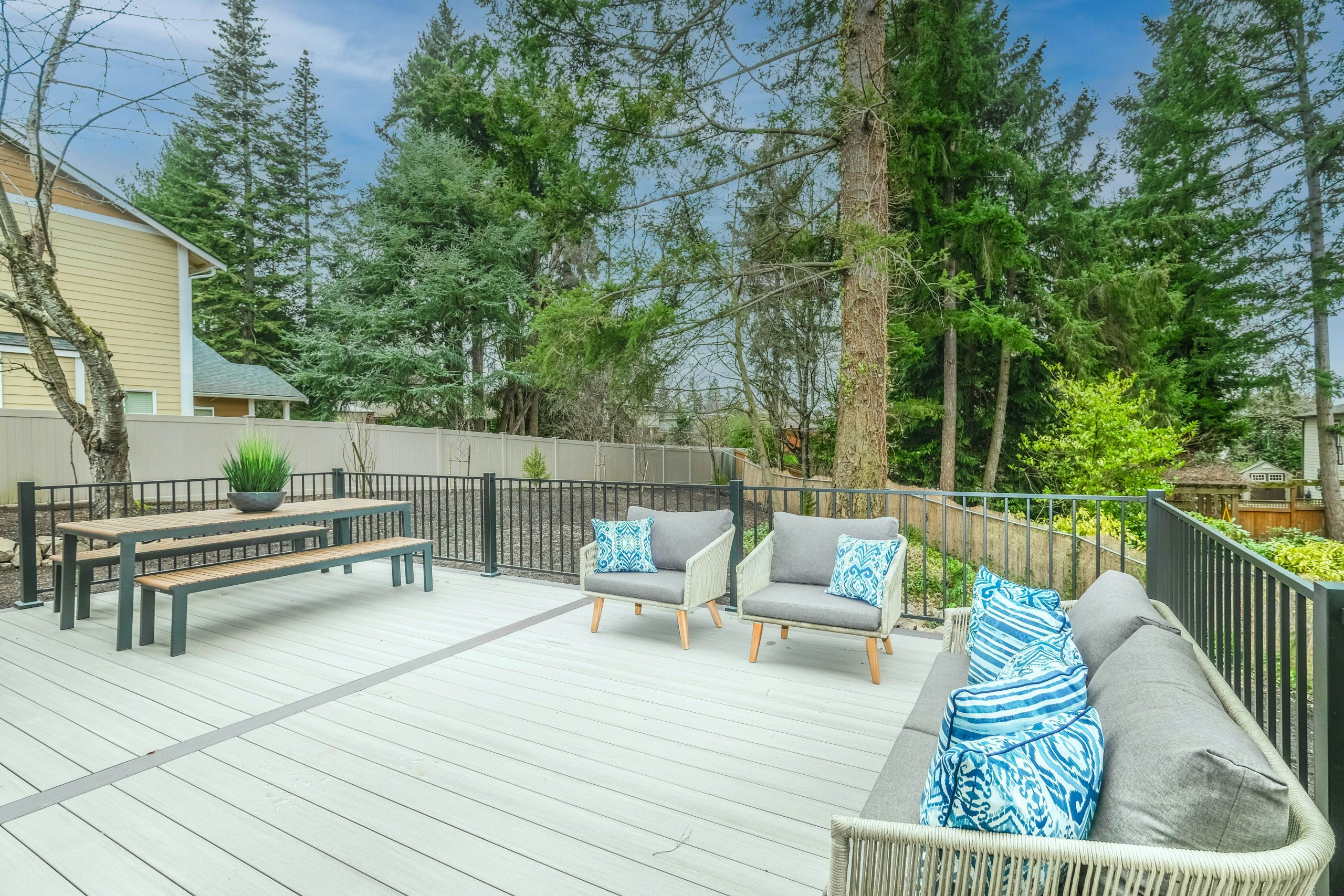
Thinking about a backyard deck project? Here’s the absolute minimum you need to figure out before you even buy a single 2×4.
- Check Setbacks & Permits: Call your local building department. How close can your deck be to your property line? Does a deck of your intended size and height require a permit? Do not skip this step.
- Locate Utilities: Before you dig any footings, call 811. It’s a free national service that will come out and mark the location of underground gas, water, and electrical lines.
- Assess the Grade: Is your yard perfectly flat, or does it slope? The slope will determine your footing height and framing complexity, which directly impacts cost and labor.
21. Dark Composite Decking with a Natural Wood Look
The number one thing to know about dark composite decking is its heat absorption. A deep brown or charcoal gray deck in direct, all-day sun can become uncomfortably hot to the touch, especially for children and pets. Manufacturers have improved this with cool-deck technology, but physics is physics. If your deck gets blasted by the sun from noon to 5 PM, consider a lighter color. If your deck is mostly shaded by trees or a pergola, or if you live in a cooler climate, then a dark color can be a stunning and practical choice.
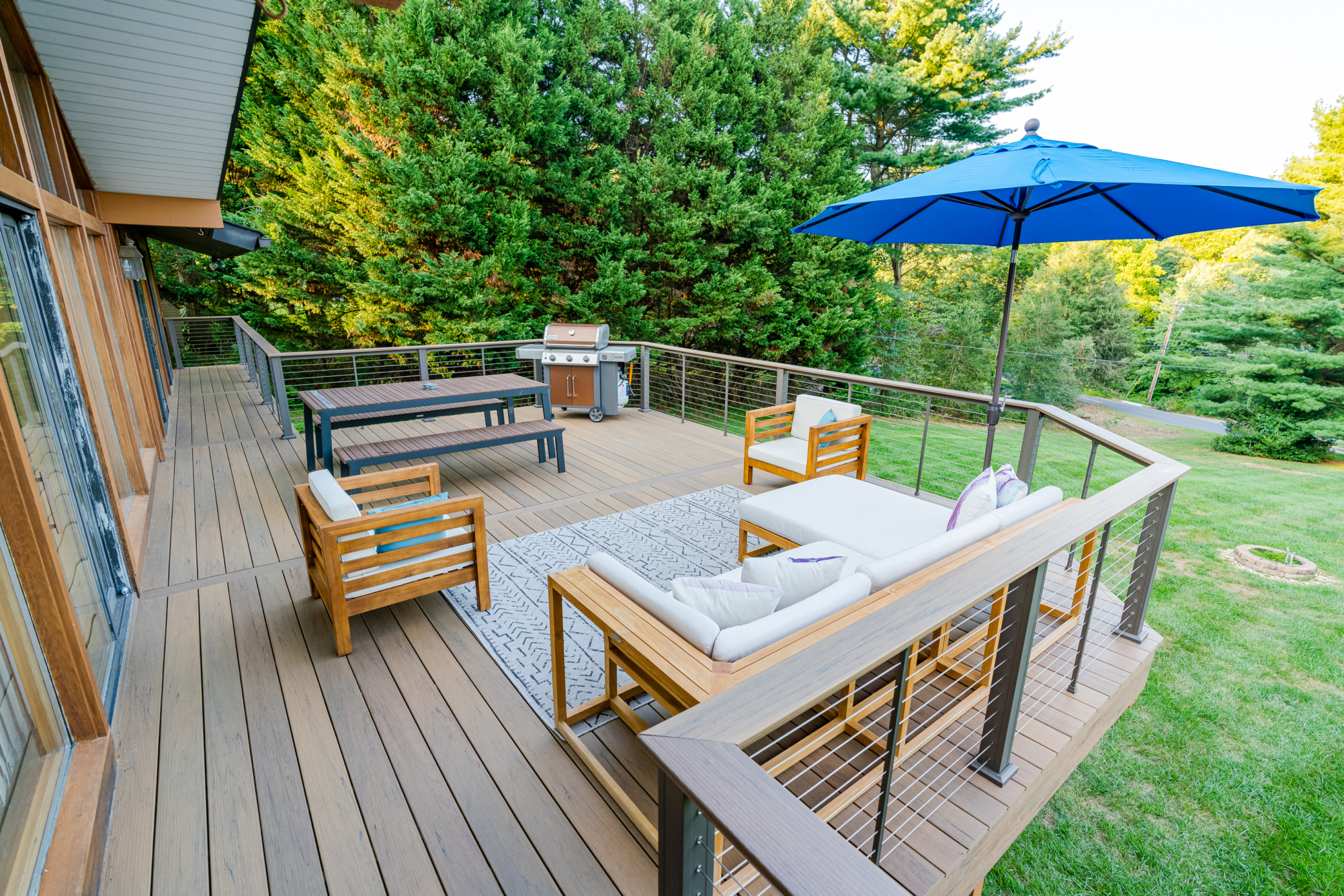
When you choose a very dark floor, like a deep brown or black deck, the rest of your design needs to provide balance. The formula is 60% dark decking + 30% light, bright furniture + 10% greenery & accents. The dark deck provides a dramatic, grounding base. You must then contrast this with light-colored furniture—think white, light gray, or natural teak—to keep the space from feeling like a black hole. The greenery and small pops of color in pillows or planters add the final layer of life and visual relief.
22. Light Natural Wood Deck Paired with Red Brick and Brown Siding
This combination works because it leans into a harmonious, earthy palette. The red brick provides a warm, textured backdrop. The brown siding is in the same color family, just a different shade and texture. The light, natural wood of the deck then acts as the ‘bright’ element in this warm, neutral scheme. It connects to the brown tones but is light enough to provide contrast and keep the whole scene from feeling too dark or heavy. The crisp white trim is essential, acting as a clean outline that defines each material.
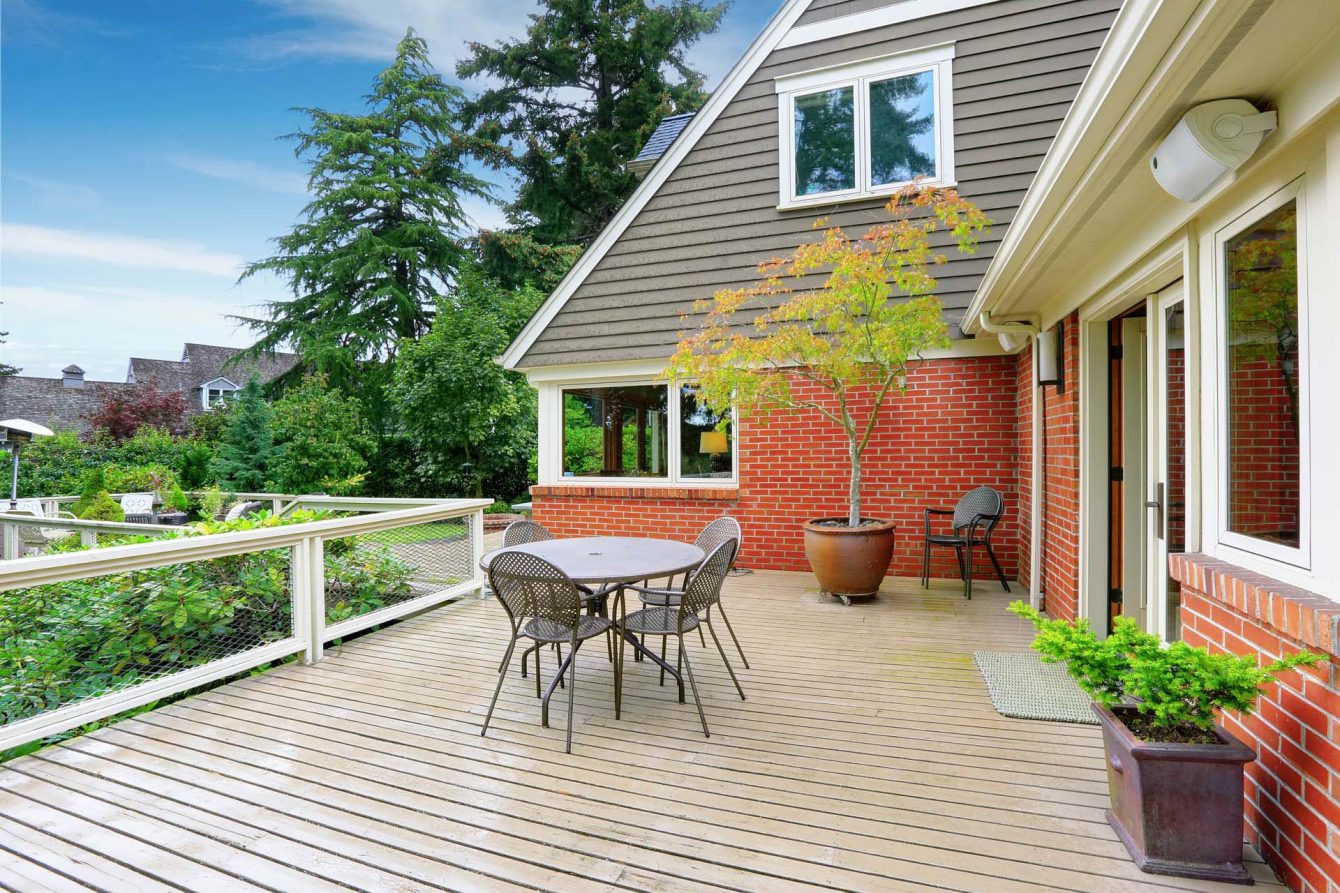
Pairing a natural wood deck with a ‘forever’ material like brick requires thinking about the future. The brick will look the same in 20 years. The wood will not, unless you are diligent about maintenance. If you let the wood weather to a natural gray, how will that cool tone look against your warm red brick? In many cases, it’s beautiful, creating a more rustic, aged look. But if you love the warm-on-warm look you have on day one, you must commit to cleaning and re-staining the deck every few years to maintain that original color.
23. Warm Wood Porch Deck with Slate Blue Rocking Chairs
The magic in this serene porch scene comes from the slate blue rocking chairs. The deck is a beautiful, warm reddish-brown, and the house is a soft, creamy beige—a lovely but quiet combination. The chairs introduce a cool, calming color that perfectly complements the warmth of the wood. It’s a sophisticated color pop that feels more thoughtful and less obvious than a primary red or yellow. Remove the chairs, and you have a nice porch. With them, you have a styled, inviting destination. The color pairing is much subtler than the bold orange in Idea #1.
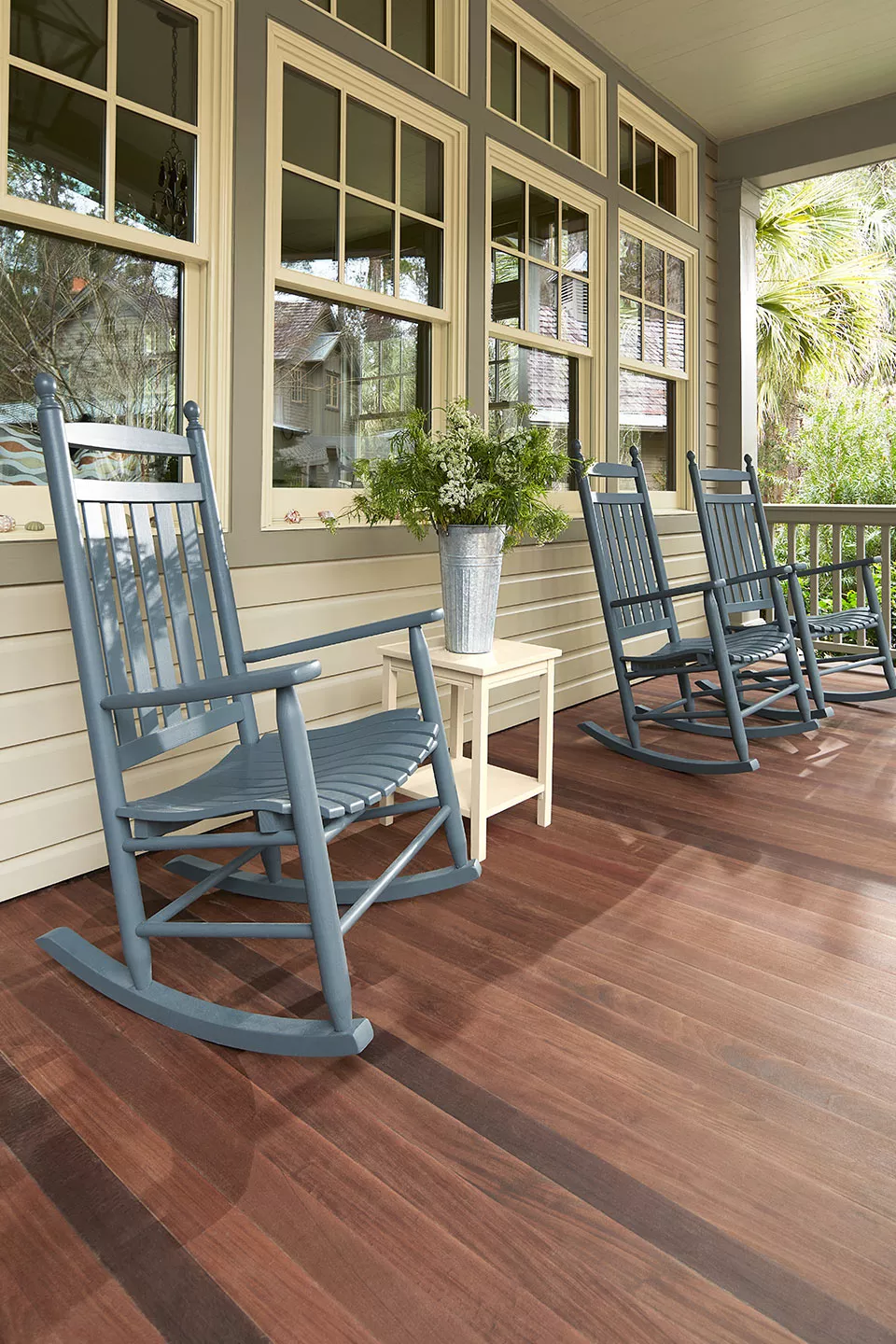
When choosing a paint color for outdoor furniture, don’t just pick a color you like. Buy a small sample can and paint it on a piece of scrap wood. Take that sample outside and look at it next to your deck and house siding in the morning, at noon, and in the late afternoon. The color of natural light changes dramatically throughout the day, and a blue that looks perfect in the cool morning light might look completely different in the warm glow of sunset. Test it in its real environment before you commit to painting three whole chairs.
24. Gray Composite Deck with a Contrasting Dark Border
Creating a ‘picture frame’ border with composite decking is a surefire way to get a custom look. This technique, also called race-tracking, adds a polished finish. Time: Adds 5-8 hours. Cost: A few extra boards.
- Build your deck substructure as planned.
- Install the joists that will run parallel to the house as usual.
- Add extra blocking and joists around the perimeter where the border will go. This provides the necessary support for the perpendicular border boards.
- Install the border boards first, letting them overhang the frame.
- Install the main field of decking boards inside the border.
- Finally, snap a chalk line and use a track saw to trim the overhanging border for a perfectly straight edge.
This picture frame effect is also used in Idea #4, but with a diagonal inlay.
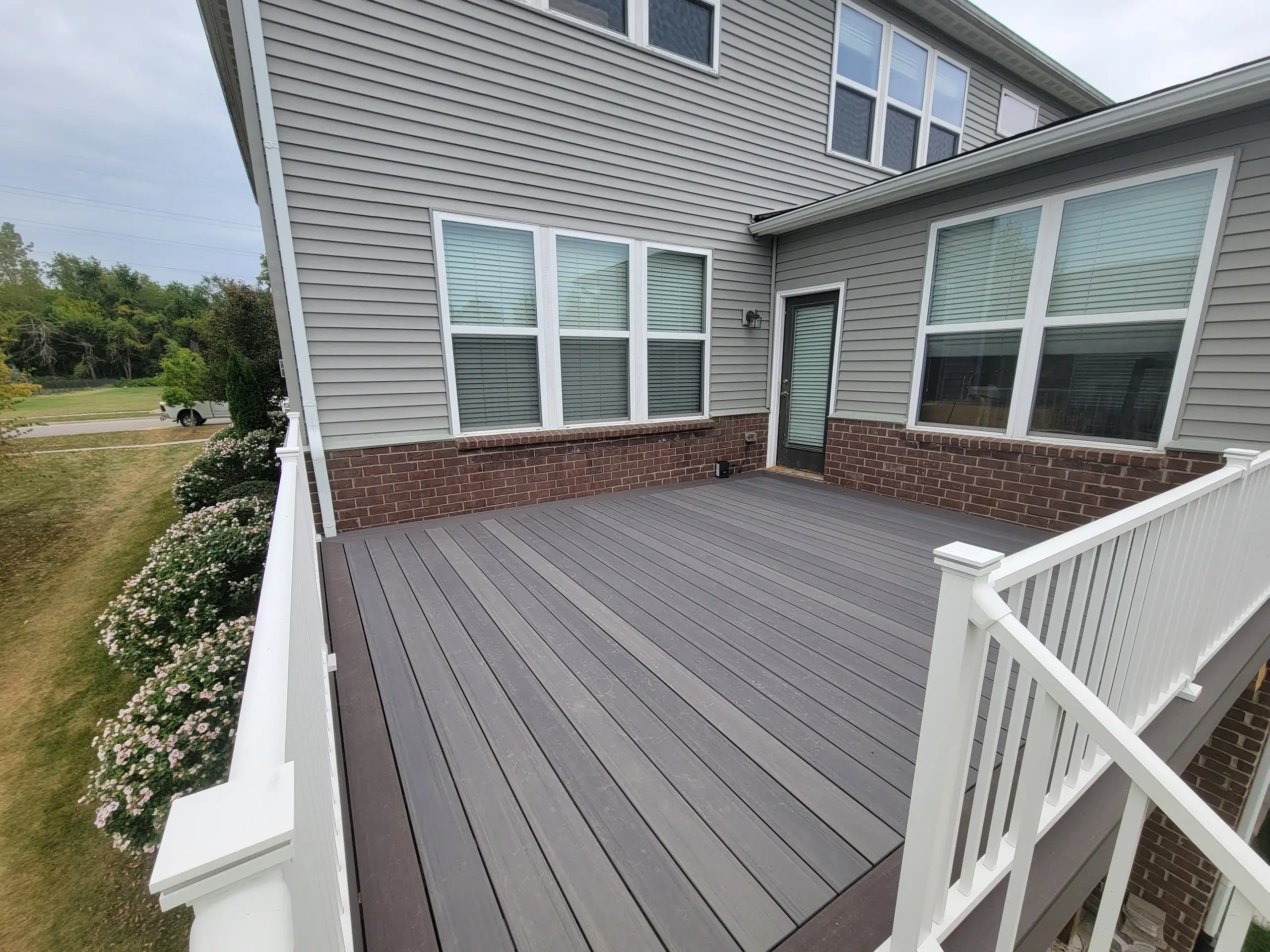
A contrasting border is a fantastic design tool, especially on large, expansive decks (400 sq ft or more). On a huge surface, a border helps to break up the visual monotony and provides a sense of scale and definition. You can also use interior border lines to define different ‘rooms’ on a very large deck—for example, framing out a 12×14 ‘dining area’ within a larger 20×30 deck. On a very small deck (under 100 sq ft), a wide, contrasting border can sometimes feel too heavy and make the space feel smaller.
25. Light Gray Deck with Black Rockers and a Brick House
This is a timeless, foolproof color combination that works by balancing warm and cool tones. The formula is: 50% Warm Red Brick + 30% Cool Light Gray Decking + 20% Black Accents. The red brick provides a classic, warm, textured background. The cool gray of the deck modernizes the look and provides a neutral floor that doesn’t compete with the brick. The black rocking chairs and railing balusters add a strong, graphic punch that ties it all together and adds a touch of sophistication. It’s a palette that feels both classic and current.
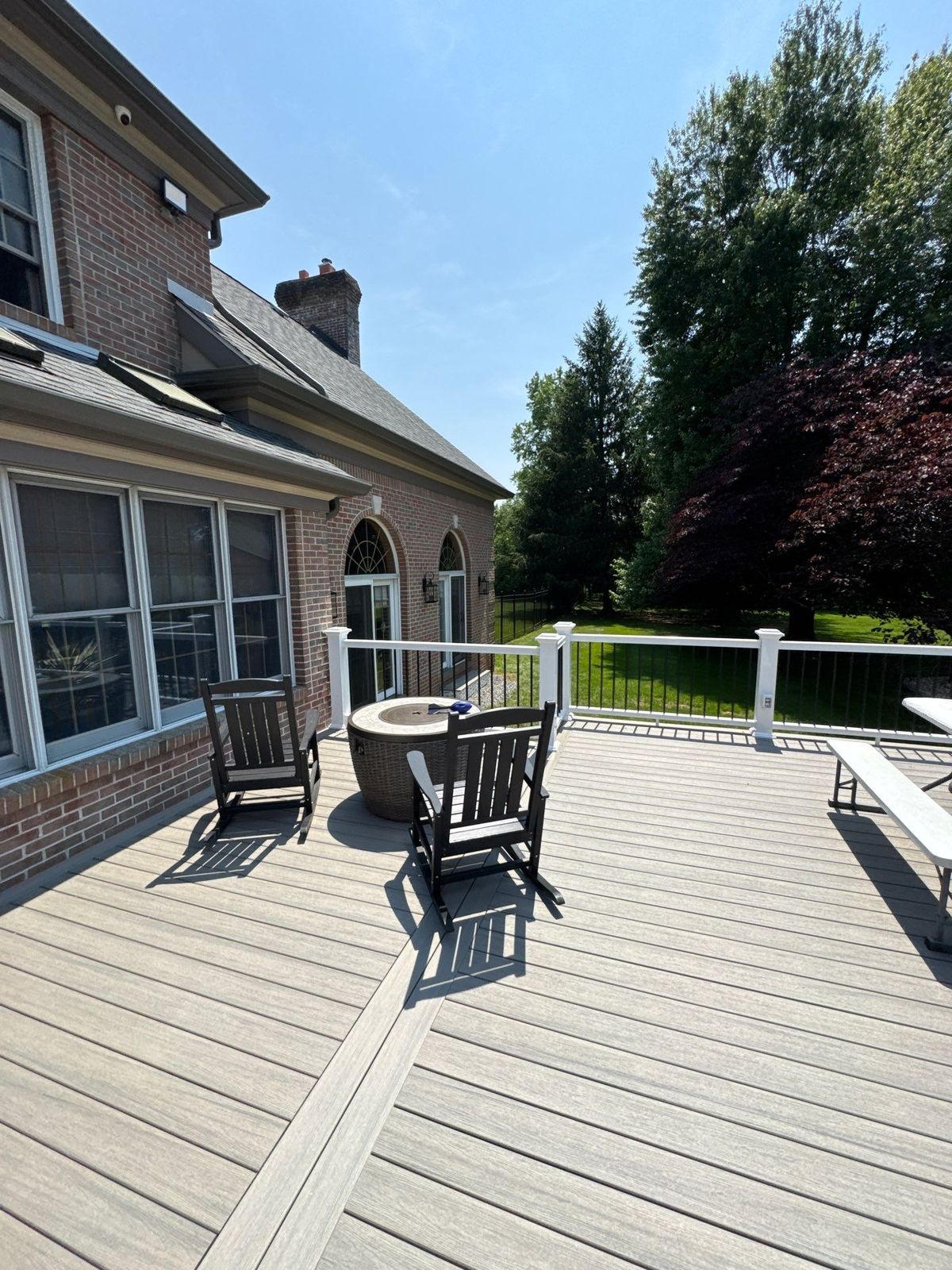
You can achieve this exact color palette on a shoestring budget. Start with a standard, builder-grade pressure-treated wood deck. Clean and prep it thoroughly, then apply a solid-color stain in a light, cool gray. Find a pair of classic wooden rocking chairs on Facebook Marketplace or at a thrift store for $20-$50 each. A little light sanding and a quart of black exterior paint, and you have your stylish seating. The entire color transformation could cost you less than $200 and a weekend’s worth of work.
26. Dark Brown Deck with Olive Green Siding and Rattan Chairs
This deck is a beautiful study in earth tones. The deep, rich brown of the deck planks provides a solid, grounding foundation. The house siding is a soft, muted olive green, which is a natural companion to brown. The black of the railings and lantern provides a crisp, dark accent. Finally, the natural woven rattan of the chairs introduces another earthy texture and a lighter, warmer tone. Nothing is loud or jarring. All the colors are pulled from a forest palette, creating a space that feels incredibly calm, natural, and relaxing.
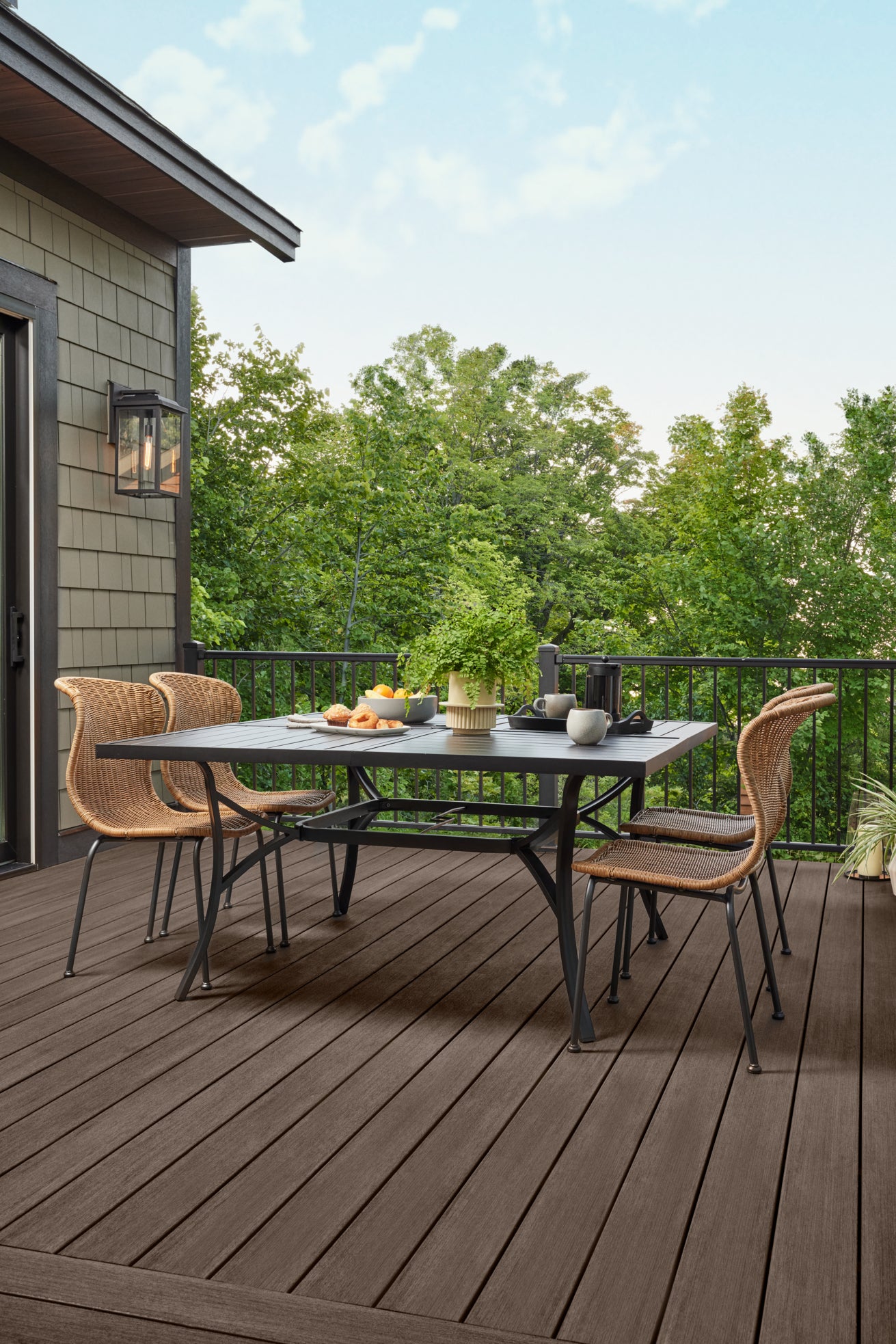
Natural rattan and wicker furniture bring incredible texture to an outdoor space, but they are not as carefree as their plastic or metal counterparts. To keep them from getting brittle, moldy, or discolored, they need protection. They should ideally be used on a covered porch or, if on an open deck, be brought indoors or covered when not in use, especially during rainy seasons or the off-season. An annual cleaning with a soft brush and mild soap, followed by a light coat of tung oil or a specialized furniture wax, will keep the fibers supple and prevent cracking.
Your Deck’s New Chapter Starts Here
Choosing a deck color is about more than just maintenance or trends; it’s about setting the stage for future memories. Whether you landed on a warm wood tone or a sleek modern gray, we hope these ideas have given you the confidence to make a choice that feels right for your home. Now the fun part begins.
Don’t forget to save your favorite ideas to your ‘Backyard Dreams’ board on Pinterest! It’s the best way to keep your inspiration organized and ready for when you start your project.