
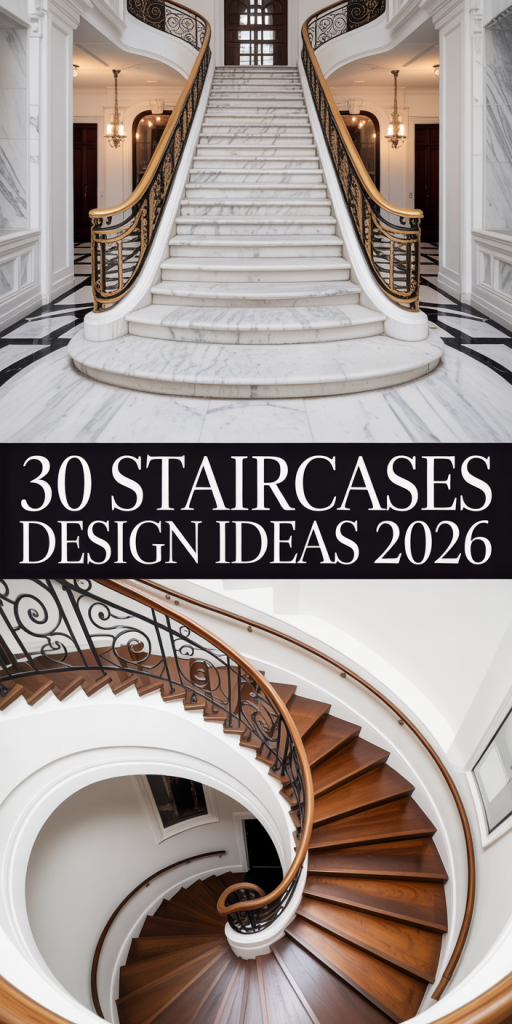
You know that feeling when you finally find the staircase design that looks exactly right for your space? It stops the endless scrolling and makes you think, “That’s the one.” But then reality hits. How do you translate that perfect pin into your actual home? We’ve been there. After filtering through hundreds of options, we narrowed it down to 30 incredible staircase ideas that deliver on style and function. From ambitious architectural statements to clever under-stair solutions, this collection is your definitive guide for 2026. And stay until the end—we break down the most common mistakes that can ruin these looks. 📌 Save this to Pinterest for later—you’ll want to revisit these ideas.
1. Blend Indoors and Out with a Floating Wood & Glass Staircase
This design is all about disappearing architecture. By using floating blonde wood treads and a completely clear glass balustrade, the staircase avoids blocking the magnificent forest view from the floor-to-ceiling windows. It forces the eye outward, making the room feel like an extension of the landscape. The materials are in perfect harmony, too. The light tone of the wood treads mirrors the exposed ceiling beams, creating a cohesive visual frame that feels both modern and deeply connected to the natural setting beyond the glass.

|
📋 Copy HEX 🔗 Share |
Let’s have some real talk about a look this pristine. Glass railings and massive windows require constant cleaning to look their best. If fingerprints and dust bunnies are your nemesis, this style might not be the design for you. The open-riser design also means there’s no sound separation between floors; noise will travel freely. It’s stunning for a serene retreat or a quiet household but might be less practical for a busy family home with lots of activity and a desire for acoustic privacy between levels.
2. Embrace Classic Grandeur with a Curved Staircase
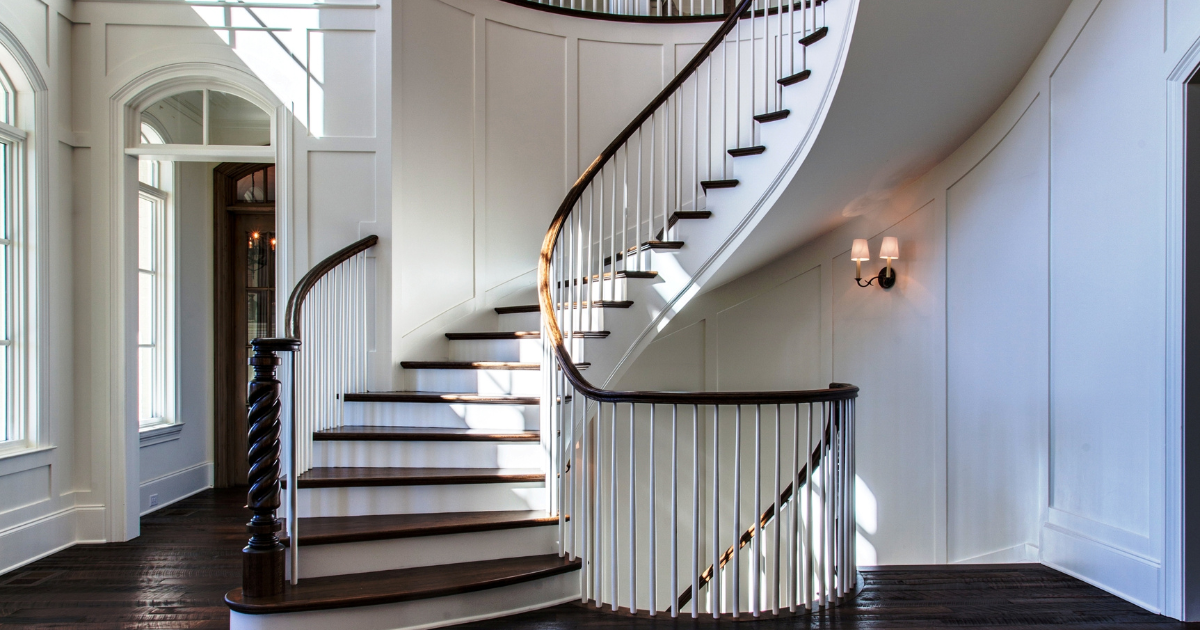
When designing a curved staircase, the handrail’s flow is everything. For a truly high-end look, insist on a continuous handrail crafted from a single piece of wood or steam-bent to perfection. Avoid visible joints or sectional pieces, as they break the elegant, sweeping line that makes a curved staircase so breathtaking. This detail, along with the contrast between the dark wood treads and the crisp white risers and paneling, creates the timeless, polished look you see here.
|
📋 Copy HEX 🔗 Share |
The visual formula for this classic entryway is surprisingly simple and adaptable. Think of it as 60% crisp white (walls, risers, balusters). + 30% deep wood tones (treads, handrail, floor) + 10% warm metal and soft light (brass sconces, natural sunlight). You could easily swap the dark wood for a rich walnut or even a painted black for a more dramatic effect. The key is maintaining that high-contrast balance between the structural elements to achieve a bright, grand, and welcoming feel.
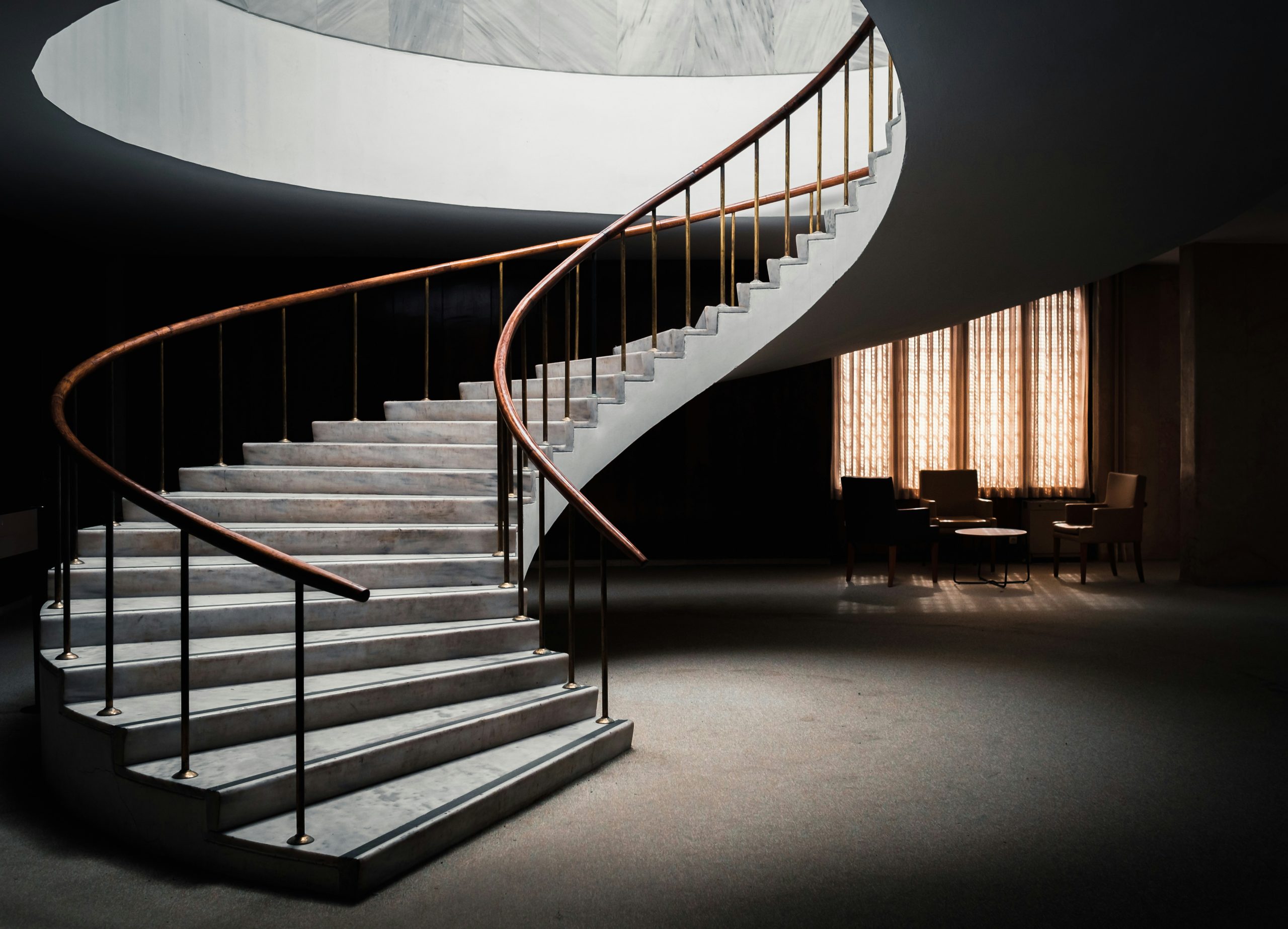
3. Achieve Timeless Drama with a Spiral Marble Staircase
What makes this staircase unforgettable is the masterful mix of materials. It’s not just a marble staircase; it’s the specific combination of cold, smooth white marble treads with the warm, dark wooden handrail and the delicate, shimmering brass balusters. Removing any one of these three elements would diminish its power. The brass, in particular, adds a layer of jewelry-like detail that elevates the entire structure from a simple spiral to a piece of functional sculpture.
|
📋 Copy HEX 🔗 Share |
A grand spiral like this demands vertical space. This idea works best in homes with a two-story foyer or a living area with a ceiling height of at least 16-20 feet. The staircase itself will require a circular footprint of approximately 8-10 feet in diameter to feel substantial and not cramped. It’s a statement piece for a generous floor plan. For smaller spaces, consider the more compact spiral shown in Idea #4, which achieves a similar verticality with a much smaller footprint.
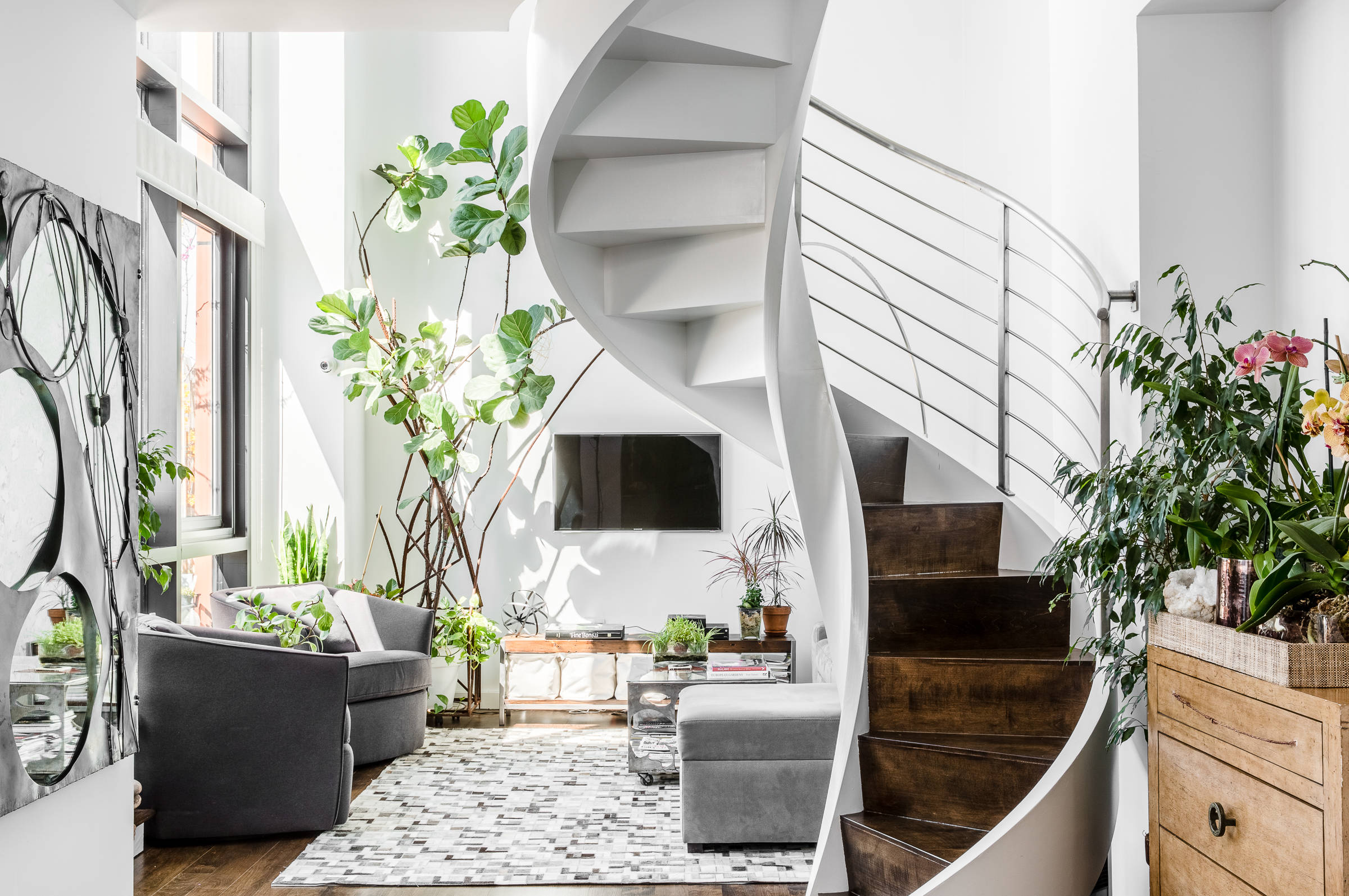
4. Go Contemporary with a White Spiral and Dark Wood Treads
The success of this design lies in its bold use of contrast and clean lines. The bright white of the spiral’s central column and outer structure acts as a powerful graphic element against the warmth of the dark wood treads. The horizontal metal bar railing enhances the contemporary feel, creating a sense of lightness and transparency. It’s a modern twist on the classic spiral, feeling less formal and more integrated into a comfortable living space, especially when paired with soft grey furniture and a large potted tree for an organic touch.
|
📋 Copy HEX 🔗 Share |
You don’t need a custom-fabricated staircase to get this look. Companies like Dolle or Arke offer modular spiral staircase kits that can be purchased for a fraction of the price of a custom build, often ranging from $2,000 to $5,000. Look for a kit that lets you use wood treads and a simple metal railing. Pair it with a statement plant from a local nursery and a neutral rug from IKEA or Target, and you can capture this modern, serene vibe without commissioning a bespoke architectural piece.
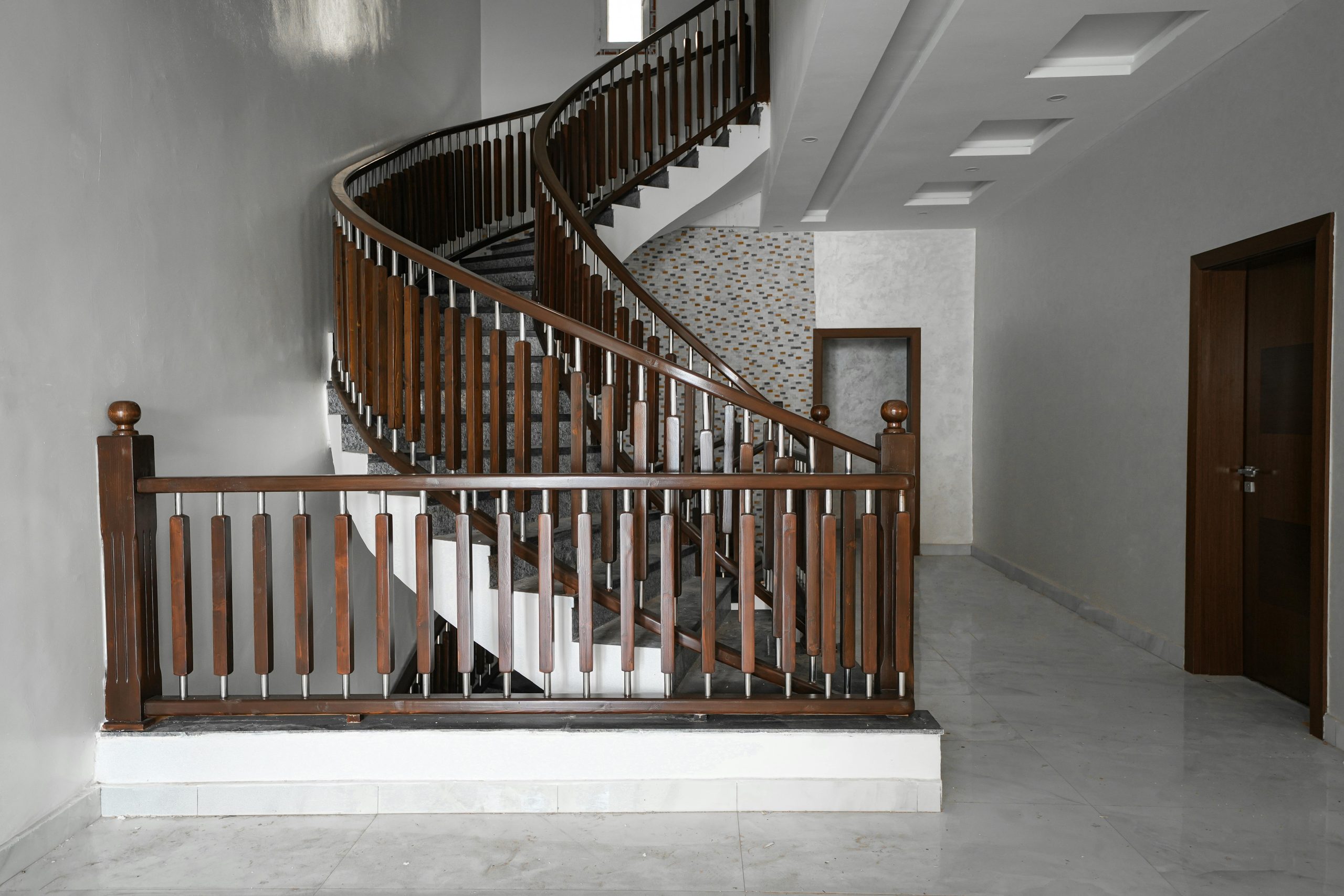
5. Define Your Space with a Mixed-Material Curved Staircase
Here’s a pro tip for using mixed materials on a balustrade: create a repeating rhythm. In this design, the pattern is three dark wood balusters followed by one silver-toned metal rod. This intentional repetition prevents the design from looking random or busy. It establishes a clean, contemporary cadence that guides the eye upward. For your project, decide on your “beat”—be it 2:1, 3:1, or 4:2—and stick to it for a polished, professionally designed appearance.
|
📋 Copy HEX 🔗 Share |
The move toward subtle, textural details is a giant trend right now, and this staircase is a perfect example. We’re seeing homeowners and designers move away from loud, singular statements and toward layered, nuanced spaces. The patterned accent wall, with its small, earth-toned tiles, adds depth and interest without overwhelming the senses. It’s part of a larger shift towards “quiet luxury,” where the quality of materials and thoughtful details—like the mix of wood and metal—matter more than overt displays of opulence.
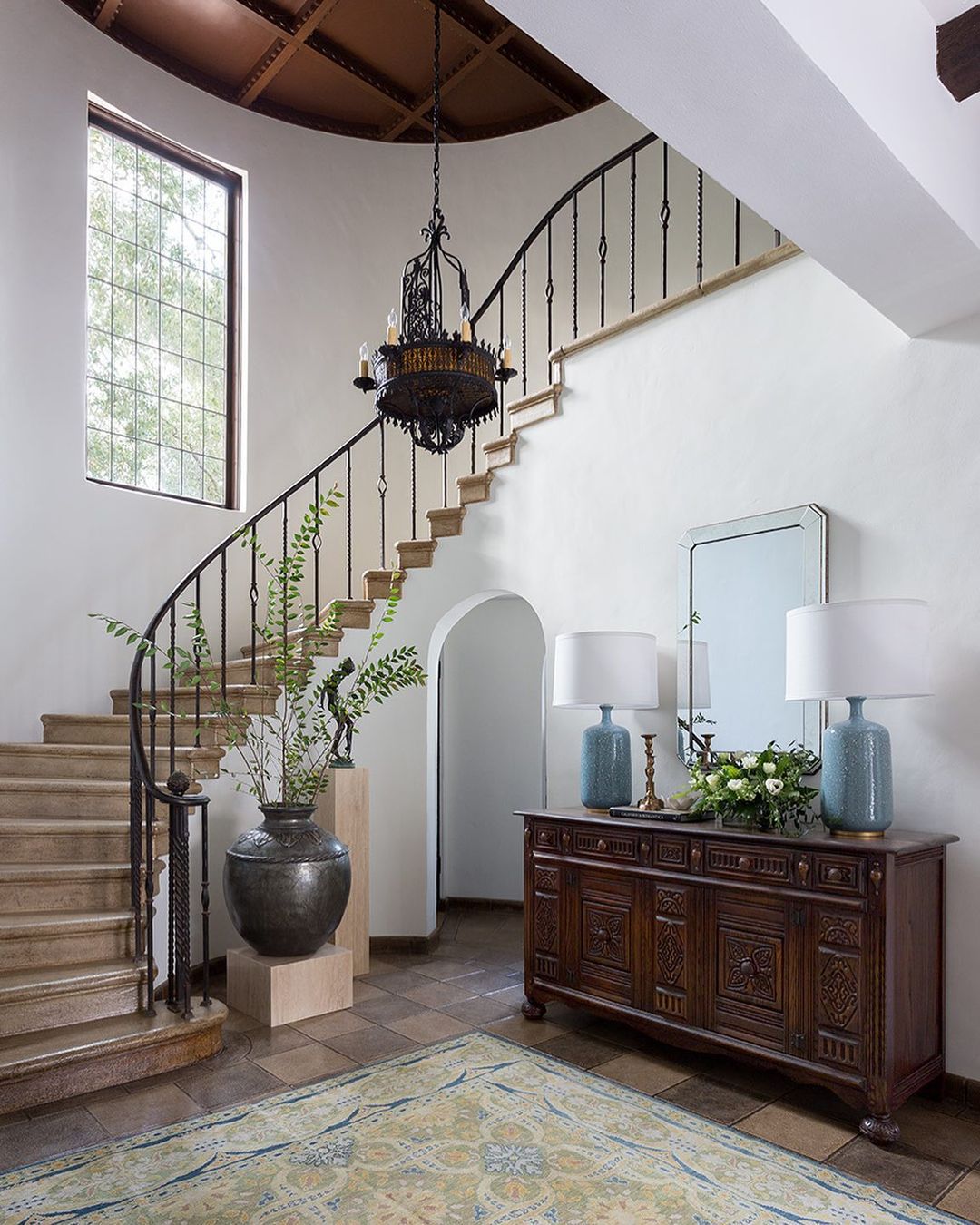
6. Channel Mediterranean Warmth with a Stone and Wrought Iron Staircase
- Custom Wrought Iron Railing: $8,000 – $15,000
- Stone Treads & Risers: $7,000 – $12,000
- Lighting (Chandelier & Sconces): $1,500 – $4,000
- Furniture & Decor (Console, Lamps, Rug): $2,000 – $5,000
- TOTAL: $18,500 – $36,000
- Budget alternative: Use a pre-fabricated iron railing, stain concrete to look like stone, and source furniture from Facebook Marketplace. Estimated cost: $7,000 – $13,000.
|
📋 Copy HEX 🔗 Share |
This look feels so authentic and welcoming because of its commitment to texture and warmth. The slightly rough texture of the stone steps grounds the space, while the dark, ornate wrought iron provides a strong graphic counterpoint. The real star, however, is the coffered wooden ceiling, which adds architectural depth and a rich, warm tone that balances the coolness of the stone and white walls. Finally, the terracotta-toned floor tiles complete the Mediterranean vibe, creating a cohesive and immersive experience from floor to ceiling.
7. Create a Welcoming Entry with a Classic Curved Stair and Wrought Iron
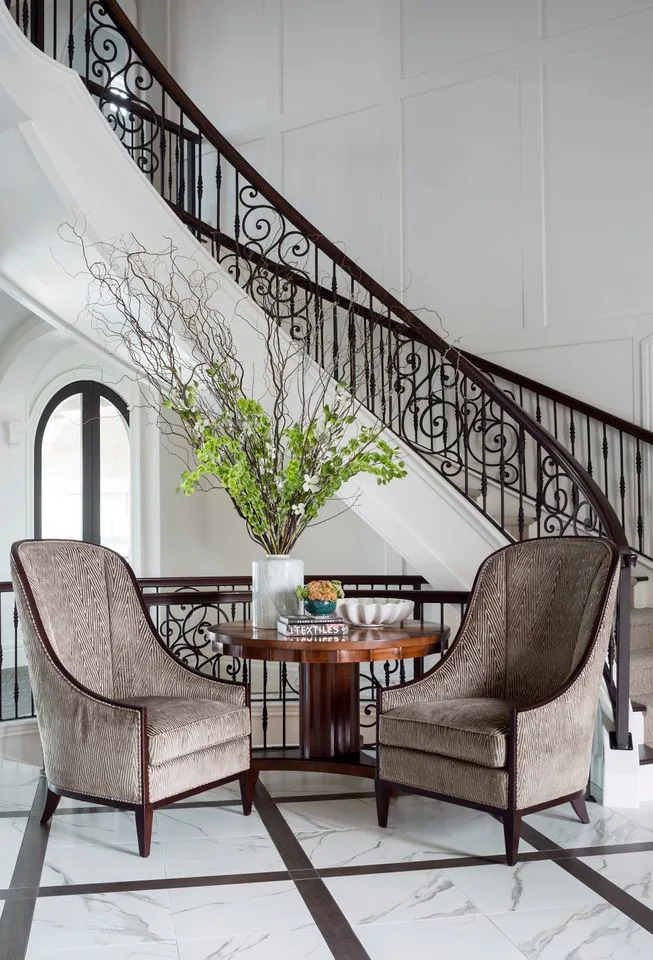
What truly makes this entryway work is the graceful curve of the staircase itself. While the wrought iron is beautiful and the styling is elegant, it is the generous, sweeping line of the stairs that defines the space and creates that immediate sense of grandeur and welcome. It turns a simple functional element into the home’s main architectural event. Without that curve, the entry would feel far more linear and formal; with it, it feels organic and stately. Compare this design to the symmetrical formality of Idea #25.
|
📋 Copy HEX 🔗 Share |
A grand, single-sided curve like this design is perfect for entryways that are wide but perhaps not exceptionally deep. It requires a significant footprint, typically a minimum of 12 feet in width, to allow for the curve and comfortable passage. The ceiling should be at least 10 feet high on the ground floor, rising to a two-story height in the stairwell itself to accommodate the drama of the ascent and the scale of the wrought iron balustrade. This is a look designed for a generous, open foyer.
8. Illuminate Your Steps with Integrated LED Lighting
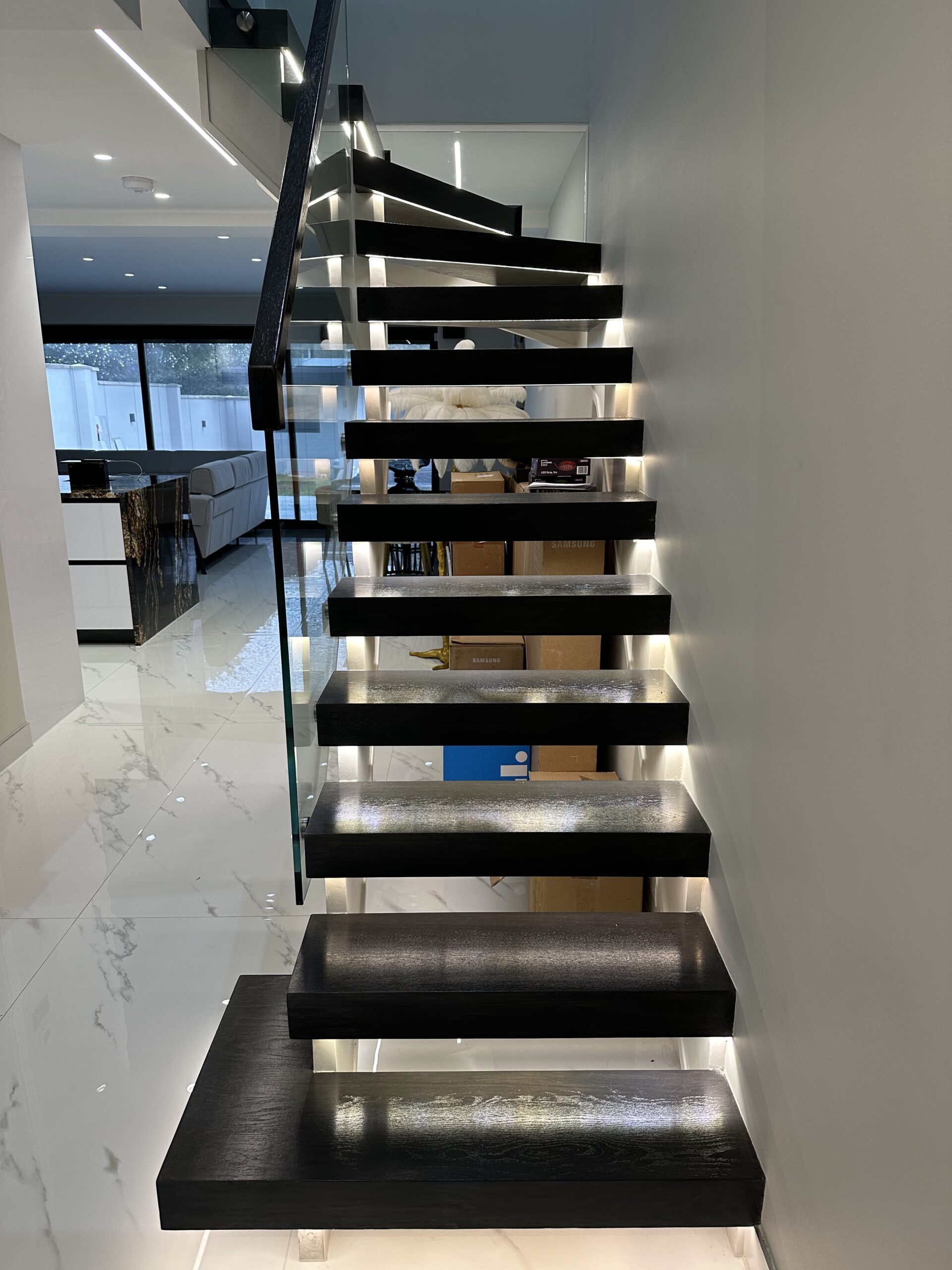
Installing integrated stair lighting requires planning well before the drywall goes up. Here’s a quick guide: 1. Choose your light type: linear LED strips (like the ones shown) for a seamless glow, or individual puck lights for a scalloped effect. 2. Work with your electrician to run low-voltage wiring from a transformer to each tread location. This is a critical pre-build step. 3. Have your stair fabricator create a recessed channel on the underside of each tread to hide the LED strip. 4. Connect everything to a dimmer switch. Full brightness is great for utility, but a 20% glow is perfect for late-night ambiance.
|
📋 Copy HEX 🔗 Share |
While this look is undeniably sleek and modern, there are a few practical points to consider. The floating design with a glass railing, much like in Idea #1, offers minimal sound insulation. More importantly, the integrated lighting, while beautiful, adds another layer of electronic complexity to your home. If an LED strip or a driver fails, accessing and replacing it can be complicated and may require a specialist. Furthermore, be mindful of the light’s color temperature; a cool white light (around 4000K) feels very modern, while a warm white light (2700K-3000K) creates a cozier effect.
9. Make a Statement with a Floating Staircase and Orb Chandelier
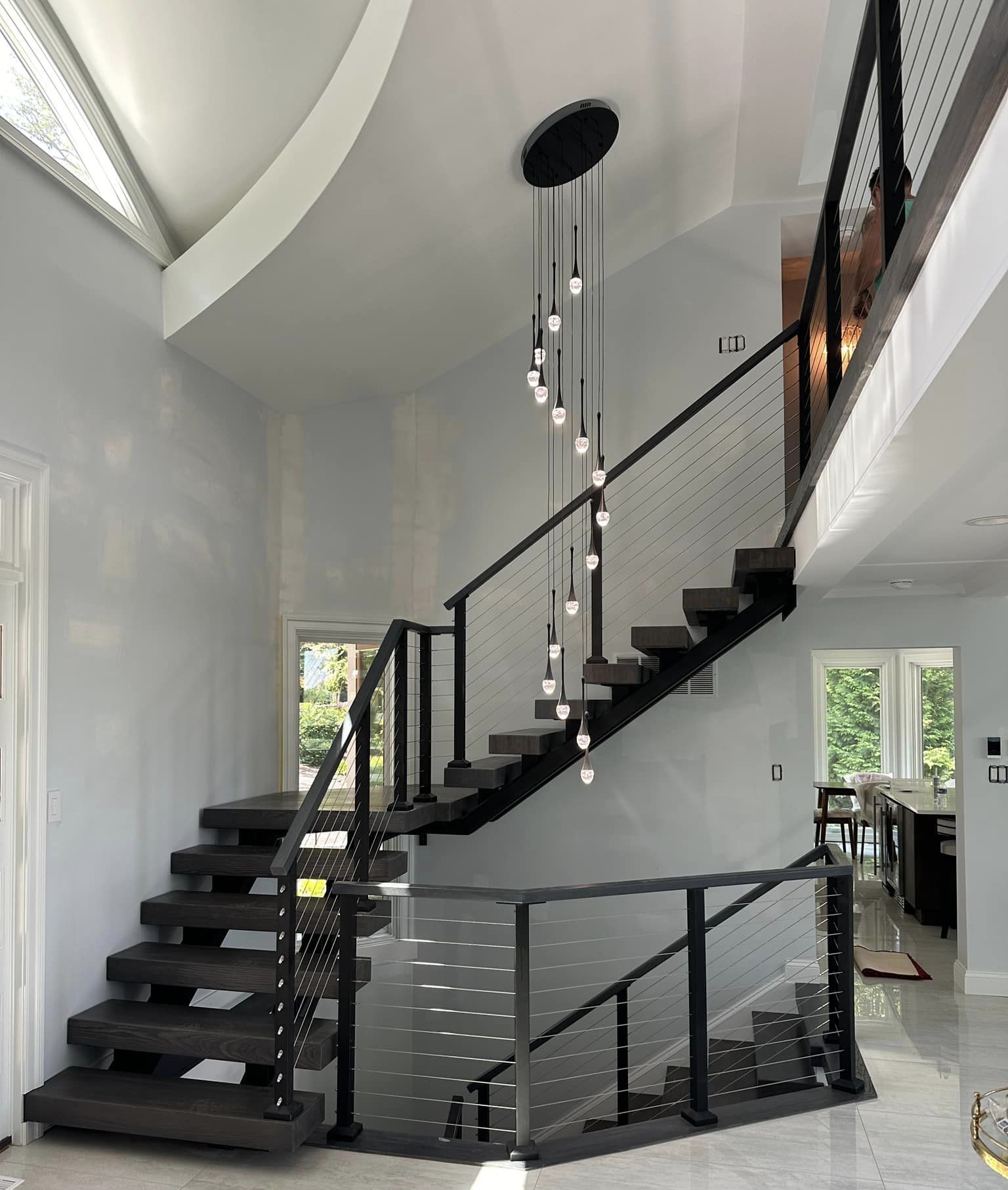
This entryway is a masterclass in balancing bold, linear elements with soft, sculptural forms. The strong horizontal lines of the floating dark wood treads and cable railing create a rigid, modern framework. The overall look is then perfectly softened by the dramatic, multi-light orb chandelier, which introduces curves and a sense of cascading movement in the vertical space of the stairwell. The high-gloss, light gray floor tiles add to the sleekness while reflecting light, making the entire area feel brighter and more open.
|
📋 Copy HEX 🔗 Share |
When hanging a large statement chandelier in a stairwell, the placement height is critical. The bottom of the fixture should hang low enough to be a feature from the ground floor, but high enough that it doesn’t obstruct the view or create a hazard as you ascend the stairs. A good rule of thumb is to ensure the lowest point of the chandelier is at least 36 inches above the stair treads at their closest point and about 7-8 feet off the ground floor. This ensures it feels integrated into the space from every angle.
10. Add Artistic Flair with a Floating Staircase and Sculptural Railing
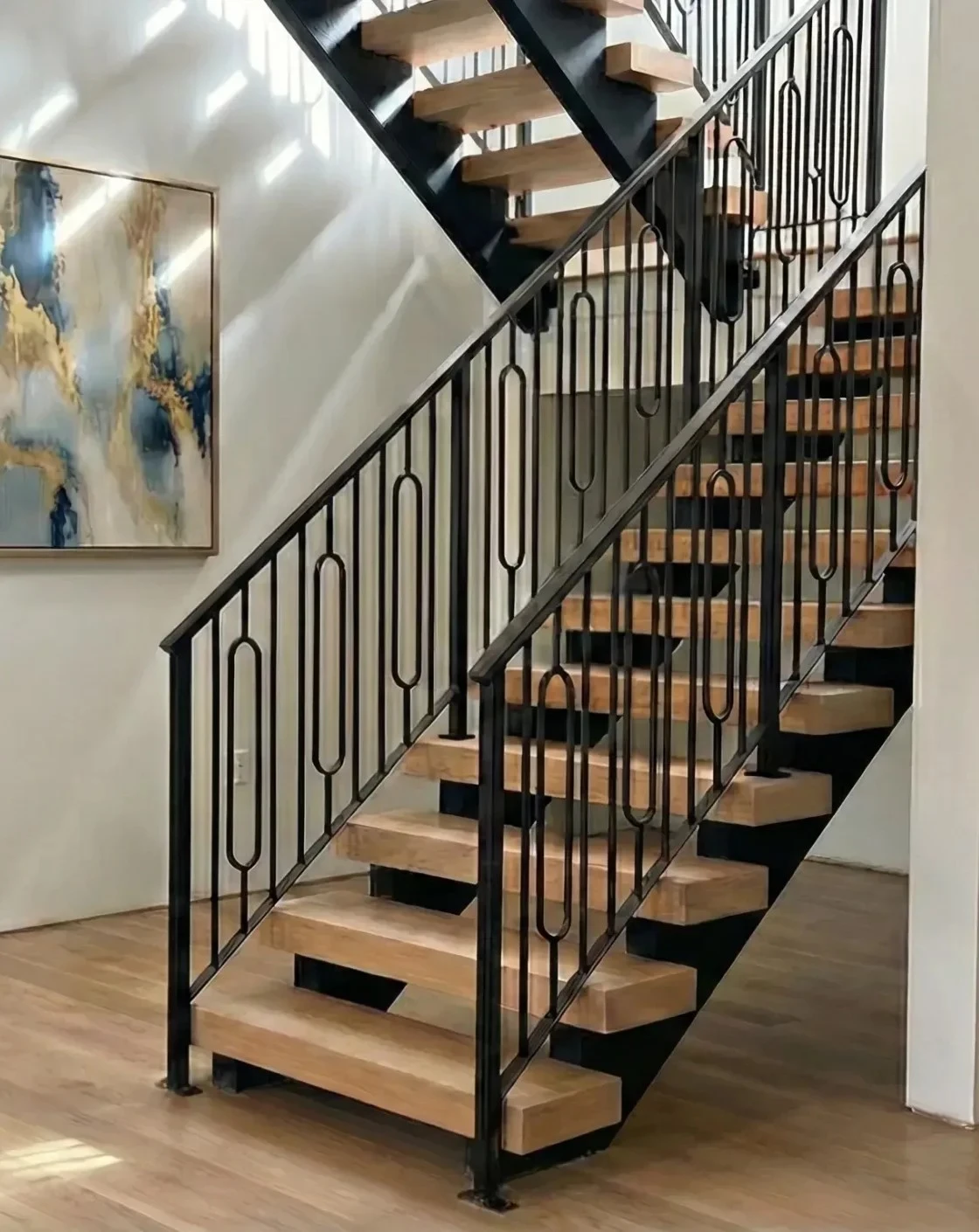
The absolute standout feature here is the railing’s unique elongated oval balusters. In a world of simple vertical posts or horizontal cables, this sculptural choice turns the railing from a safety requirement into a piece of art. It’s a detail that demonstrates incredible thoughtfulness and a commitment to custom design. It interacts with the adjacent abstract artwork, making the entire wall a curated composition of form, color, and line. This is a much warmer take on a modern stair than the industrial version in Idea #12.
|
📋 Copy HEX 🔗 Share |
Get this artistic-modern formula: 50% Natural Raw Materials (light oak treads and flooring) + 40% Matte Black Metal (stringers, handrail, and those gorgeous balusters) + 10% Curated Color (the blues and golds from a single piece of statement art). By keeping the foundational palette so tight and neutral, you create the perfect backdrop for a powerful pop of artistic expression. You could swap the art and instantly change the accent color without having to redecorate the entire space.
11. Inject Personality with Floating Treads and Vibrant Art
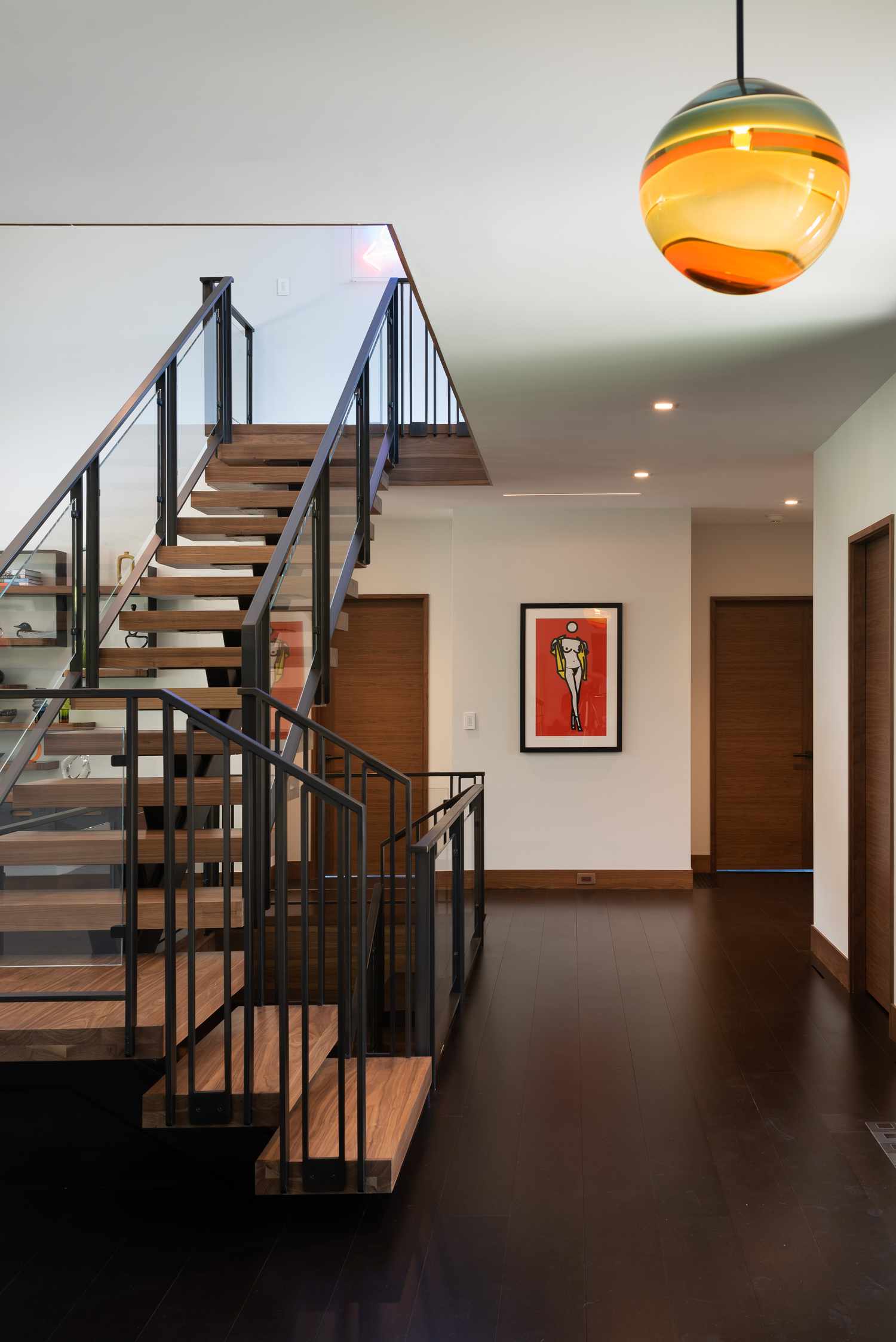
This space feels so vibrant and sophisticated because it confidently pairs clean, modern architecture with bold, personal touches. The staircase itself, with its floating wood treads, glass panel, and dark metal handrail, is a textbook example of contemporary design. However, it’s the injection of color and personality—the playful orange-striped globe pendant and the fiery red and yellow abstract artwork—that elevates it from a generic modern house to a home with a soul. It’s proof that modern design doesn’t have to be cold or sterile.
|
📋 Copy HEX 🔗 Share |
A word of caution about floating staircases: they are not universally kid-friendly. The open risers can be a potential hazard for small children, and many local building codes now have specific requirements regarding the maximum opening size between treads. While beautiful, it’s essential to check your local regulations before committing to this style. Some areas may require riser bars or other modifications to meet safety standards, which can alter the ‘true’ floating appearance.
12. Embrace Industrial Minimalism with Wood Treads and a Concrete Wall
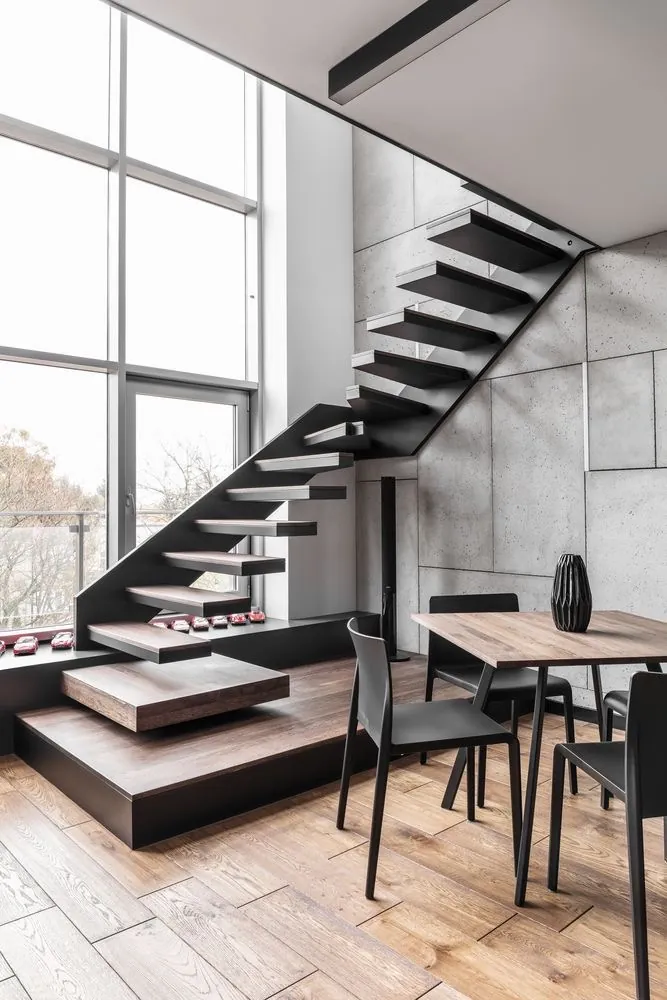
This look is at the forefront of the “Industrial Luxe” trend. For years, industrial design meant reclaimed, rough-hewn everything. Now, it’s about refining that aesthetic. Here, the raw, patterned gray concrete wall provides the industrial edge, but it’s paired with sleek, dark wooden treads and a minimalist black metal stringer. It’s a grown-up version of industrial style—less about looking like a factory and more about celebrating raw materials in a highly designed, intentional way. The large, clean platforms at the base are a perfect example of this refined approach.
|
📋 Copy HEX 🔗 Share |
While a raw concrete wall is incredibly durable, it’s not entirely maintenance-free. Unsealed concrete can be porous, meaning it can absorb stains from spills or even oily fingerprints. To keep it looking sharp, it should be cleaned with a pH-neutral cleaner and sealed upon installation, with the sealant being reapplied every 3-5 years, especially in a high-traffic area like a stairwell. The dark wood treads will also show dust more readily than lighter wood, so they’ll benefit from frequent sweeping or vacuuming.
13. Create a Cozy Reading Nook Beneath Your Stairs
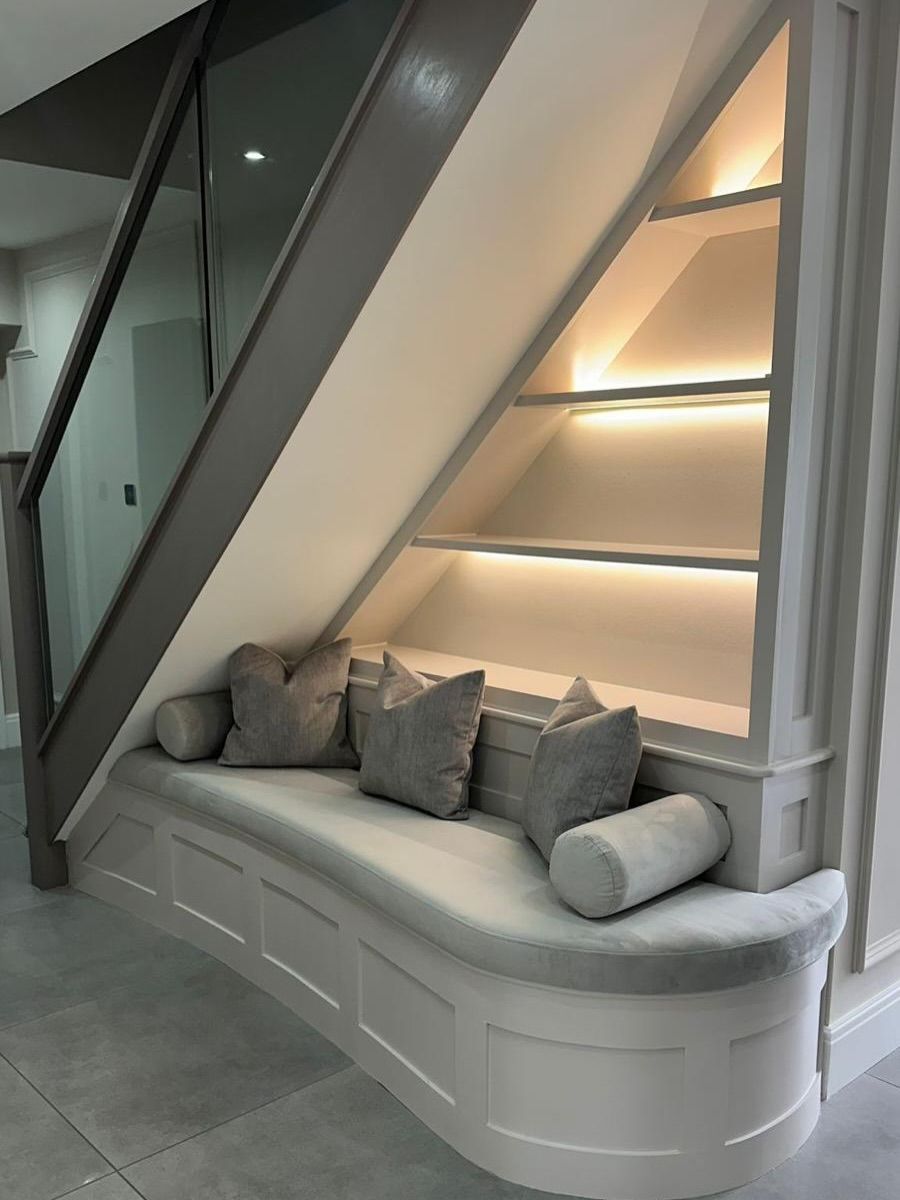
- Measure the space accurately. You’ll need at least 30 inches of depth and 60 inches of length to create a bench that feels comfortable, not cramped.
- Check for utilities. Ensure there is no plumbing, HVAC, or essential electrical wiring in the wall you plan to open up.
- Plan your lighting. Will you have integrated LEDs like these? A stylish wall sconce? Plan the wiring with an electrician before you begin construction.
- Confirm your flooring. Can the existing floor tiles be patched if the footprint of the wall changes?
|
📋 Copy HEX 🔗 Share |
The single element that makes this nook so successful and inviting is the integrated, warm lighting within the built-in shelves. Without it, the space under the stairs could feel dark and cave-like. The lighting provides practical illumination for reading and casts a soft, ambient glow that turns the entire area into a focal point. It highlights the displayed objects and makes the gray upholstery feel warmer and more inviting. It’s a simple addition that completely transforms the mood of the space from a clever storage spot to a truly cozy retreat. Much more inviting than the pull-out storage of Idea #20, isn’t it?
14. Filter Light with a Translucent Wall and Wood Slat Staircase
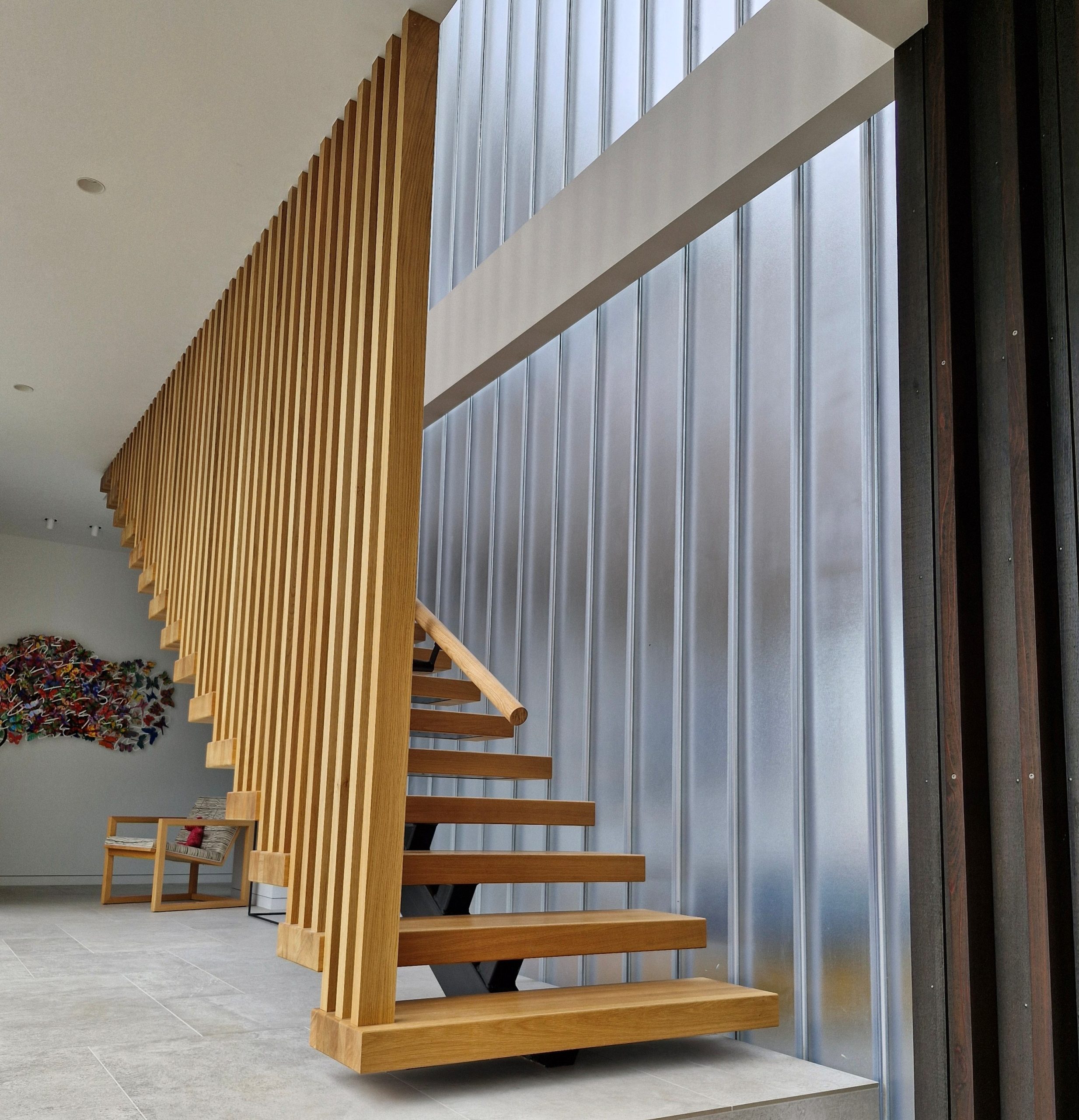
This design masterfully plays with light and texture. The primary genius is the translucent corrugated wall, which allows natural light to flood the space while maintaining privacy. It creates a soft, diffused glow that makes the entire stairwell feel ethereal and bright. This is beautifully contrasted with the rigid, linear texture of the vertical wood slats on both the railing and the adjacent wall section. The mix of transparent, translucent, and opaque surfaces creates a dynamic and sophisticated experience.
|
📋 Copy HEX 🔗 Share |
When using wood slats as a design feature, consistency in spacing is key to achieving a high-end, architectural look. A gap of 1/2 to 3/4 of an inch between slats is a good standard. For a stair railing, ensure the gap is small enough to meet building codes (typically, a 4-inch sphere cannot pass through). Use a spacer block when installing to guarantee every gap is identical. This precision is what separates a DIY look from a professional-grade installation.
15. Achieve an Airy Feel with a Curved Floating Staircase
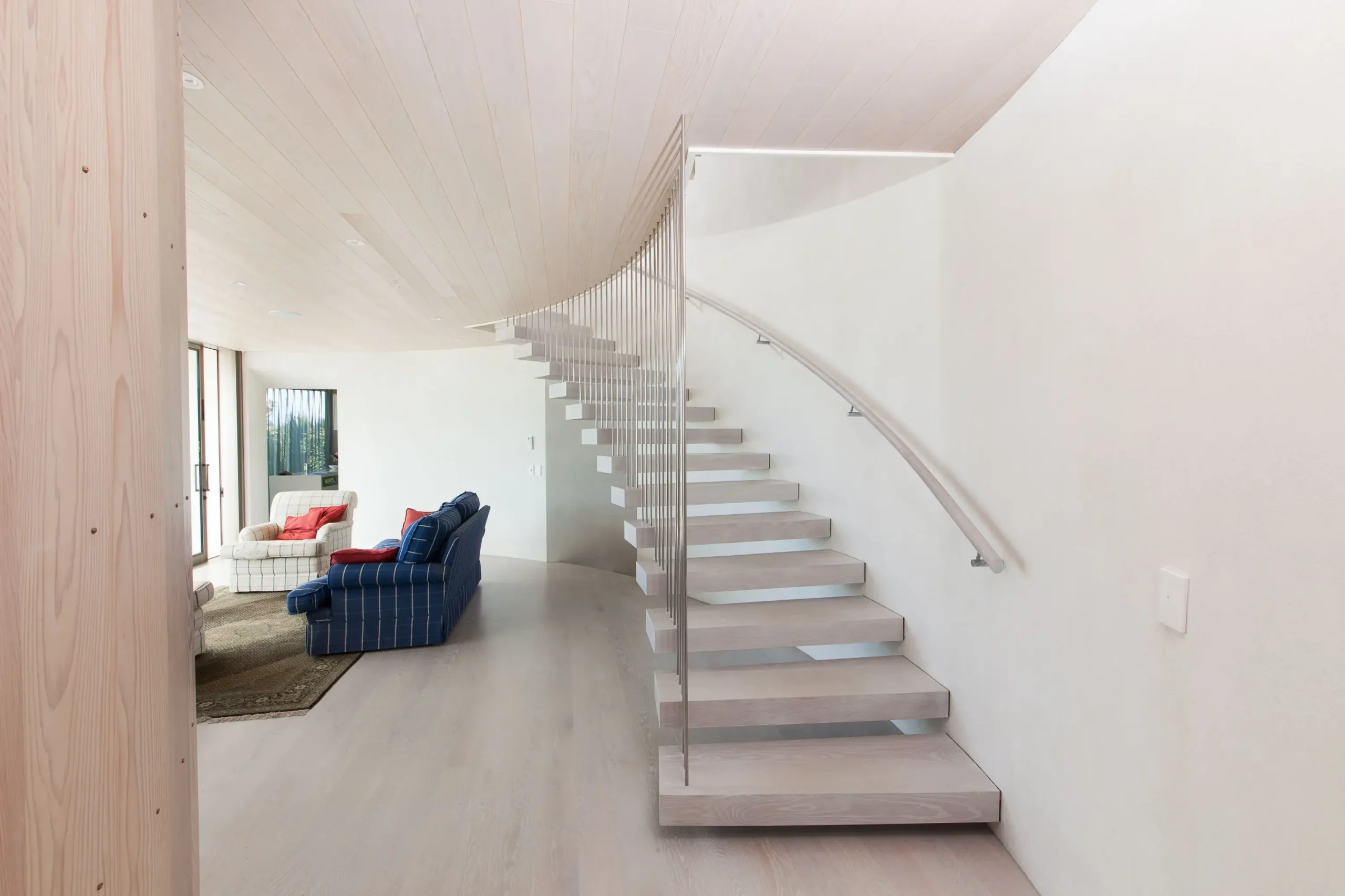
A curved floating staircase is a true work of art, but its engineering is complex and expensive. This is not an off-the-shelf purchase. It requires a significant structural spine, often custom-fabricated steel, hidden within the wall to support the cantilevered treads. The cost can be 3-5 times that of a conventional staircase due to the specialized engineering, fabrication, and installation that are required. It’s a breathtaking choice, but be prepared for a significant investment in both time and budget.
|
📋 Copy HEX 🔗 Share |
This style of staircase is ideal for open-concept spaces where maintaining a sense of light and airiness is paramount. Because the treads are individual planks and the balusters are thin metal rods, it has a very low visual weight. It works best with ceiling heights of 9 feet or more to allow the delicate structure to feel proportional. The footprint is relatively compact for a curved stair, but ensure you have at least a 7-foot diameter of open space to allow the curve to feel graceful rather than forced.
16. Embrace Minimalist Contrast with Light Wood and Black Metal
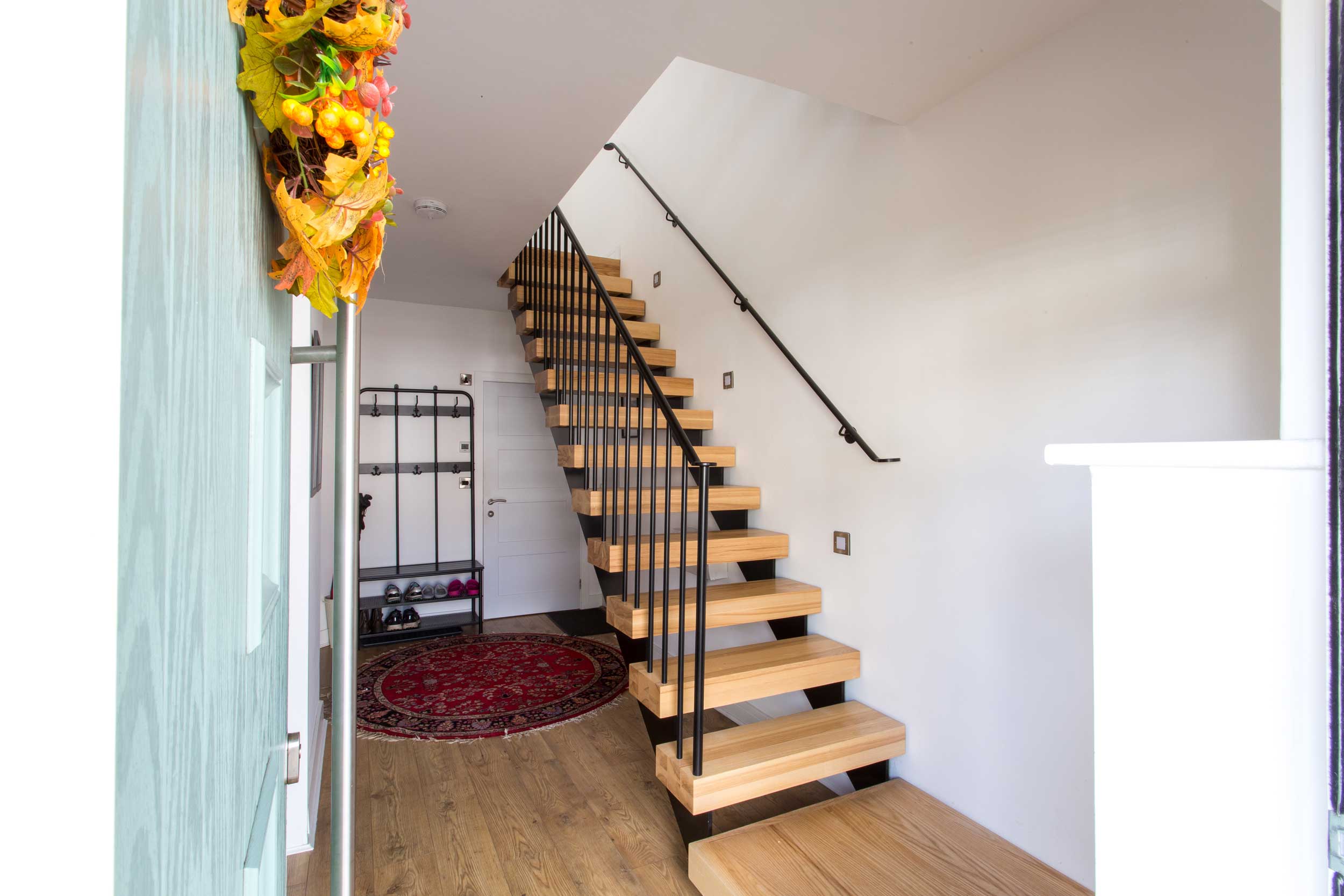
This clean, modern look is more accessible than you might think. The floating treads can be achieved by using a hidden steel stringer painted to match the white wall, with the light wood treads mounted on top. The black metal railing is a standard component available from many suppliers. Check out stores like Wayfair or homedepot.com for simple, modern railing kits. The key is the high-contrast palette. By keeping the walls white, the floors and stairs light wood, and the accents (railing and coat rack) matte black, you get that Scandinavian-inspired look for less. You can see similar palettes in Idea #10, but with a more artistic railing.
|
📋 Copy HEX 🔗 Share |
The power of this design comes from its simplicity and restraint. It adheres to a strict three-part palette: light wood, white, and black. This creates a clean, graphic quality that feels intentional and uncluttered. The floating treads create negative space, making the entryway feel larger and more open. The black metal railing acts as a bold line drawing in the space, defining the path of travel without adding visual bulk. It’s a testament to the idea that exceptional design is often about what you leave out.
17. Energize Your Space with a Bold Green Metal Staircase
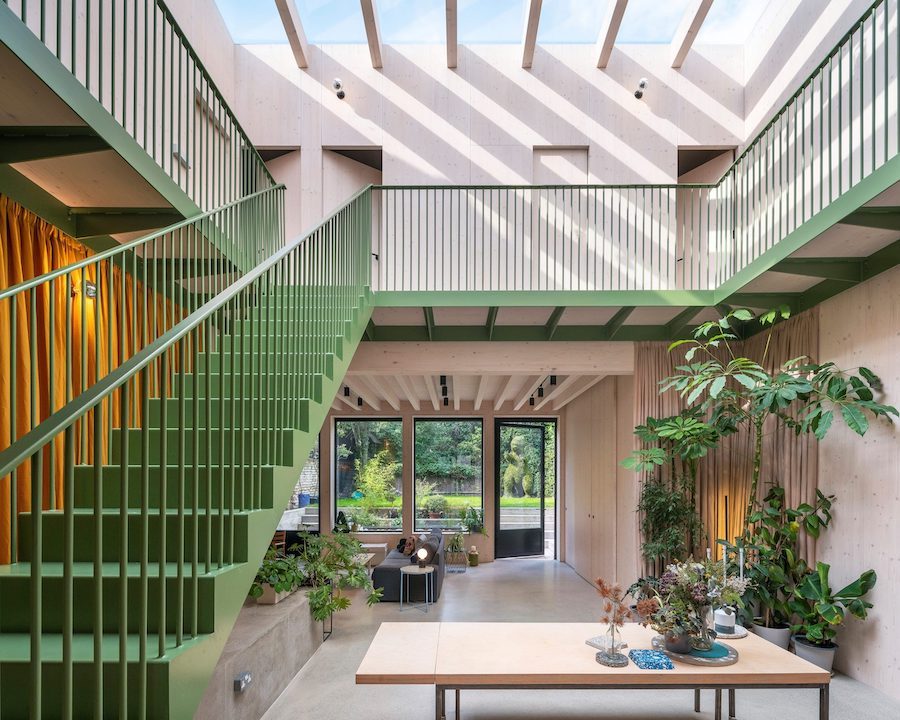
The single element that defines this entire space is the audacious choice of green for the metal staircase. In a world of black, white, and wood, this splash of vibrant, saturated color is a bold declaration of personality. It transforms the staircase from a mere utility into the home’s central sculpture. The color choice connects harmoniously with the numerous potted plants, reinforcing a theme of vibrant, natural life within an otherwise industrial-leaning structure with concrete floors and a massive skylight.
|
📋 Copy HEX 🔗 Share |
This design perfectly captures the current trend of “joyful expression” in interior design. After years of minimalist neutrals, people are craving color and personality in their homes. This isn’t just about a painted accent wall; it’s about making bold, confident choices on major architectural elements. Using an unexpected color like this vibrant green on a staircase says that you don’t take your home too seriously and that you prioritize creating a space that feels energetic, optimistic, and uniquely yours.
18. Create Warm Contrast with Wood Stairs and a Dark Accent Wall
When pairing a wooden staircase with a dark wall, the wood’s undertone is key. These stairs have a warm, slightly reddish-brown finish. This warmth is beautifully balanced by the cool, deep charcoal gray of the accent wall. If the wood had been a cooler, ashier brown, the combination wouldn’t feel as rich and inviting. Before committing to a paint color, get samples of your wood stain and your potential dark paints and look at them together in your home’s natural light to find the perfect pairing.

|
📋 Copy HEX 🔗 Share |
The formula for this inviting, modern look is all about balance: 50% warm, medium-toned wood + 30% deep, cool charcoal/black + 20% crisp white and light grey. The wood provides the warmth and natural texture. The dark wall creates depth, drama, and a focal point. The white walls and light grey floor tiles act as a neutral canvas, preventing the dark elements from overwhelming the space and ensuring the overall feeling is bright and modern, not dim and heavy.
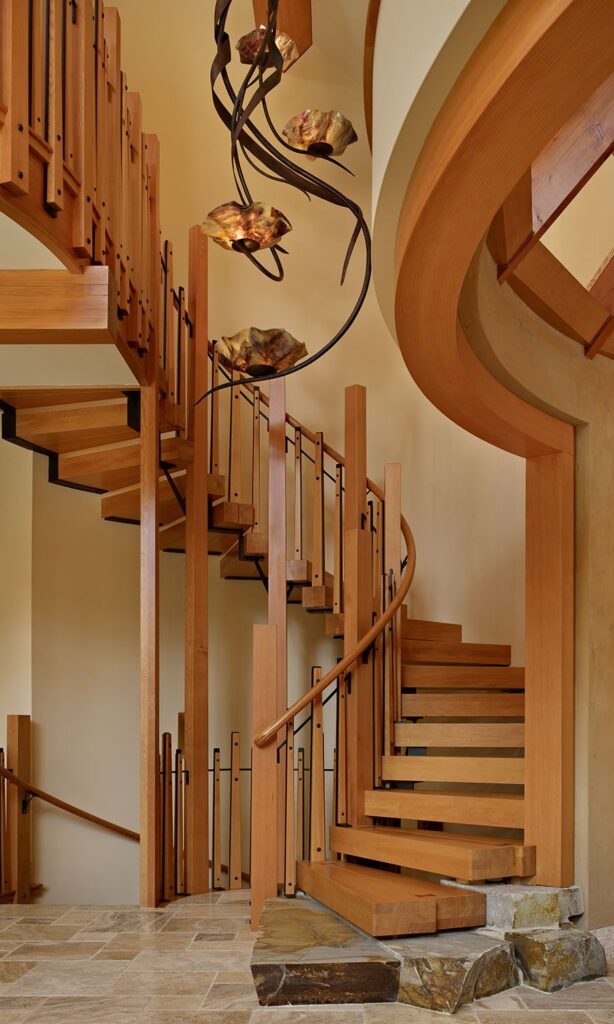
19. Go Organic with a Sculptural Wooden Spiral Staircase
This staircase feels like a piece of natural sculpture because of its commitment to organic forms and materials. The balusters aren’t simple posts; they are stacked, molded wooden pieces that create a sense of rhythm and texture, almost like a spine. The base isn’t a simple tread; it’s made of large, free-form natural stone steps. Even the chandelier, with its wrought iron branches and hand-blown glass, mimics organic shapes. The entire composition avoids straight lines in favor of curves and natural patterns, resulting in a grand, artistic, and grounded design.
|
📋 Copy HEX 🔗 Share |
A staircase with this much intricate woodwork requires specific care. The stacked wood balusters create many small surfaces and crevices where dust can accumulate. Regular dusting with a microfiber cloth or a brush attachment on a vacuum is essential. To maintain the wood’s luster, it should be cleaned with a wood-specific cleaner and polished once or twice a year. Be mindful of the natural stone base; it should be sealed to prevent staining and cleaned with a pH-neutral stone cleaner, avoiding acidic products like vinegar.
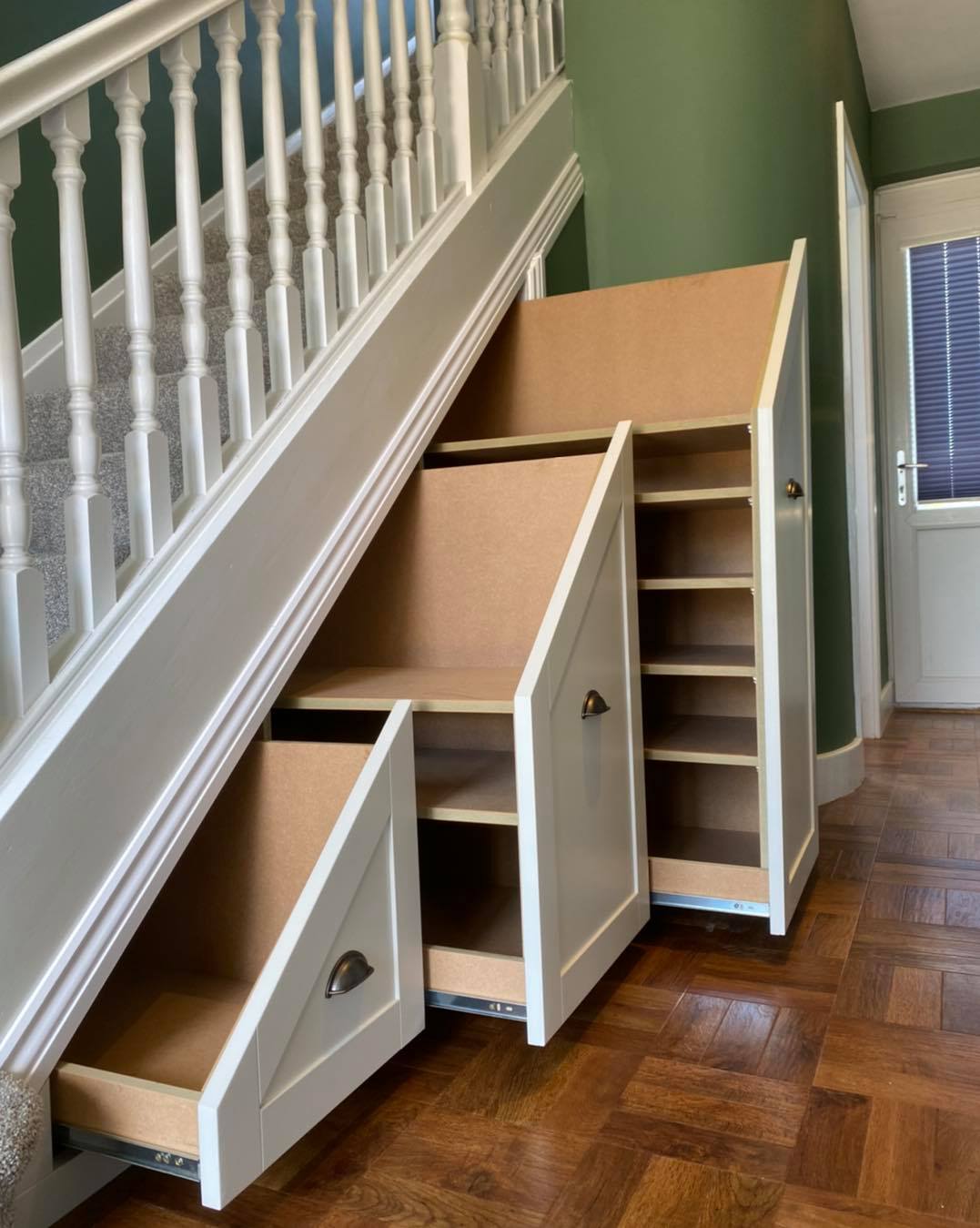
20. Maximize Space with Custom Pull-Out Under-Stair Storage
- Measure and Plan: Carefully measure the height and depth of the space under your stairs. Sketch out the configuration of drawers and cupboards you want, assigning a purpose to each (e.g., shoes, coats, vacuum).
- Build the Frames: Construct sturdy boxes for each pull-out unit using 3/4-inch plywood. The largest units should have heavy-duty castors on the bottom to help support the weight.
- Install Heavy-Duty Slides: This is crucial. Use full-extension, side-mount drawer slides with a high weight rating (100 lbs or more) to ensure smooth operation without sagging.
- Attach Front Panels: Cut MDF or furniture-grade plywood for the drawer fronts. Prime and paint them to match your trim for a seamless, built-in look.
- Add Hardware: Choose handles or knobs that match your home’s existing style. The bronze handles here add a touch of classic warmth.
|
📋 Copy HEX 🔗 Share |
The smartest detail in under-stair storage is to graduate the functions. Use the tallest, deepest pull-out for bulky items like a vacuum cleaner or stacks of sports equipment. The medium-sized sections are perfect for backpacks or shoe trays. The smallest, triangular sections at the low end of the stairs are ideal for single pairs of shoes, umbrellas, or a basket for mail. By planning what goes where, you ensure every cubic inch is used effectively, turning a dead space into a hyper-functional storage hub.
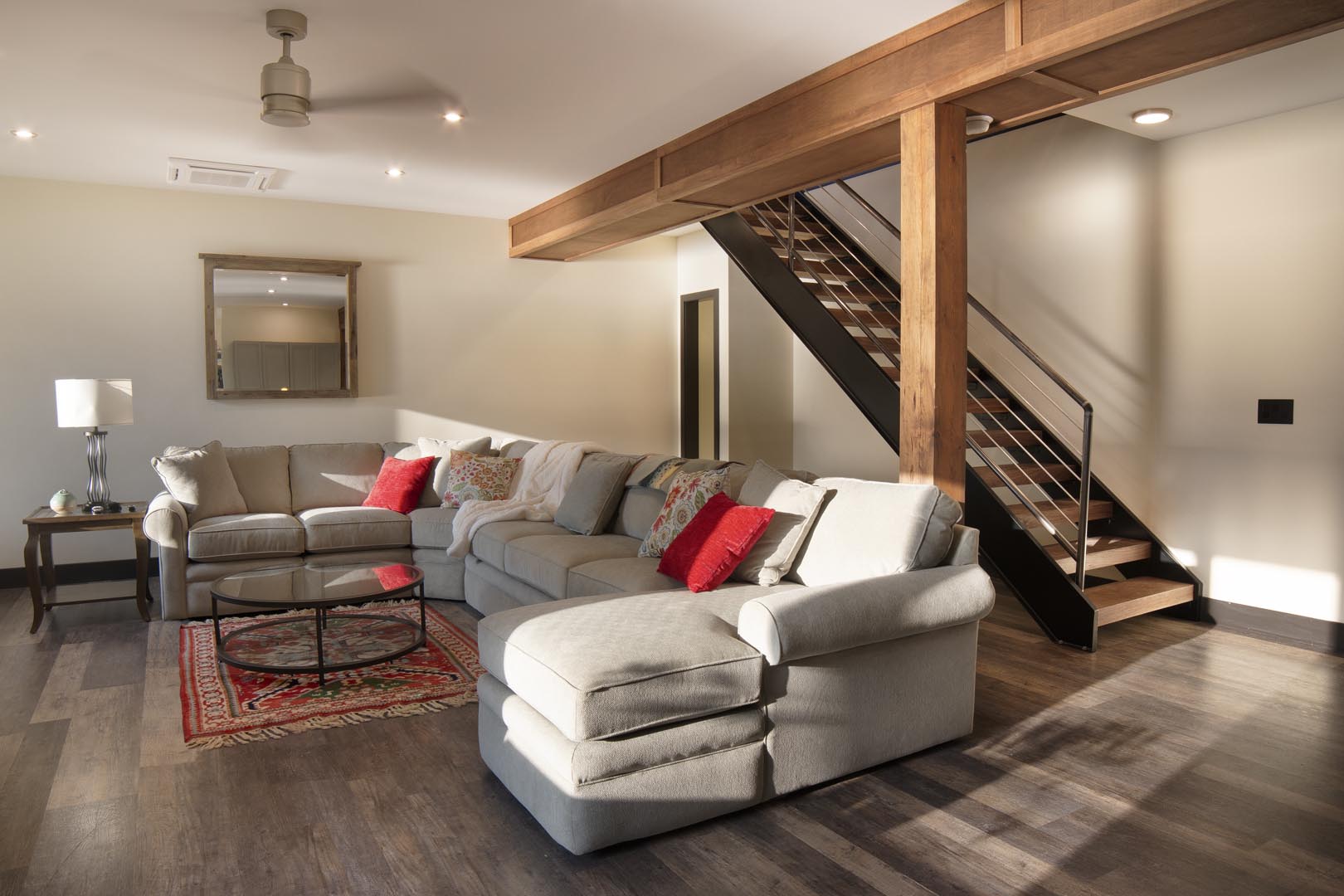
21. Integrate Structure and Style with a Wood Beam Staircase
This design’s success comes from its honesty. Instead of hiding the home’s structural elements, it celebrates them. The massive wooden beam and post aren’t just holding up the house; they are key design features that anchor the entire space. The staircase is thoughtfully integrated with this structure, with the wooden treads echoing the warm tones of the beam. The black steel stringers and stainless steel cable railing add a modern, industrial touch that contrasts beautifully with the natural wood, creating a look that feels grounded, strong, and functional.
|
📋 Copy HEX 🔗 Share |
Cable railings look sleek and minimalist, but they require periodic maintenance. The cables can lose tension over time due to temperature fluctuations and use, causing them to sag. Most systems have built-in tensioning mechanisms at the end posts that need to be tightened with a wrench every year or so to keep the cables taut and safe. Also, be aware that some jurisdictions have specific code requirements for cable railings regarding cable spacing and rigidity to prevent them from being easily climbed by children.
22. Marry Minimalism and Curves with a White Spiral Staircase
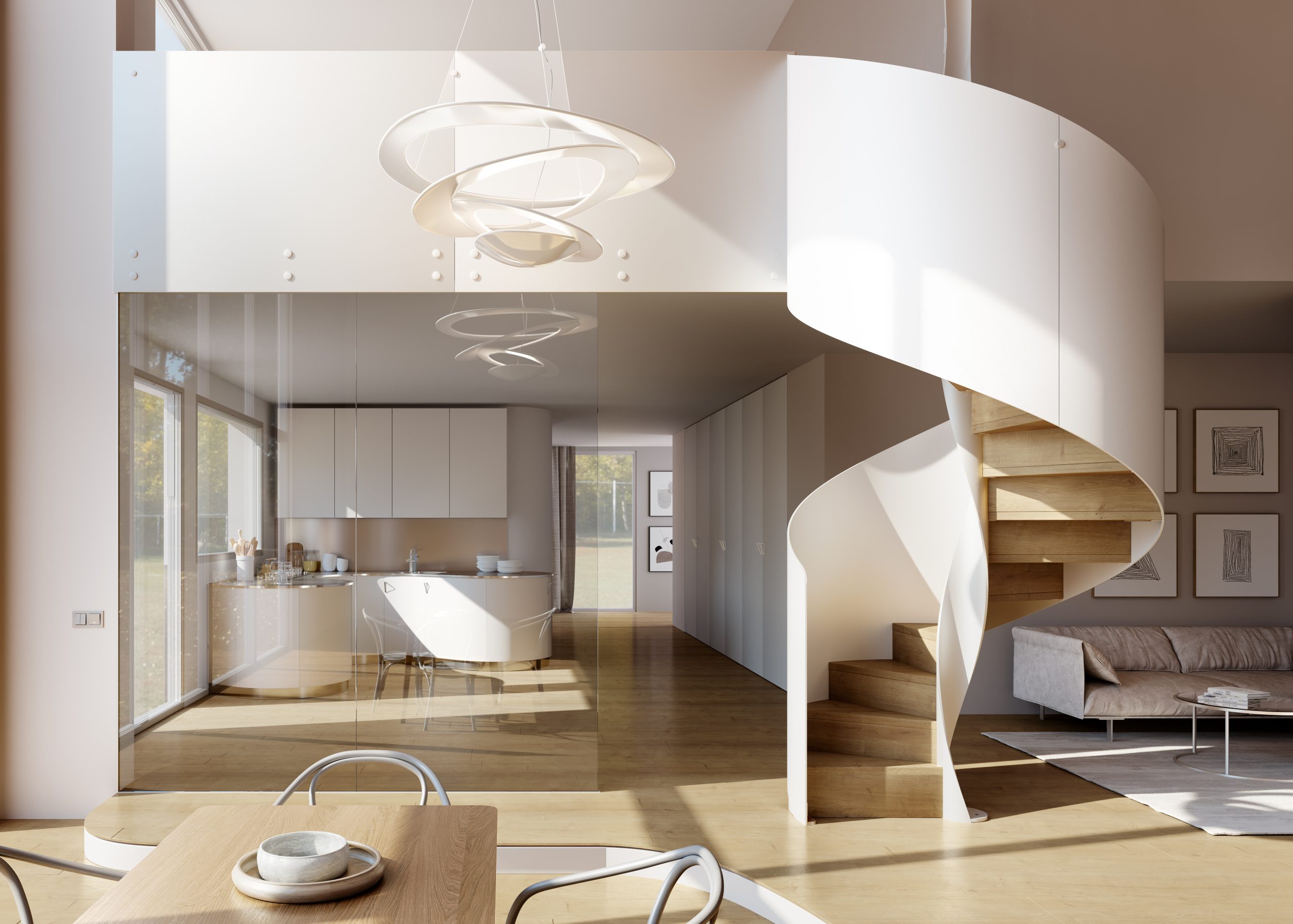
This space adheres to a strict but effective recipe for bright, open modernism: 70% brilliant white (staircase structure, walls, kitchen cabinets) + 20% light, natural wood (stair treads, flooring) + 10% soft, neutral texture (the light brown sofa, taupe rug). The clear glass partition is a key ingredient, maintaining the open feel while defining the kitchen space. By keeping the palette so restrained, the gentle curve of the spiral staircase and the pop of color from the gallery wall become the standout features. Compare it with the different spiral in Idea #4.
|
📋 Copy HEX 🔗 Share |
While a custom-built spiral like this one is a significant investment, you can achieve a very similar aesthetic for far less. IKEA’s ‘LITE’ spiral staircase kit is a fantastic budget-friendly option. Choose the version with birch treads and a white or metal structure. Pair it with white kitchen cabinets from a big-box store and a simple light brown sofa from a retailer like Article or Wayfair. The key is to stick to the minimal color palette to replicate that clean, airy, Scandinavian-inspired vibe.
23. Exude Luxury with a Curved Staircase, Glass Railing, and Brass Handrail
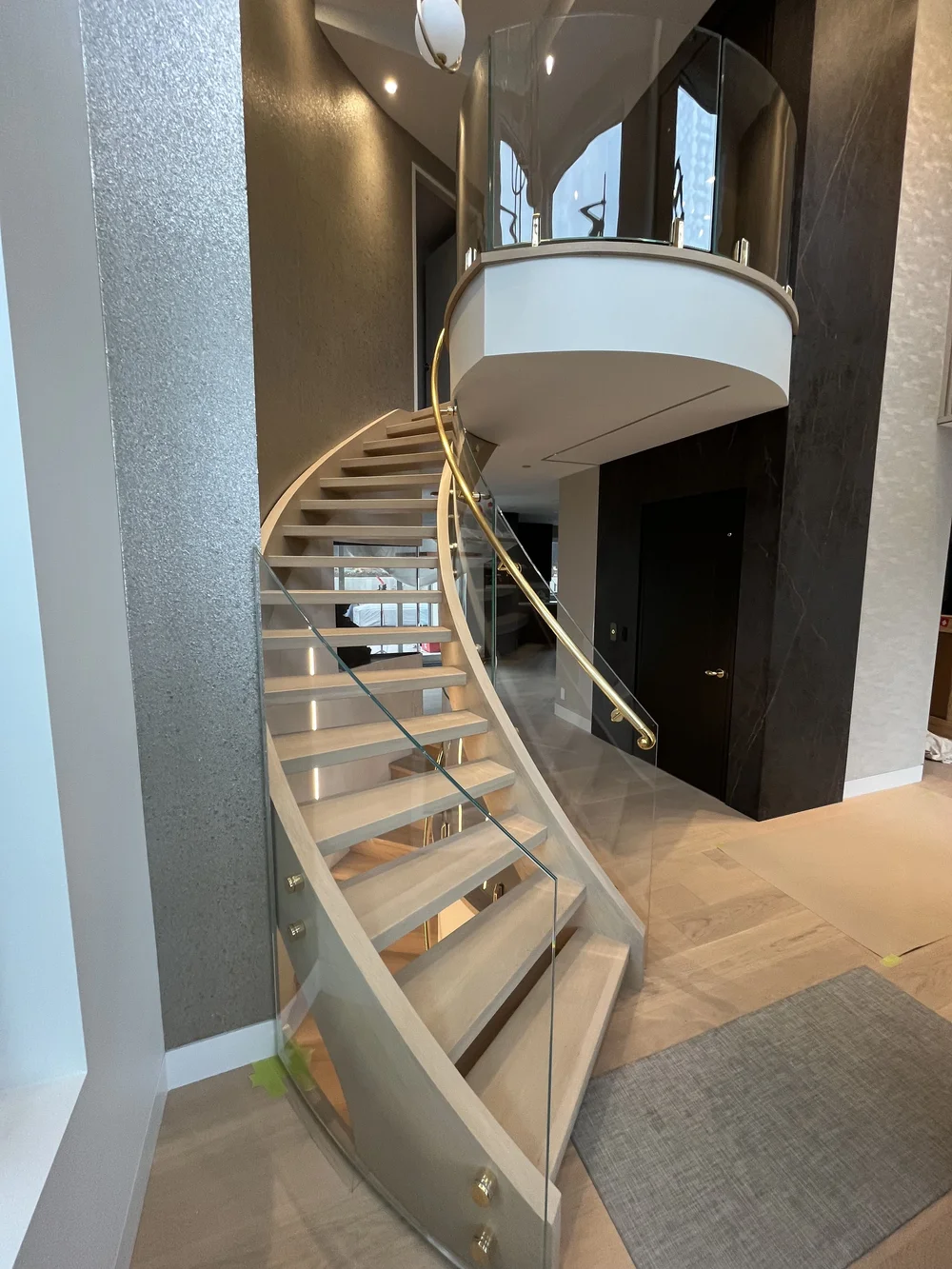
The single element that screams luxury in this design is the polished brass handrail. While the curved structure and light wood treads are beautiful, and the glass railing is modern, it’s the warm, reflective gleam of the brass that elevates the entire composition into something truly opulent. It acts like a piece of fine jewelry for the home, a detail that communicates expense and bespoke craftsmanship. The way it catches the recessed lighting adds a layer of glamour and sophistication that stainless steel or wood simply couldn’t achieve.
|
📋 Copy HEX 🔗 Share |
Polished brass is stunning, but it is not a set-it-and-forget-it material. To maintain its brilliant, mirror-like shine, it requires regular polishing with a brass-specific cleaner to remove fingerprints and prevent tarnishing. If left unpolished, it will naturally develop a patina over time, which can also be beautiful but is a different look entirely. The glass railing will also need frequent cleaning to stay free of smudges. This is a high-end look with a correspondingly high-maintenance commitment.
24. Achieve Curvilinear Modernism with Light Wood and Black Metal
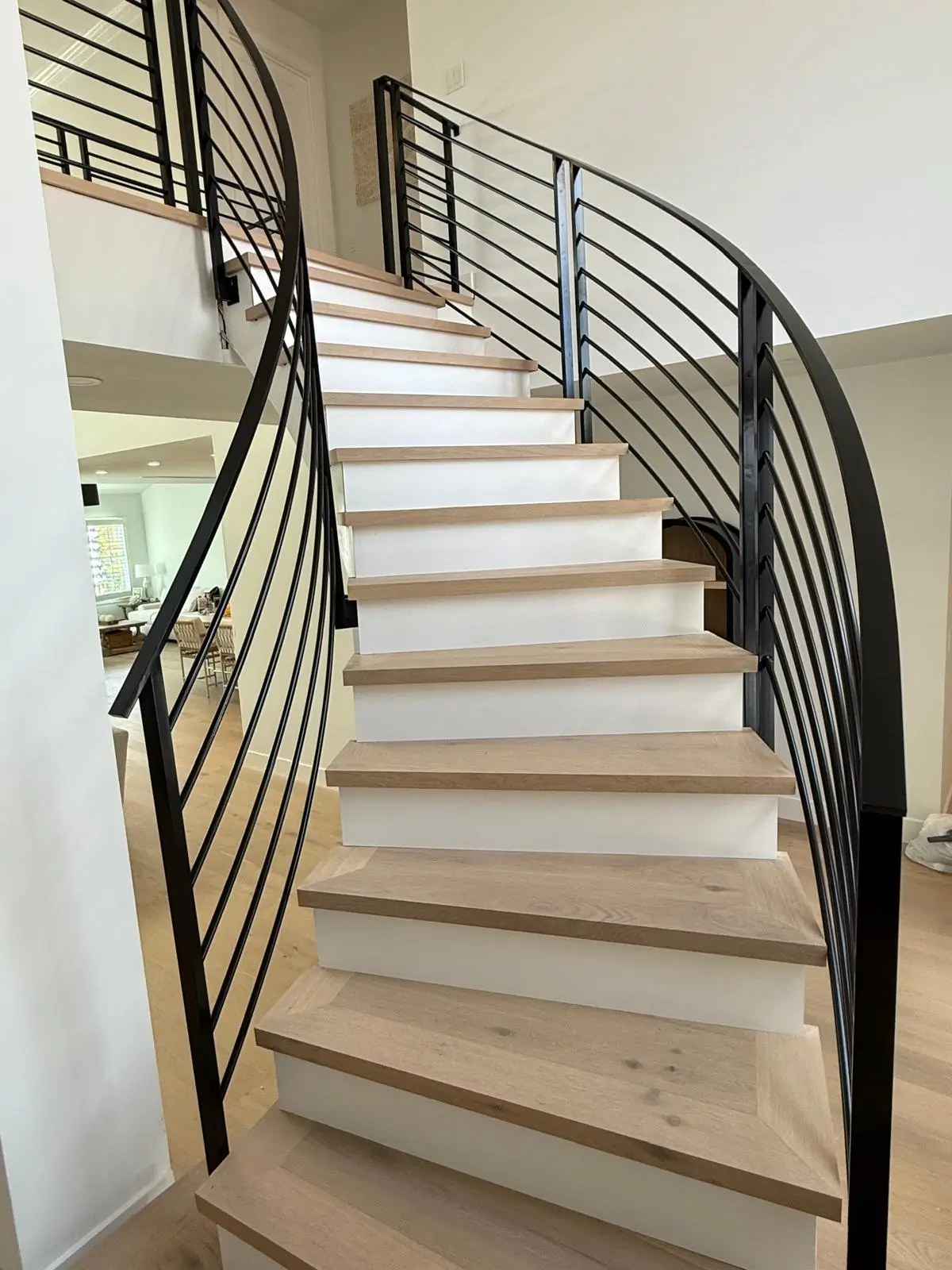
This staircase is a perfect study in graphic contrast. The design’s power comes from the interplay between three simple elements: the warm, natural grain of the light wood treads; the crisp, clean white of the risers; and the bold, black lines of the metal balusters and handrail. The horizontal orientation of the railing accentuates the sweeping curve of the staircase, drawing the eye smoothly upward. The result is clean, elegant, and modern, without feeling cold or sterile thanks to the warmth of the wood.
|
📋 Copy HEX 🔗 Share |
For a modern staircase railing, consider running the balusters horizontally instead of vertically. This small change has a big impact, creating a sense of motion and flow that’s very contemporary. For curved staircases like this one, horizontal railings can be easier and more cost-effective to fabricate than bending individual vertical balusters to match the curve. Just be sure to check local building codes, as some areas have restrictions on horizontal railings due to climbability concerns.
25. Command Attention with a Grand Double Staircase and Ornate Ironwork
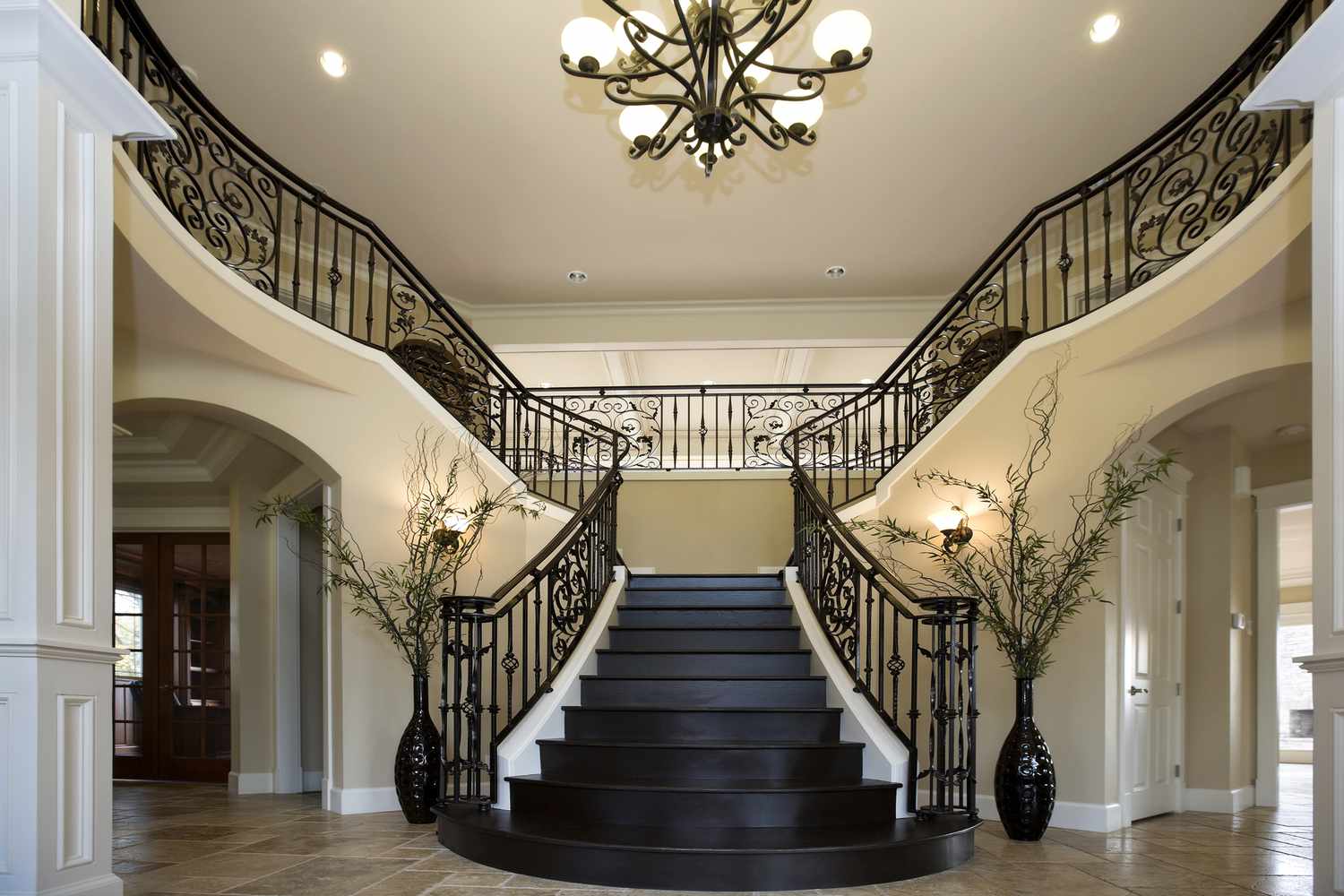
- Custom Wrought Iron Railings (both sides): $25,000 – $50,000+
- Staircase Construction (structure, treads, risers): $15,000 – $30,000
- Grand Chandelier & Sconces: $5,000 – $15,000
- Flooring & Finishes: $5,000 – $10,000
- TOTAL: $50,000 – $105,000+
- Budget alternative: Use stock decorative iron balusters instead of custom scrollwork, and opt for a high-quality wood-look laminate on the treads. Estimated cost: $20,000 – $40,000.
|
📋 Copy HEX 🔗 Share |
This is not a design for the faint of heart or the small of space. A symmetrical double staircase requires a grand, two-story foyer with a minimum width of 18-25 feet and a depth of at least 15-20 feet. The ceiling must be a full two-story height (18+ feet) to accommodate the scale of the structure and the mandatory grand chandelier. Anything less will make the staircase feel crammed and overwhelming, losing its intended effect of opulent, formal grandeur. This look is a close cousin to the single-curved entry in Idea #7, but on a much larger scale.
26. Embrace Sophisticated Warmth with a Curved Oak Staircase
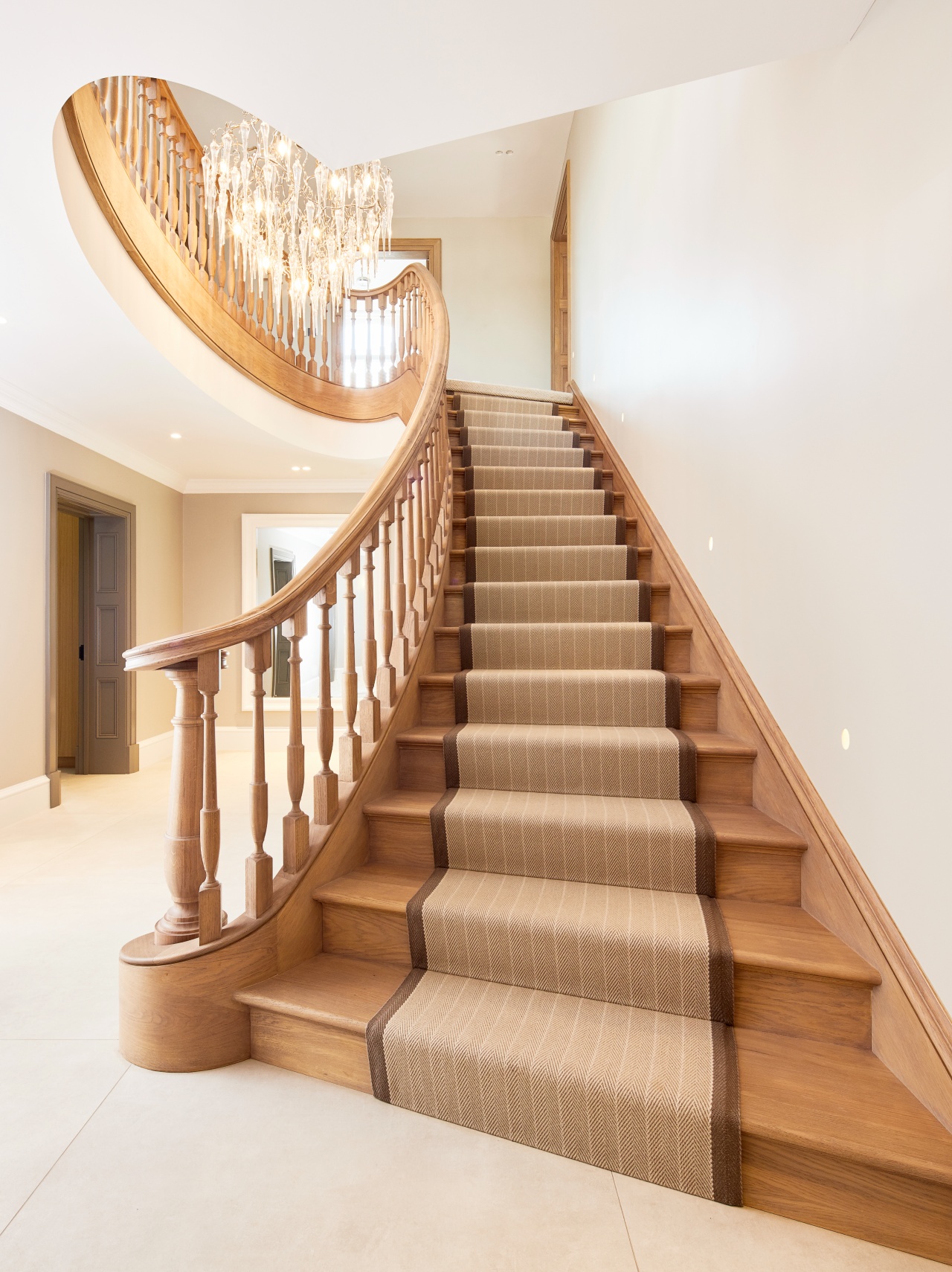
The beauty of this design lies in its tonal harmony and luxurious texture. The entire staircase—treads, handrail, and the beautifully turned balusters—is crafted from the same light, natural oak. This creates a cohesive and calming visual flow. The addition of the patterned carpet runner introduces a soft, tactile element, muffles sound, and adds a layer of sophisticated pattern. The pièce de résistance is the multi-tier crystal chandelier, which adds sparkle and a touch of formal glamour that contrasts beautifully with the understated warmth of the oak.
|
📋 Copy HEX 🔗 Share |
A carpet runner is fantastic for comfort and reducing noise, but it adds a maintenance task. The edges where the carpet meets the wood are natural dust traps and require careful vacuuming with a crevice tool. Be mindful of spills, as cleaning a stain on a runner can be trickier than wiping a bare wood tread. For high-traffic homes, choose a durable, low-pile wool or synthetic runner with a pattern, as it will be more forgiving of dirt and wear than a solid, light-colored carpet.
27. Balance Modern and Traditional with a White, Wood, and Iron Staircase
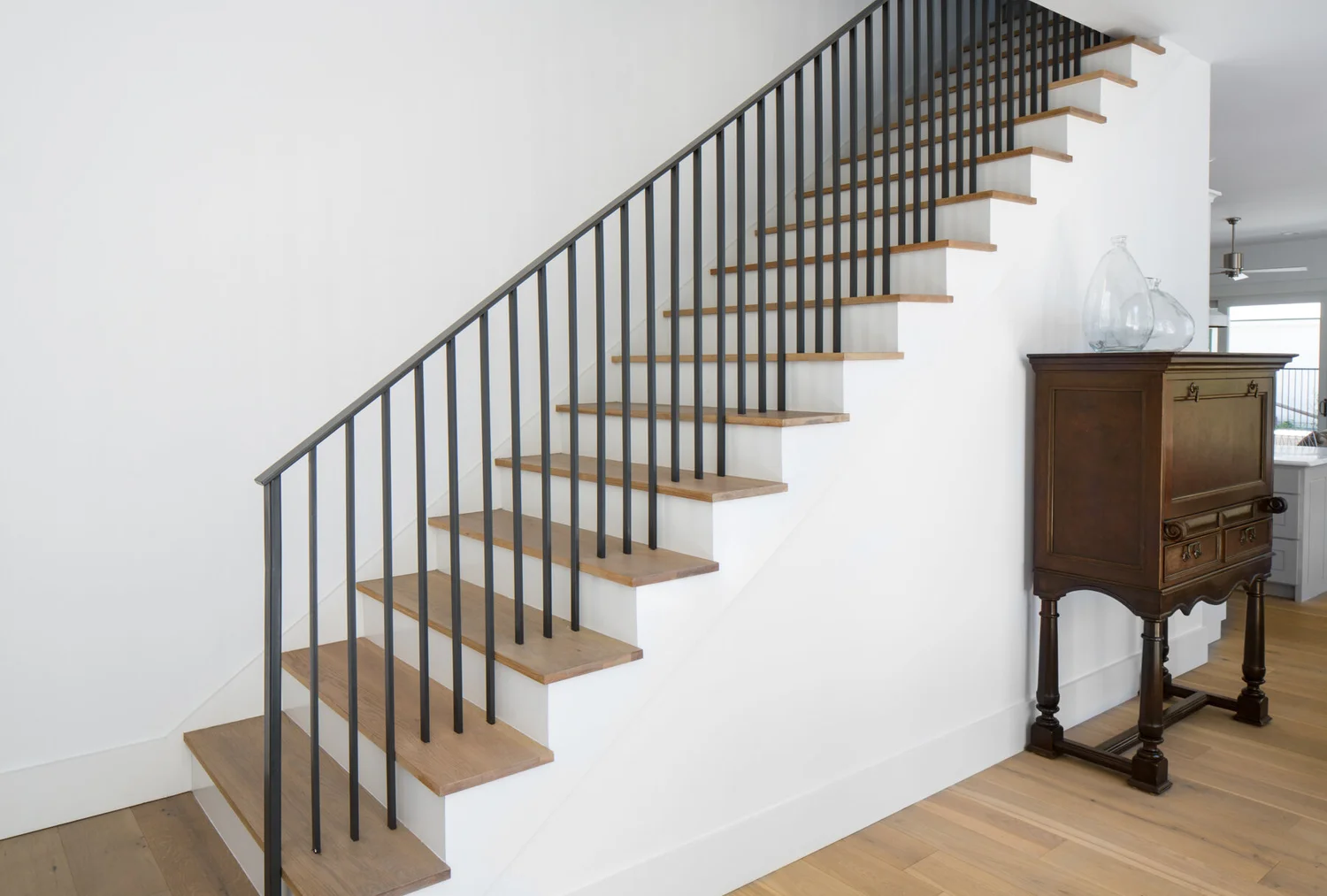
This look strikes a perfect balance between modern and classic styles. Here’s the formula: 50% Modern Farmhouse (the white painted risers and simple, clean lines) + 30% Scandinavian (the natural light wood treads) + 20% Classic Industrial (the sleek black iron vertical spindles). It’s a versatile mix that feels fresh, clean, and warm all at once. The addition of a traditional dark wood secretary desk nearby shows just how well this combination can bridge different design eras within the same space.
|
📋 Copy HEX 🔗 Share |
When using standard balusters, you can create a custom, high-end look by focusing on the newel posts (the larger posts at the start and end of the railing). Instead of a standard turned post, opt for a clean, square post with a simple cap, painted white to match the trim or black to match the spindles. This small upgrade provides a more substantial, architectural anchor for the railing and elevates the entire design from basic to bespoke.
28. Achieve Refined Style with a Curved Staircase and Carpet Runner
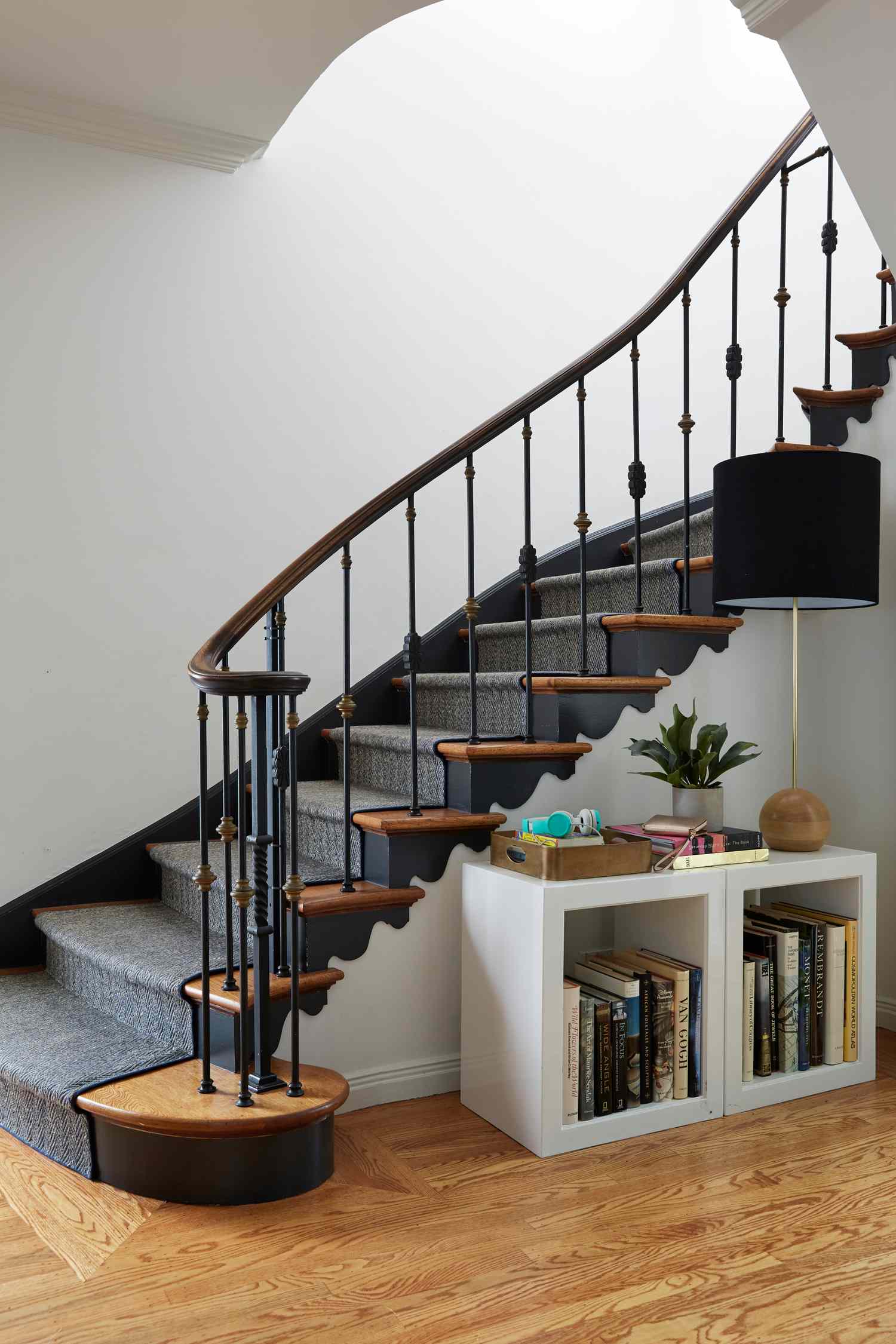
This staircase design feels so refined due to its thoughtful layering of texture and detail. The base is classic: a dark wood tread and handrail. Then, a textured gray carpet runner is added for softness and sound dampening. The real jewelry of the design, however, is the balustrade. It’s not just black metal; the balusters have subtle brass accents that catch the light and add a warm, metallic glint. This small, considered detail, paired with the unique scalloped risers, elevates the entire staircase into a custom, high-end feature.
|
📋 Copy HEX 🔗 Share |
Installing a carpet runner on a curved staircase is a job for a professional. Unlike a straight run, each step on a curve is a slightly different shape. The carpet must be expertly cut, stretched, and secured on each individual tread to avoid wrinkles and ensure the pattern flows correctly. This is not a DIY-friendly project. Expect to pay a premium for the specialized labor required for a flawless installation on a winding or curved set of stairs.
29. Infuse Artistic Energy with a Wood, Glass, and Metal Staircase
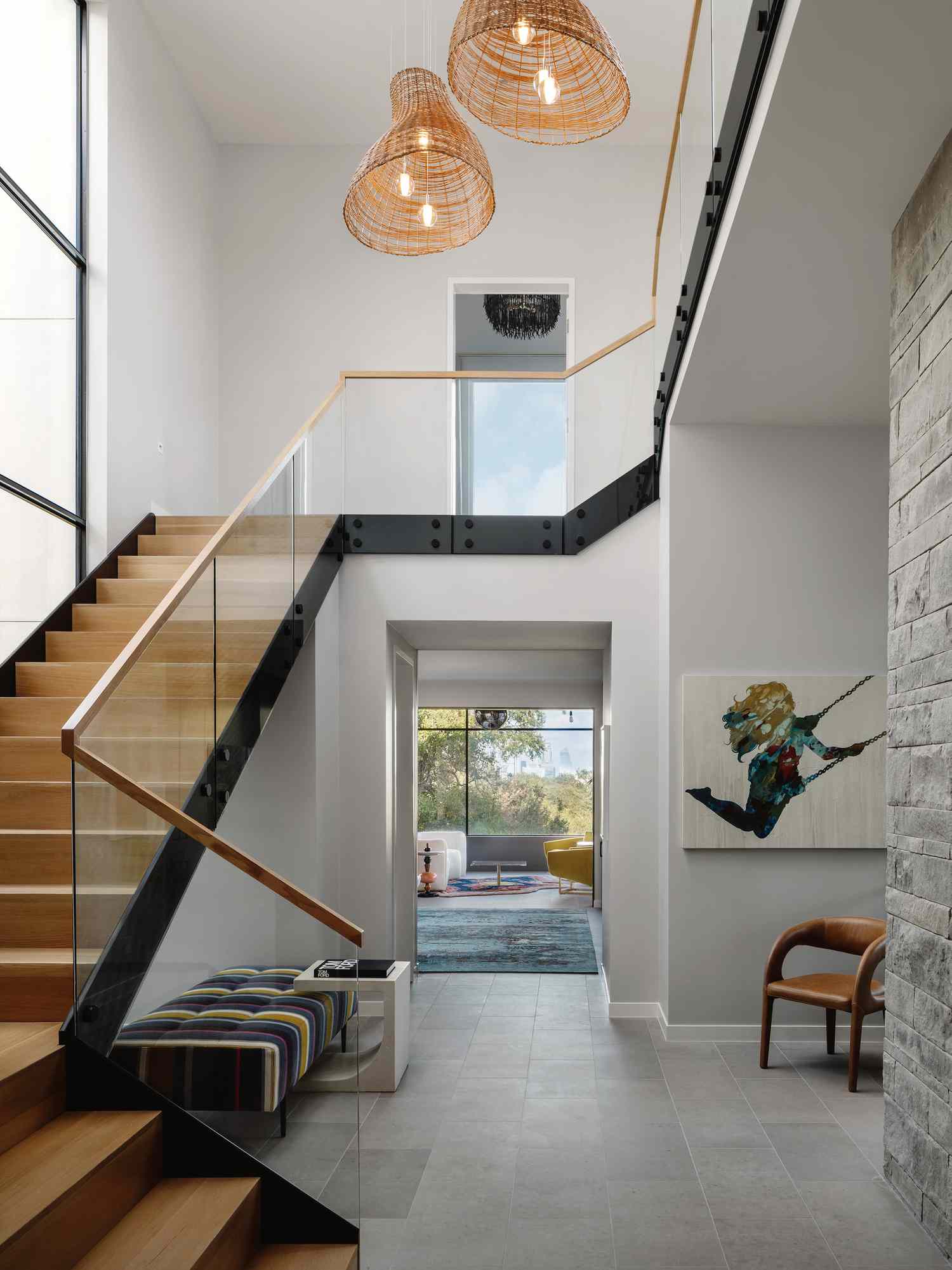
We’re seeing a major trend towards making every corner of the home personal and expressive, and this stair landing is a prime example. It’s not just a transitional space; it’s a destination. The use of a vibrant, upholstered bench and a large piece of abstract art turns the landing into a mini-gallery. The woven pendant lights add a layer of on-trend natural texture. This approach treats the staircase as an integral part of the home’s living space, not just a path between floors.
|
📋 Copy HEX 🔗 Share |
What ties this whole look together is the confident use of color and pattern. While the staircase architecture itself is a fairly standard modern mix of wood, glass, and black metal, it’s the striped bench and the bold, colorful artwork that give the space its soul. If you removed those two elements, the area would be pleasant but forgettable. They prove that you don’t need to have wild architecture to create a memorable space; sometimes, all you need is fearless decoration.
30. Design a Stately Foyer with a Gracious Curved Staircase
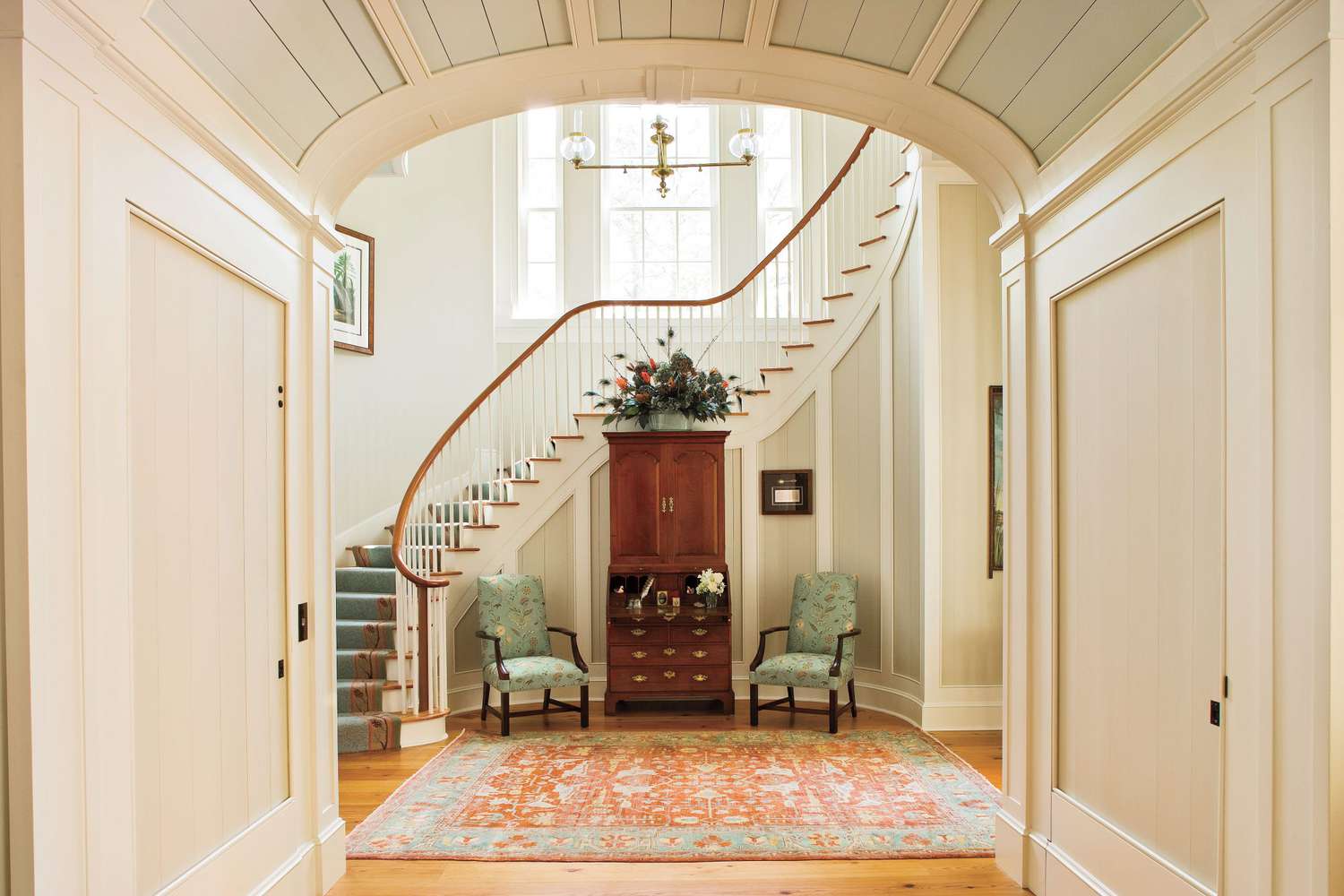
This entryway feels so stately and inviting because it perfectly balances grand architecture with comfortable, human-scale furnishings. The staircase provides the grand, curving gesture, drawing the eye upward. However, the space beneath it is made warm and approachable with a classic vignette: a traditional secretary desk flanked by two soft, upholstered armchairs. The large patterned area rug anchors this seating group and adds color and softness underfoot, preventing the large, open space from feeling cold or empty.
|
📋 Copy HEX 🔗 Share |
This classic, welcoming style follows a simple formula: 40% Architectural Elegance (the curved staircase, white balusters, and paneled walls), 40% Traditional Furnishings (wood secretary desk, upholstered armchairs, and patterned rug), and 20% Soft Color Palette (creamy beiges, soft blue-greens, and muted reds). This recipe ensures the space feels grand but livable, impressive but not intimidating. It’s a timeless approach that signals comfort and classic taste from the moment you walk through the door.
Conclusion
A staircase is so much more than a way to get from one floor to another—it’s the architectural heartbeat of your home. Whether you’re drawn to a grand, curving statement or a clever, space-saving solution, the right design can completely change your home’s story. We hope these 30 ideas have inspired you to take the next step. Now, head over to Pinterest and start creating a board for your dream staircase!