
A yellow kitchen does not have to feel like a cartoon or a diner from the 1950s. In 2027, the shade shows up in everything from glossy cabinetry to handcrafted tile, proving it can be as refined as it is cheerful.
These 25 kitchens use yellow in different ways, so you can borrow the version that fits your space and your comfort level with color. Whether you lean toward a pale butter or a saturated mustard, each look shows how yellow works as a lasting kitchen choice rather than a passing whim.
Modern Kitchen with Bright Yellow Cabinetry and Terrazzo Countertops
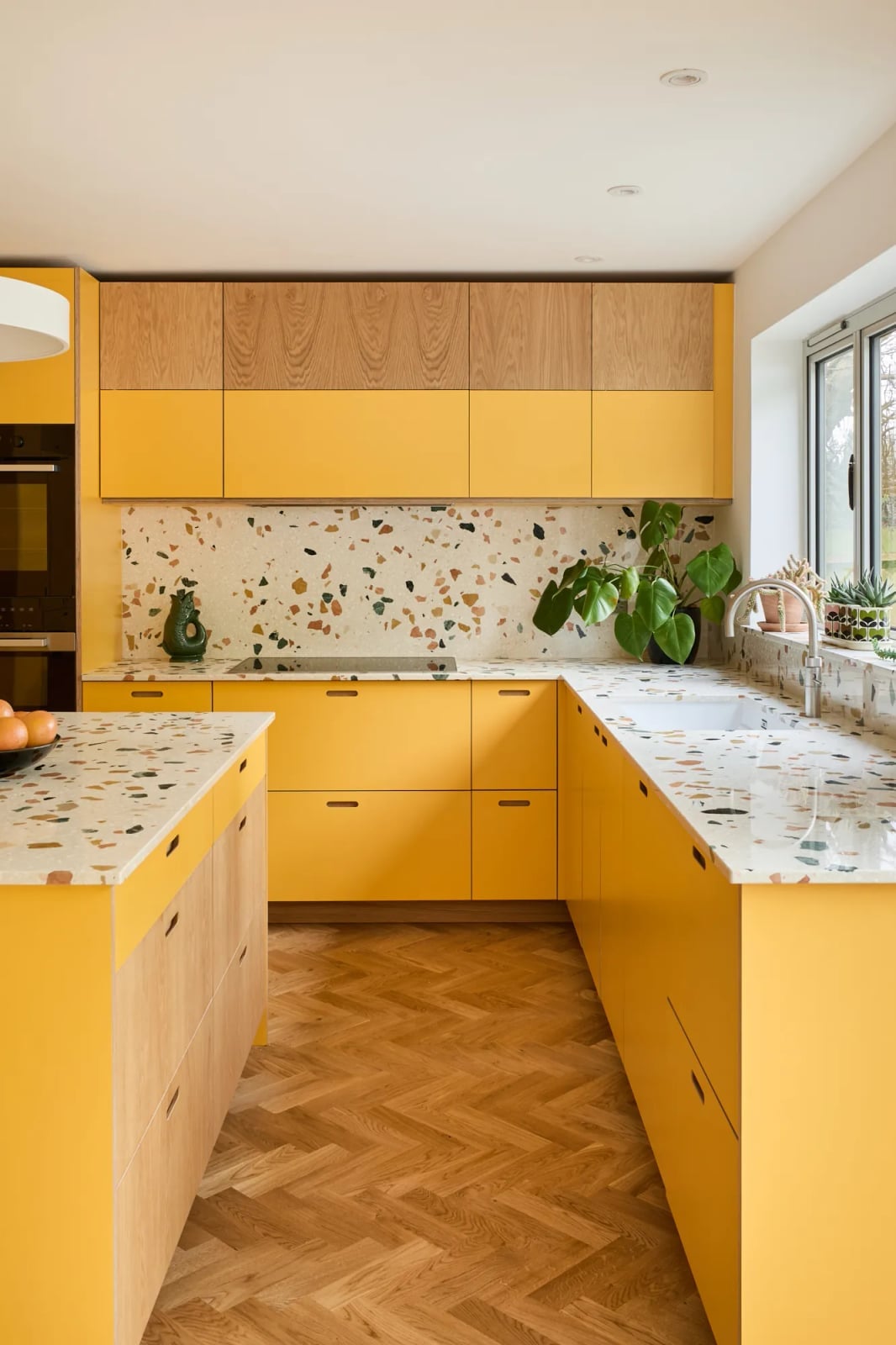
A U-shaped perimeter routes traffic around a central island, but the real move here is how the wood island base keeps the yellow cabinets and terrazzo countertops from feeling clinical. The green from a plant echoes the speckled stone, while daylight from the window stops the bright yellow from overwhelming the room. Ceiling lights add evening utility.
Sunny Kitchen Featuring Honeycomb Yellow Tile Backsplash
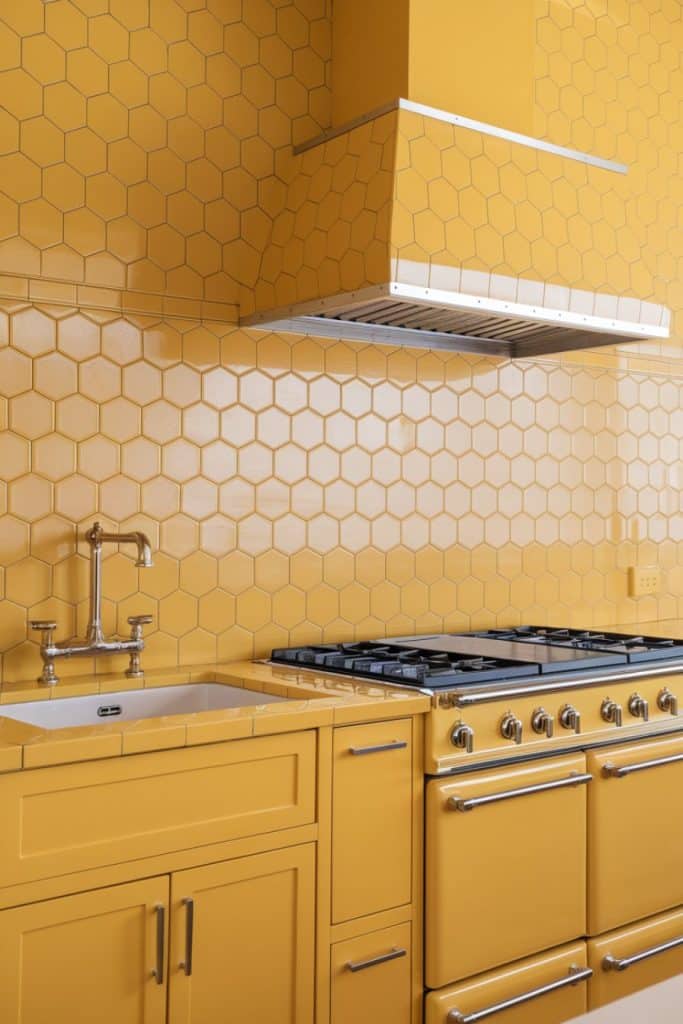
This compact kitchen proves yellow can carry a room without taking over. The honeycomb tile backsplash reads as a full wall of pattern, but the hexagonal repeat keeps it orderly rather than chaotic. Silver metal on the range and sink mirrors the tile’s grout lines, creating a continuous metallic thread. The wood countertop adds warmth and breaks up the yellow and silver ratio. Task lighting under the cabinets ensures the prep zone stays bright even when the ambient light fades. The palette stays tight: yellow, silver, and wood, with no third accent to muddy the scheme.
Galley Kitchen with Vibrant Yellow Cabinets and Concrete Walls
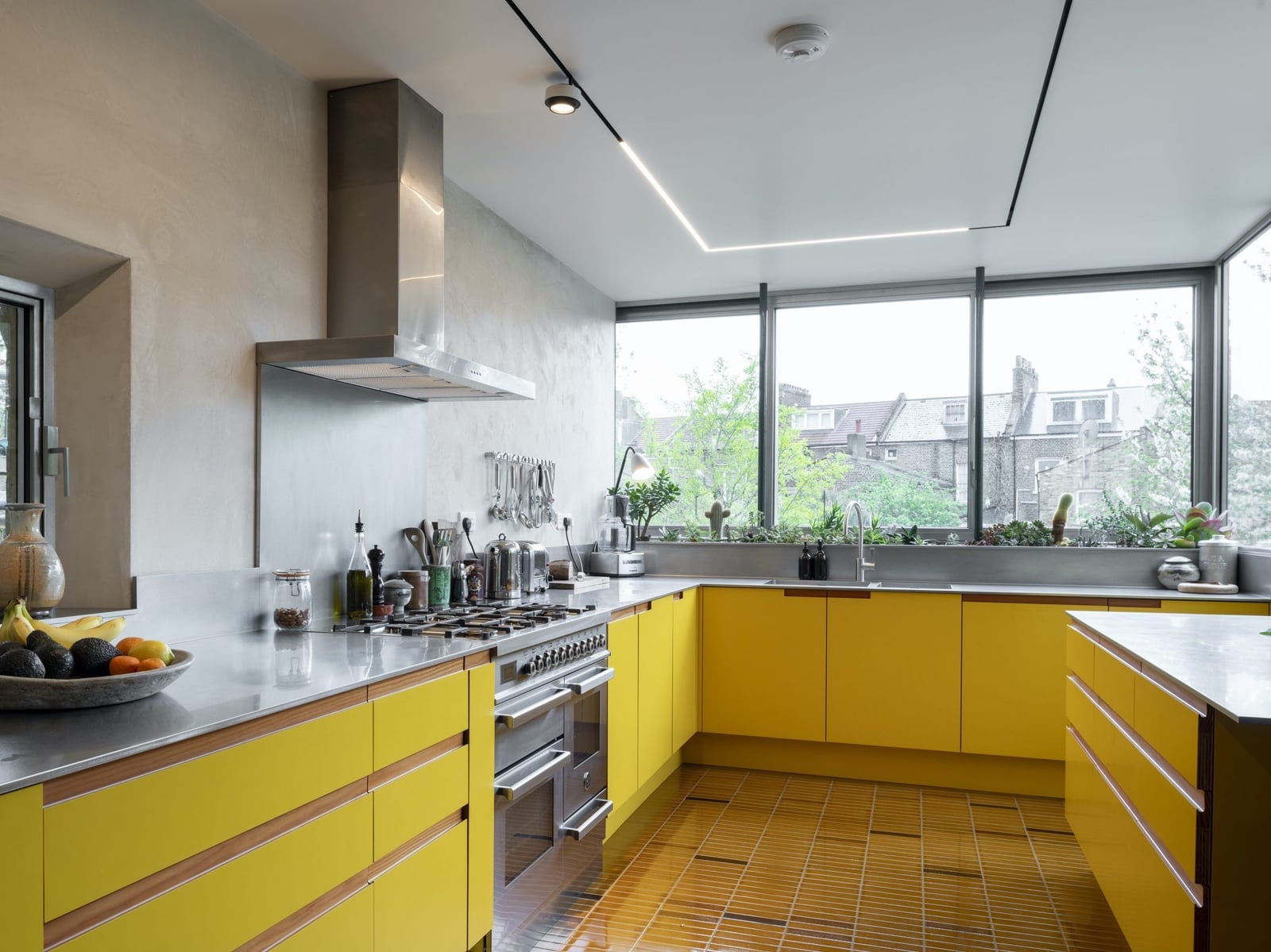
Can yellow cabinets work on raw concrete walls? Yes, if the yellow is saturated enough to hold its own. The gray concrete acts as a neutral backdrop, letting the cabinetry claim attention without competing with texture. A stainless steel range and a large window bring in reflective surfaces and natural light, which prevent the gray from turning flat. The L-shaped galley layout keeps the work triangle compact, and the wood floor adds warmth underfoot.
The palette here relies on contrast: yellow, gray, and wood. The concrete walls are the defining move, breaking the expected kitchen finish of tile or drywall. If you want this look but rent, a peel-and-stick backsplash in a concrete-look finish can mimic the texture without structural changes.
Minimalist Kitchen with Pale Yellow Cabinets and Gray Island
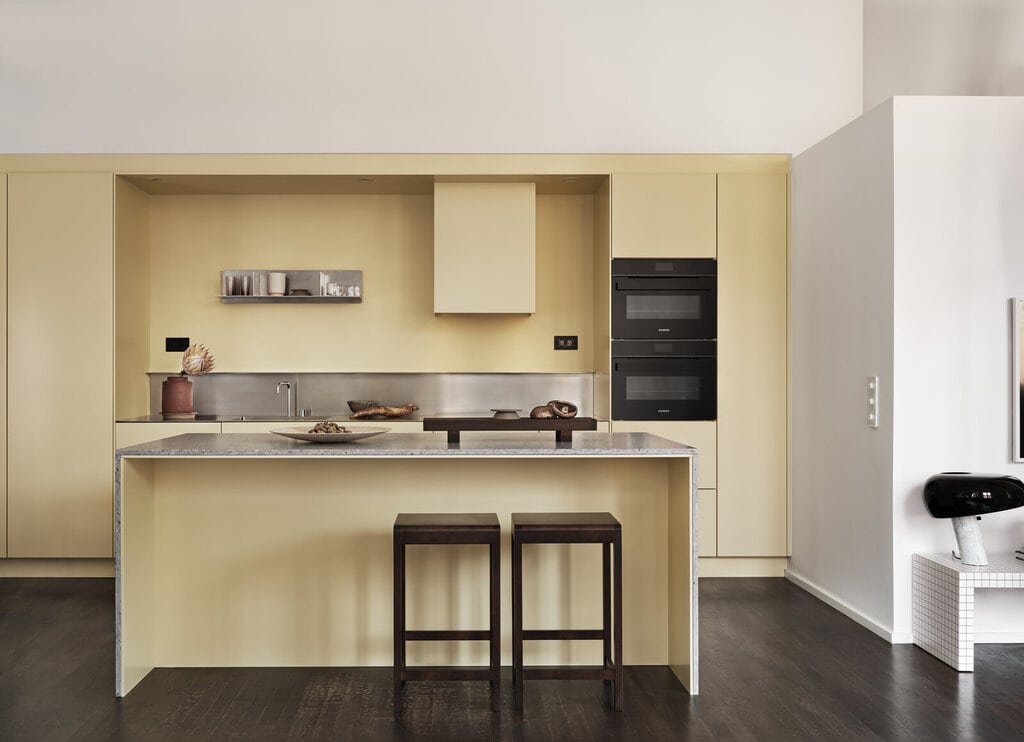
The pale yellow cabinets are flat-panel with no visible hardware, keeping the minimalist style intact. A gray island anchors the room, and black stools and oven provide the only dark notes. Sunlight gives the yellow a soft, dusty quality rather than a bright citrus tone. The room feels open because the palette is restrained: three colors, no pattern, no clutter on the countertops.
Traditional Kitchen with Pale Yellow Shaker Cabinets and Marble
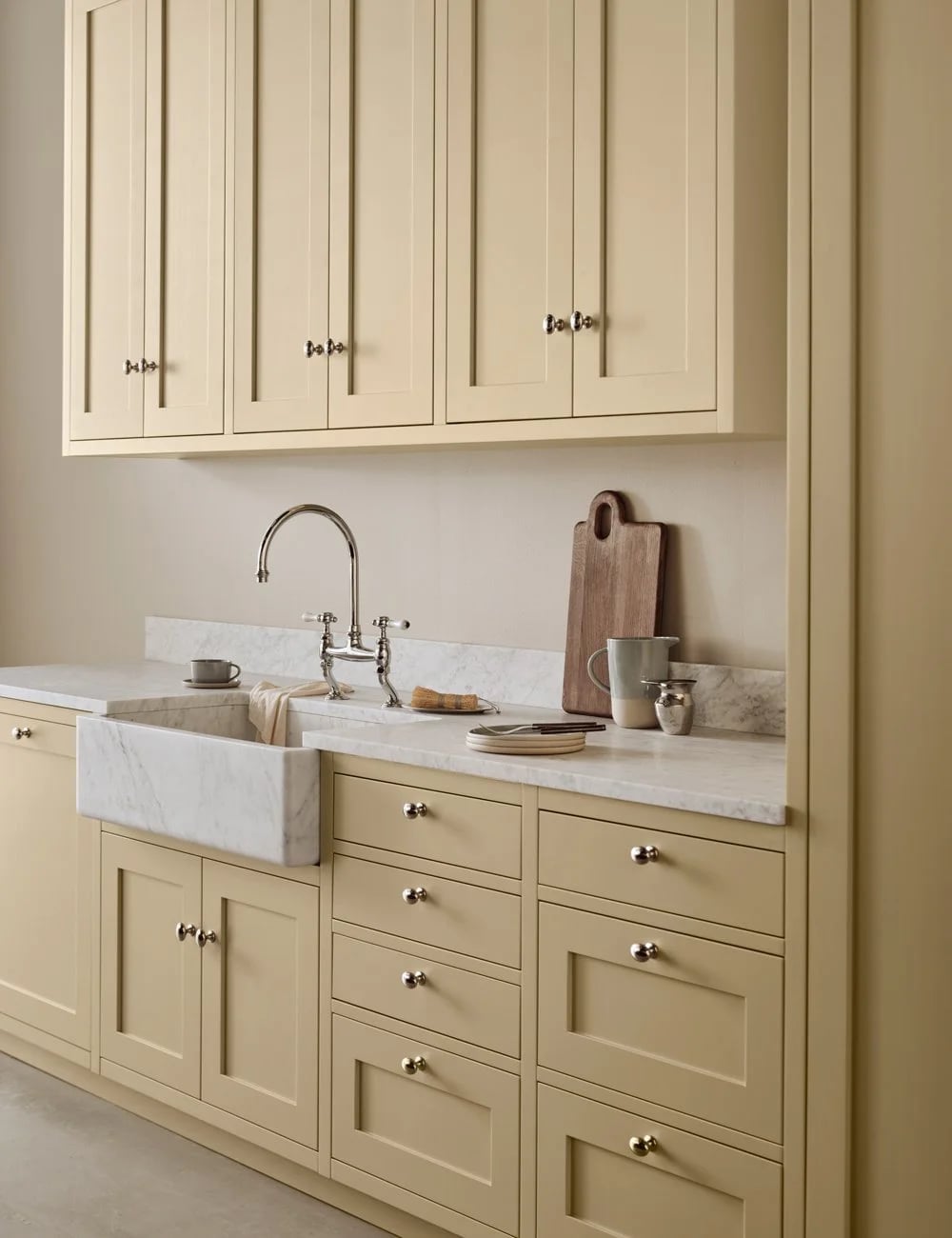
A corner sink under a window is a smart way to claim dead space, and the pale yellow Shaker cabinets keep the look classic without feeling dated. Marble countertops and a chrome faucet reinforce the traditional palette of pale yellow, white, and stone. The upper and lower cabinet layout provides ample storage for daily dishware and pantry staples. Natural light from the window highlights the subtle grain of the marble, which is the real anchor here: it gives the yellow a cool, grounded partner.
Farmhouse Kitchen with Decorative Pale Yellow Range Hood
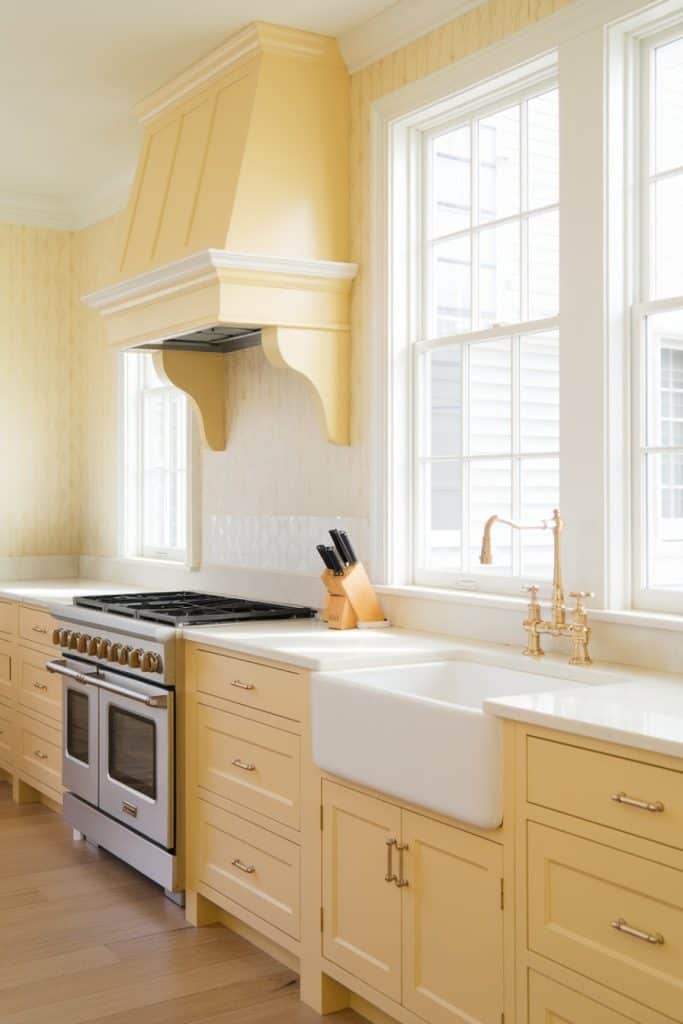
Most people assume a statement range hood means a full cabinet reface or a costly custom build. A pale yellow range hood paired with matching shaker cabinets proves otherwise. The decorative hood draws the eye without demanding the whole room match its energy. White countertops and a farmhouse sink keep the look grounded. Stainless steel from the gas range and hardware ties the metal finishes together. The traditional wood floor adds warmth. What makes this work is keeping the surrounding surfaces simple. White marble-look tile or solid white quartz lets the yellow stay the focal point without the room feeling busy.
Eclectic Kitchen with Bright Yellow Accent Walls
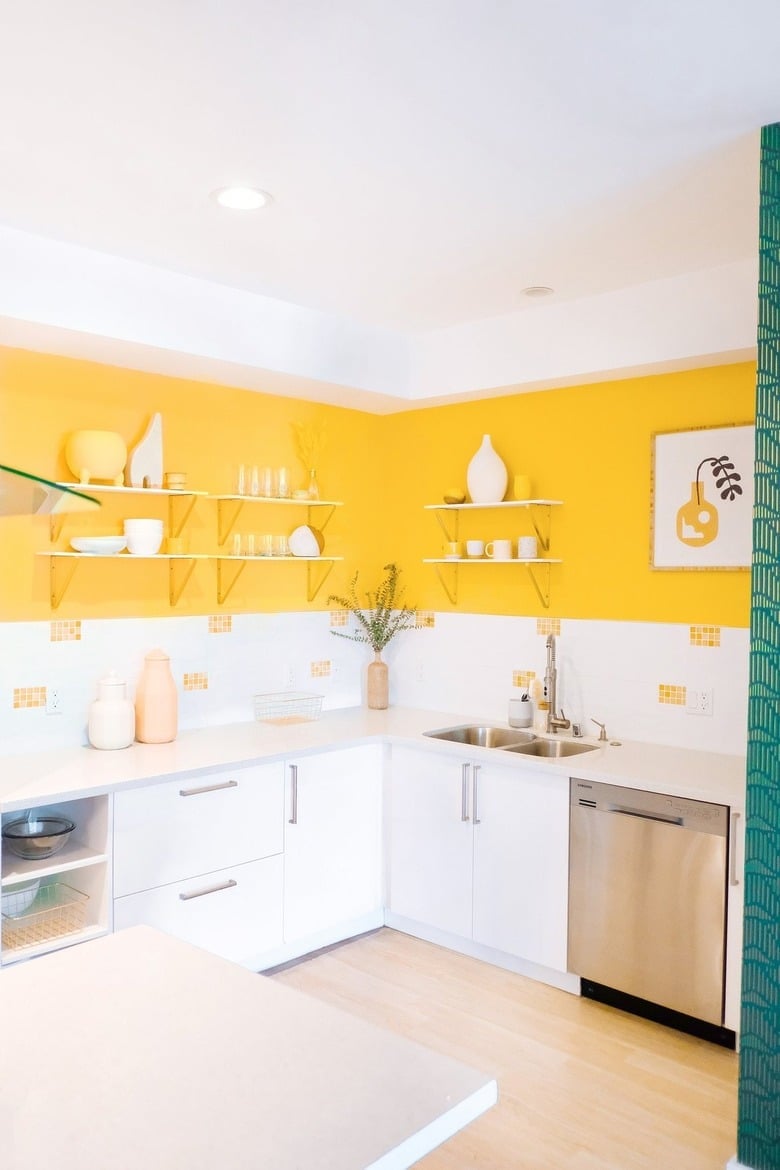
Bright yellow walls stop being a risk when the rest of the kitchen stays restrained. White cabinets and a mosaic tile backsplash give the yellow room to breathe without turning the space into a theme. The recessed ceiling lights keep the wash even, so the yellow reads as a deliberate palette choice rather than a leftover paint can. A compact corner layout actually helps here. The yellow wraps around the work zone without overwhelming the whole floor plan. Green accents from plants or accessories add a natural counterpoint that keeps the look eclectic rather than chaotic.
Boho Kitchen with Extensive Yellow Tile Work
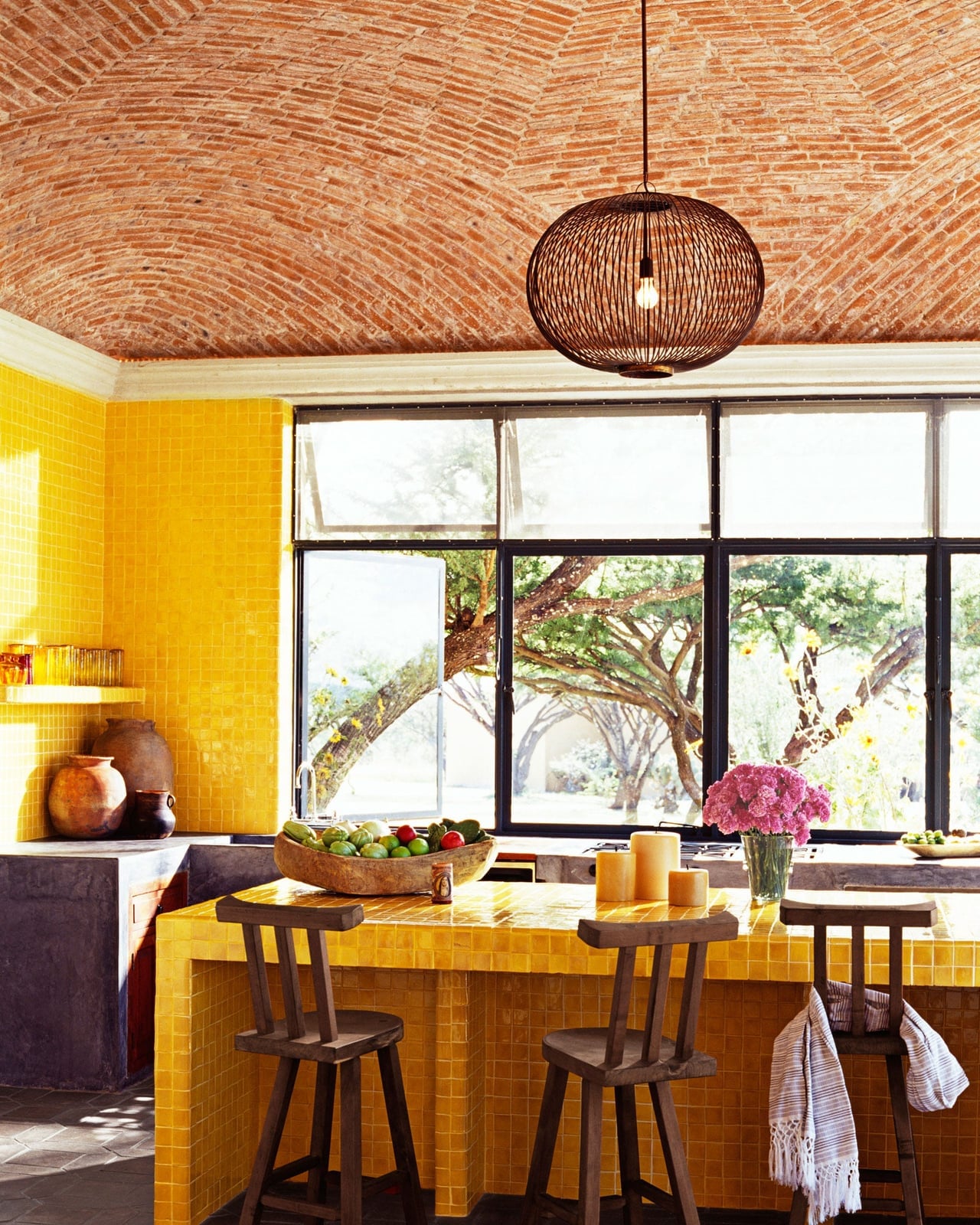
Yellow tile at this scale works because the rest of the room follows boho rules. A central island wrapped in yellow tile becomes the anchor, while wooden stools and a terracotta ceiling keep the palette earthy rather than electric. The pendant light above the island adds a warm glow that shifts the yellow from bright to golden. Open shelving on the walls repeats the tile colors through ceramics and glassware. The key is letting the tile be the only hard surface in its color family. Wood, stone, and plaster finishes let the yellow tile lead without the room feeling like one giant note.
Farmhouse Kitchen with Vibrant Yellow Cabinets and Open Shelving
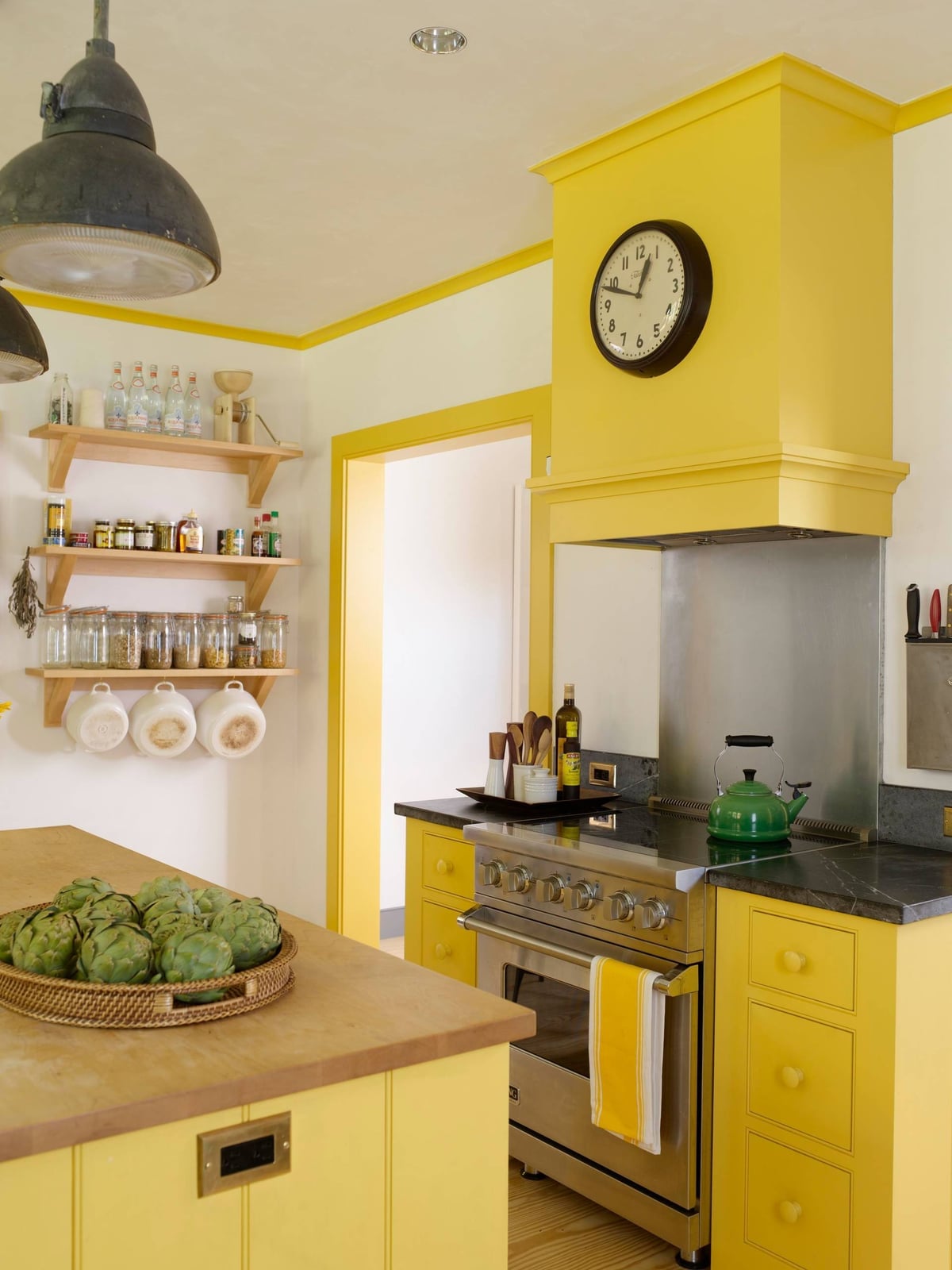
Can a bright yellow kitchen still feel practical for daily cooking? The answer is in the layout. Vibrant yellow cabinets on the perimeter keep the color contained, while a white marble island provides a neutral landing zone for prep and serving. Open shelving above the counter puts everyday dishes within reach without adding more closed storage. The range cooker against the wall becomes a natural focal point, with the yellow cabinets framing it rather than overwhelming it. Overhead pendant lights cast light directly onto work surfaces. The white and gray palette of the countertops and backsplash gives the eye a place to rest between the yellow cabinets. This setup works because the yellow is concentrated on the storage pieces, not spread across every surface.
Modern Kitchen with Highly Reflective Yellow Cabinets and Black Island
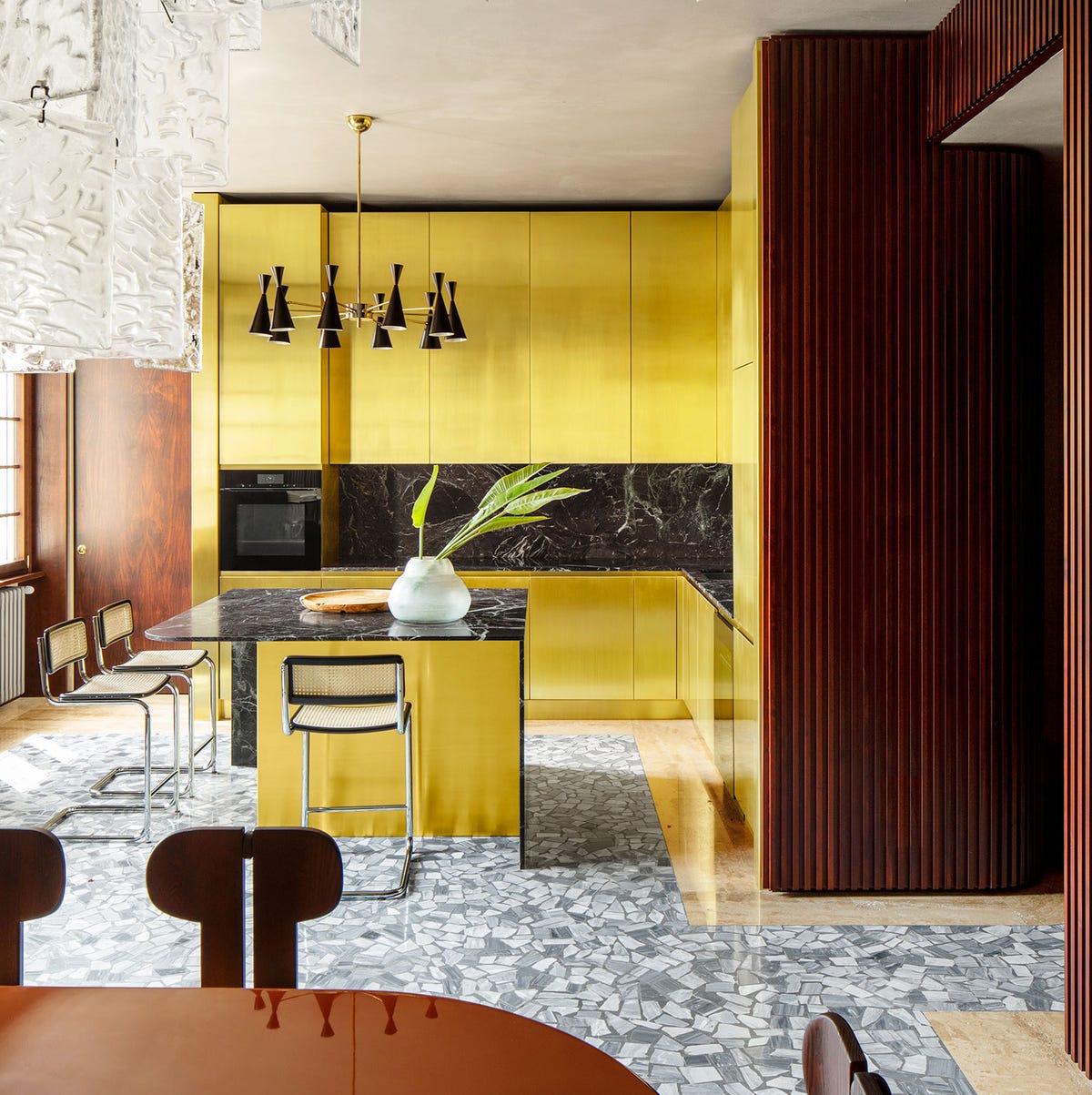
A glossy yellow cabinet finish bounces light differently than matte paint. In an open plan kitchen with natural light from windows, the reflective surface makes the room feel larger without adding a single extra square foot. The black island anchors the space and gives the eye a heavy counterpoint to the bright perimeter. Wood bar stools add a warm middle ground between the two extremes. A modern chandelier above the island adds another reflective surface that echoes the cabinet finish. The trick is keeping the black island lean. A bulky base would fight the lightness of the yellow. Slender legs or a floating profile maintain the balance.
Traditional Kitchen with Yellow Cabinets and Floral Wallpaper
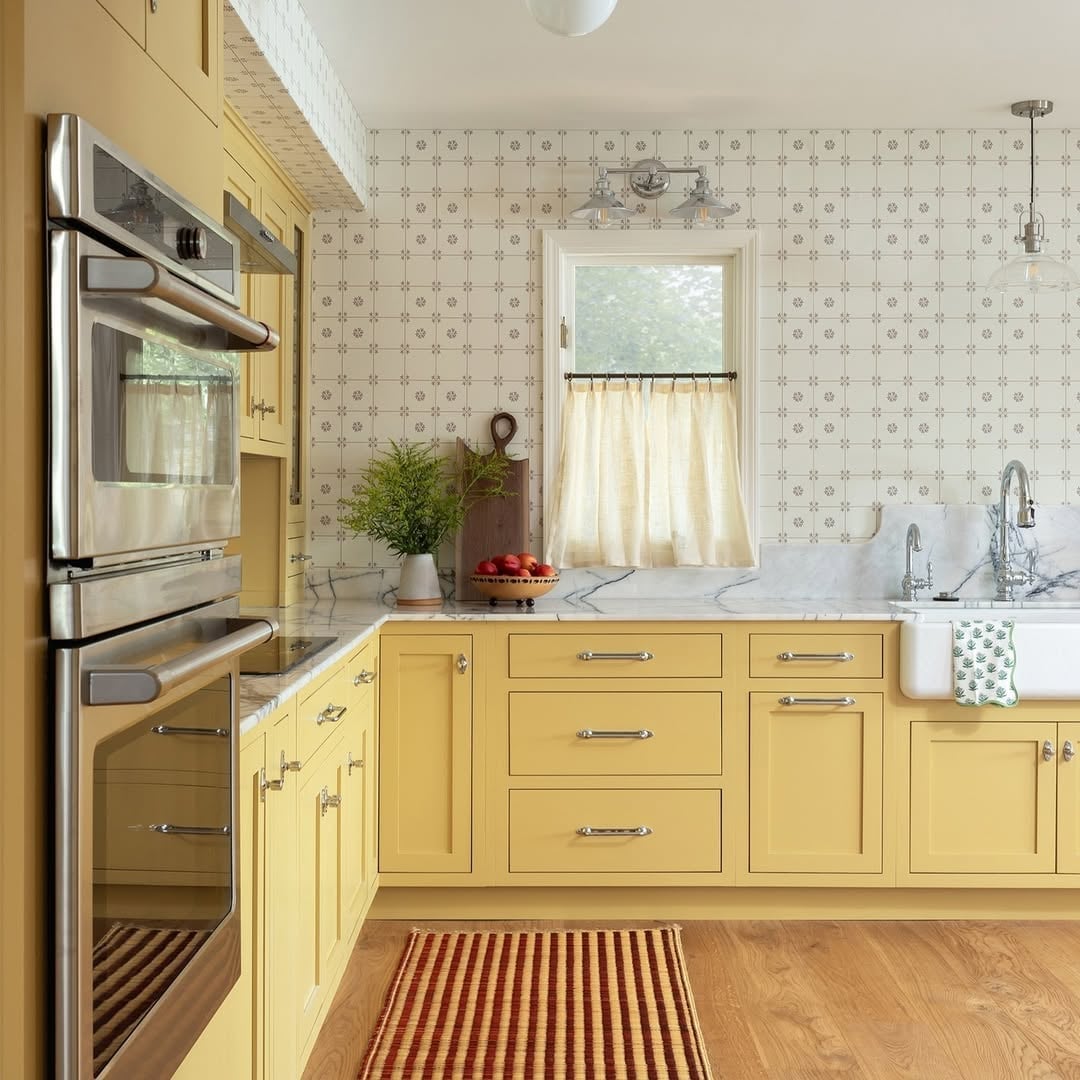
When a room has two strong patterns, let one lead and the other follow. This compact L-shaped kitchen uses delicate floral wallpaper as the backdrop, while the yellow cabinets and white marble countertops stay clean and unfussy. The farmhouse sink grounds the traditional look without adding another print. The floral pattern is small-scaled and light, which keeps it from competing with the cabinetry. A white subway tile backsplash between the counter and the wallpaper would break the flow, but here the wallpaper runs uninterrupted, making the room feel taller than it is.
Traditional Kitchen with Vibrant Yellow Island and Perimeter Cabinets
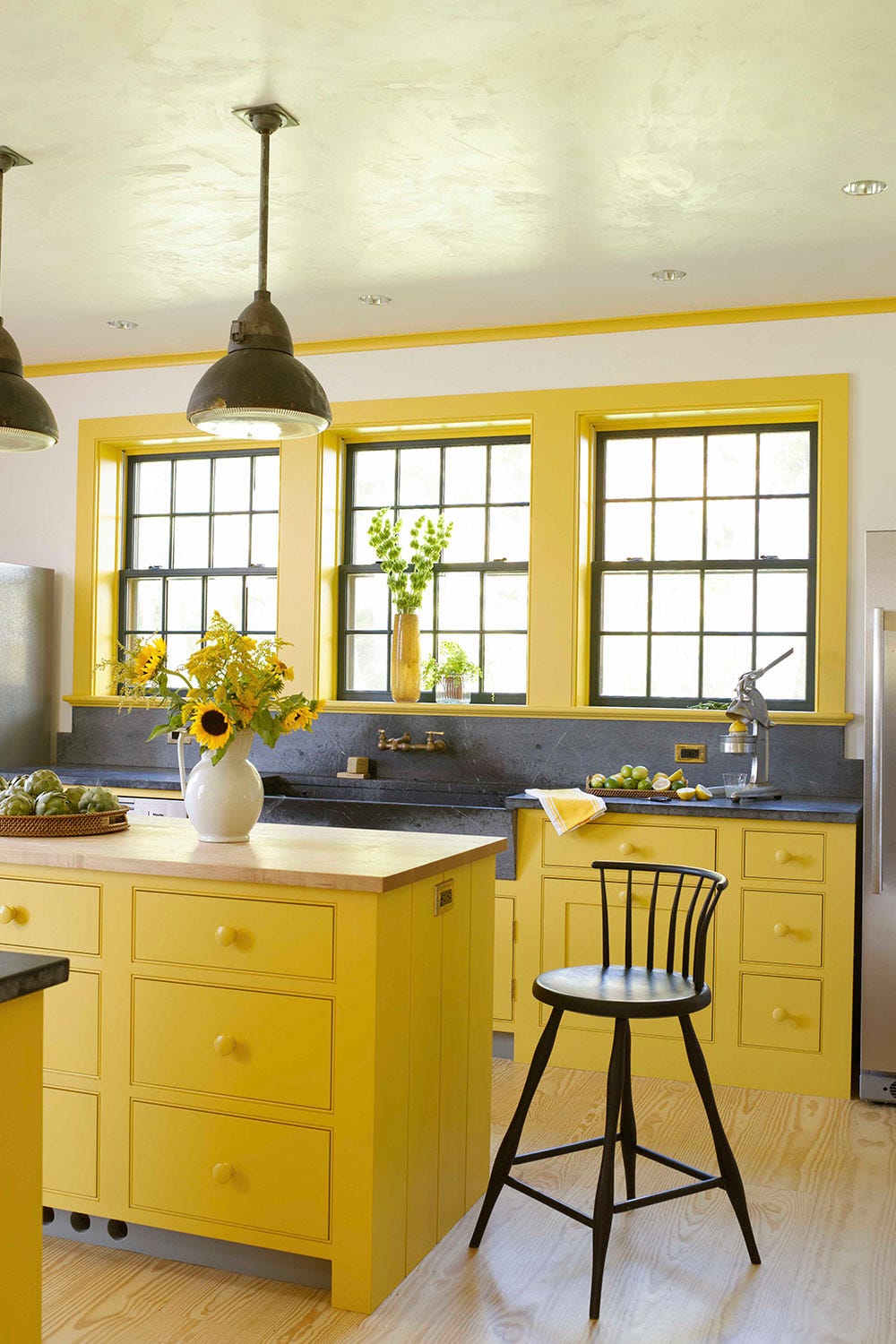
A roomy traditional kitchen with an all-yellow perimeter and island might sound like a lot of one color, but the palette keeps it in check. The vibrant yellow cabinets cover both the island and the wall cabinets, while white countertops and black chairs at the island create clear breaks. The wood floor adds warmth that keeps the yellow from reading as too cool or too clinical. Three pendant lights hang above the island, drawing the eye down and breaking up the vertical mass of cabinetry. The black chairs are a deliberate contrast, not a compromise. They anchor the island visually and keep the yellow from floating. The natural light from the windows hits the cabinets differently through the day, so the yellow shifts from bright at noon to softer in late afternoon. That variation is part of the appeal.
Traditional Kitchen with Yellow Subway Tile Backsplash and Scalloped
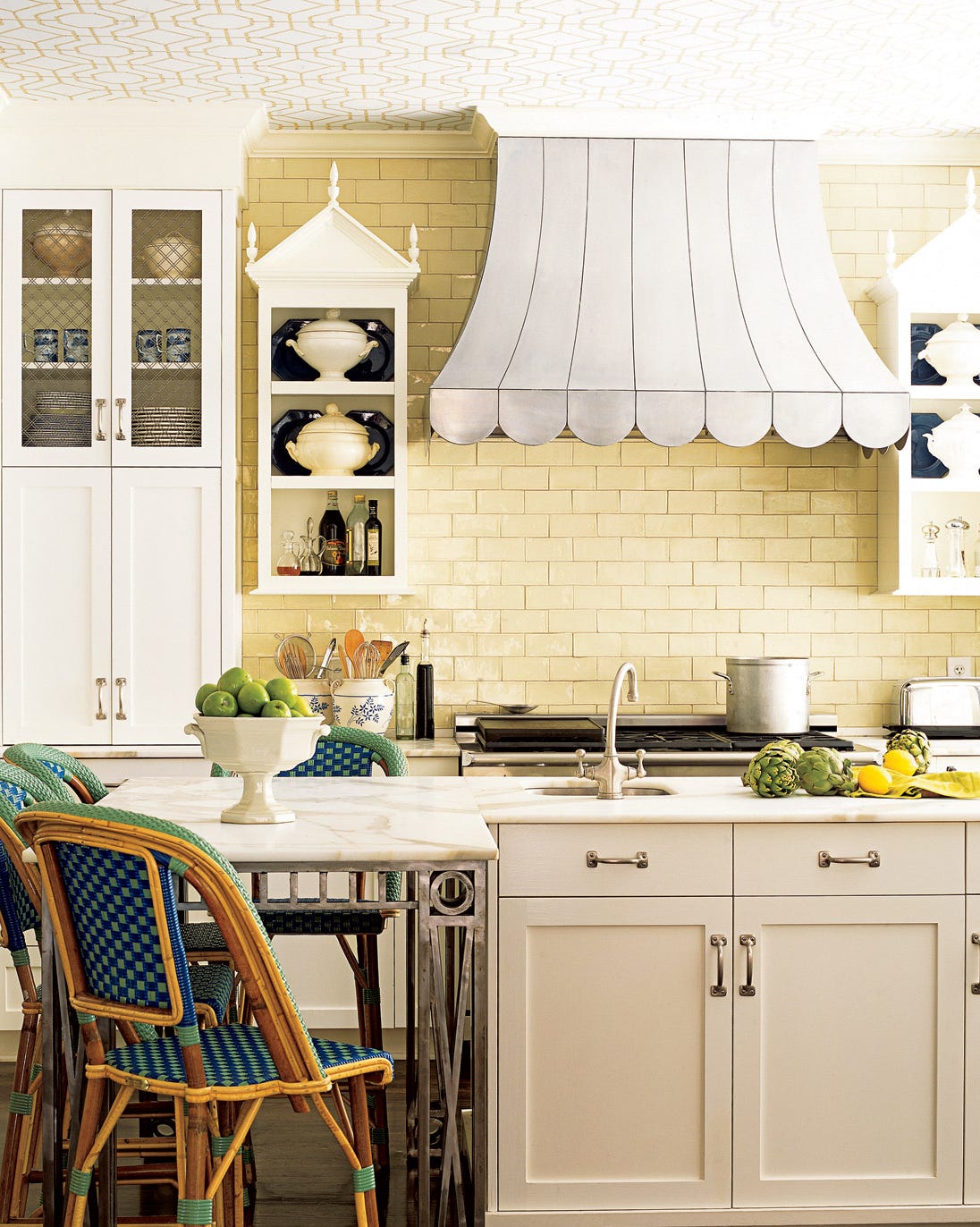
The scalloped range hood is the detail that makes this kitchen feel finished. It sits above a run of yellow subway tile that covers the full backsplash, and the curve of the hood softens the straight lines of the tile. The palette stays restrained with white cabinets, a marble countertop, and a blue-toned island. The yellow tile is warm but not loud, and the scalloped hood keeps the look from leaning too formal.
Transitional Kitchen with Pale Yellow Cabinets and Marble Backsplash
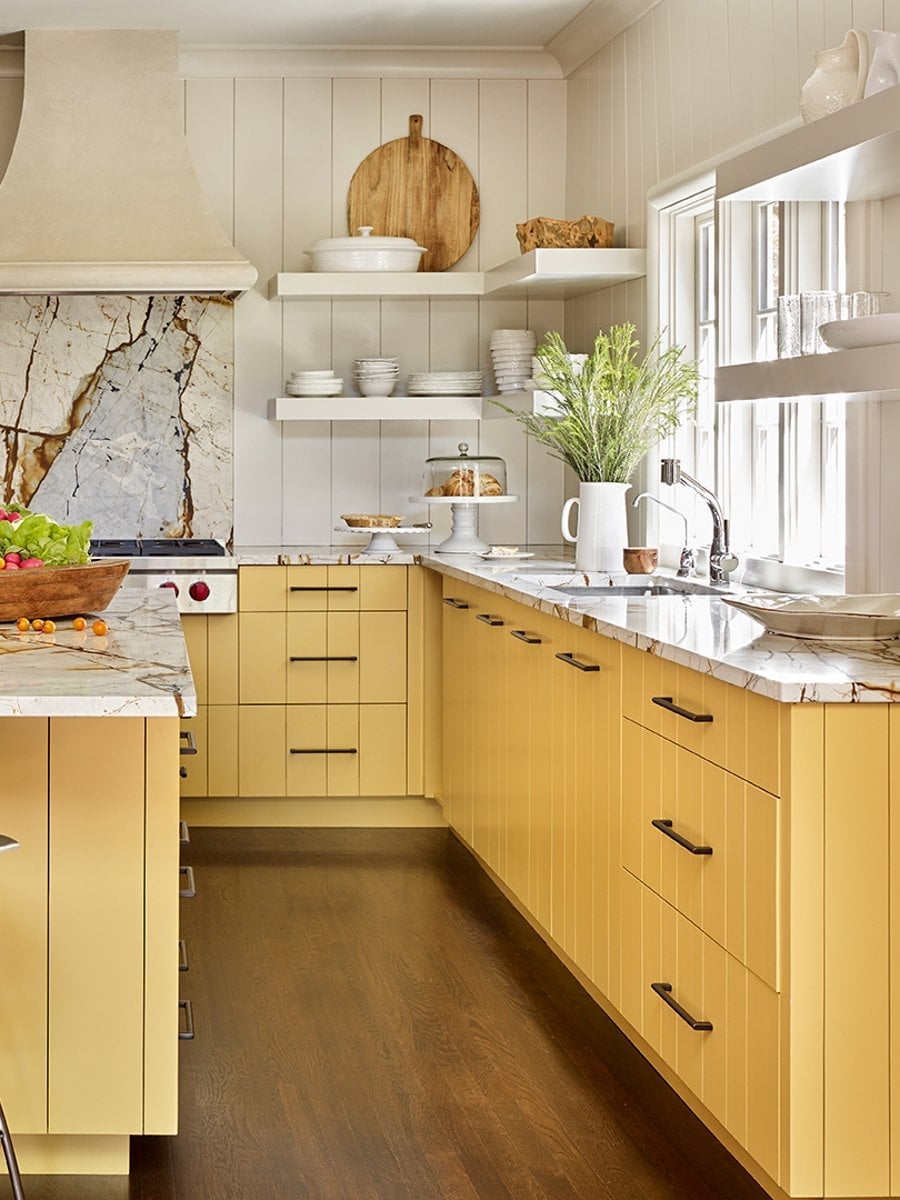
This transitional kitchen gets its character from the contrast between soft and hard surfaces. The pale yellow cabinets are flat-panel and understated, while the marble backsplash is dramatic with heavy veining. The marble covers the entire wall behind the range, making it the focal point. Open shelves above the counter keep everyday items within reach and break up the stone. Recessed lighting keeps the room bright without adding visual clutter. The wood floor and a warm-toned island balance the cool gray undertones in the marble. The pale yellow cabinets act as the bridge between the warm floor and the cool stone.
Modern Kitchen with Pale Yellow Flat-Panel Cabinets
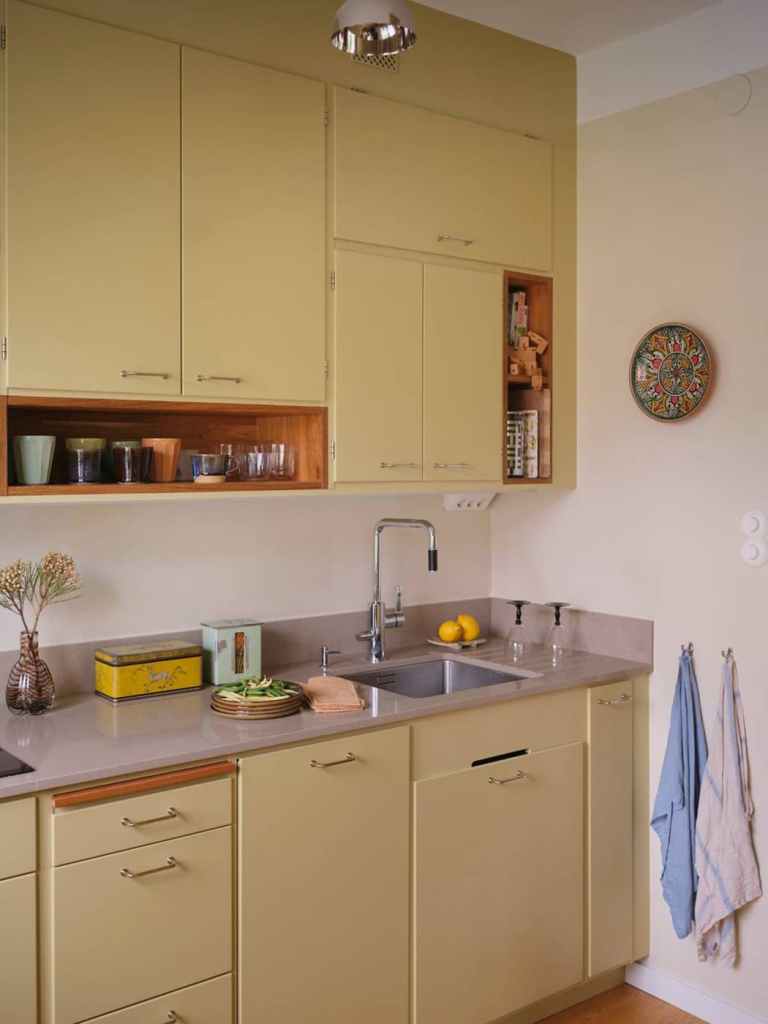
In a compact linear kitchen, flush upper cabinets with the counter below create a clean line without custom sizing. Flat-panel cabinets in pale yellow achieve this look. The lack of hardware on the doors means nothing interrupts the surface, which is useful in a small space where every inch counts. The stone countertops are a mid-tone gray that does not compete with the cabinets. The overhead lighting is recessed, so it does not hang into the work zone. The pale yellow is neutral enough to pair with almost any accent color, but it does show smudges more readily than a darker shade. A quick wipe with a damp cloth handles that. The real trick here is that the cabinets go almost to the ceiling, which uses vertical storage without adding bulk at eye level.
Rustic Kitchen with Bright Yellow Tiled Island and Stone Walls
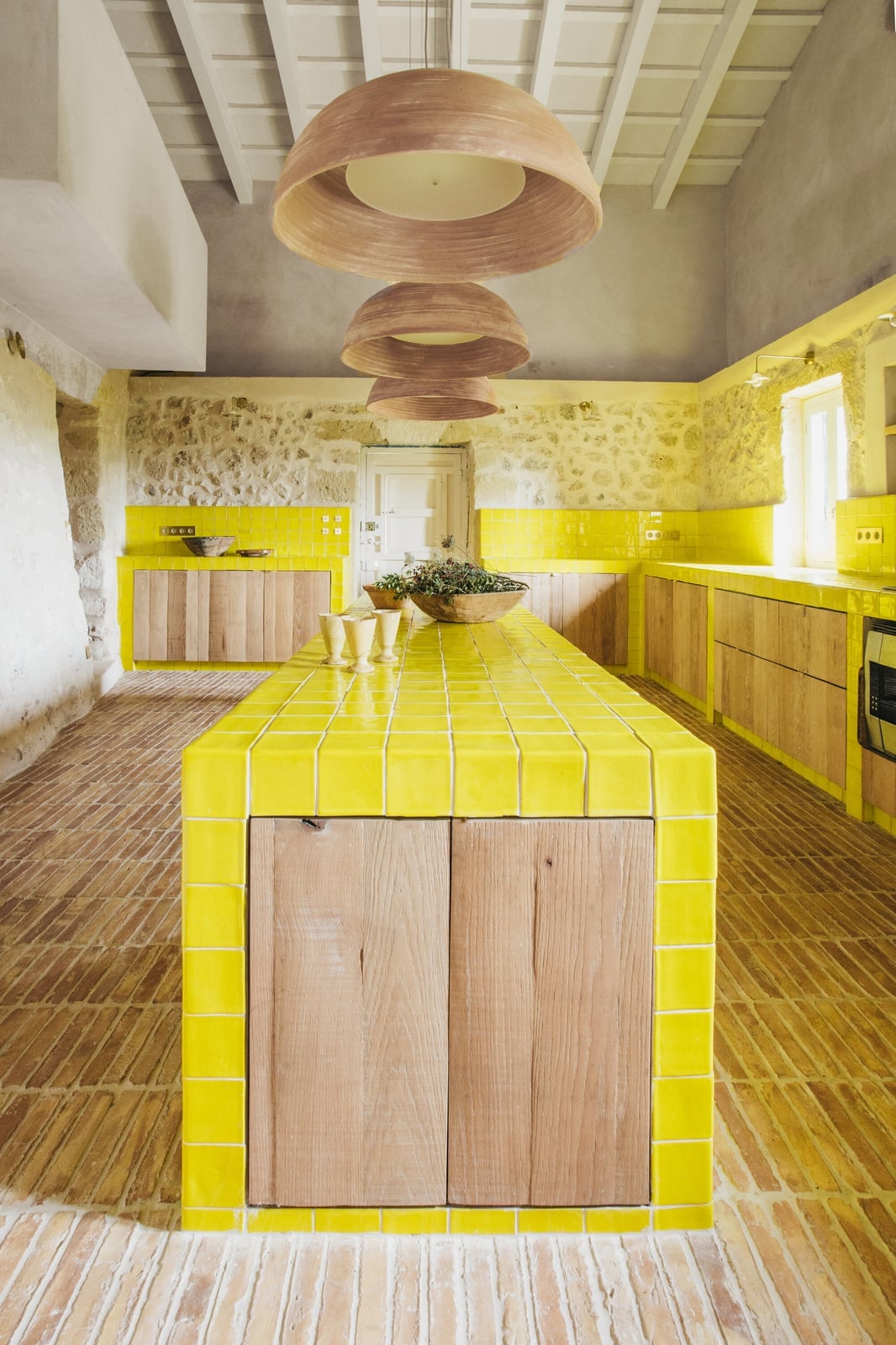
A rustic kitchen can handle bold color when the materials around it are rough and natural. Here, bright yellow tile covers the island and the countertops, wrapping the central workspace in a single sunny finish. Wooden cabinets with visible grain sit along the perimeter, and the stone walls add texture without competing. The palette keeps the yellow from feeling isolated: stone reads gray-brown, the wood reads warm brown, and white trim offers a resting point. A glossy, high-impact surface like glazed tile needs something matte and earthy nearby to prevent a one-note look.
Traditional Kitchen with Pale Yellow Cabinets and Blue Tile Backsplash
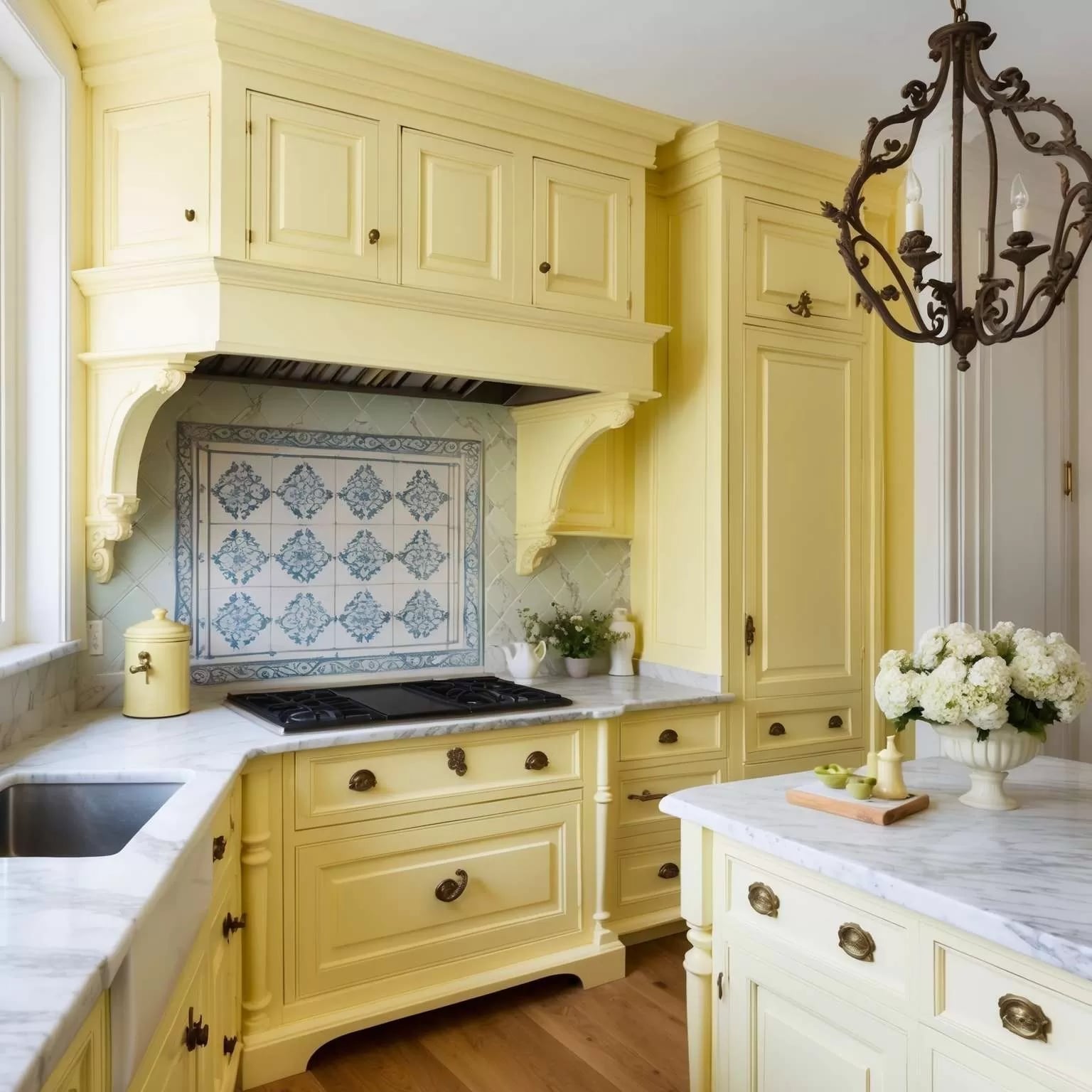
A practical rule for combining two colors in a kitchen is to let one dominate while the other works as the accent. Here, pale yellow cabinets set the tone, and the decorative blue and white tile backsplash supplies the contrast. The backsplash runs in a distinct pattern that draws the eye, but it does not fight the cabinetry because the blue is a secondary color. Marble countertops in white keep the surface neutral. The layout is L-shaped with an island, so the backsplash covers the main work zone while the island stays clean. Renters can try this with peel-and-stick backsplash tile in a similar blue pattern. The ratio is roughly 70 percent pale yellow to 30 percent blue and white. That split keeps the palette clear without muting either color.
Mid-Century Modern Kitchen with Geometric Yellow Tile Backsplash
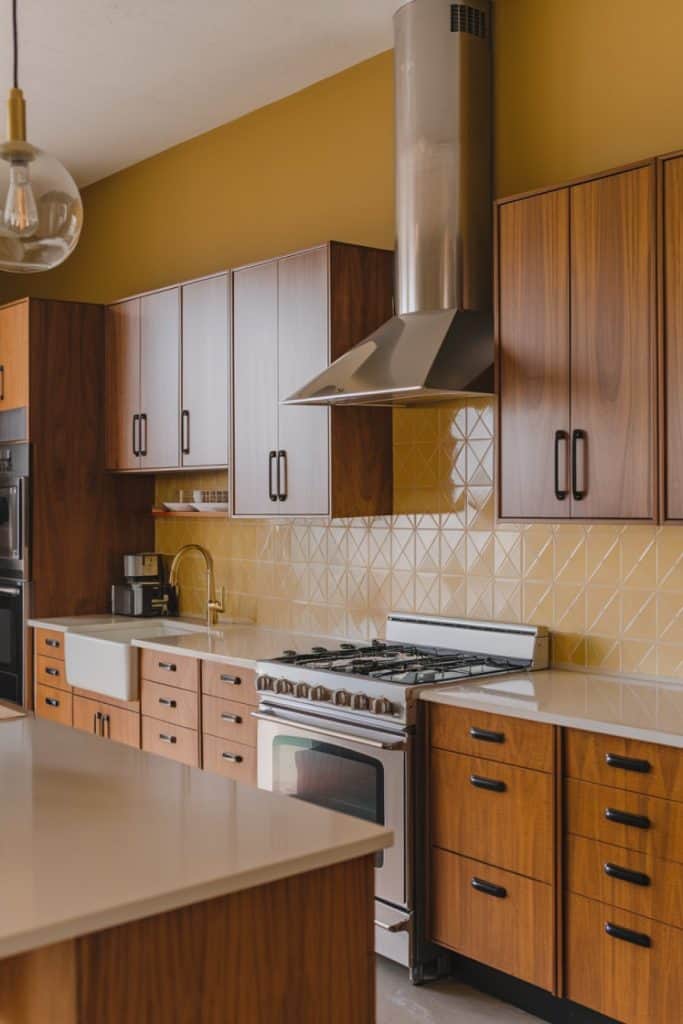
This design is mid-century modern because the yellow tile is geometric and the kitchen stays restrained. A galley layout keeps the backsplash as the visual anchor, and the overhead pendant light matches the metal hardware in a warm tone. The wood elements are kept to a narrow band, so the yellow tile has room to work.
The tile pattern is what defines the look. It has repeating angles that echo the clean lines of mid-century furniture. The cabinets are simple and flat-fronted, and the range and hood are in a neutral finish that does not draw attention. A geometric tile backsplash in this style needs a simple countertop to balance it. A solid surface in a light wood tone or a muted neutral will let the tile hold the focus without visual clutter.
Traditional Kitchen with Pale Yellow Cabinets and Large Wooden Island
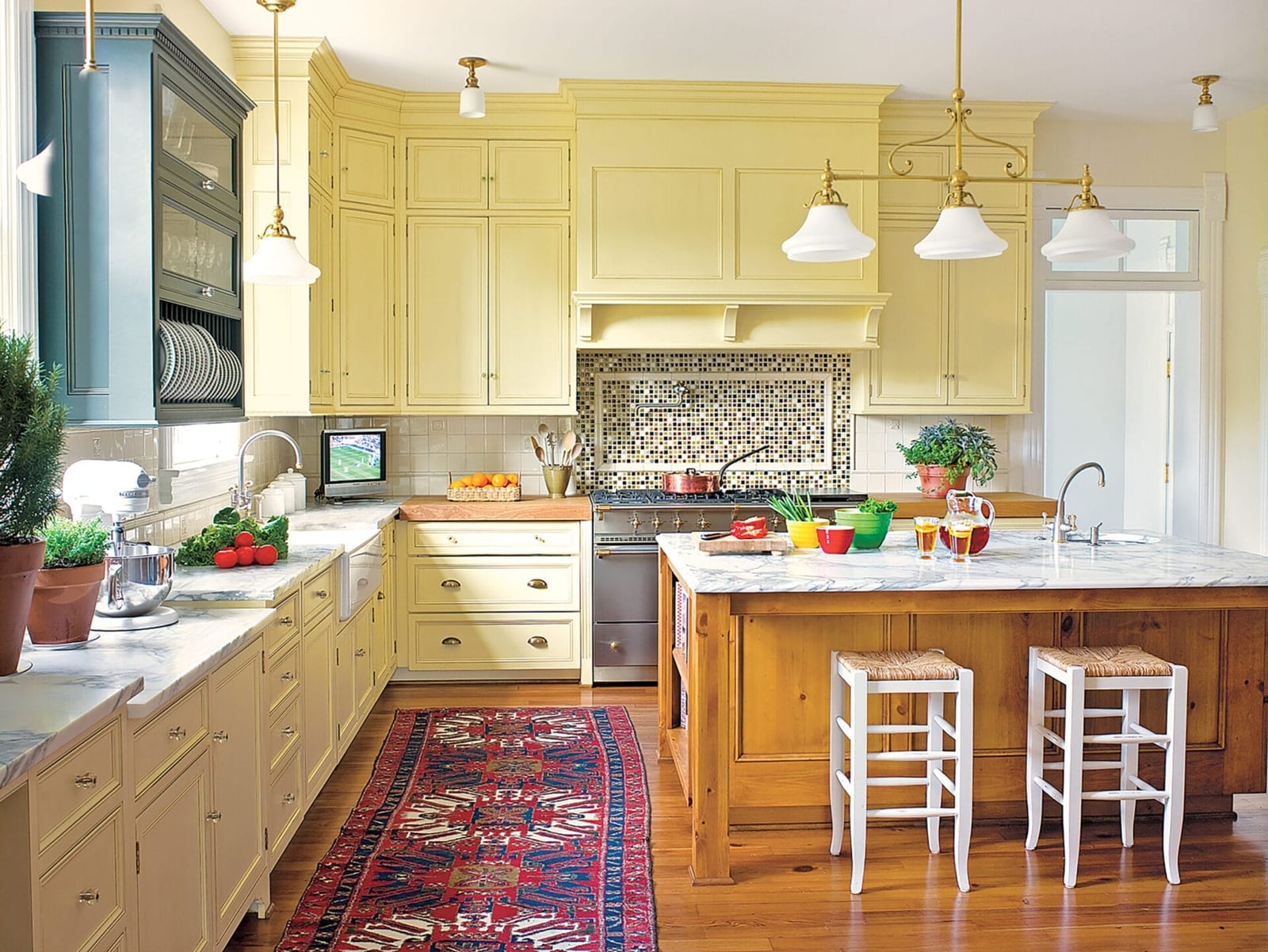
The warm wooden island is the first thing you notice in this kitchen, and that is by design. The pale yellow cabinets around the perimeter recede, letting the wood take center stage. A patterned rug under the island adds red and blue accents that connect to the wood tones. The pendant lights above the island are simple and do not compete. The layout is roomy enough that the island functions as a separate zone. The principle here is hierarchy: one piece holds visual weight while the rest supports it. In a traditional kitchen, a large wooden island against pale cabinetry creates a natural focal point without needing a second strong color.
Maximalist Kitchen with Mustard Yellow Cabinets and Bold Wallpaper
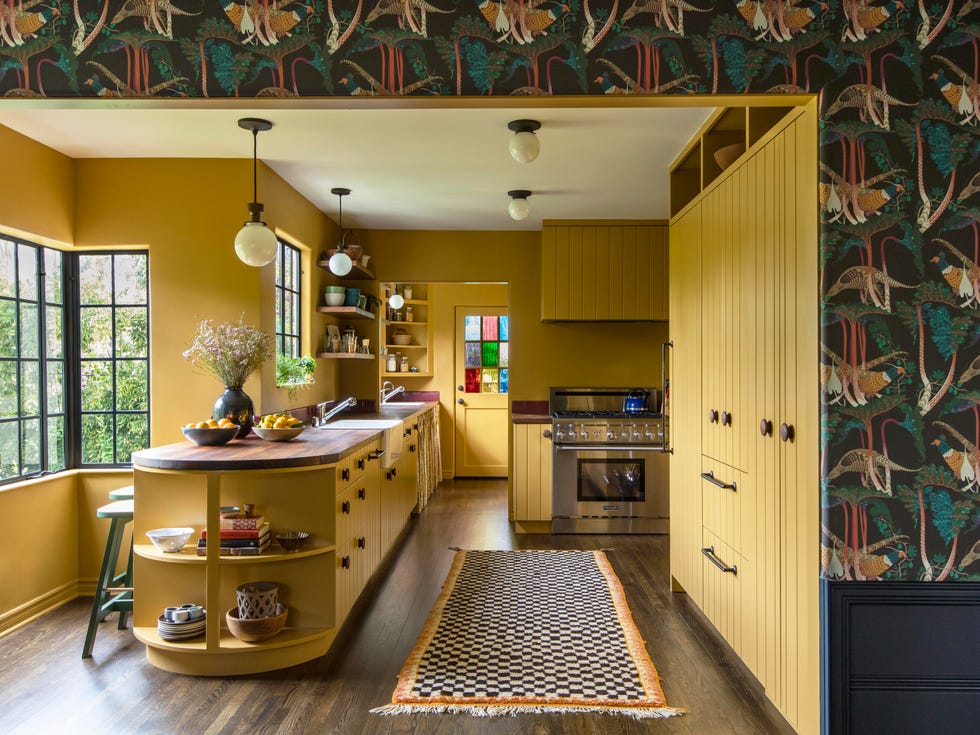
This kitchen knows exactly what it wants to be. Mustard yellow cabinets cover the perimeter and the curved island, and the walls are covered in a patterned wallpaper that pulls in dark green, black, and multicolored details. The yellow is the anchor: it is warm and saturated, but it is not a primary yellow. The wallpaper uses that same warmth in its background, so the two surfaces relate to each other. The open plan layout means the kitchen flows into the living space, and the colorful door on the far wall continues the maximalist idea. The style is defined by the ratio of pattern to solid surface. Here, pattern covers the walls while solid color covers the cabinetry. That balance prevents visual chaos.
Country Kitchen with Warm Butter Yellow Cabinets and Wooden Island
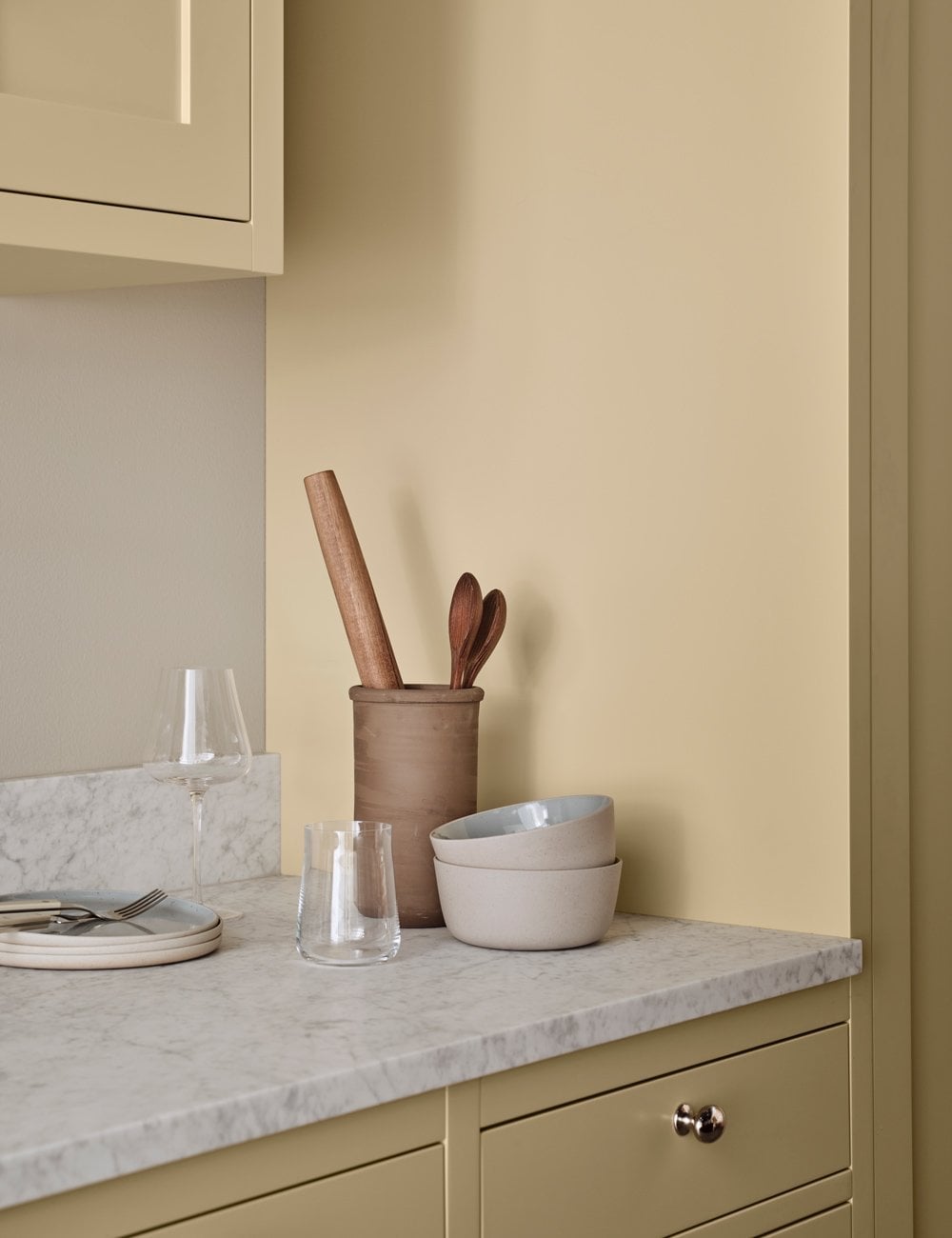
A country kitchen puts the island front and center. Here, a large wooden island anchors the room, with warm butter yellow cabinets lining the perimeter and a tiled floor underfoot. The butter yellow cabinets give the space a soft, welcoming glow without overwhelming the natural wood tones. White countertops and walls keep the palette light, while the wooden island adds texture and warmth. Overhead lighting and windows balance the room, making it feel roomy and lived-in. The idea is to let the island act as the visual anchor, and keep the surrounding cabinets in a single, cohesive hue so the space feels unified.
Farmhouse Kitchen with Pale Yellow Shaker Cabinets and Dark Gray
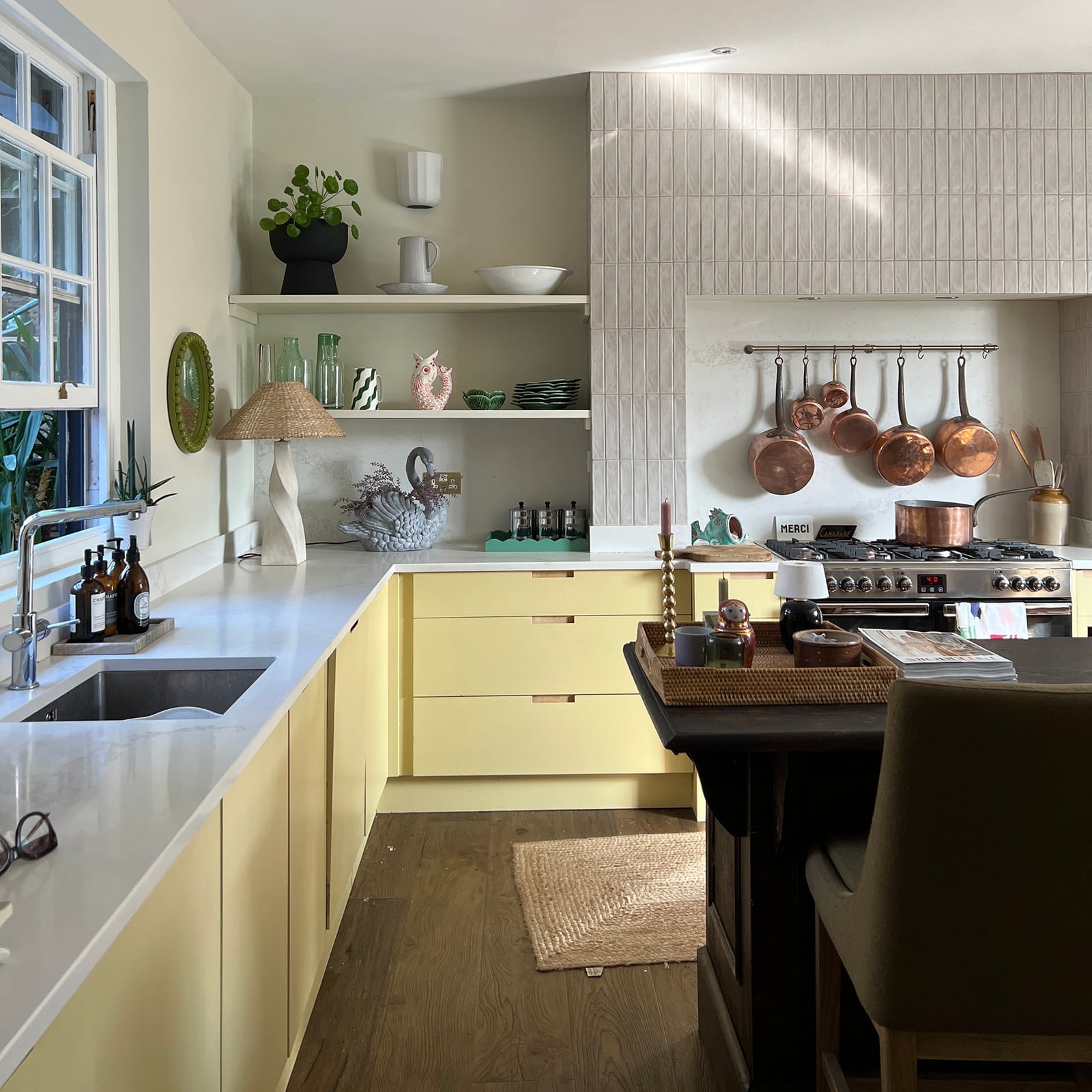
Pale yellow shaker cabinets pair with dark gray countertops in this farmhouse kitchen, creating a crisp contrast that feels both classic and current. A window above the sink brings in natural light, while a basket adds a touch of rustic texture. The dark gray stone countertops ground the pale yellow. The palette rule here is simple: a strong, neutral countertop color gives pale yellow cabinets the weight they need to feel grounded.
Eclectic Kitchen with Bright Yellow Base Cabinets and Gray Uppers
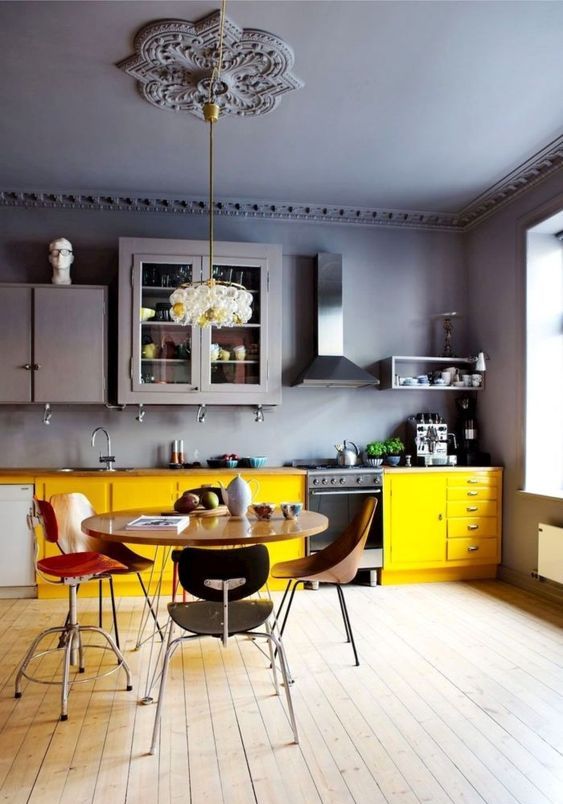
When mixing cabinet colors, a practical rule is to use the bolder hue on the base cabinets so it grounds the room. In this eclectic kitchen, bright yellow base cabinets sit beneath gray upper cabinets, with a dining table and chairs nearby. The contrast between the vibrant yellow and the neutral gray is balanced by wood tones in the table and floor. A pendant light above the table and natural light keep the space bright. This two-tone approach works because the darker gray on top keeps the eye from bouncing around, while the yellow below adds energy without dominating the room.
Ultra-Modern Kitchen with Floor-to-Ceiling Yellow Cabinetry
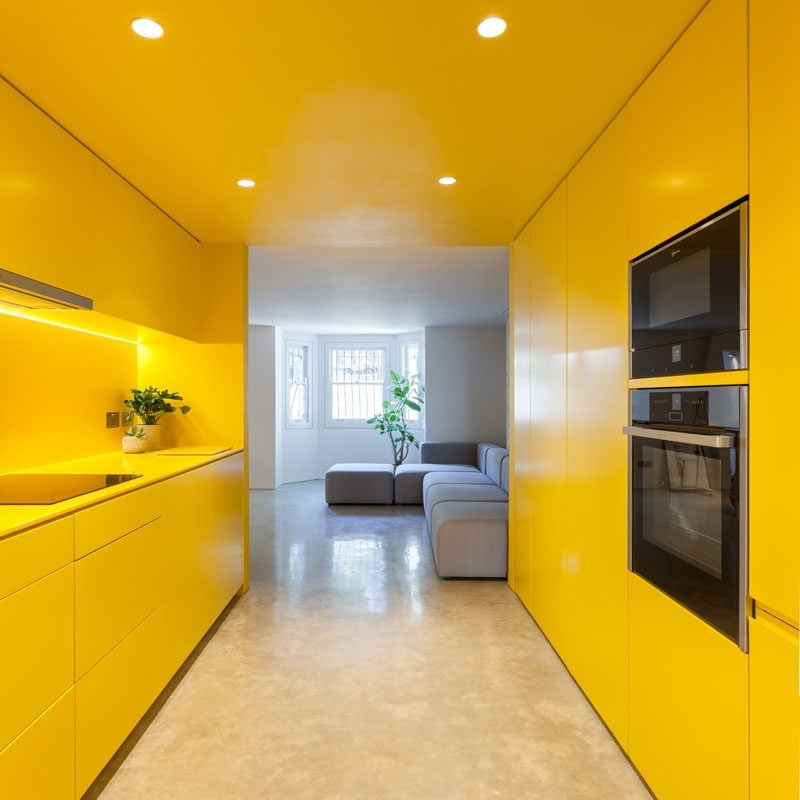
A full wall of yellow cabinetry might sound overwhelming, but this ultra-modern kitchen proves it can work when the scale and proportion are right. The cabinets run from floor to ceiling, creating a seamless, monochromatic block of color that actually makes the room feel larger. Integrated appliances disappear into the yellow, while a concrete floor and minimalist furniture keep the look clean. LED strip lighting and recessed lights add depth, preventing the yellow from feeling flat. The cabinetry becomes the room’s architecture, not just storage. When a single color covers that much surface area, the lighting becomes the real hero. The LED strips create subtle highlights that break up the yellow plane, and the recessed lights keep the overall brightness even. This approach works best in a layout open to the living area where the yellow becomes a backdrop.
Traditional Kitchen with Yellow Granite Island Countertop
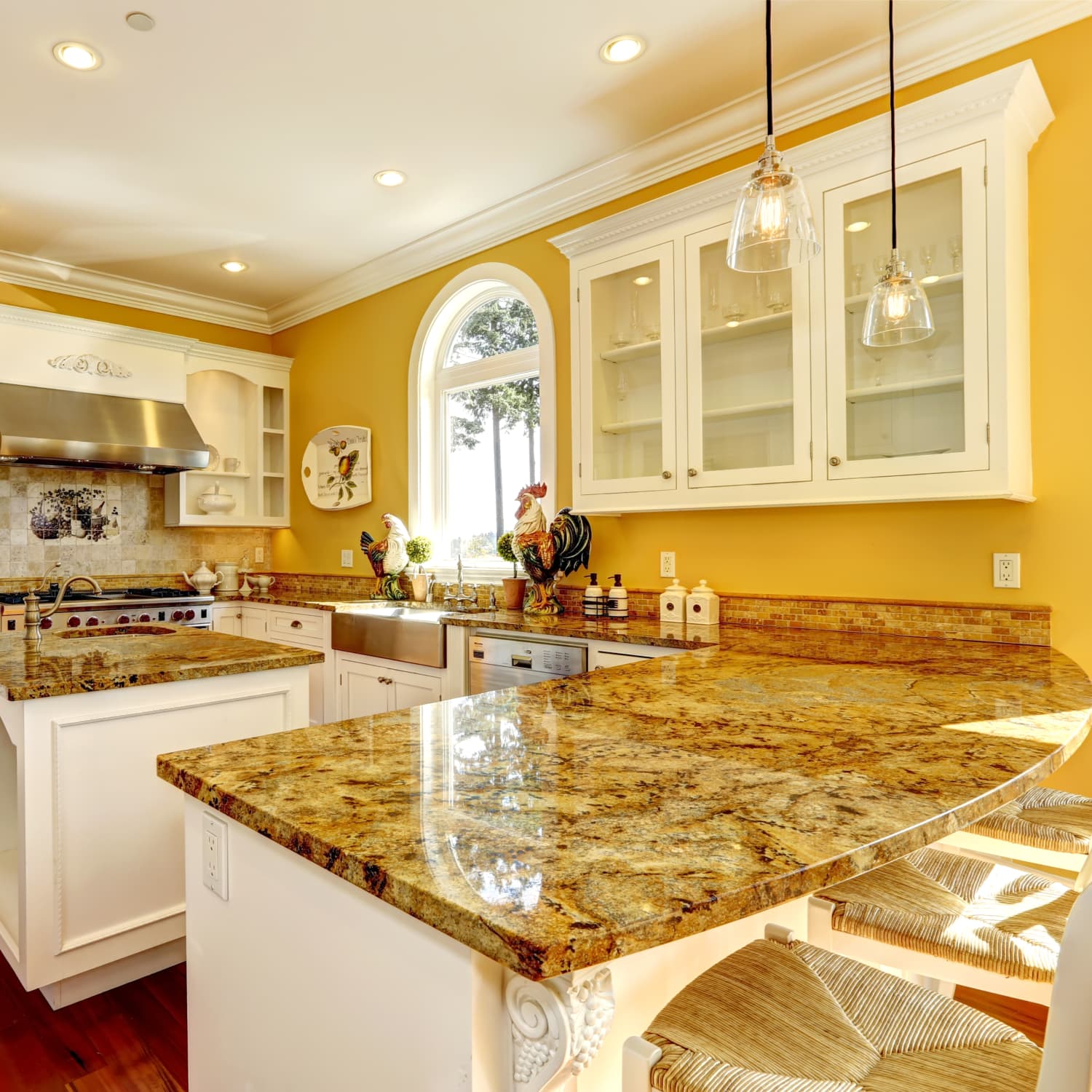
A vibrant yellow granite countertop turns the island into the focal point of this traditional kitchen. The warm yellow tones in the stone echo the gold undertones in the pendant lights above, while the white cabinets and wood floors keep the space neutral. The recessed ceiling lights provide general illumination, and the pendants add task lighting over the island. The material choice is key here: granite brings natural variation and depth that a solid surface can’t match, making the yellow feel organic.
Final Thoughts
From a single yellow tile to floor-to-ceiling cabinetry, these kitchens prove the color can work in any style. The key is finding the right shade and placement for your space. A pale yellow keeps things light and airy, while a vibrant or mustard tone adds energy. Pair it with neutrals like white, gray, or wood to let the yellow stand out without overwhelming the room. For upkeep, wipe down painted cabinets with a damp cloth and use mild soap on tile to keep the color bright. Yellow is a practical choice that brings warmth and personality to the heart of your home.