48 Modern Farmhouse Exterior Ideas for 2026: Transform Your Home’s Curb Appeal

The modern farmhouse exterior has become one of the most searched home styles on Pinterest in 2026, blending clean lines with warm, rustic charm that resonates across American neighborhoods. From suburban Texas to coastal New England, homeowners are reimagining curb appeal with fresh takes on board-and-batten siding, metal roofing, and statement entryways that feel both timeless and contemporary. This style speaks to families seeking authenticity without sacrificing modern functionality—homes that look like they’ve stood for generations while incorporating today’s building standards and design sensibilities. In this guide, you’ll discover inspiring modern farmhouse exterior ideas that capture the movement’s versatility, from bold black trim to breezy coastal adaptations, each designed to help you envision your own perfect façade.
1. Classic White Board-and-Batten with Black Windows
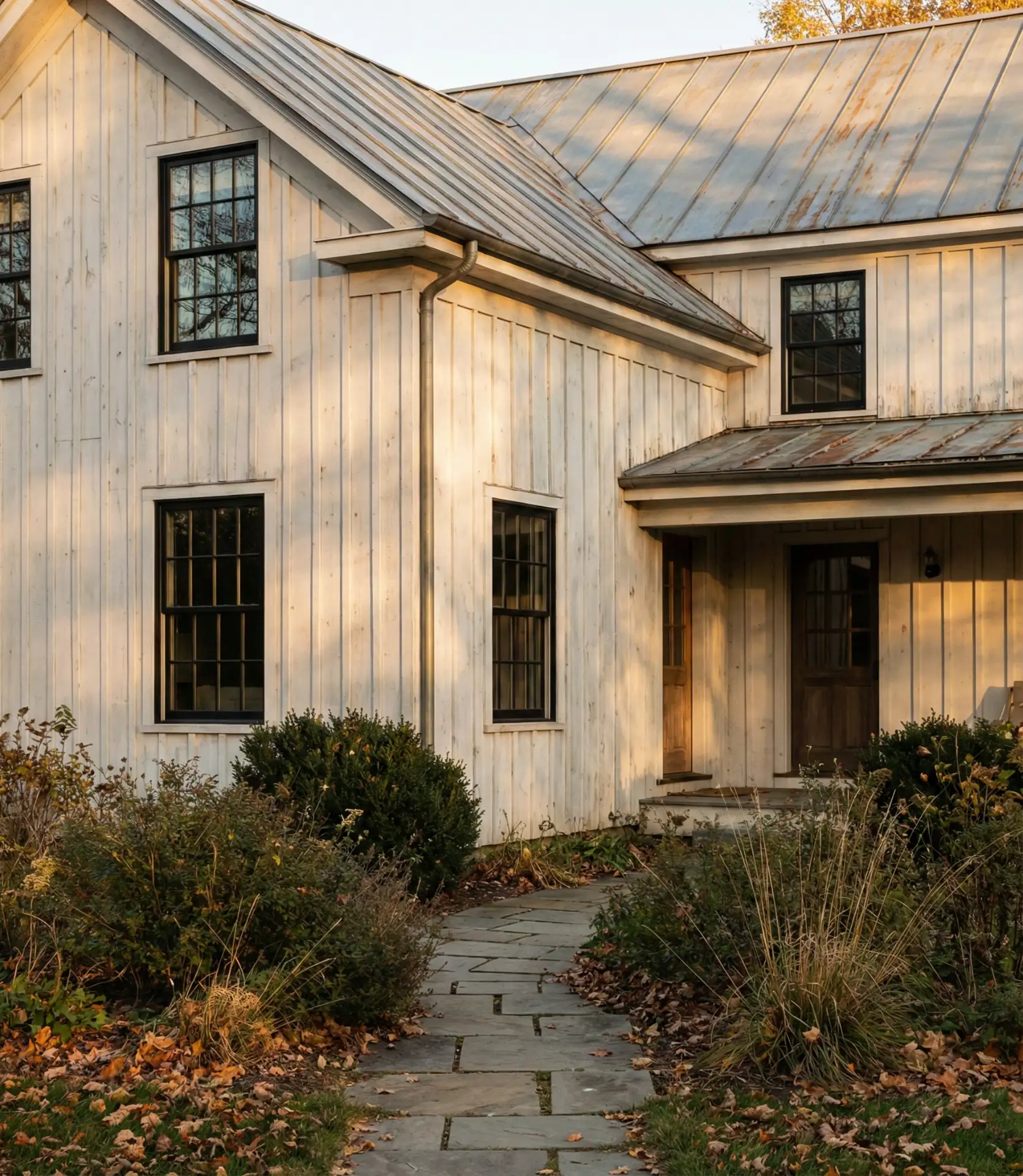
The quintessential modern farmhouse look starts with crisp white vertical siding paired with black-framed windows that create dramatic contrast. This combination works beautifully on both single-story ranches and two-story builds, offering a clean canvas that highlights architectural designs like gabled rooflines and covered porches. The high-contrast palette feels fresh yet grounded, making it a favorite for homeowners updating older properties or building new construction in established neighborhoods.
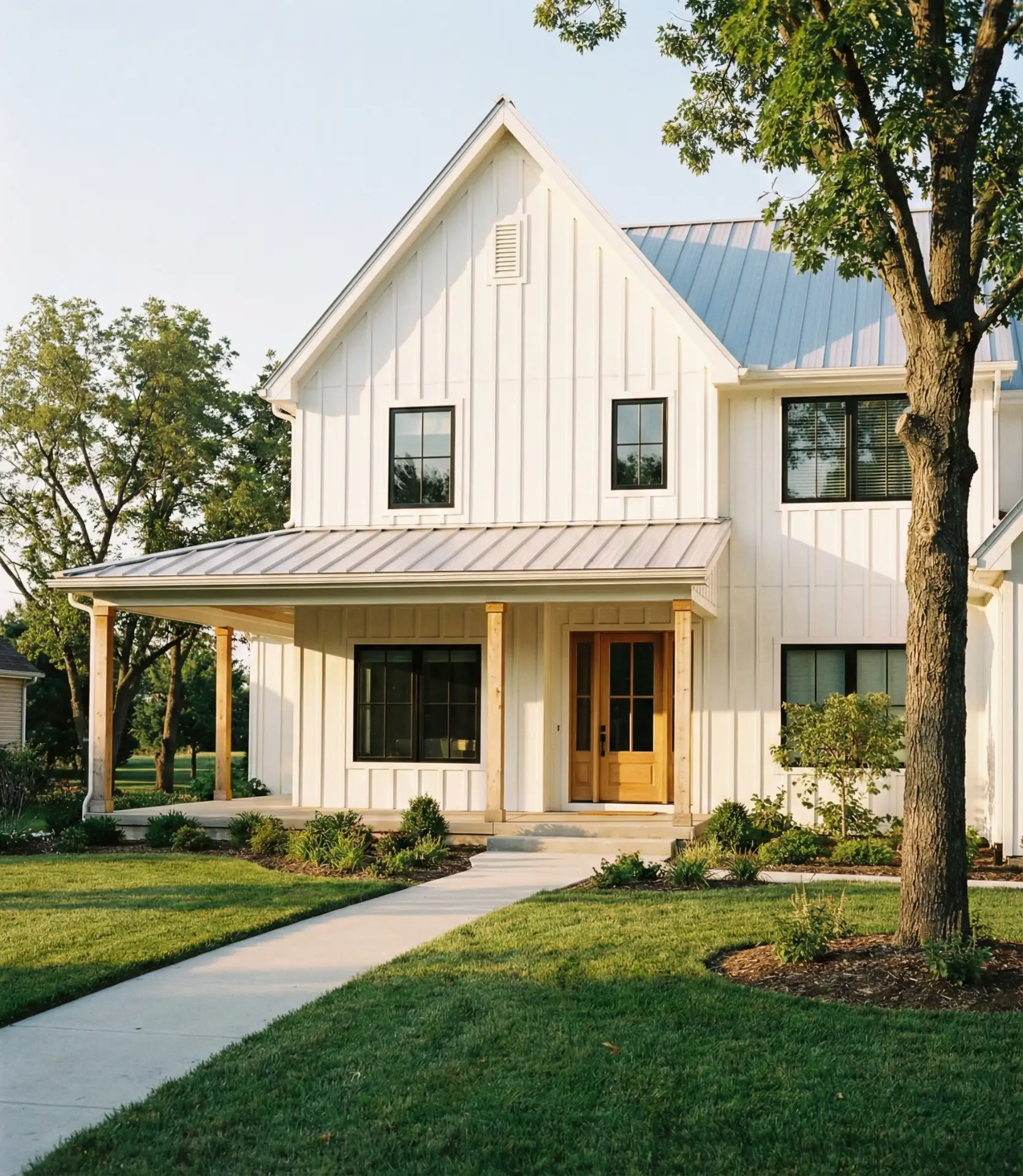
This pairing works best in regions with strong sunlight where the black frames won’t absorb excessive heat—think Colorado, the Carolinas, or Pacific Northwest suburbs where overcast days balance the boldness. Homeowners often report that black windows require less frequent cleaning to maintain their crisp appearance compared to white trim, which shows dust and pollen more readily. The key is choosing true matte black rather than glossy finishes that can look plasticky and undermine the sophisticated farmhouse aesthetic you’re cultivating.
2. Charcoal Gray Exterior with Natural Wood Accents
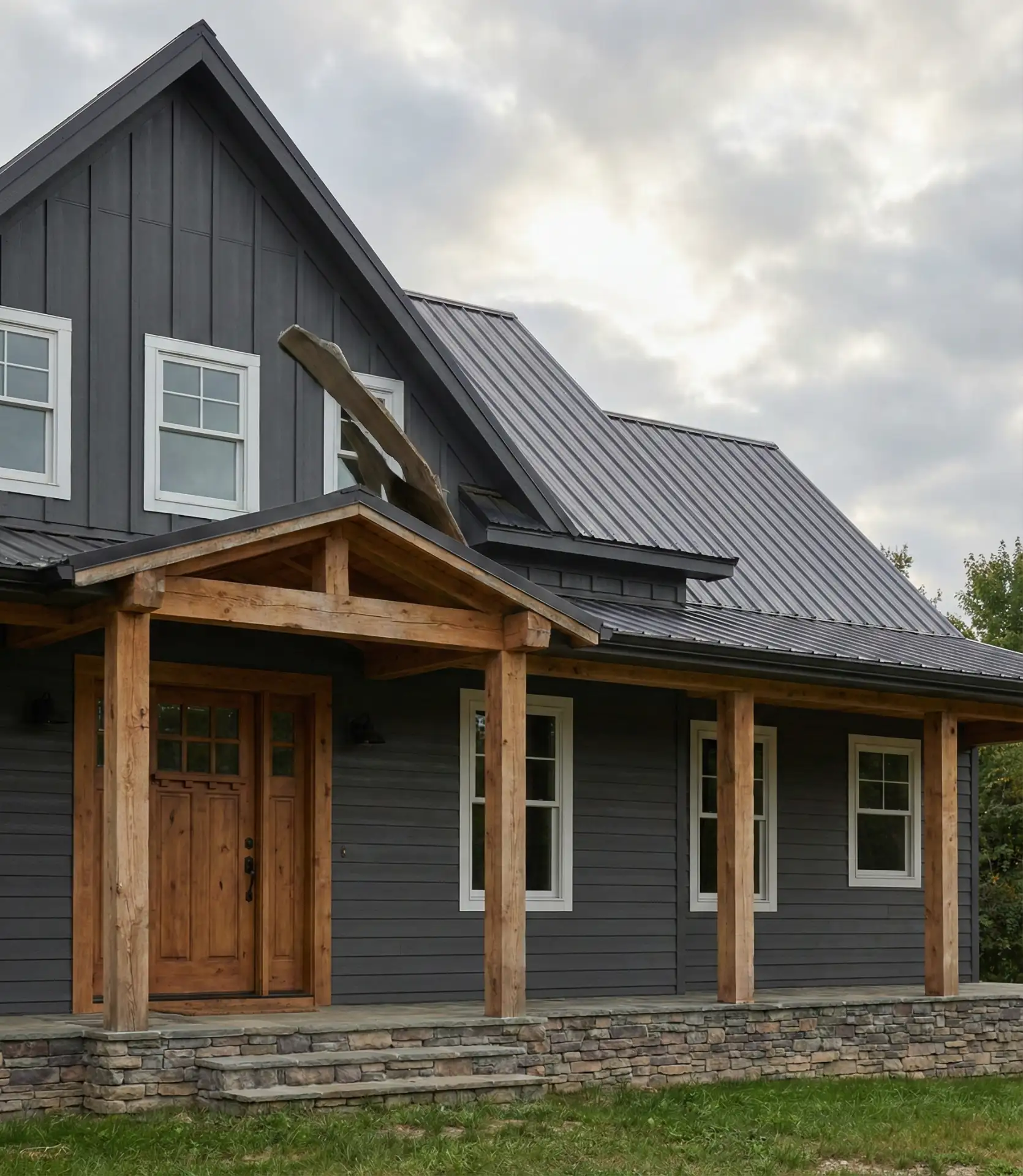
Beyond the traditional white hue, gray exteriors provide a modern take on the farmhouse style, especially suited for urban and suburban environments. Deep charcoal or slate tones paired with rustic cedar beam accents and natural wood doors create depth and visual interest without overwhelming the architecture. This approach allows the color palettes to shift with the seasons—the gray reads cooler in summer light and warmer against winter snow—while maintaining year-round sophistication.
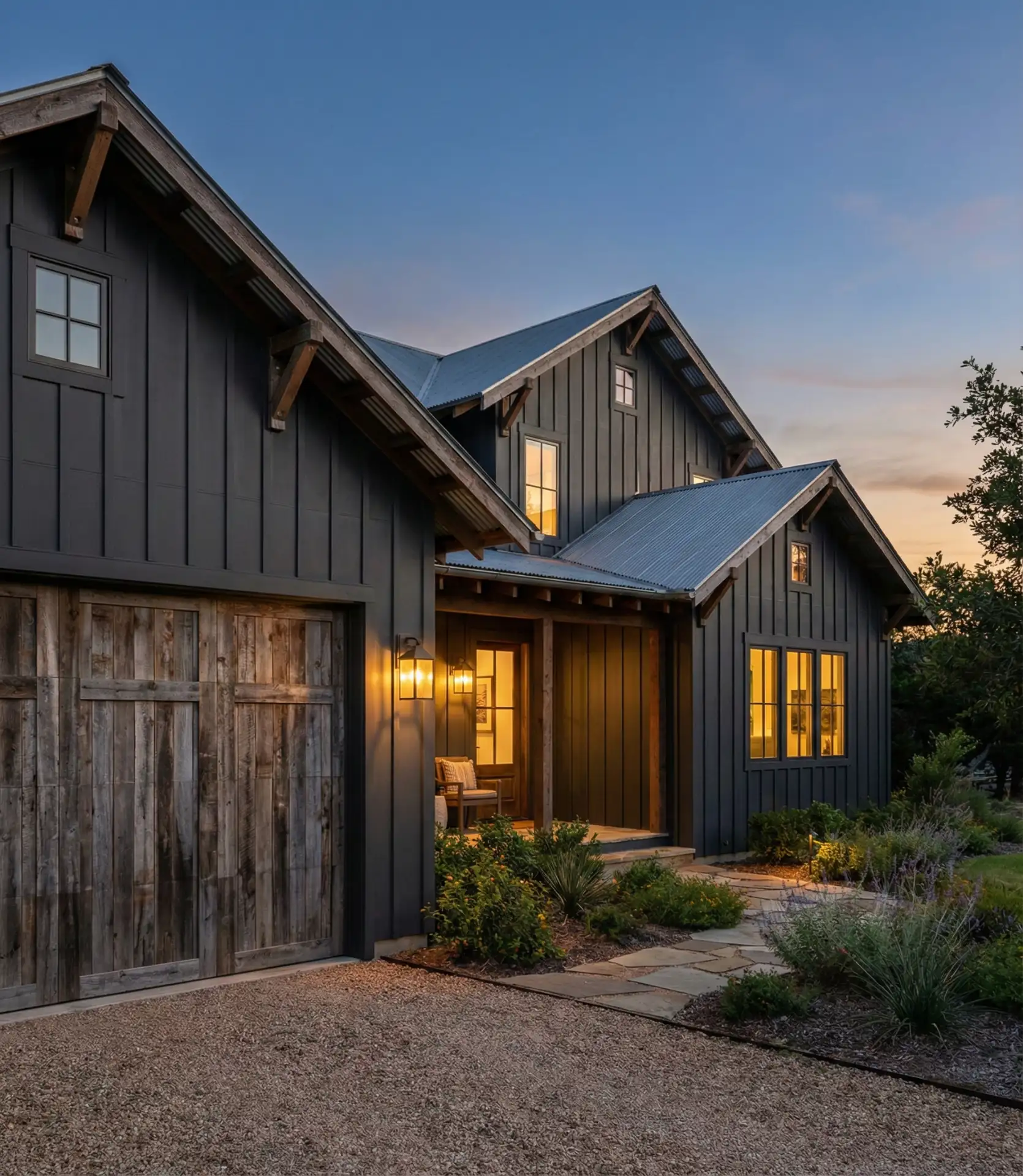
Gray exteriors hide dirt and weather staining remarkably well compared to lighter shades, making them practical for families in rainy climates like Washington or Georgia, where pollen and red clay dust are constant challenges. The investment in quality exterior paint with UV protection pays dividends here—cheaper formulations can fade to an unflattering purple-gray within two years, while premium paints maintain their true tone for a decade or more with proper application.
3. Modern Farmhouse with Wraparound Porch
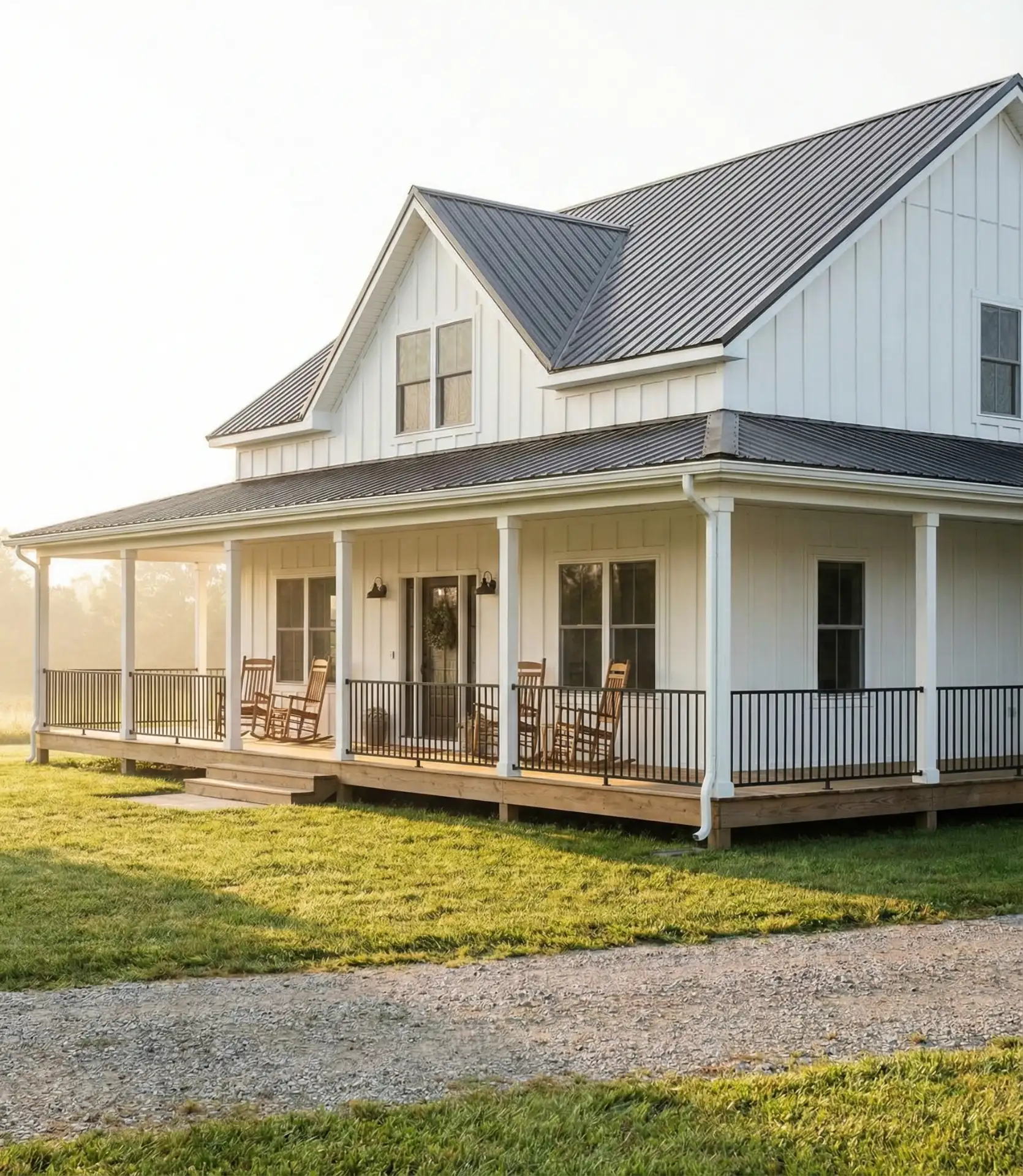
The wraparound porch remains the heart of American farmhouse living, and modern interpretations emphasize clean lines with metal railings and white-painted columns instead of ornate Victorian details. These house plans wrap around porches that extend living space outdoors, perfect for morning coffee or evening gatherings, while the elongated roofline creates dramatic shadow play that changes throughout the day. Pairing this classic feature with contemporary elements like horizontal cable railing or oversized black pendant lights bridges traditional and modern aesthetics seamlessly.
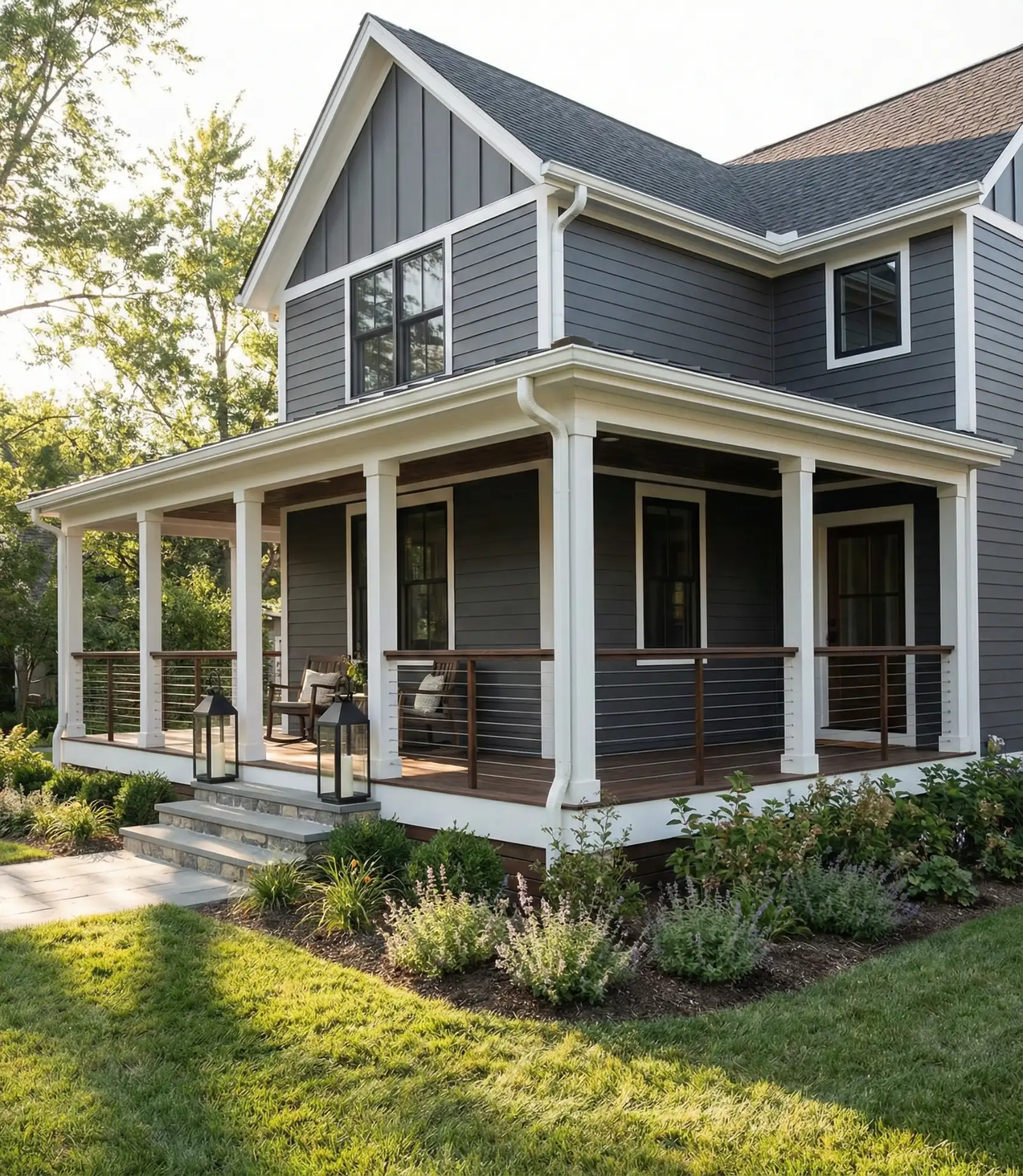
In the South and Midwest, wraparound porches aren’t just aesthetic—they provide genuine climate control by shading windows and walls from intense sun, reducing cooling costs by up to 20% during summer months. However, many homeowners underestimate the maintenance commitment: wood porch floors require annual staining or painting, and composite decking, while low-maintenance, can cost three times more upfront but eliminates the yearly refresh cycle entirely, making it worth considering during the planning phase.
4. Black Farmhouse with White Trim Reversal
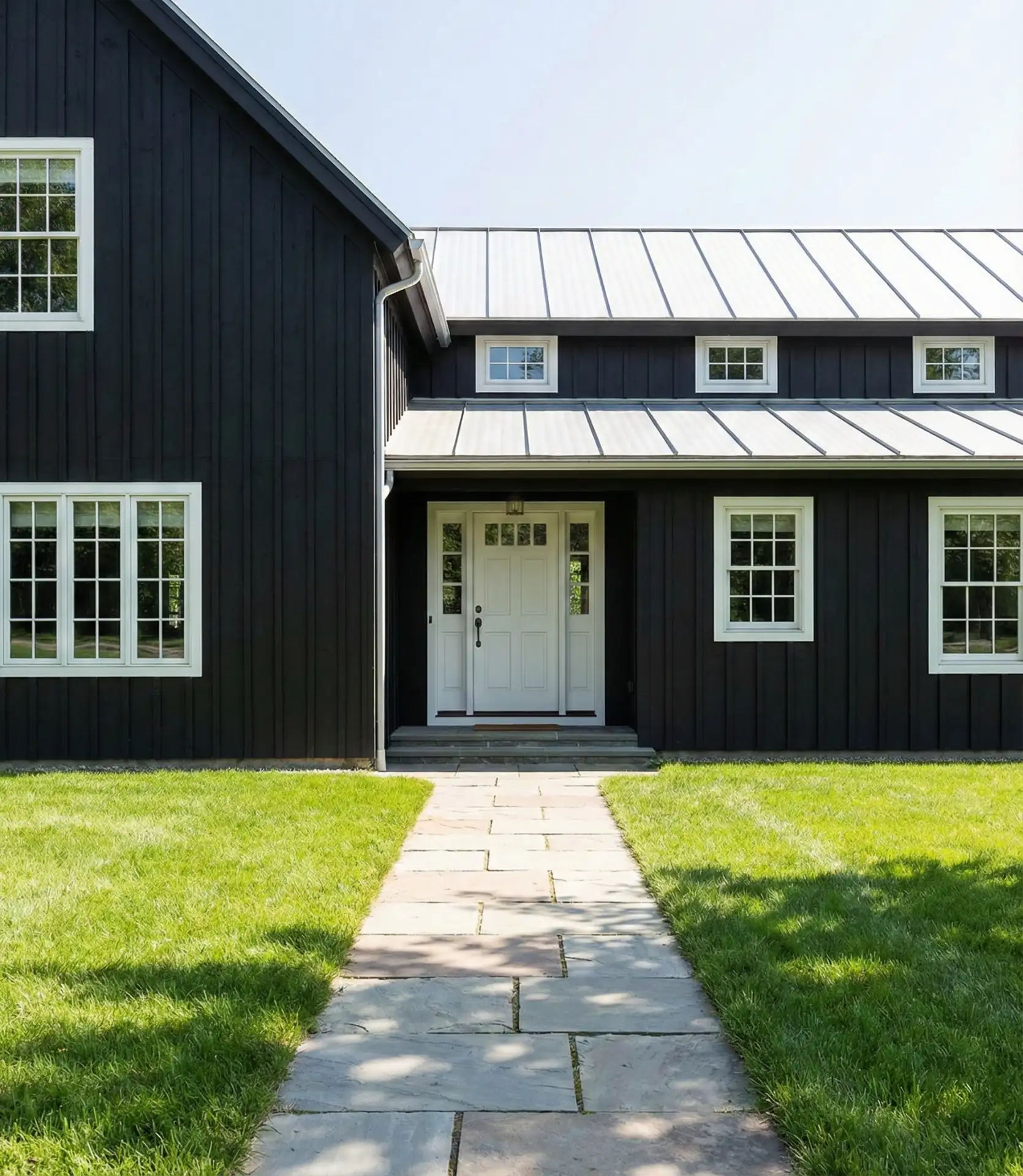
Contrary to traditional farmhouse colors, a black or dark charcoal body paired with crisp white windows and trim creates a striking, gallery-like backdrop that accentuates landscaping. This bold black and white reversal has gained traction on Pinterest for its Instagram-worthy impact and surprisingly versatile personality—it reads sophisticated in urban contexts and dramatic against rural settings. The high contrast emphasizes every architectural detail, from window grids to fascia boards, demanding precise execution during construction or renovation.
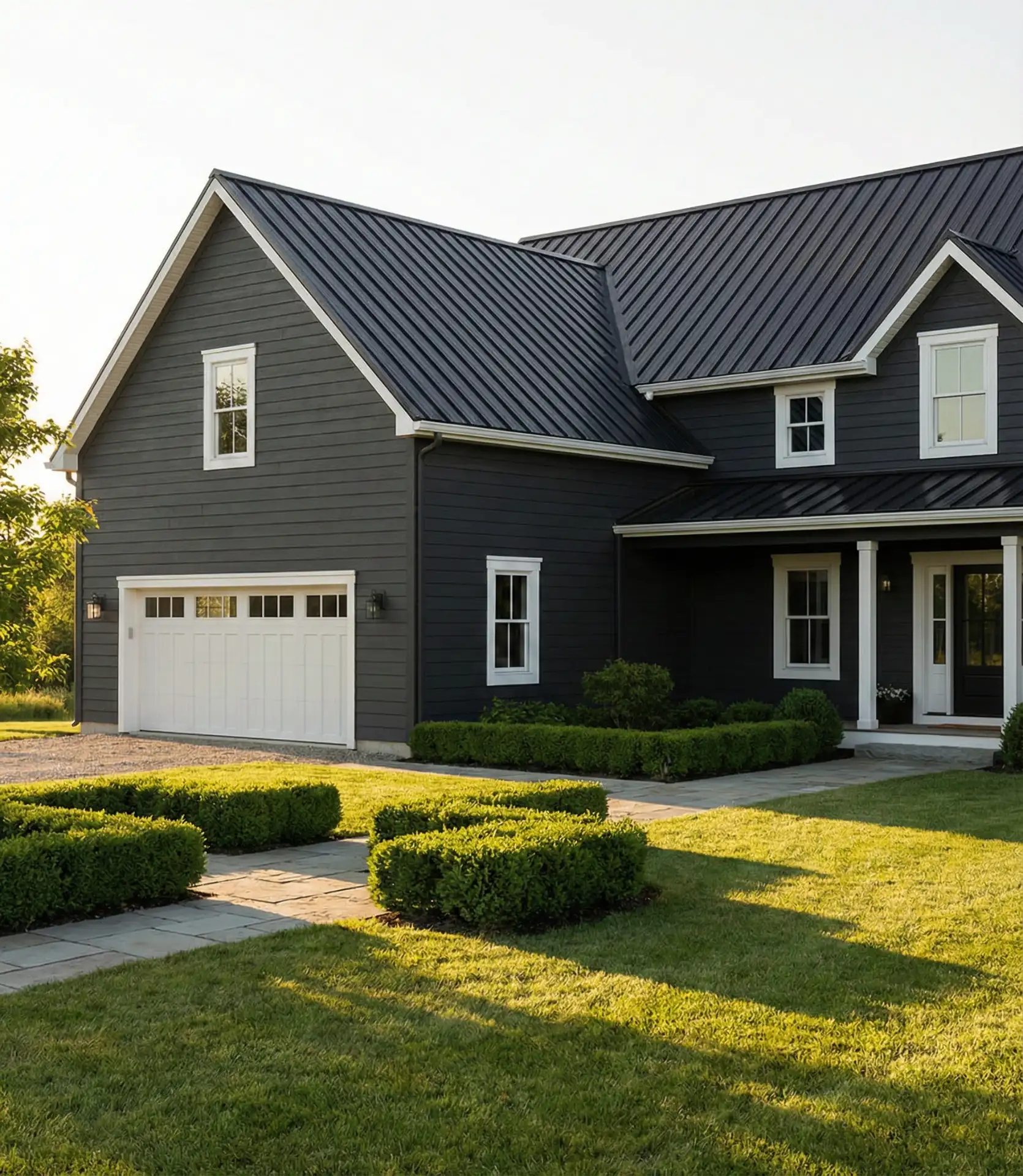
A designer I spoke with in Austin mentioned that black exteriors have become her most requested finish since 2024, but she always warns clients about heat absorption in southern climates—surface temperatures can reach 170°F on summer afternoons, potentially warping vinyl siding or compromising paint adhesion. She recommends fiber cement or Hardie board over vinyl and lighter blacks (think graphite or iron ore rather than true black) in regions where summer temperatures regularly exceed 95°F to prevent thermal damage.
5. Stone and Wood Blend for Rustic Texture
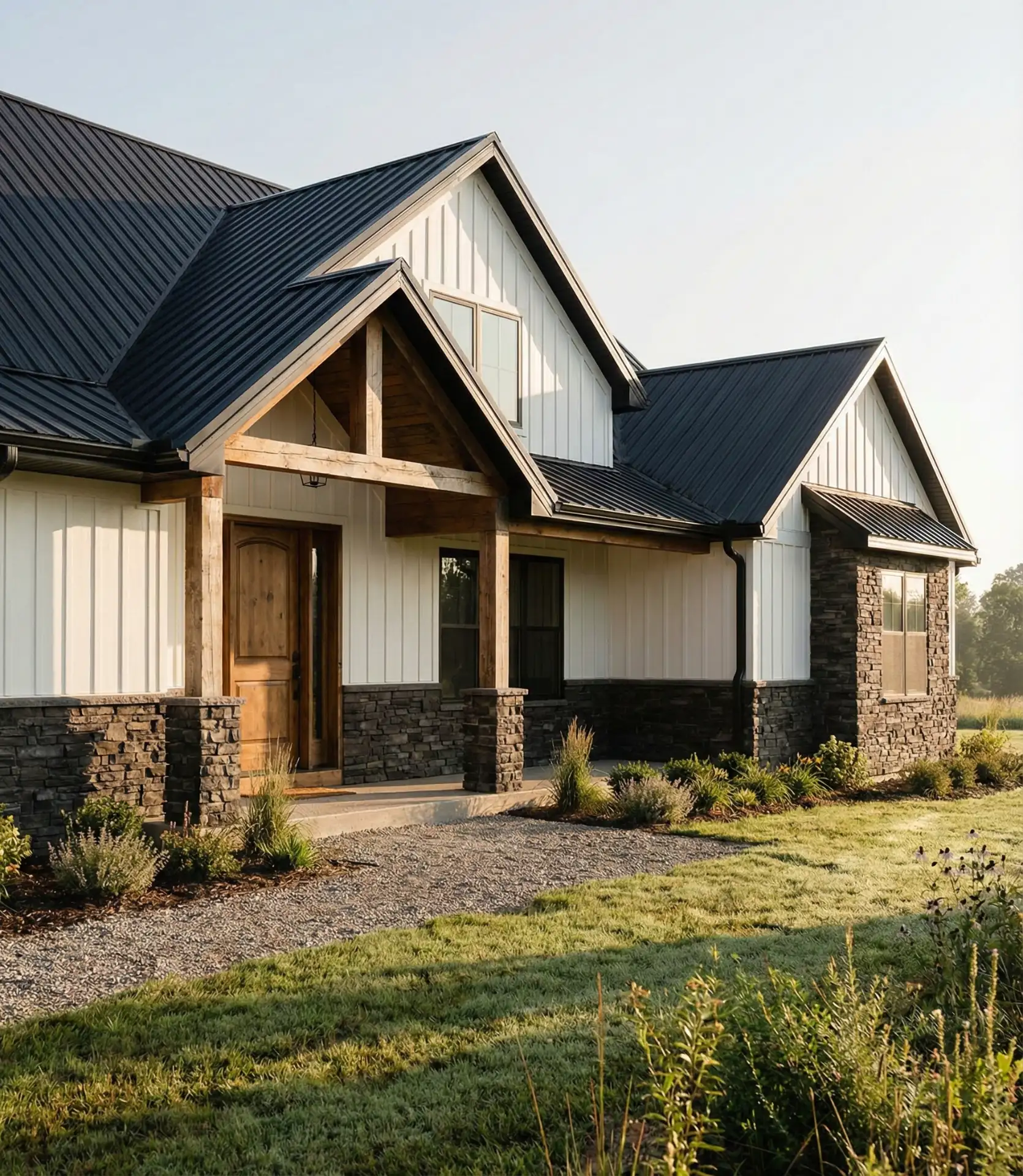
Combining natural stone veneer with rustic wood siding creates tactile richness that grounds modern farmhouse designs in organic materiality. The stone typically anchors the foundation and corners, while board-and-batten or horizontal siding covers the main body, establishing a visual hierarchy that feels both substantial and approachable. This mixed-material approach echoes traditional barn construction, where stone foundations supported timber frames, translating that heritage into contemporary residential architectural design house plans.
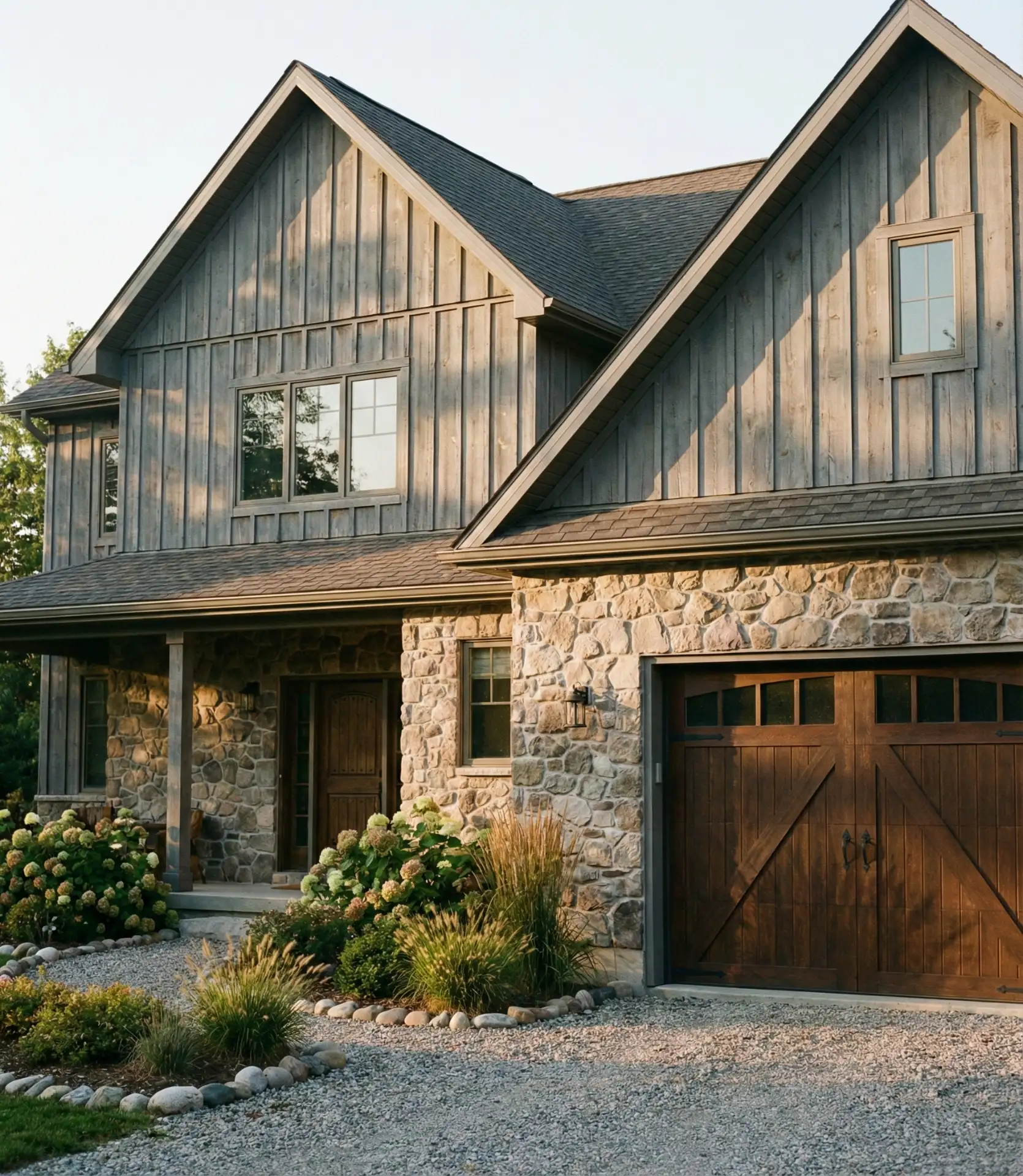
Where it works best: Properties with sloping lots can showcase stone foundations dramatically, while flat suburban sites benefit from stone accent walls around garages or entry vestibules to break up large expanses of siding. In New England and the Mountain West, local stone varieties tie homes to regional geology—Pennsylvania bluestone, Colorado moss rock, or Tennessee fieldstone—creating authentic connections to place that manufactured materials simply can’t replicate regardless of how well they’re installed.
6. Soft Blue-Gray for Coastal Farmhouse Vibes
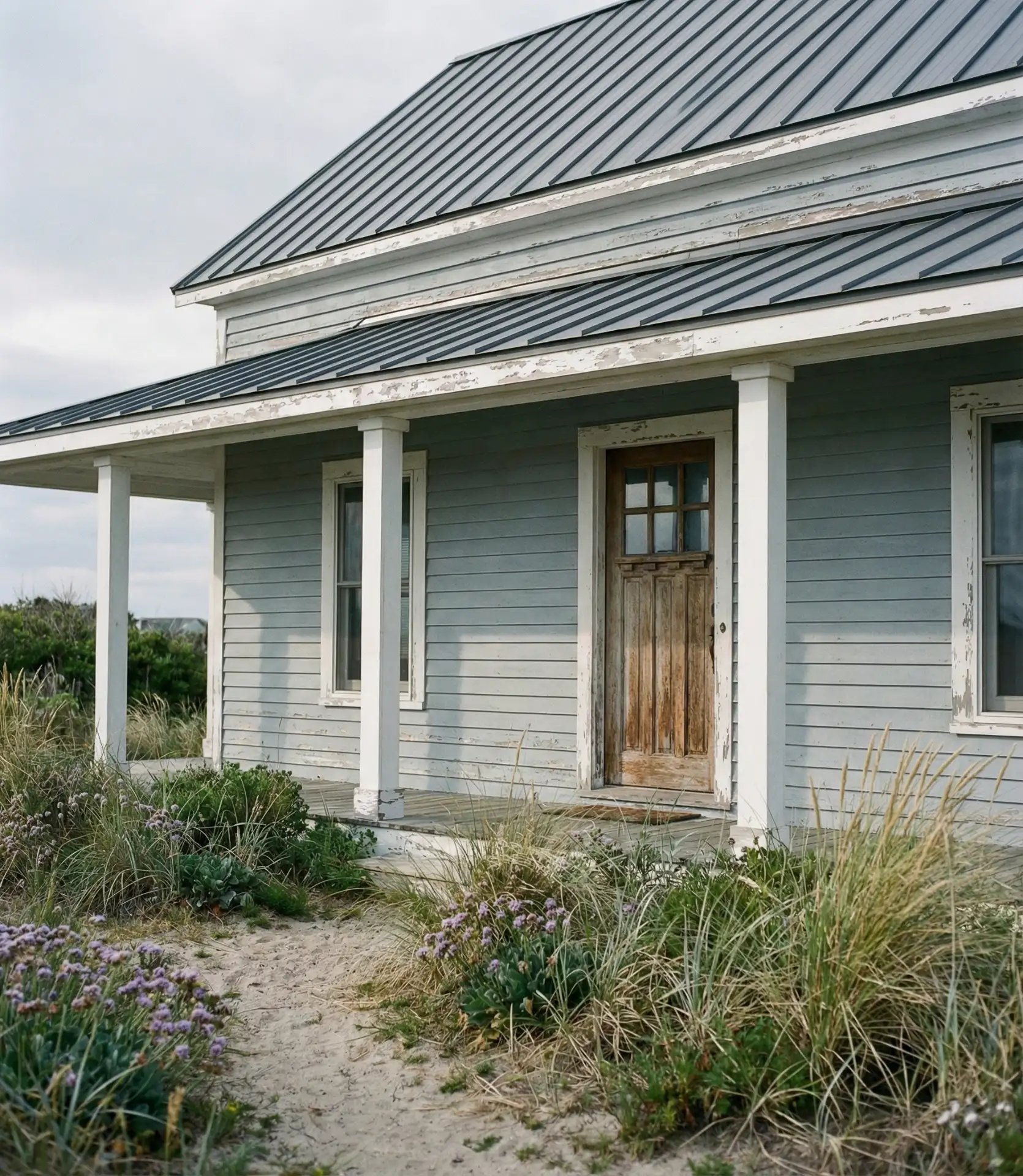
Light blue or seafoam gray exteriors nod to coastal farmhouse traditions while maintaining the style’s signature simplicity. These paint colors work beautifully with white trim and natural wood doors, evoking seaside cottages without the literal nautical clichés of anchors or rope details. The palette feels particularly authentic in the Mid-Atlantic and Gulf Coast regions, where historic farm buildings were often these softer hues, faded by salt air and sun into the muted tones we now deliberately specify.
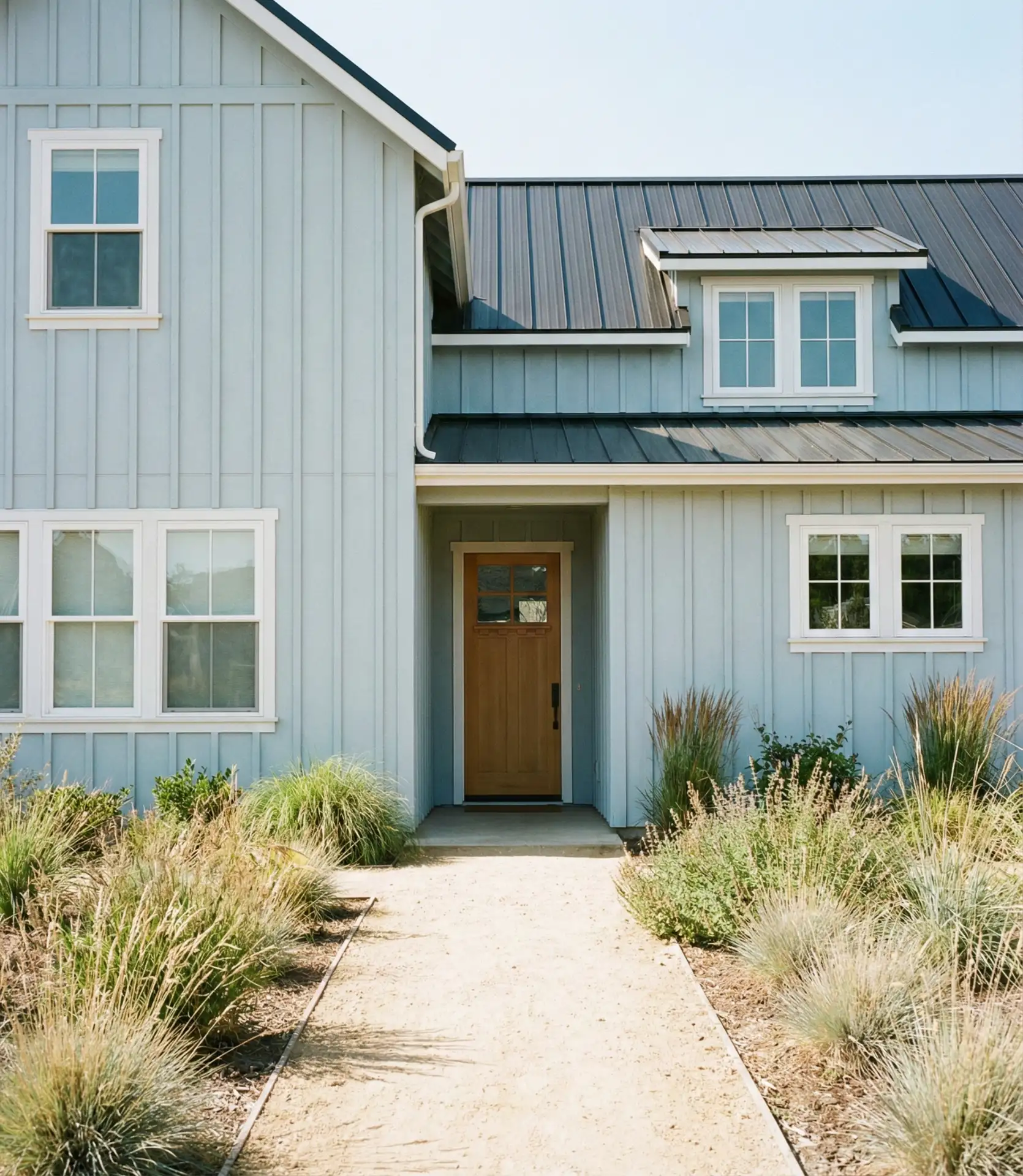
These lighter color palettes reflect rather than absorb heat, making them practical choices for warm climates where cooling costs matter—a pale blue exterior can remain 20-30 degrees cooler than black or dark gray on a summer afternoon. Real homeowners in Virginia and the Carolinas often choose these shades specifically for this energy efficiency, finding that their air conditioning runs less frequently even before considering attic insulation or window upgrades that would provide additional savings.
7. Modern Farmhouse with Vertical Metal Siding
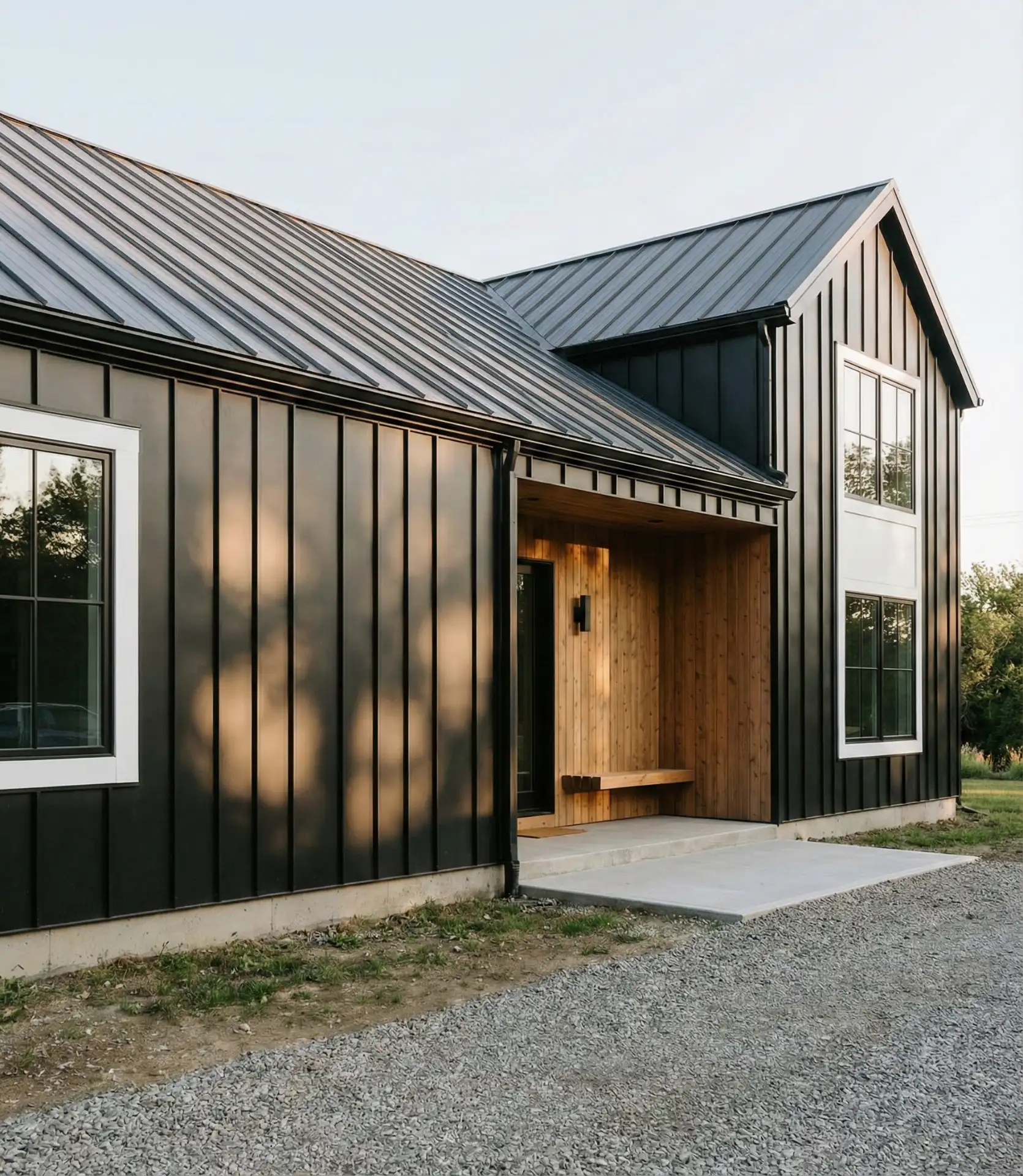
Vertical metal panel siding in matte black, dark gray, or even forest green brings agricultural authenticity to modern farmhouse designs, referencing the corrugated metal barns that dot rural America. The material’s clean lines and shadow reveals create rhythm across the façade while offering exceptional durability and virtually zero maintenance compared to wood alternatives. This choice particularly appeals to homeowners building in wildfire-prone areas, where non-combustible materials provide both aesthetic appeal and crucial fire resistance ratings.
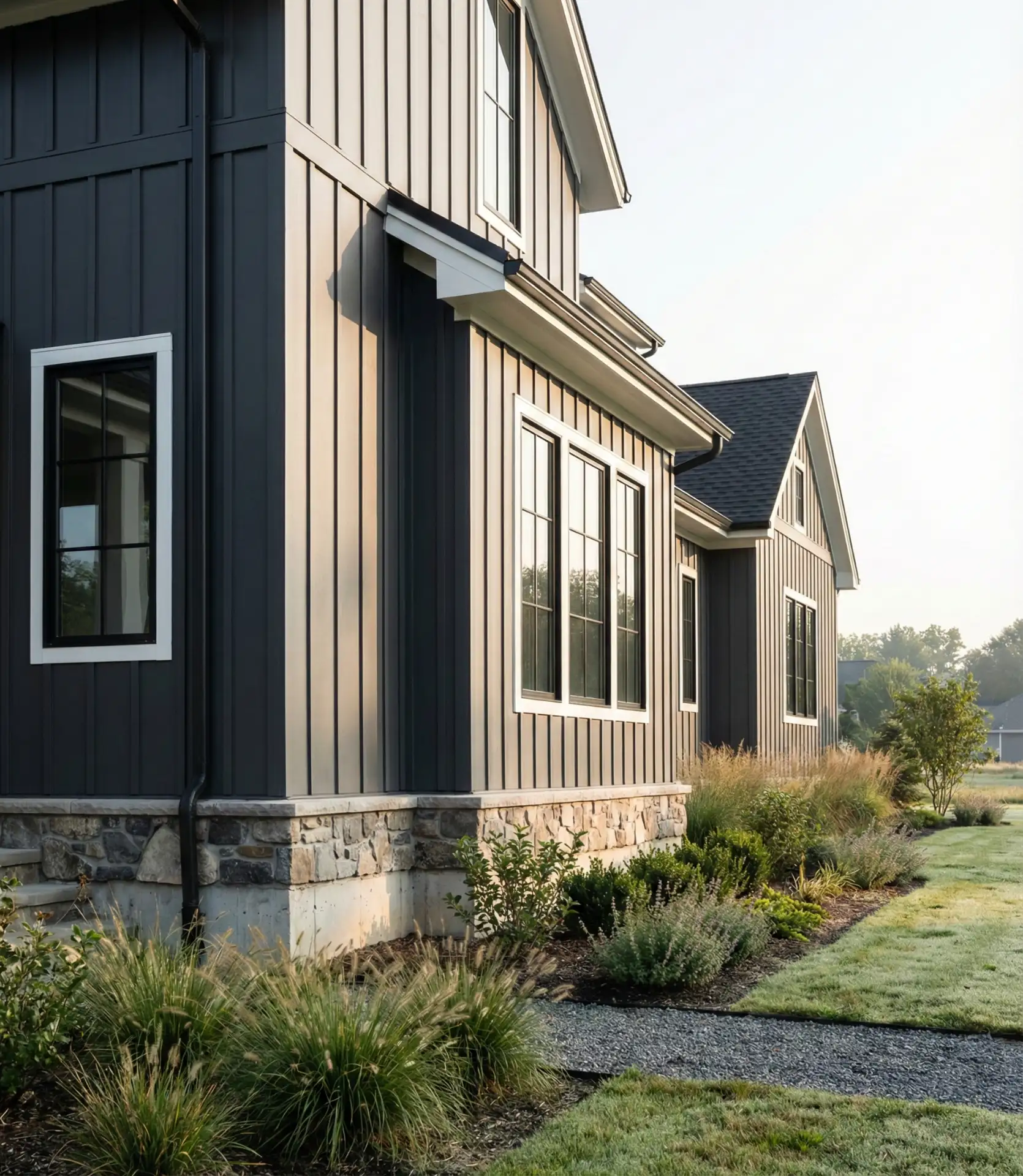
Metal siding typically runs $8-12 per square foot installed, positioning it between vinyl ($3-7) and fiber cement ($10-14), but its 50+ year lifespan without painting or replacement makes the cost per year remarkably competitive. The common mistake homeowners make is pairing metal siding with cheap asphalt shingles—the quality mismatch is jarring. If you’re investing in metal walls, budget for standing seam metal roofing to maintain visual coherence and maximize the modern farmhouse impact you’re after.
8. Single-Story Ranch with Deep Eaves
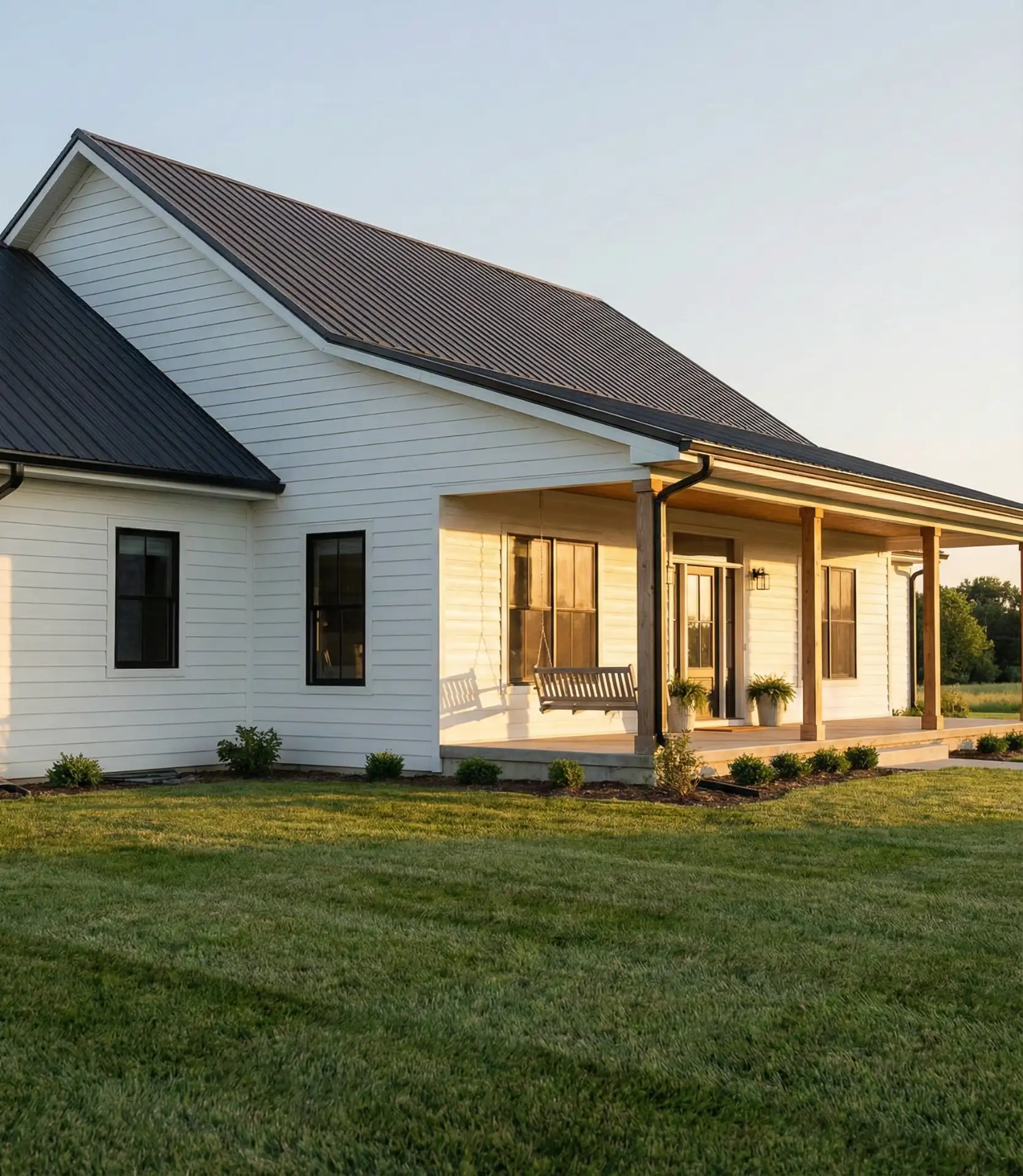
The modern single-story farmhouse infuses accessible, age-in-place floor plans with the warmth of the style, making it appealing to both young families and those who are downsizing. Deep overhanging eaves—often 24-36 inches rather than the standard 12—create dramatic horizontal shadow lines while providing practical weather protection for walls and windows. These extended rooflines work particularly well with white or light gray siding, where the shadow play becomes a defining architectural feature that changes throughout the day and across seasons.
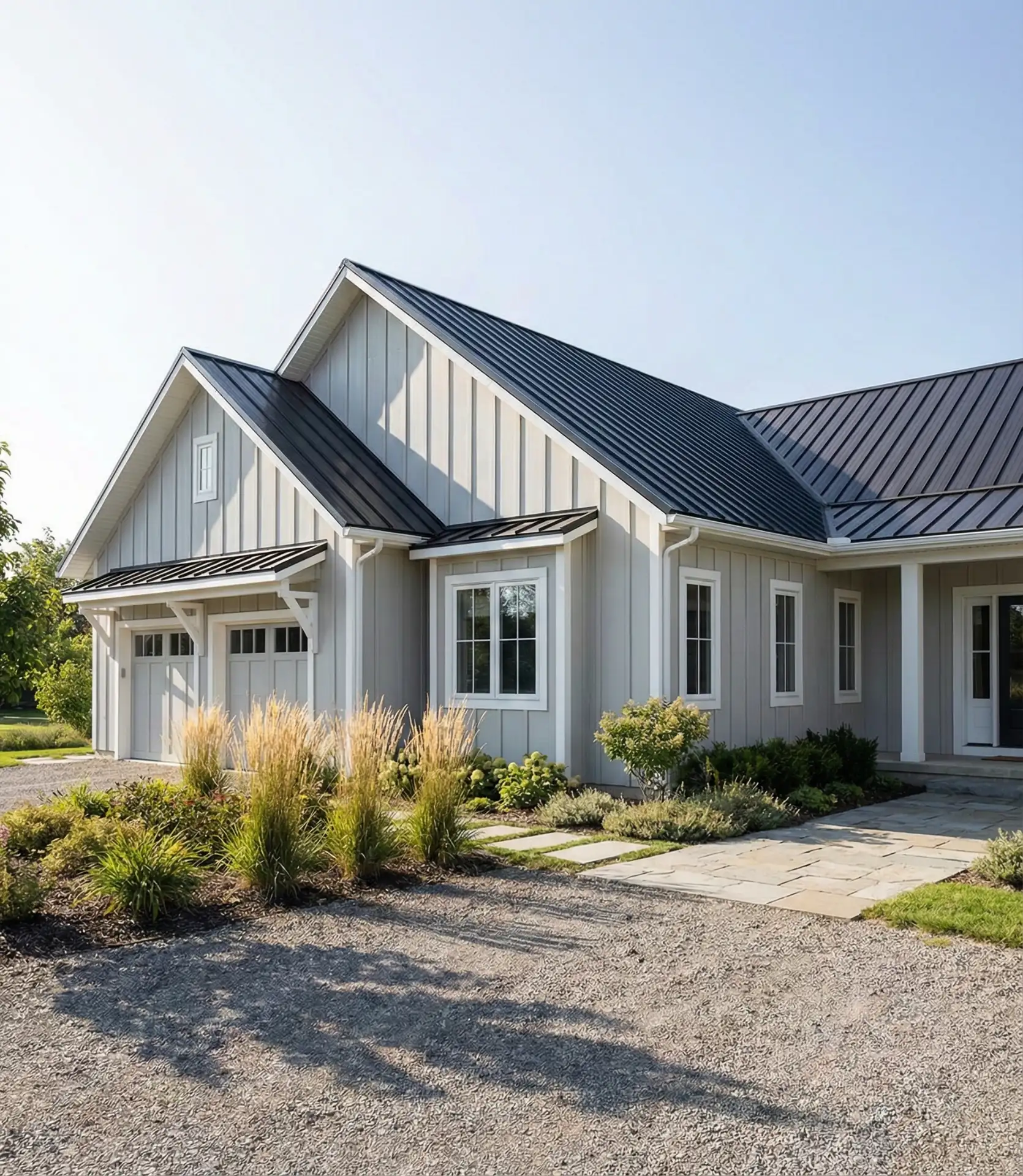
Deep eaves aren’t purely aesthetic—they’re strategic. In the Southwest and Southeast, those extra inches of overhang can reduce direct solar gain through windows by up to 30%, keeping interiors cooler without heavy window treatments that block views. The structural trade-off is that deeper eaves require more robust framing and may increase lumber costs by 15–20%, but most homeowners find this investment worthwhile when they’re not running ceiling fans constantly or drawing curtains against afternoon glare.
9. Green Sage Exterior with Cream Trim
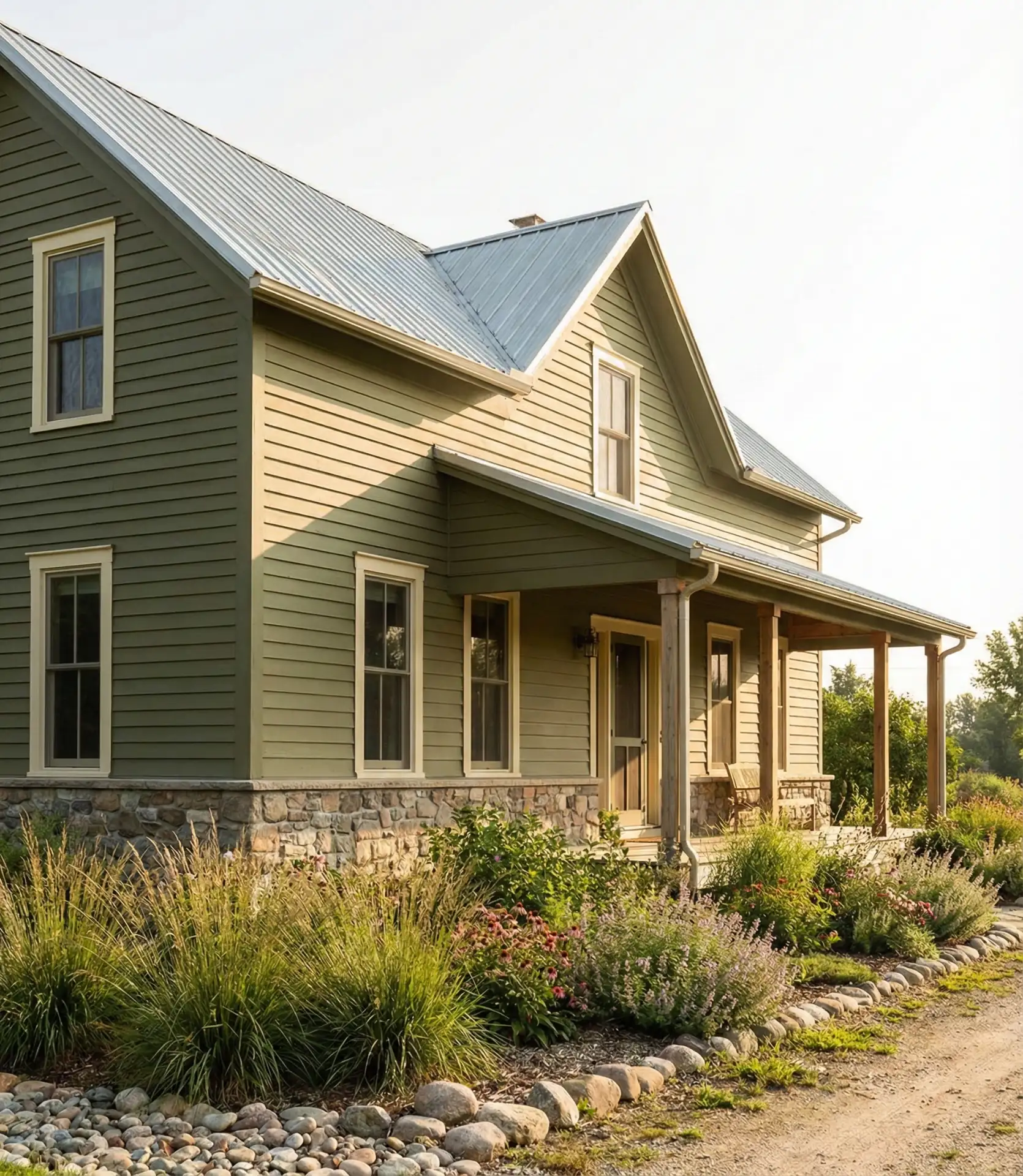
Muted sage or olive green exteriors bring an organic earthiness to farmhouse design, creating visual harmony with surrounding landscapes that white or black homes can’t quite achieve. Paired with warm cream or off-white trim rather than stark white, these color palettes feel settled and timeless, as though the house grew from its site rather than being imposed upon it. This combination has surged on Pinterest as homeowners seek alternatives to the ubiquitous gray and white schemes, offering freshness without trendiness.
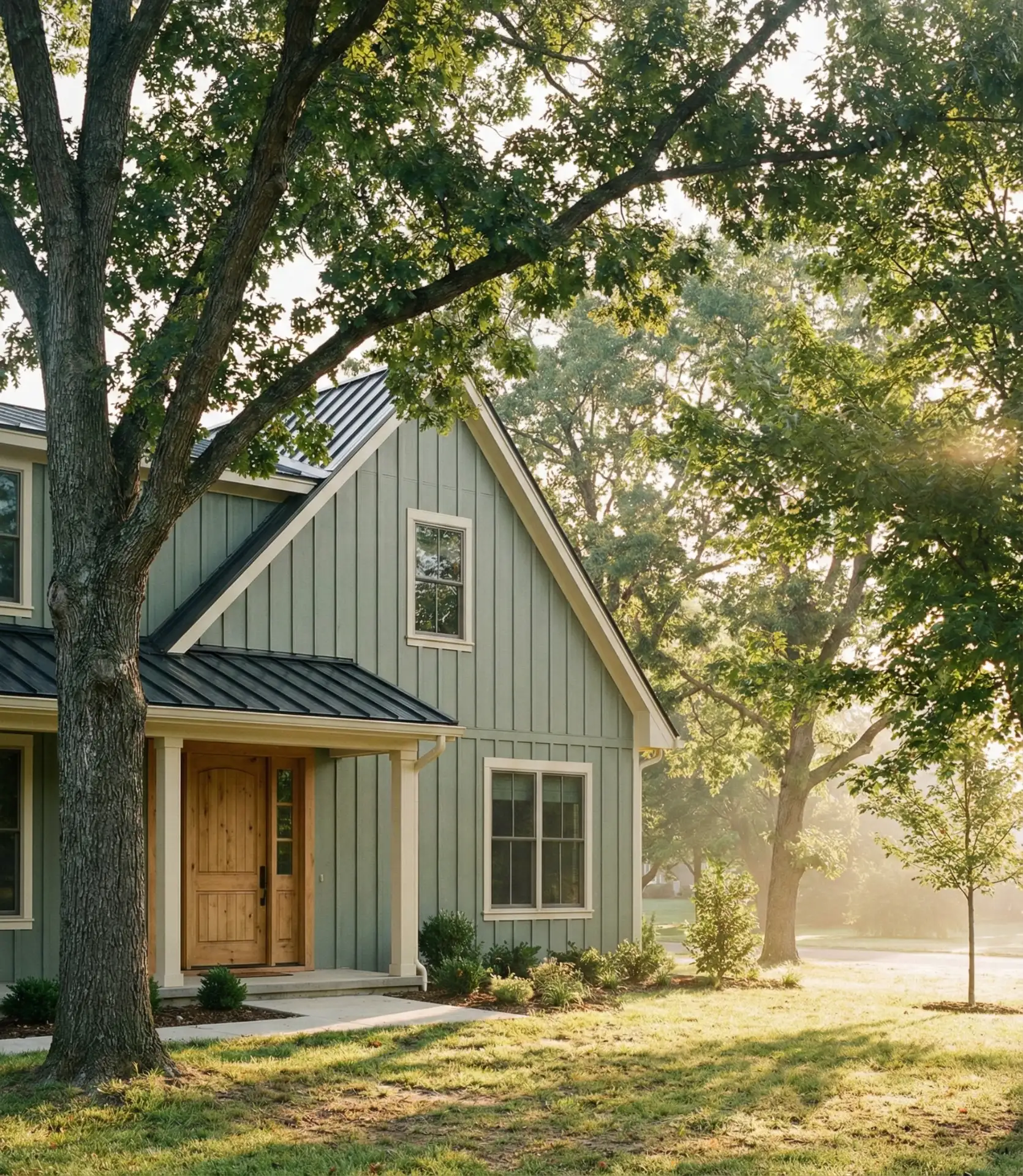
In practical terms, green exteriors show pollen, mildew, and dirt less conspicuously than white homes, reducing visible grime between power washing sessions—a meaningful consideration in humid southern climates or Pacific Northwest regions where moss and algae growth is constant. Expert painters recommend sampling your chosen green at different times of day, as these complex paint colors can shift dramatically from warm olive in morning light to cool gray-green at dusk, and you want to love it in all conditions.
10. Bloxburg-Inspired Symmetrical Design
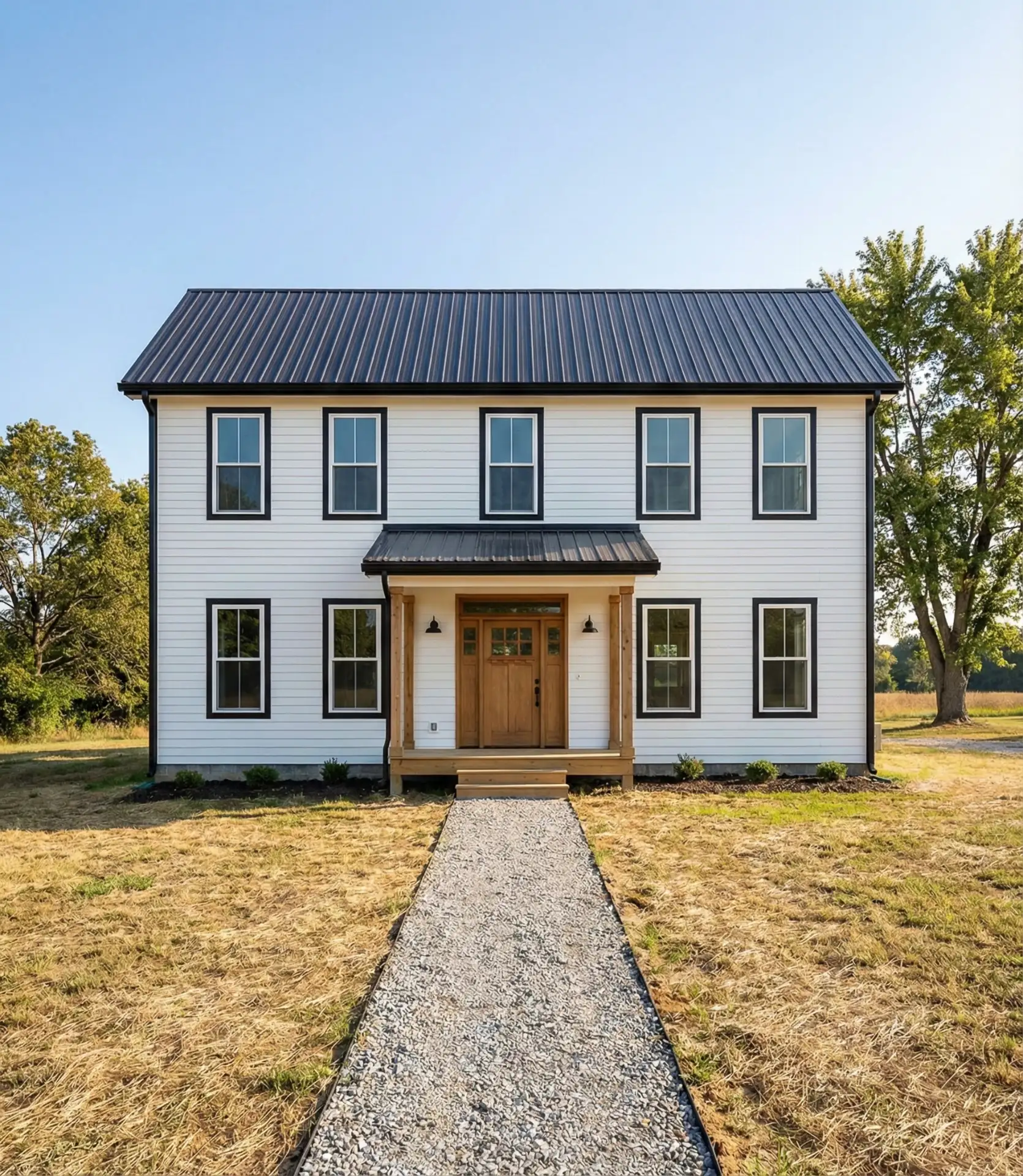
The gaming platform Bloxburg has unexpectedly influenced real-world architectural house designs through its popularization of perfectly symmetrical farmhouse facades—centered doors, evenly spaced windows, and balanced gable peaks that create Instagram-ready geometry. While actual construction must accommodate structural realities that virtual builds ignore, this ideal symmetry has pushed designers toward more balanced compositions that feel intentional and harmonious. Young homeowners who grew up playing design games often bring these preferences to their first home projects, seeking that same satisfying visual order in three-dimensional reality.
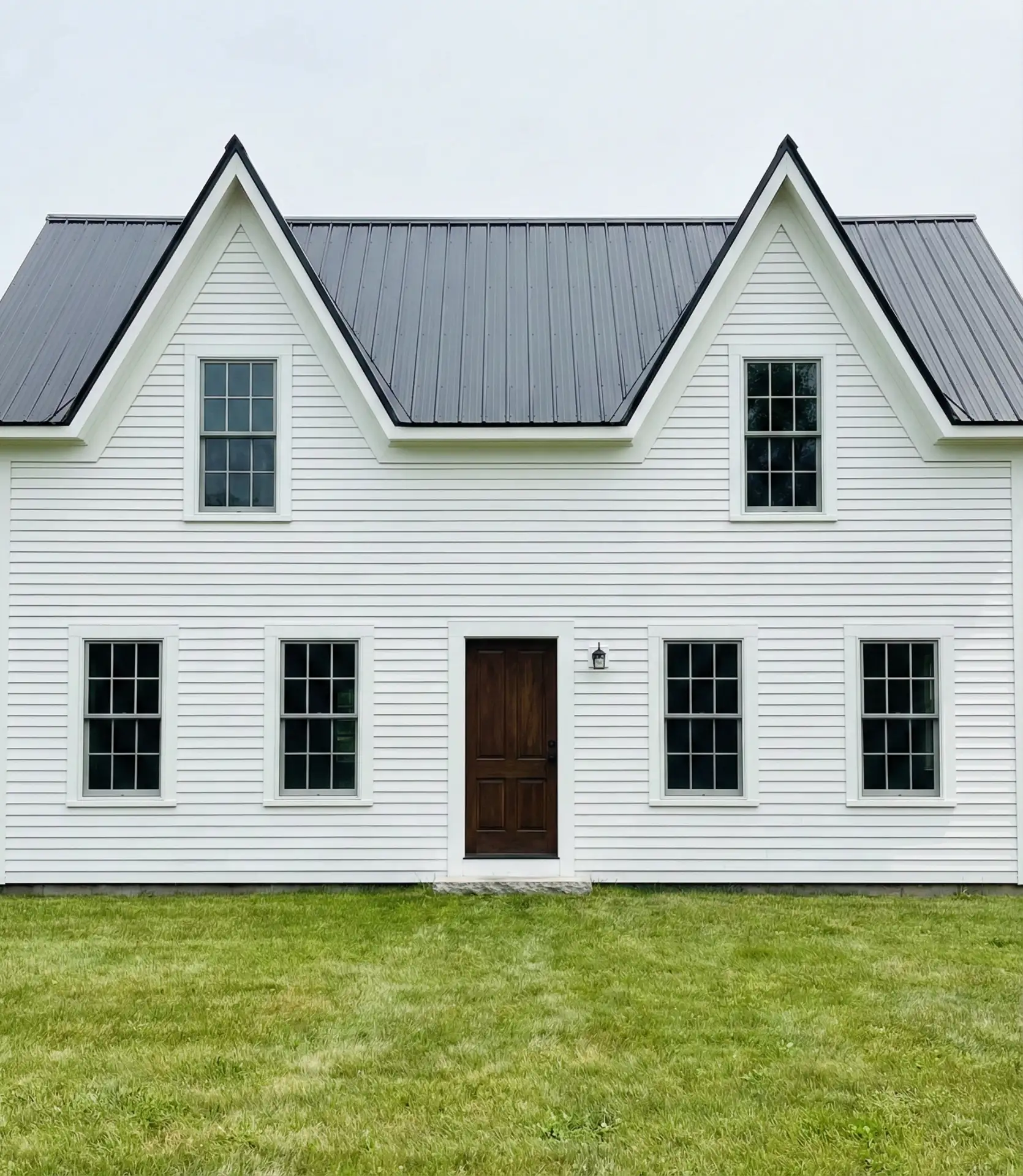
Where it works best: New construction on level lots where you’re working from scratch without existing structures to accommodate, making perfect symmetry achievable without compromise. However, renovation projects often can’t achieve this ideal without moving windows or doors—costly interventions rarely worth the aesthetic payoff. A skilled architect can create perceived symmetry through careful material placement and trim work even when the underlying structure isn’t perfectly balanced, delivering visual satisfaction without structural upheaval.
11. Barn-Style Garage with Living Space Above
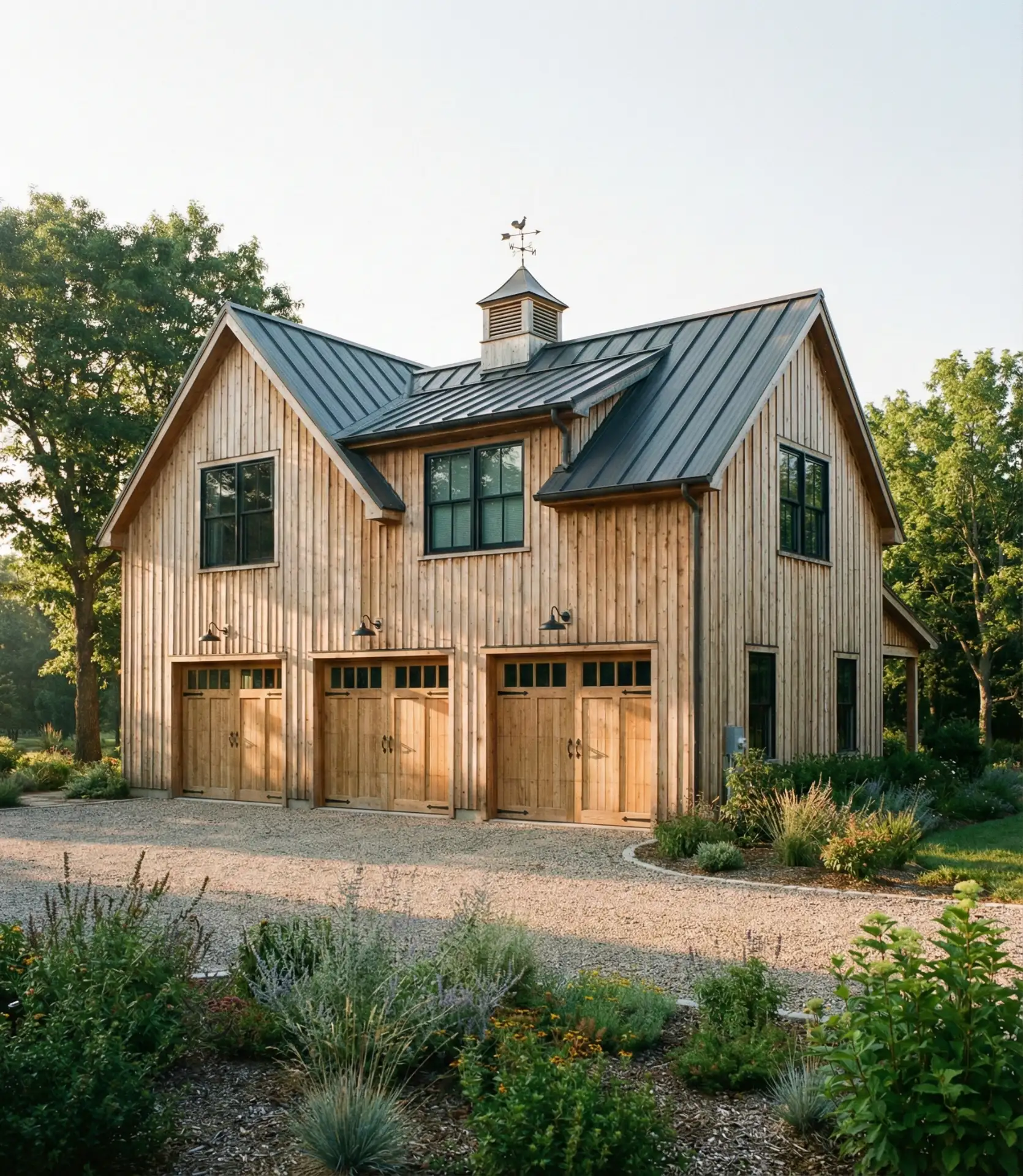
A detached or attached garage with a gambrel or gabled roofline and functional loft space above extends farmhouse character beyond the main residence while maximizing property utility. These barn-inspired structures work especially well on larger lots where the garage can be positioned to create courtyard-like entry sequences or frame views from the main house. The vertical board-and-batten siding, oversized sliding doors, and cupola or weather vane details reinforce the agricultural aesthetic while housing cars, workshops, or guest quarters in a cohesive architectural family.
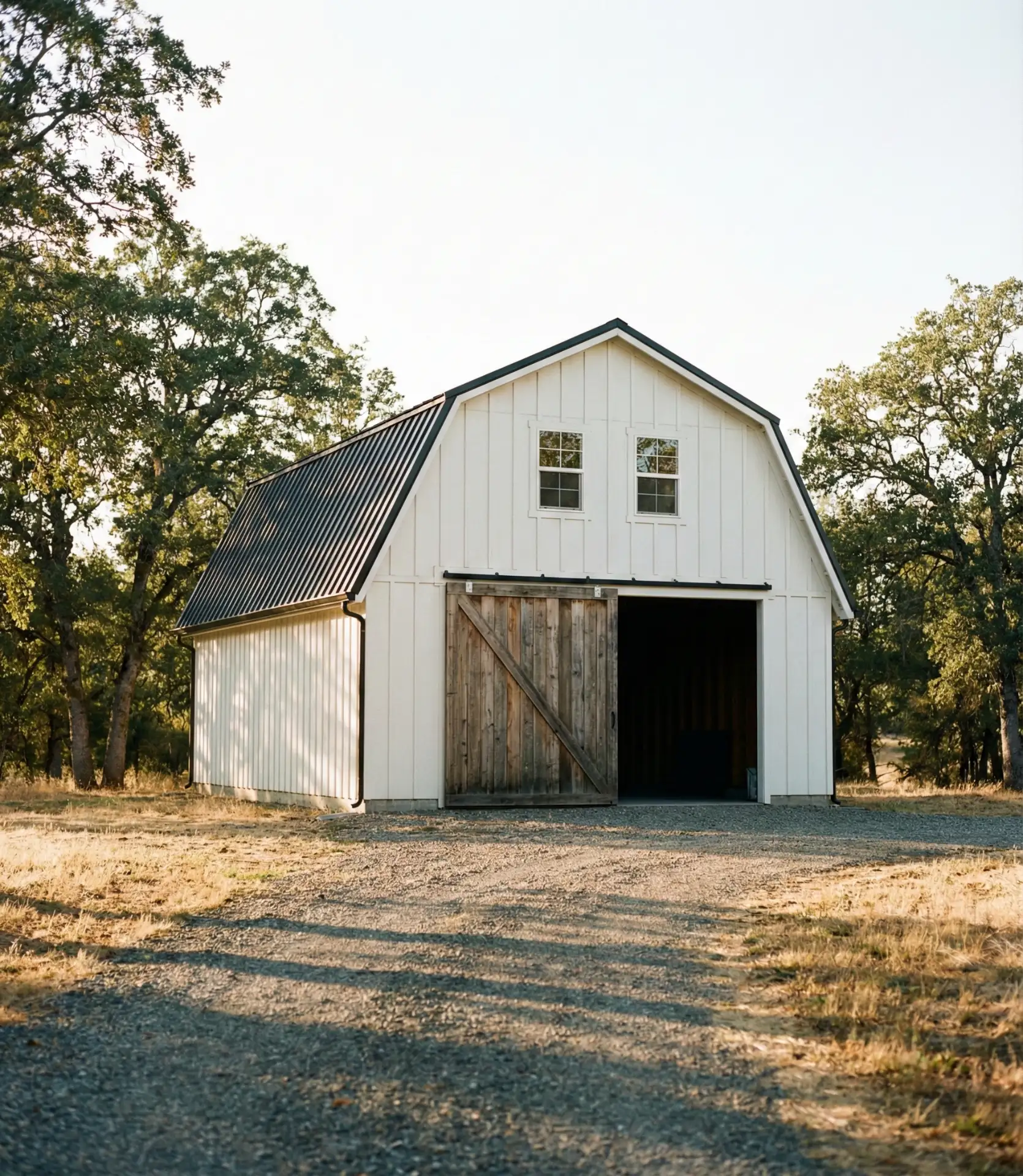
Building departments increasingly view these accessory structures favorably as they address housing density goals—the loft becomes an ADU (accessory dwelling unit) for rental income or multigenerational living without altering the main house’s character. Construction costs typically run $150-200 per square foot, comparable to additions but with the advantage of separate utility meters and potential rental income that can offset monthly mortgage costs by $1,000-1,500 in many suburban markets.
12. Mid-Century Meets Farmhouse Fusion
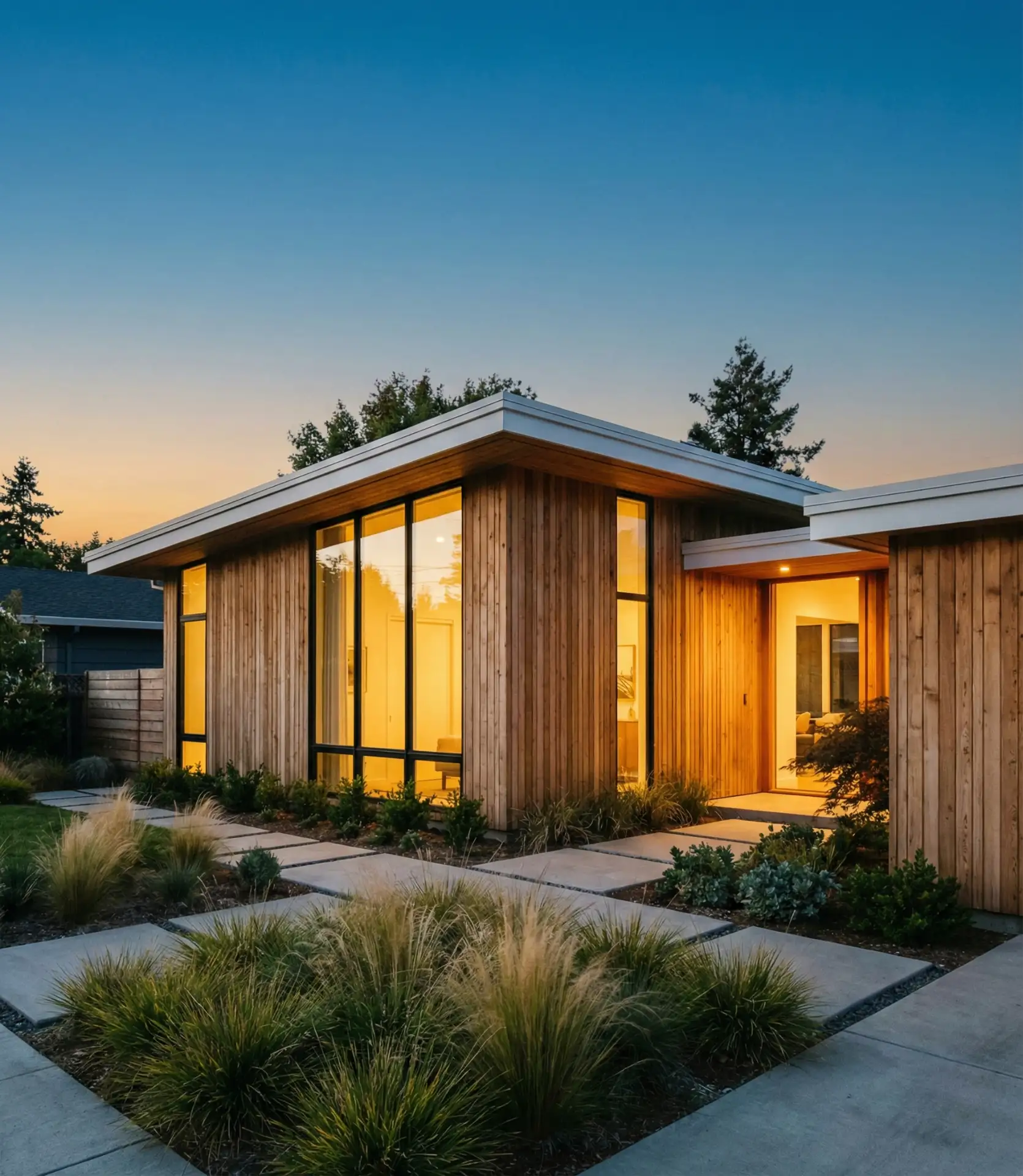
Blending mid-century horizontal lines with farmhouse verticality creates unexpected tension that feels both nostalgic and fresh. Low-pitched rooflines with visible beams, clerestory windows, and board-and-batten accent walls combine modernist restraint with farmhouse warmth, appealing to design-forward homeowners who want something beyond the standard Pinterest aesthetic. This fusion works particularly well when the color palettes lean toward natural materials—unpainted cedar, warm gray stain, or charcoal with white trim—rather than bold contrasts that might emphasize the style clash rather than harmonizing it.
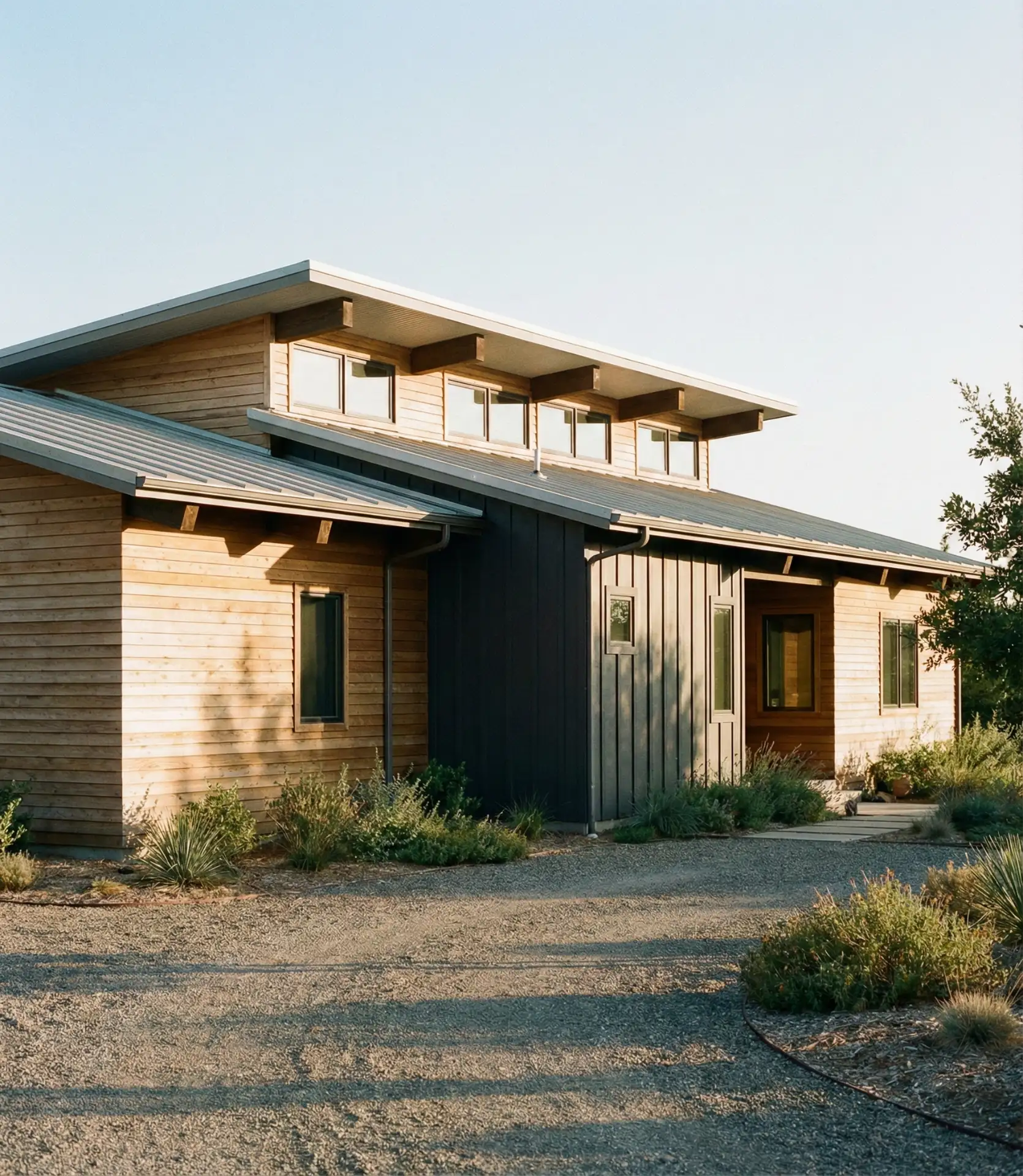
A friend renovating a 1960s ranch in Oregon took this approach, preserving the home’s original post-and-beam structure while adding board-and-batten siding and a metal roof. She mentioned that contractors initially resisted the combination, calling it “confused,” but the finished product drew more compliments than any other home on her street. The lesson: trust your vision, but work with professionals who understand both vocabularies—a carpenter versed in historical details plus a designer comfortable with modernism ensures the fusion feels intentional rather than accidental.
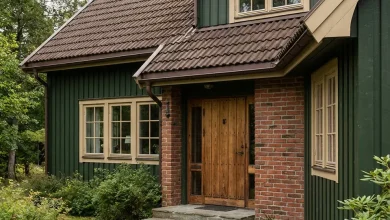
13. Dramatic Dark Exterior with Natural Wood Door
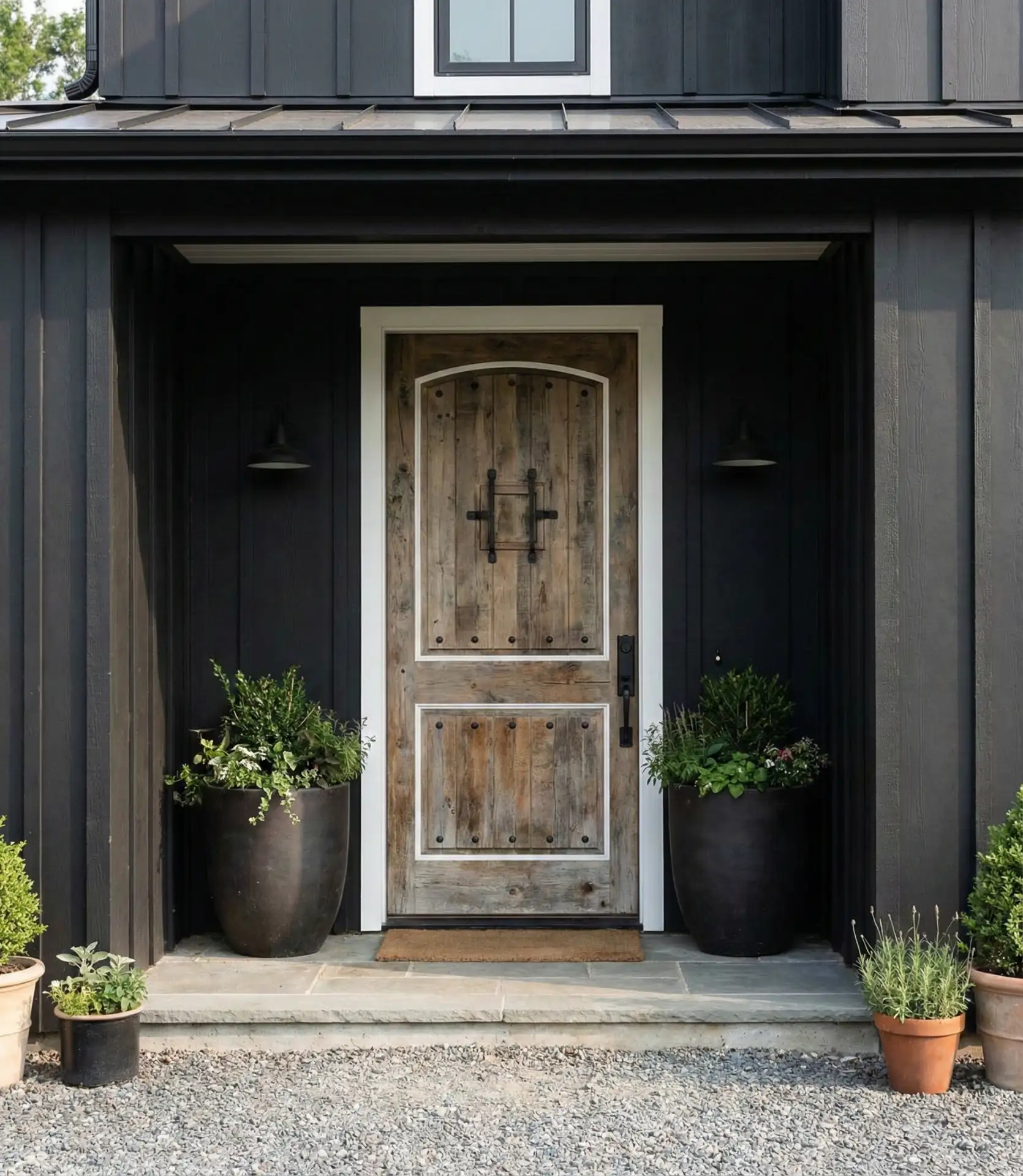
A dark charcoal or near-black body provides the perfect backdrop for a statement natural wood door—think thick-slab cedar, reclaimed barn wood, or even live-edge slabs that introduce organic texture against the monolithic backdrop. This pairing has become a signature move in modern farmhouse design, offering instant curb appeal and creating a focal point that draws visitors toward the entry. The door becomes sculptural, its grain and natural color variations celebrated rather than hidden under paint.
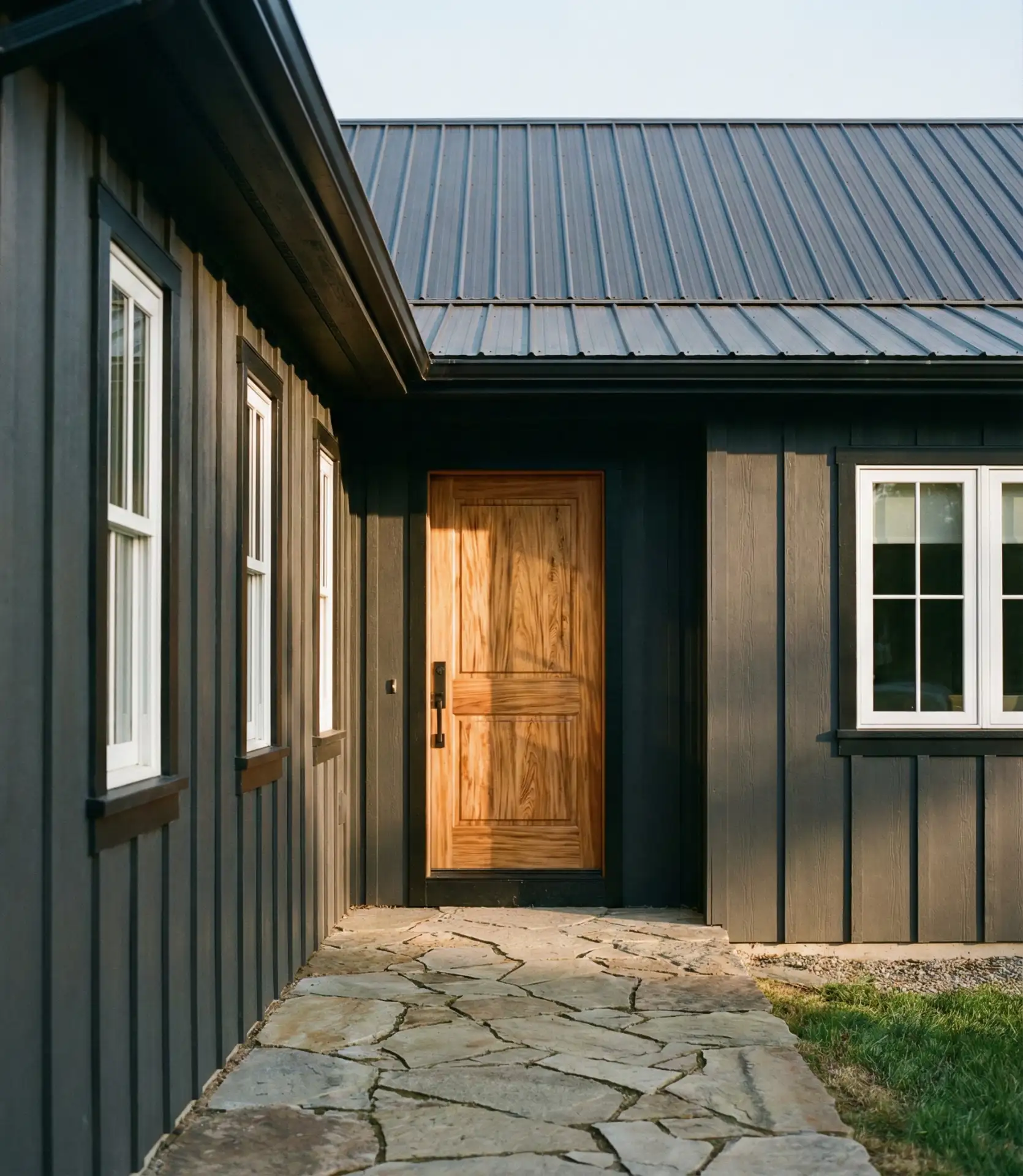
Maintenance reality check: Natural wood doors in direct sun exposure require refinishing with marine-grade sealer or exterior varnish every 1–2 years to prevent graying and splitting, more frequently in intense UV environments like Arizona or Texas. Many homeowners underestimate this commitment and end up disappointed when their beautiful walnut door turns silver-gray within 18 months. Consider a covered entry porch deep enough to shield the door from direct weather, or be prepared for the maintenance schedule—there’s no low-maintenance way to keep natural wood looking pristine outdoors.
14. White shiplap siding serves as a clean, horizontal canvas for a front door painted in unexpected colors—navy blue, forest green, terracotta, or even soft coral—that adds personality without overwhelming the overall design.
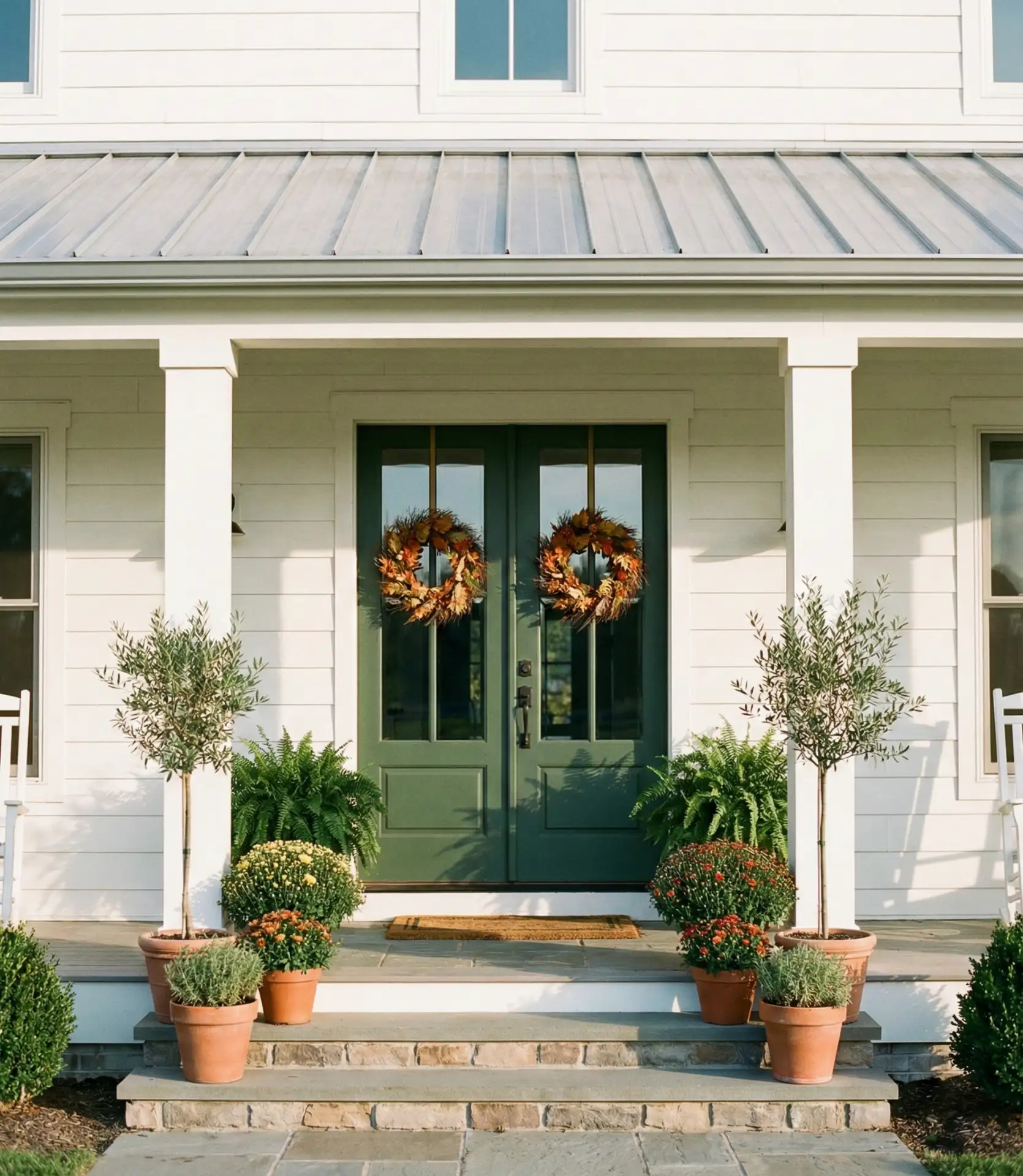
Clean horizontal white shiplap siding creates a crisp canvas for a front door in unexpected colors—navy blue, forest green, terracotta, or even soft coral—that brings personality without overwhelming the composition. This approach allows homeowners to refresh curb appeal every few years simply by repainting the door, making it an accessible entry point into modern farmhouse style without full exterior renovation. The monochrome backdrop also makes landscaping choices more forgiving, as virtually any planting palette looks intentional against pure white.
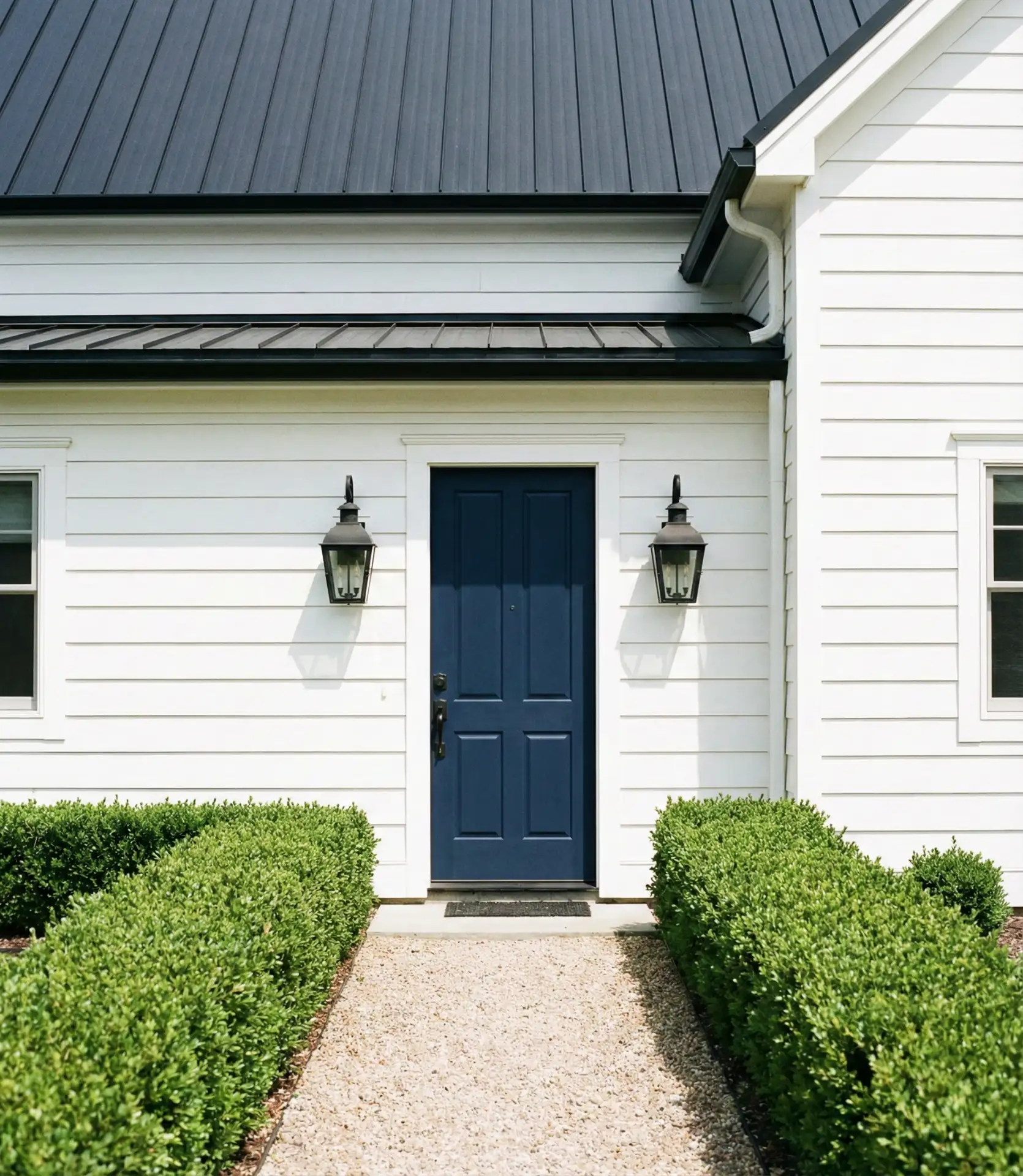
Paint experts recommend using the same finish level on the door as the body—if your siding is matte, keep the door matte; if you’ve gone satin, match it on the door. Mixing finishes creates subtle visual discord that most people can’t articulate but registers as “off.” The color itself should pull from your interior palette or landscape—a blue door that echoes your kitchen island or green that matches your boxwoods creates satisfying continuity that makes the whole property feel considered and cohesive.
15. Stacked Stone Chimney as Focal Point
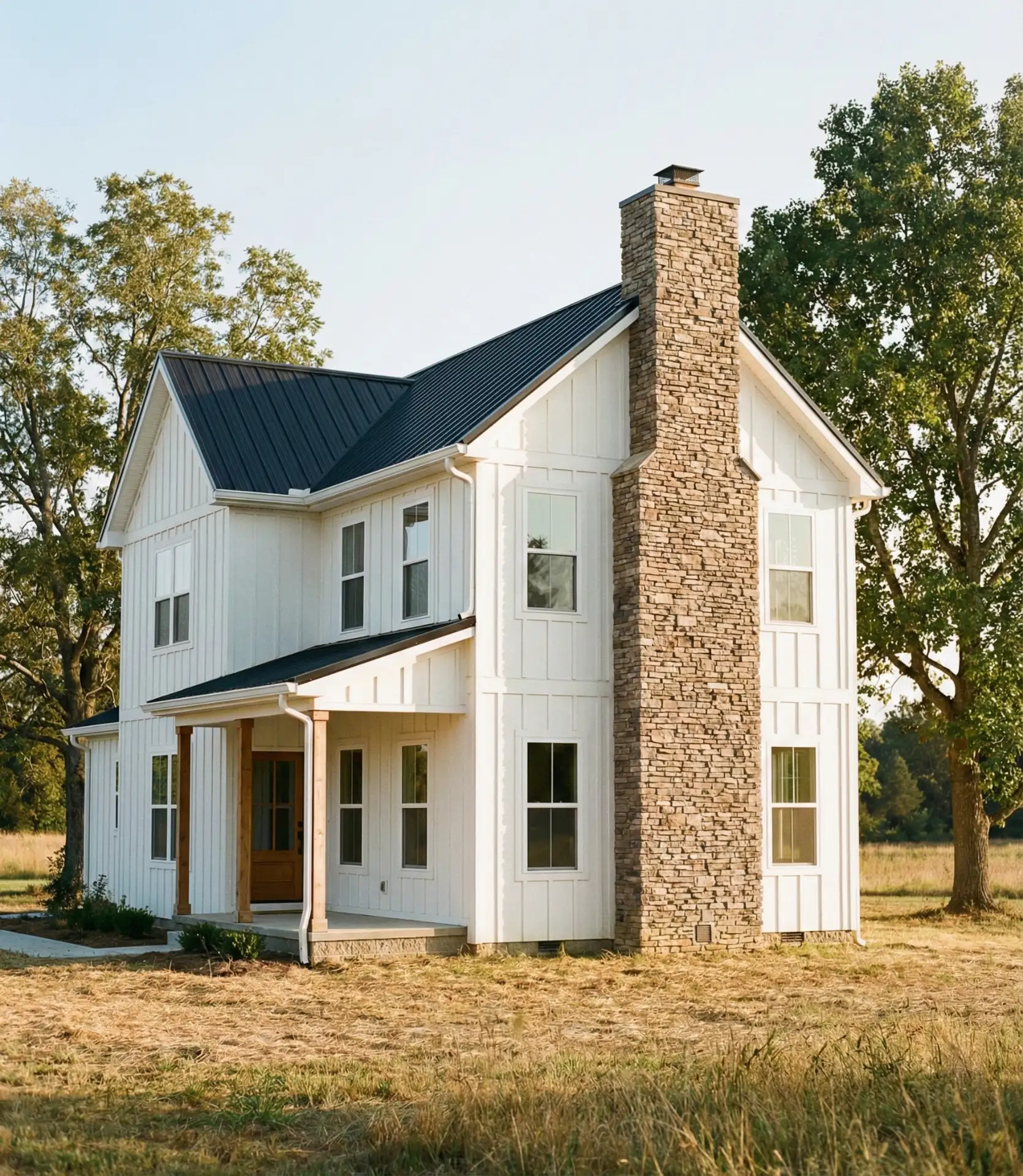
An exterior stone chimney running the full height of the façade becomes an architectural exclamation point, breaking up siding and adding sculptural mass that reads as permanent and substantial. Whether it’s cultured stone veneer or natural fieldstone, the chimney introduces texture and shadow play that flat siding simply cannot achieve, particularly effective when positioned asymmetrically rather than centered. This feature pairs beautifully with white or light gray siding, where the stone’s natural color variations become the visual focal point, drawing the eye upward and emphasizing the home’s verticality.
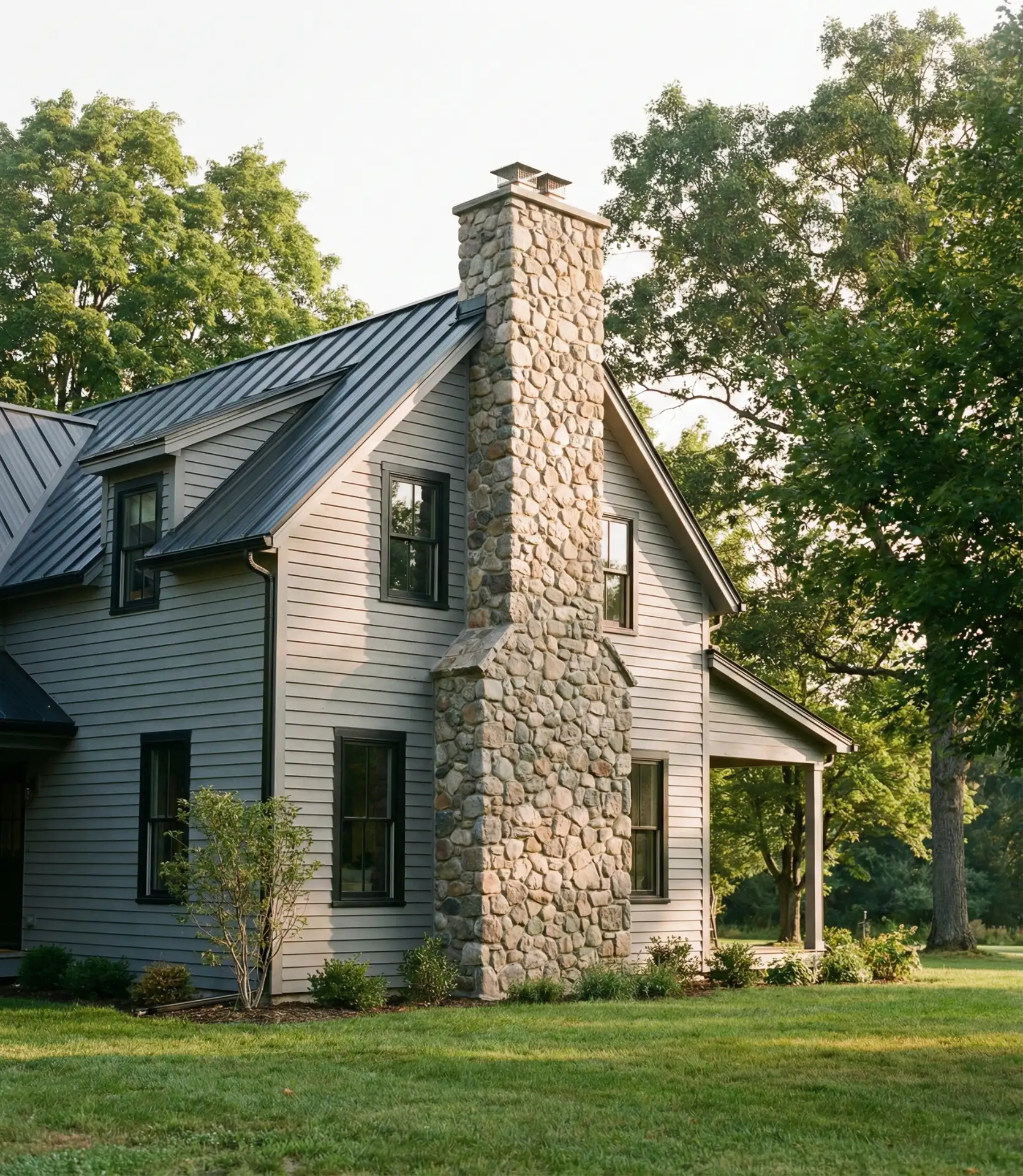
Budget-conscious homeowners often face the choice between a real masonry chimney ($15,000-30,000) or a decorative chase covering a metal flue ($3,000-8,000). The visual difference is significant—real masonry has weight and irregularity that manufactured systems can’t fully replicate—but the functional difference for most modern high-efficiency fireplaces is negligible. If budget allows, invest in real masonry; if not, a well-detailed chase with quality stone veneer delivers 80% of the impact at 30% of the cost.
16. Breezeway Connecting House and Garage
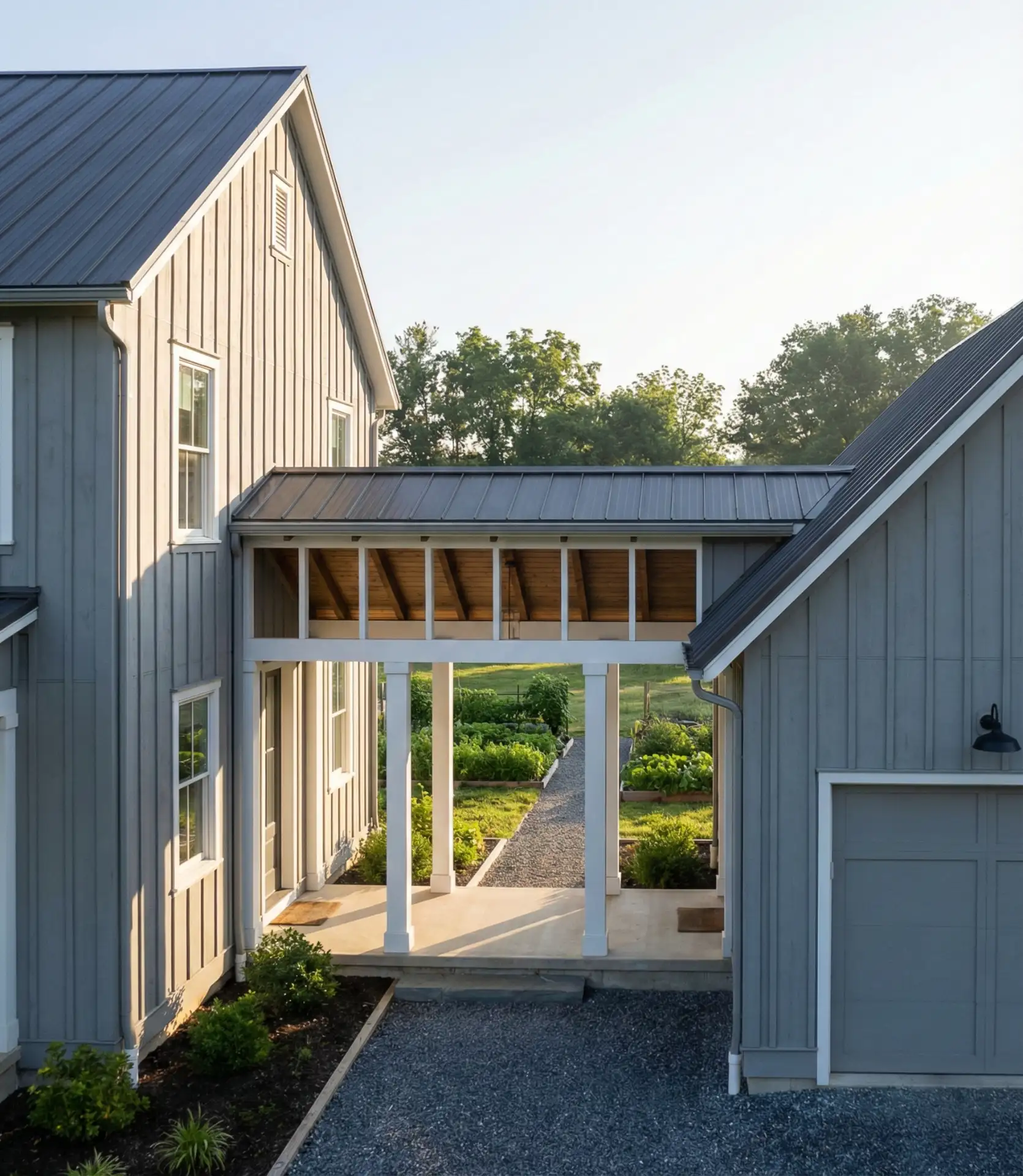
A covered breezeway linking the main house to a detached garage creates a transitional outdoor room that’s quintessentially farmhouse while serving practical functions year-round. This architectural design element provides weather-protected circulation, frames garden views, and establishes a courtyard-like entry sequence that feels more gracious than a direct attached garage connection. The breezeway roof extends the home’s profile horizontally across the site, making even modest houses feel more substantial and anchored to their lots.
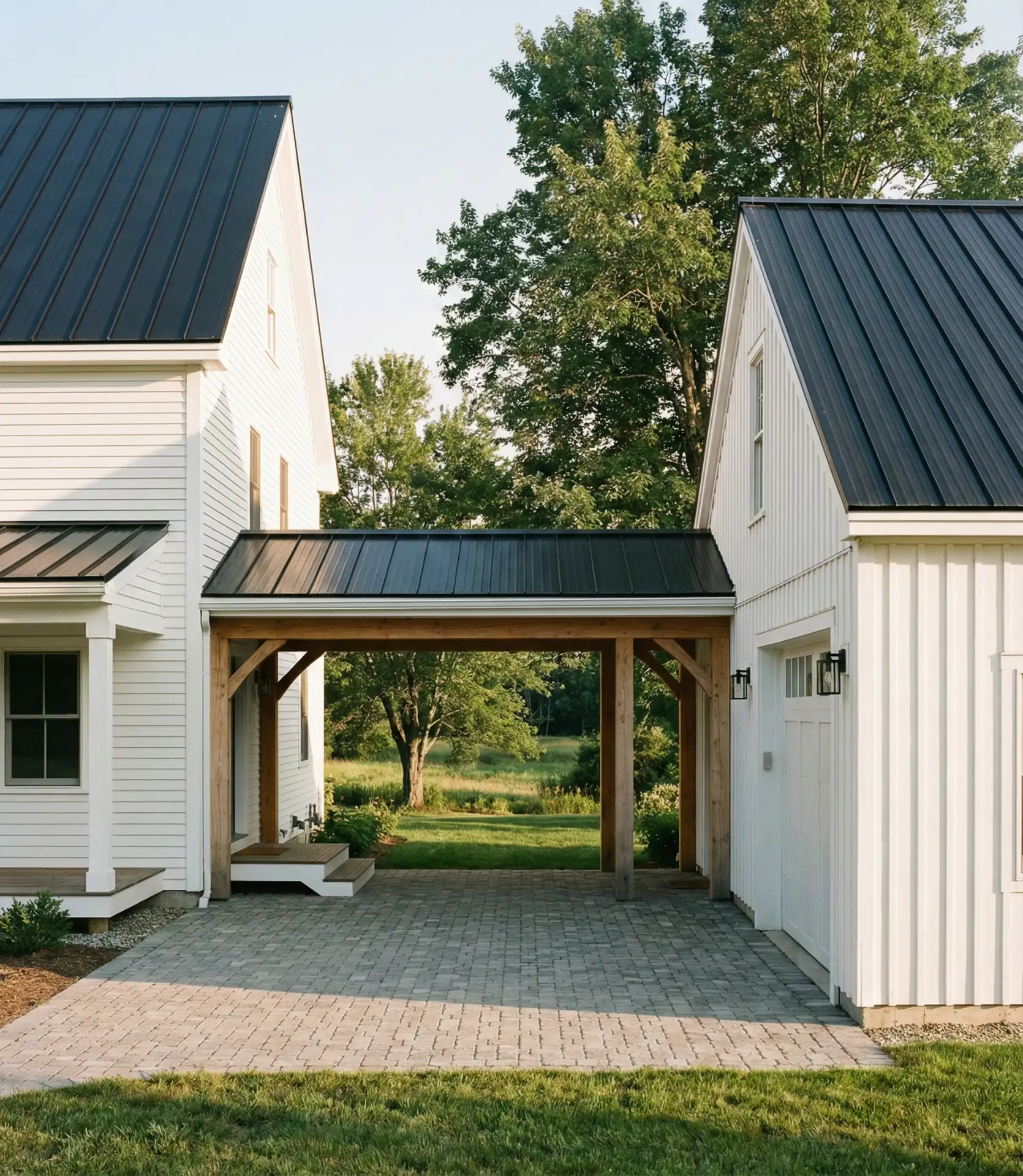
In northern climates, homeowners often enclose breezeways with removable panels or screens for three seasons, effectively adding 200–400 square feet of usable space for less than half the cost of conditioned interior square footage. The trade-off is that detached garages require longer utility runs for electricity and potentially separate HVAC if you’re finishing space above, adding $5,000-10,000 to project costs compared to attached construction—but many find the architectural distinction well worth the premium for the character and light it brings to the property.
17. Mixed-Width Siding for Visual Interest
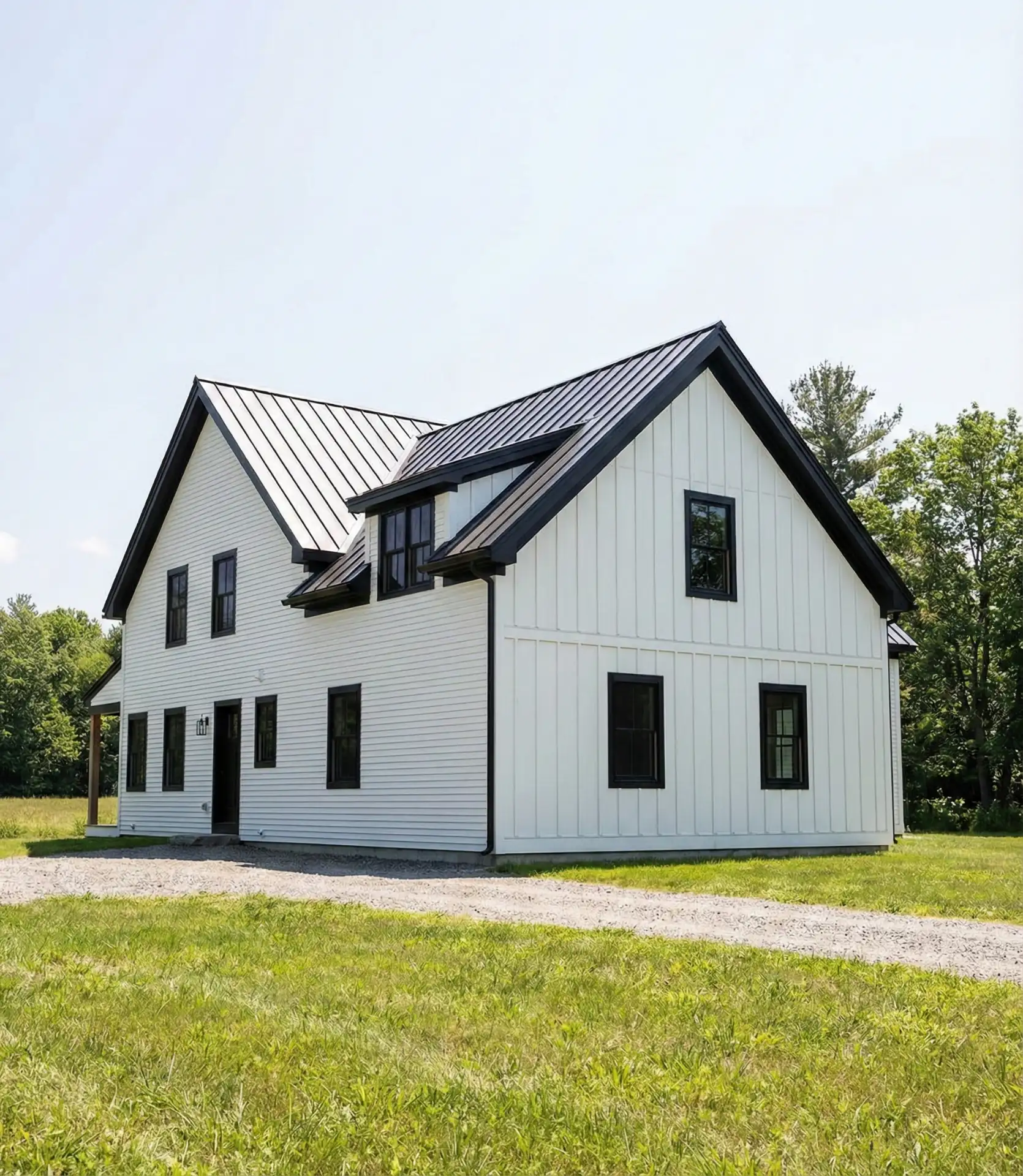
Combining different siding widths—say, 8-inch horizontal shiplap on the first floor with 12-inch board-and-batten on gables—creates visual layering that prevents monotony on larger facades. This subtle variation honors farmhouse tradition, where buildings evolved using available materials, resulting in organically varied textures rather than uniform surfaces. The technique works particularly well when color palettes remain consistent, letting the dimension changes provide interest rather than competing colors and textures simultaneously creating visual chaos.
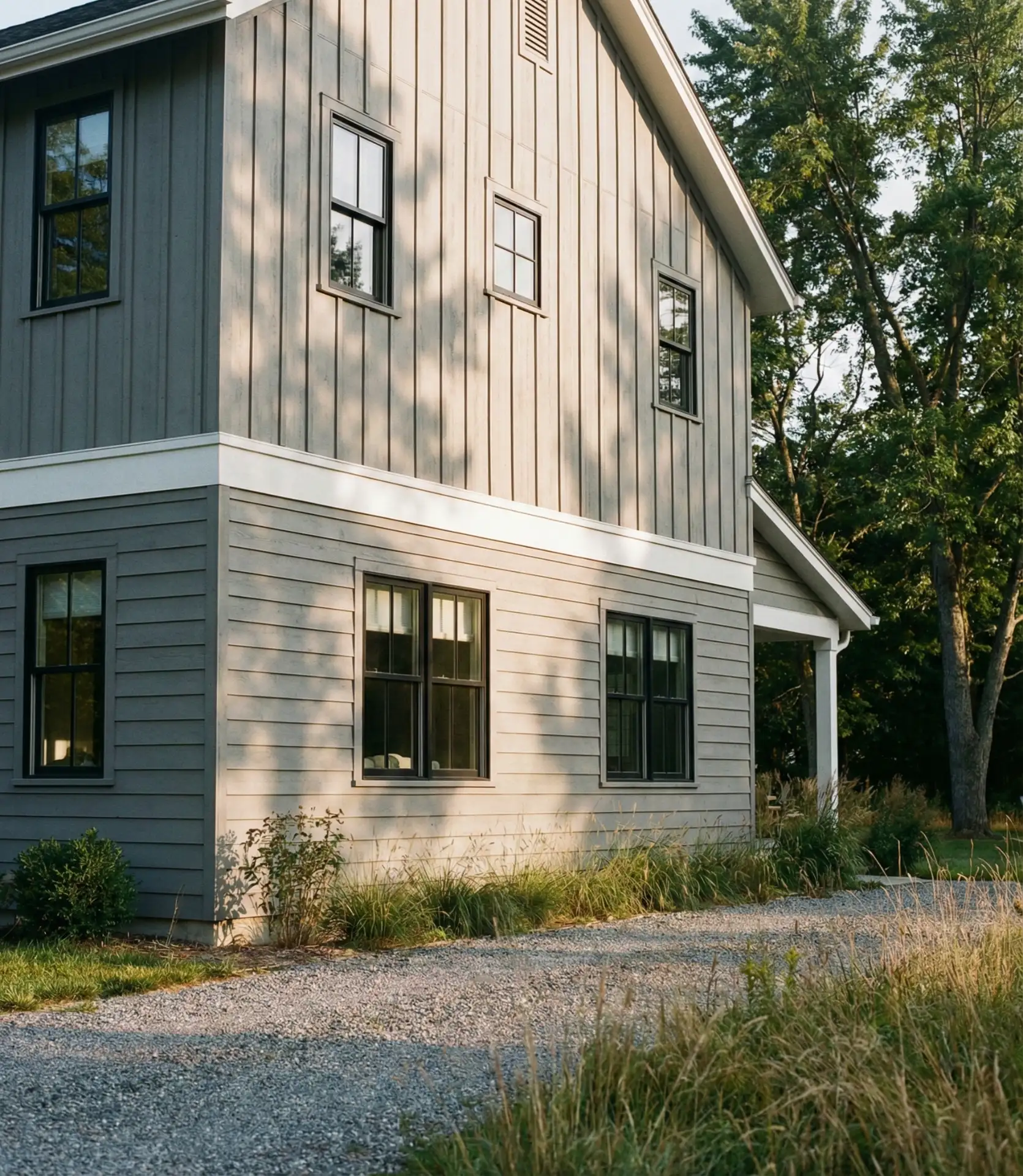
Where it works best: Homes with distinct architectural zones—two-story sections with gables or L-shaped plans where wings can receive different treatments—rather than simple rectangular boxes where the changes would feel arbitrary. One common mistake is changing siding direction or width at awkward heights that cut through windows or create alignment issues; the transitions should occur at natural breaks like floor lines, roof intersections, or corner boards that provide logical justification for the shift.
18. Painted Brick in Modern Neutrals
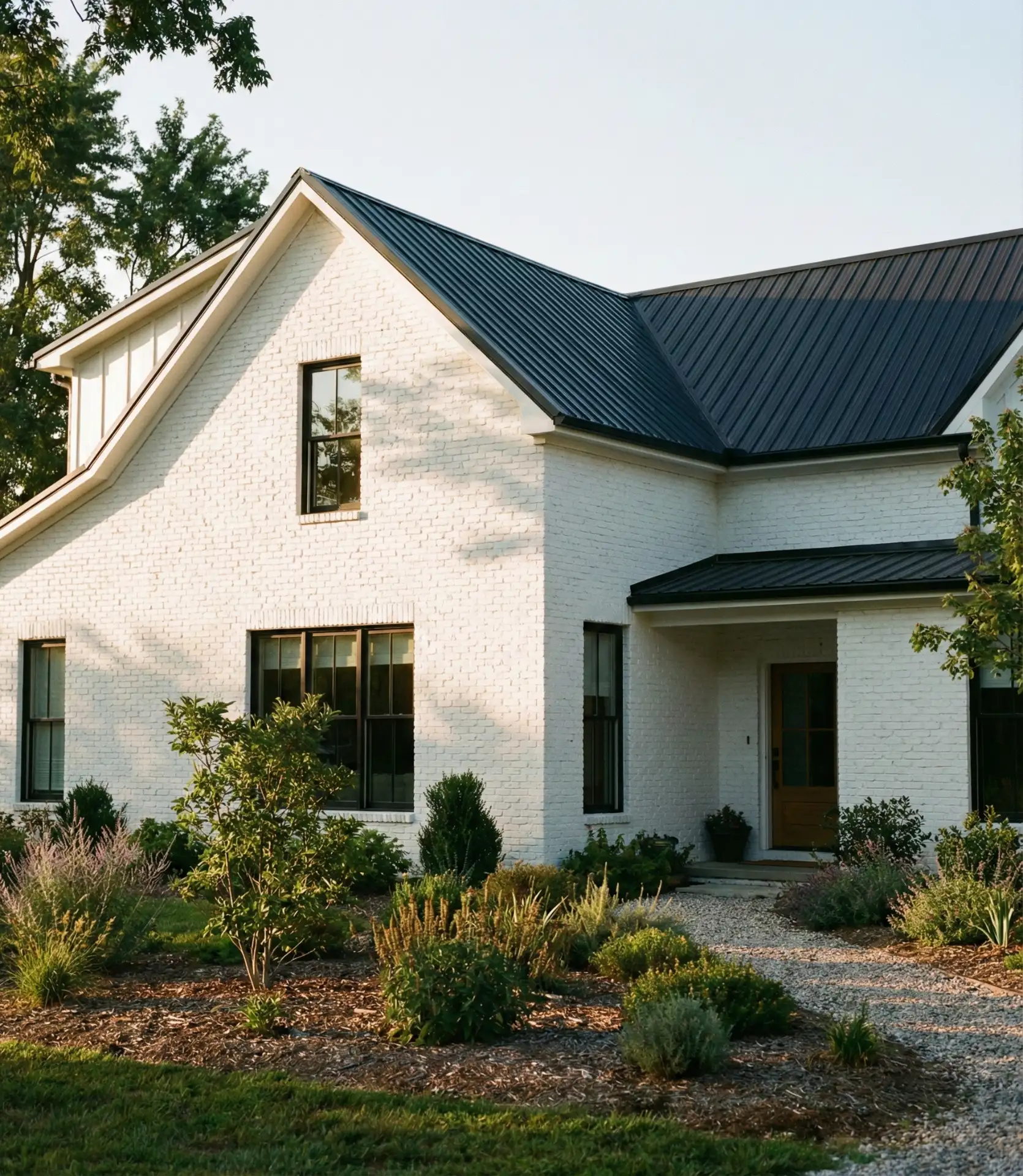
Painting existing brick in white, gray, or even soft black transforms dated exteriors into contemporary farmhouse statements while preserving the material’s texture and mass. This approach revitalizes homes from the 1970s-1990s that homeowners wish to modernize without a complete re-siding, providing a significant improvement in curb appeal at a cost of $3,000-6,000, as opposed to $20,000-40,000 for new siding. The paint unifies the surface, while the underlying brick’s dimensional quality creates depth that flat siding cannot replicate, delivering a unique interpretation of farmhouse style.
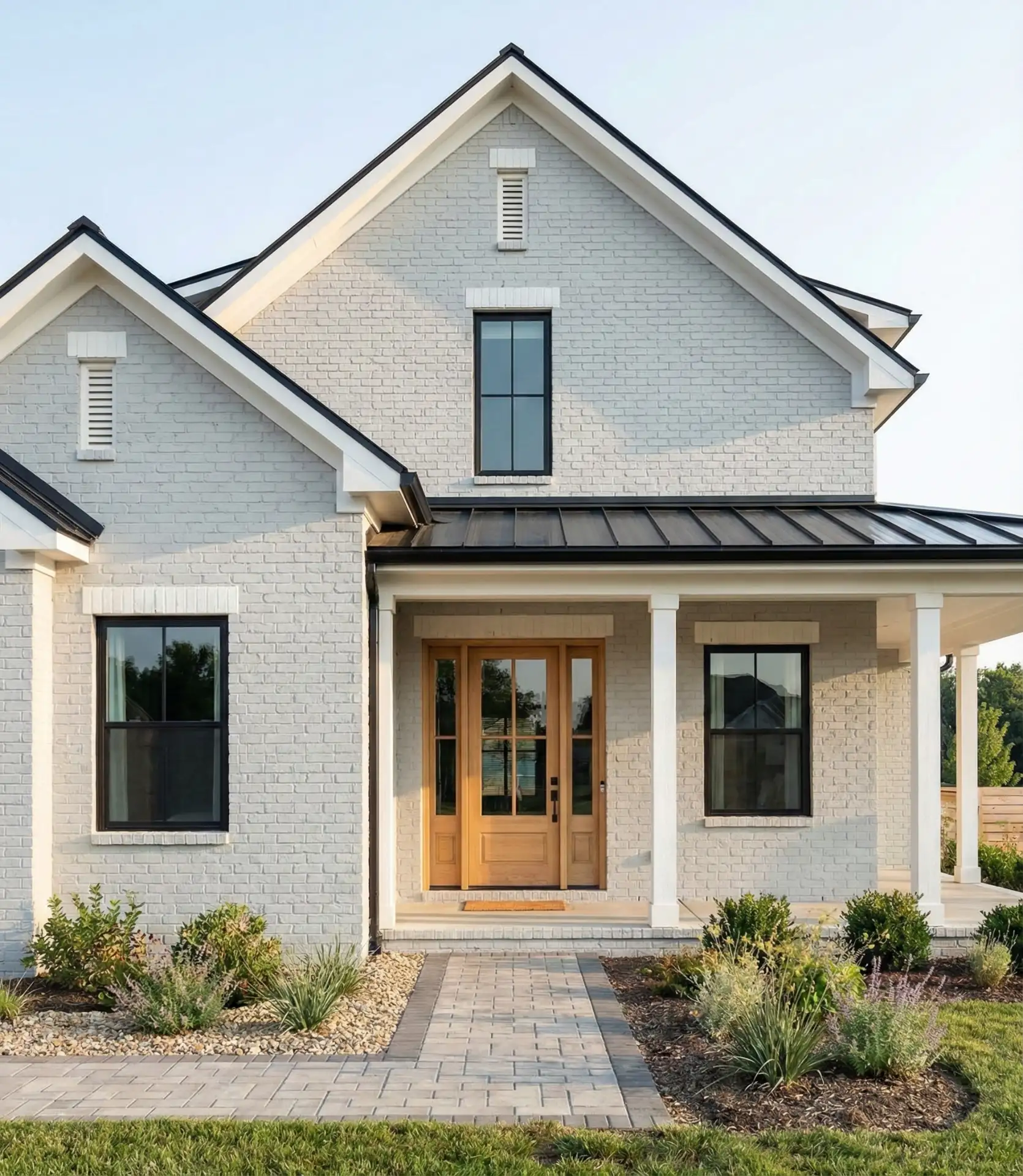
The painted brick debate divides design communities—purists argue it’s irreversible and destroys historic character, while pragmatists note that most suburban brick homes lack historical significance and painting dramatically improves livability and resale value. If you’re considering this route, use only breathable masonry paint specifically formulated for brick (Sherwin-Williams or Benjamin Moore exterior masonry lines) and ensure the brick is in excellent condition without moisture issues, as paint can trap water and accelerate spalling if applied over compromised masonry.
19. Contrasting Gable Accents
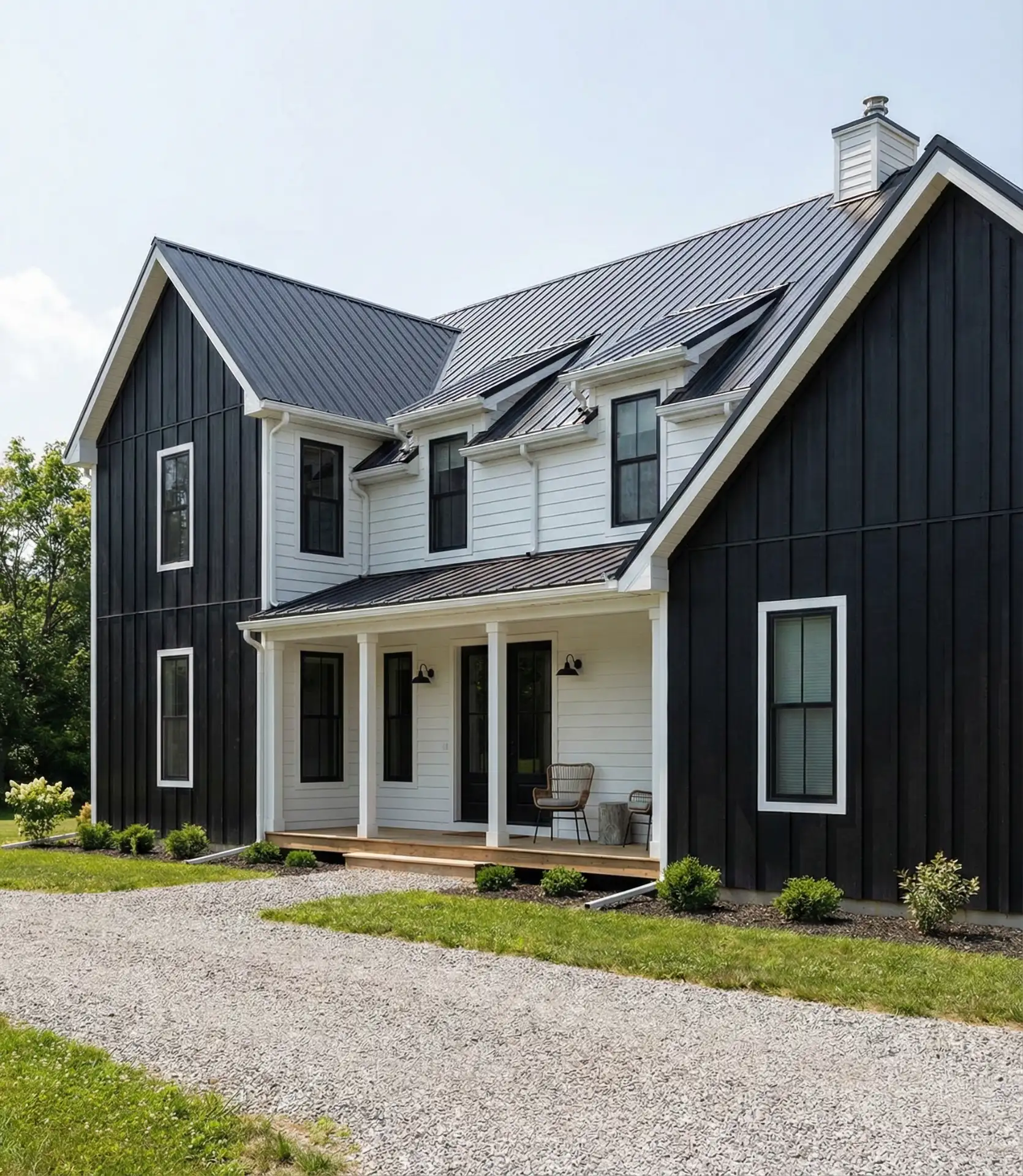
Highlighting gable ends with a contrasting material or color—stone on a siding body, dark board-and-batten on a white house, or stained wood against painted surfaces—emphasizes the roofline and creates focal points that prevent visual monotony. This technique draws from traditional barn design, where gable vents or hay doors required different construction, translated here into deliberate aesthetic choices that add sophistication to standard gabled forms. The contrast should feel intentional but not jarring, typically limiting the palette to two complementary materials or colors rather than introducing multiple competing elements.
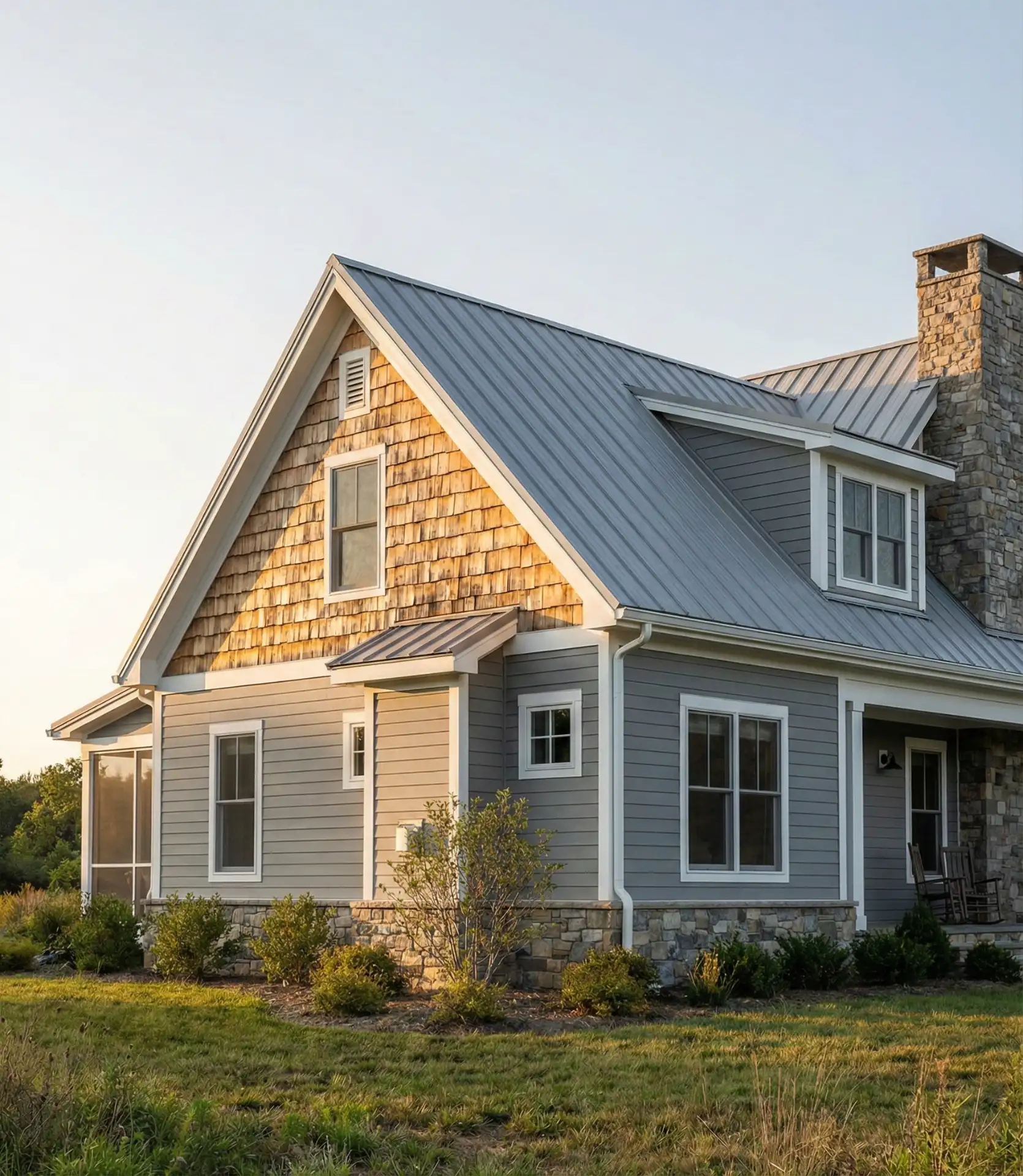
A contractor friend in Tennessee specializes in these details and notes that the material transition must be flashed properly or you’ll invite water infiltration—the corner where horizontal siding meets vertical batten at the gable base is particularly vulnerable. He recommends metal Z-flashing behind the joint and a slight reveal or trim board to create a crisp detail line that’s both watertight and visually intentional, turning a potential leak point into an architectural feature that actually sheds water away from the vulnerable junction.
20. Standing Seam Metal Roof with Deep Profile
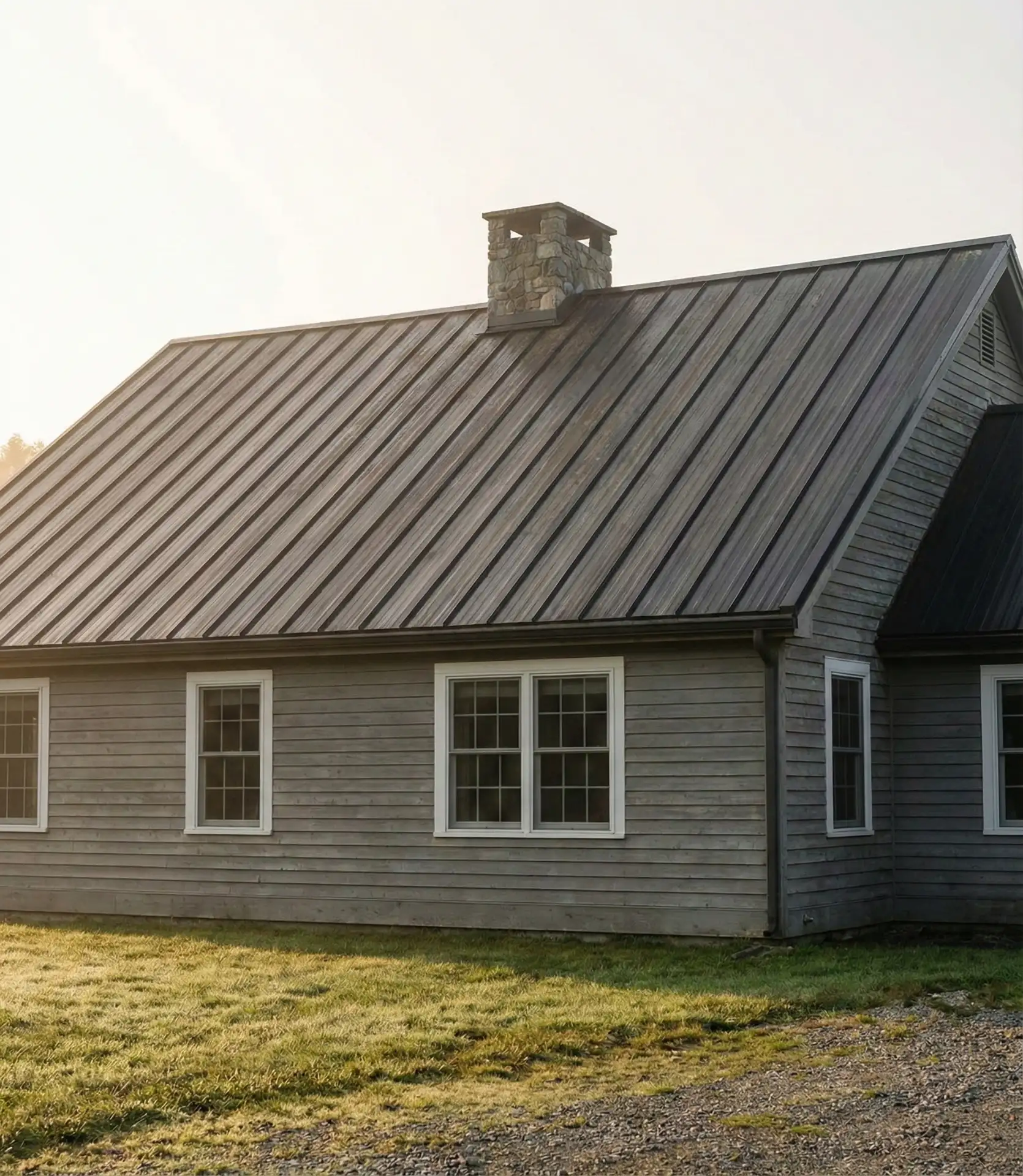
A standing seam metal roof in black, dark gray, or charcoal has become nearly synonymous with modern farmhouse style, offering clean lines, exceptional longevity, and a strong visual presence that asphalt shingles cannot match. The vertical seams create rhythm and shadow lines that complement board-and-batten siding, while the material’s durability—50+ year lifespan versus 20-25 for quality shingles—makes it a sound long-term investment despite 2-3x higher upfront costs. Color choice matters: matte finishes feel more agricultural and authentic, while glossy surfaces can read too commercial or industrial for residential applications.
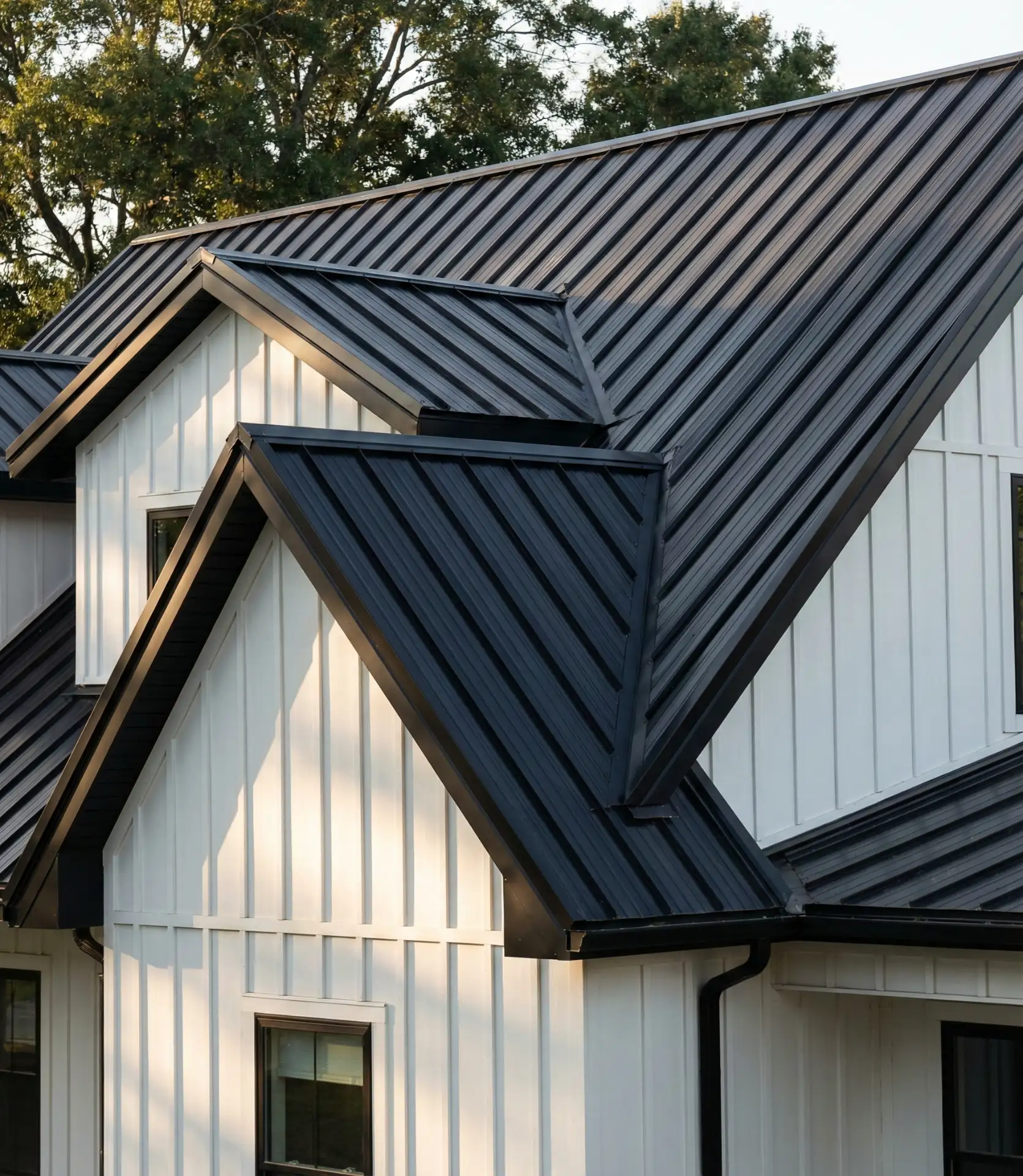
Real homeowner insight: Expect metal roofs to be louder during rain and hail than asphalt, though proper insulation and decking largely mitigate this. More significant is snow shedding—in heavy snow climates, metal roofs release accumulation in dramatic slides that can damage gutters, landscaping, or anyone unfortunate enough to be below. Install snow guards or cleats to control this behavior, and position downspouts and walkways accounting for where snow will naturally shed, or you’ll be replacing crushed shrubs and bent gutters every winter.
21. Oversized Black Hardware and Light Fixtures
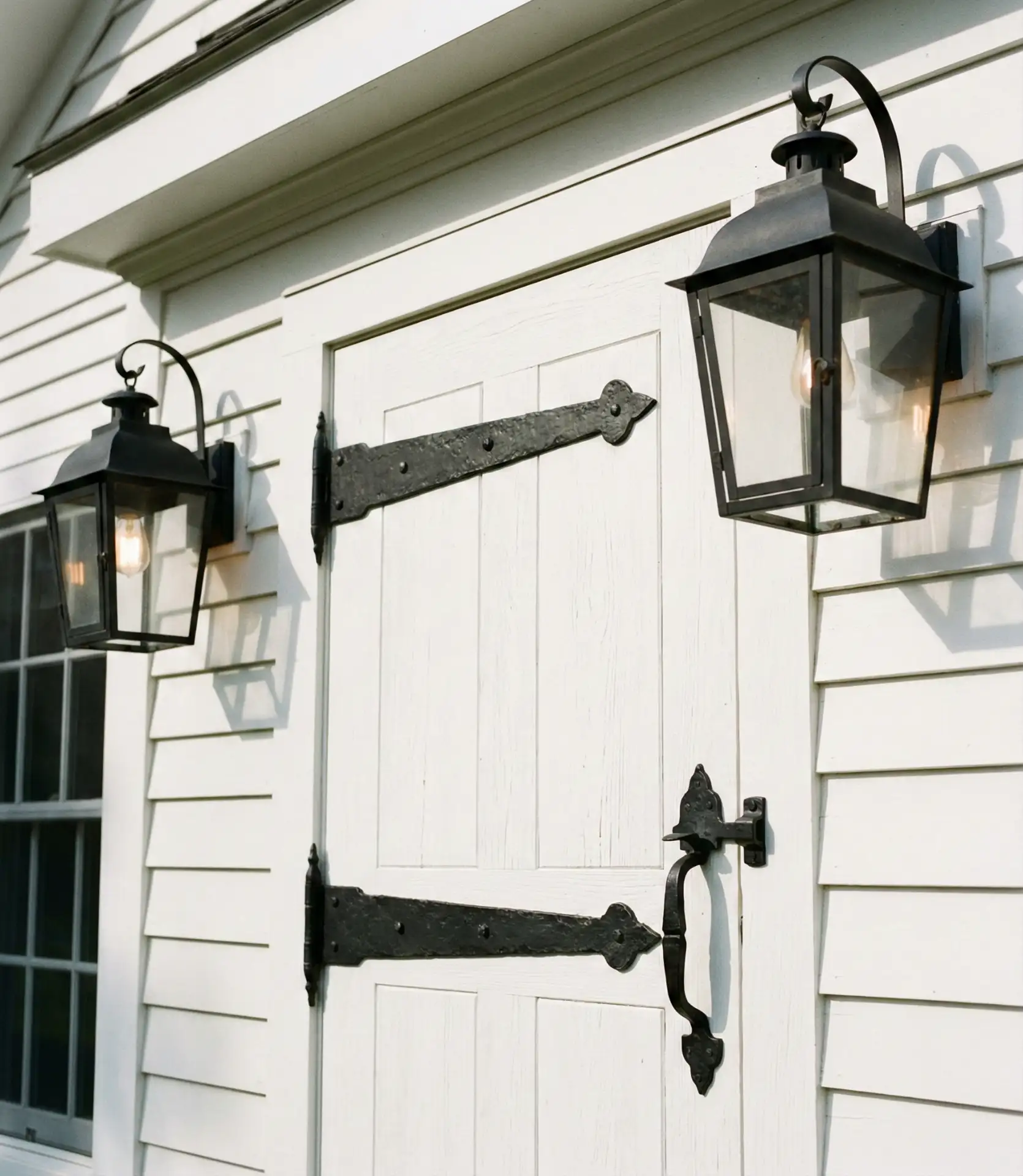
Statement black exterior elements—oversized barn-style door hinges, chunky deadbolts, or scaled-up lantern sconces—add jewelry-like detail that elevates basic farmhouse forms into designed compositions. These elements read clearly on the street, contributing to curb appeal in ways that standard hardware simply cannot, while reinforcing the modern farmhouse vocabulary of strong contrasts and simplified forms. The scale is crucial: fixtures and hardware should be 30–50% larger than traditional sizes, ensuring visibility and impact rather than fading into the background like standard residential fixtures.
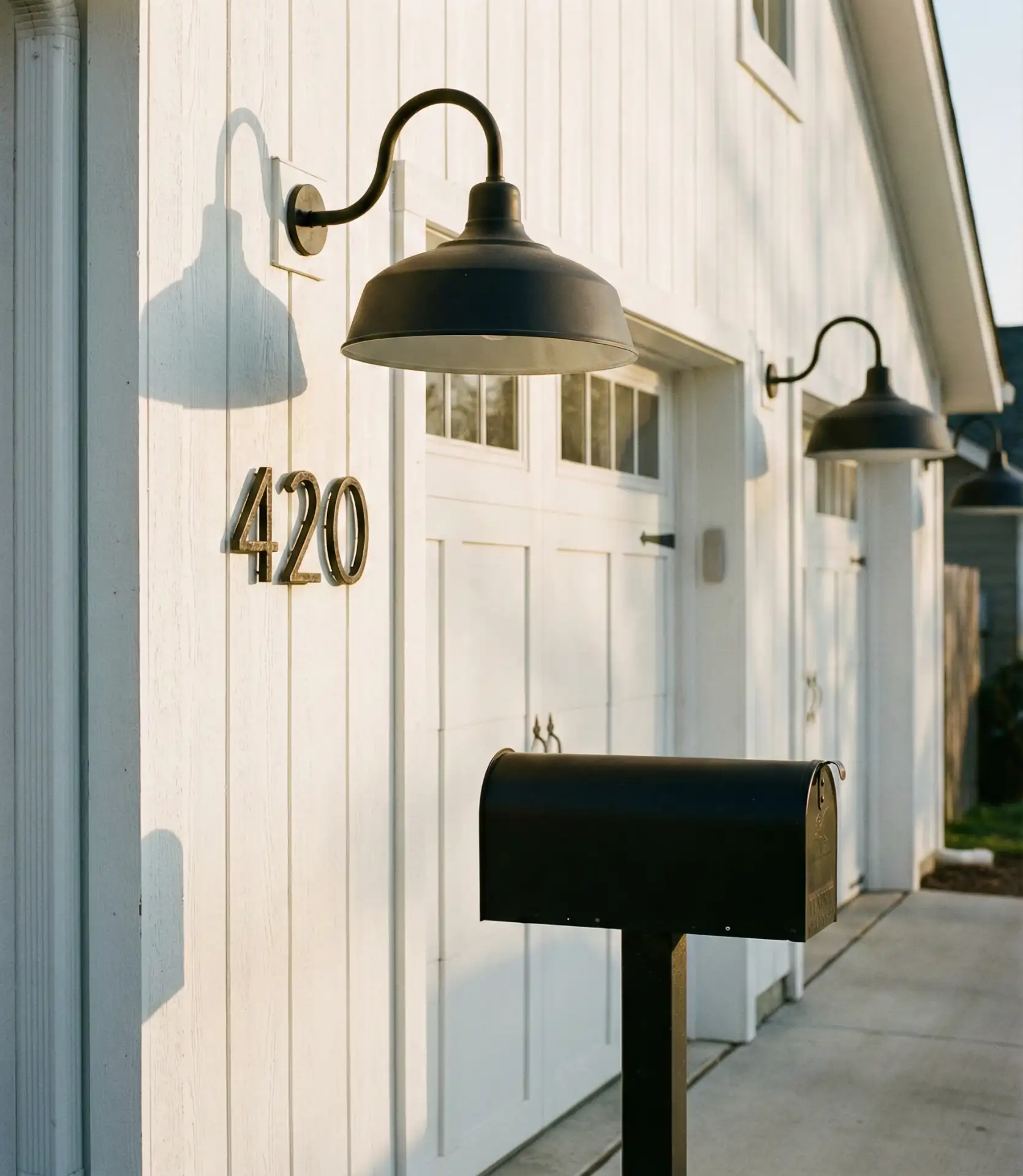
Quality matters enormously here—cheap black-painted hardware from big box stores will chip and rust within months, revealing brass or steel underneath and looking worse than if you’d installed standard finishes. Invest in powder-coated steel or solid cast brass with a matte black finish from architectural hardware suppliers; the $300-800 premium for an exterior hardware set pays for itself in longevity and appearance, maintaining that crisp contrast for decades rather than requiring touch-ups and eventual replacement after a few seasons.
22. Natural Cedar Accents Left to Weather
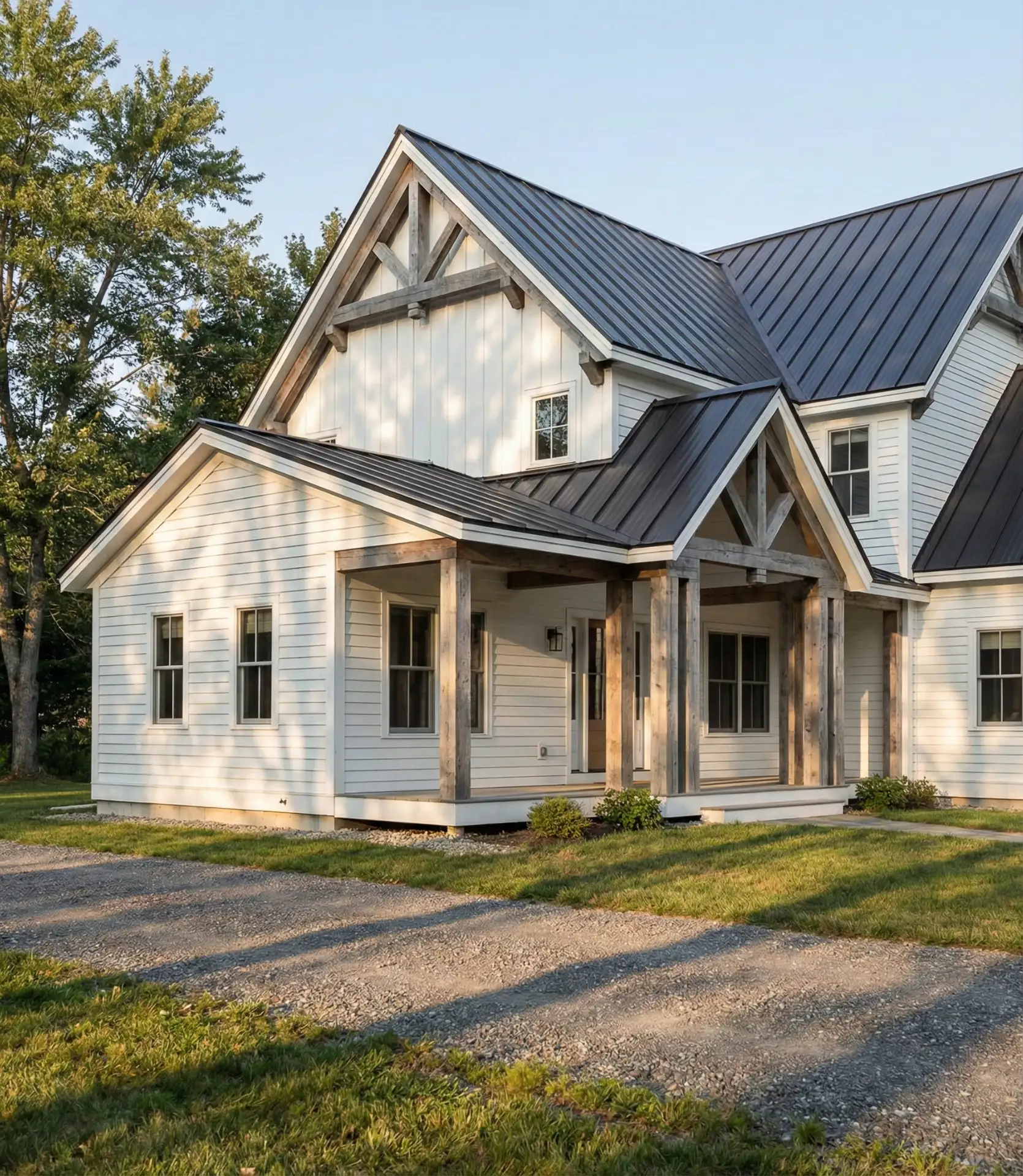
Unpainted cedar boards, beams, or shutters that weather naturally to silvery gray introduce organic texture and temporal character—the house visibly ages and evolves rather than remaining static. This approach works beautifully as accent material against painted siding, where the weathered wood provides warmth and authenticity that contrasts with crisp white or gray backgrounds. The silvering process takes 6–18 months, depending on sun exposure and climate, before eventually stabilizing into a stable patina that requires no maintenance beyond occasional cleaning to remove surface mildew in humid climates.
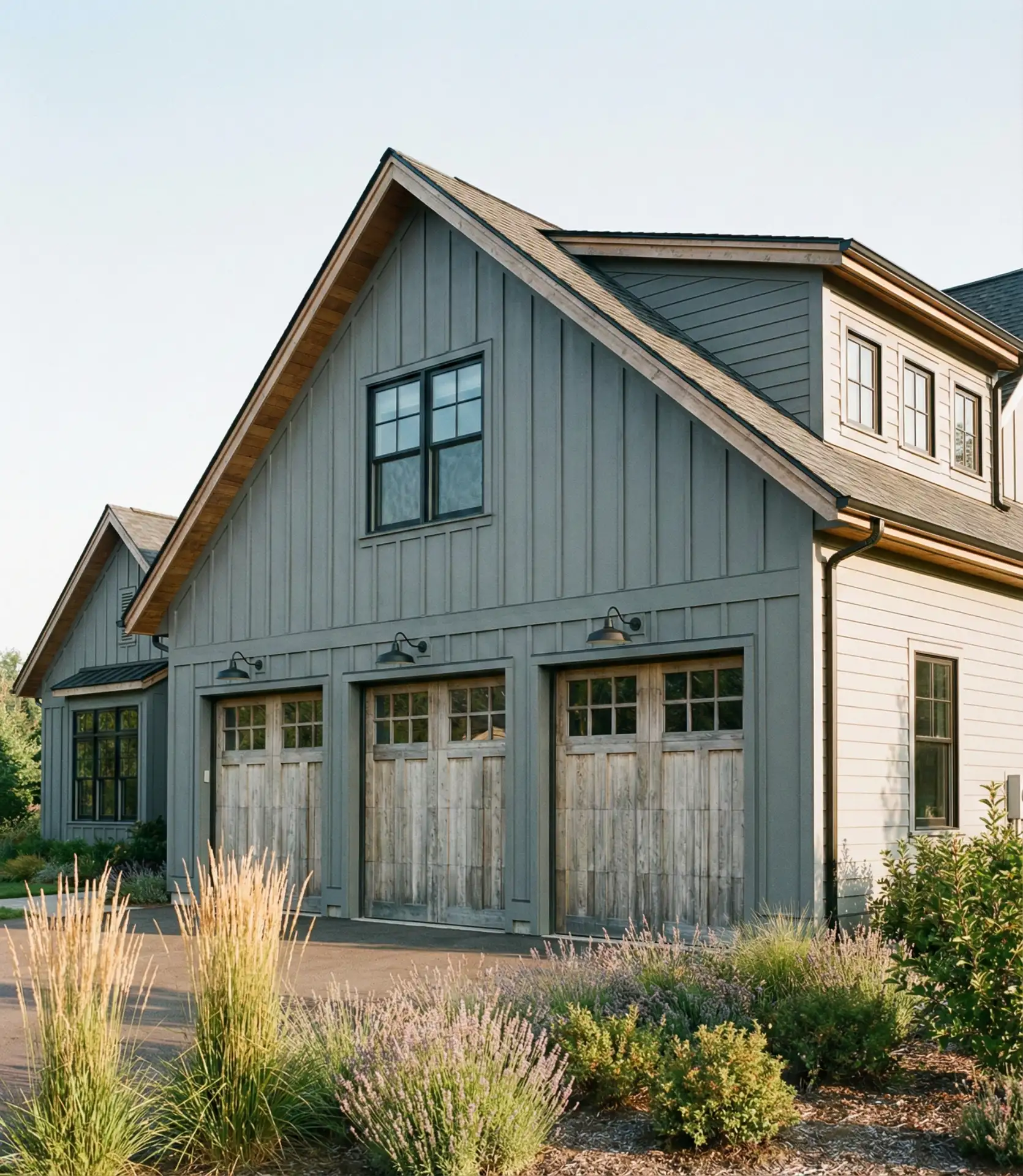
Budget insight: Cedar costs 2-3x more than pressure-treated lumber but substantially less than composite alternatives, positioning it as a mid-tier choice that delivers authentic material character. The common misconception is that weathered cedar looks “dirty”—in reality, well-detailed cedar develops an even, silver-gray patina that reads as elegant and intentional, not neglected. Poor detailing where water pools or where cedar contacts soil will result in irregular darkening and rot, so proper flashing, ground clearance, and ventilation are non-negotiable for this low-maintenance aesthetic to actually be low-maintenance.
23. Story-and-a-Half Design with Dormers
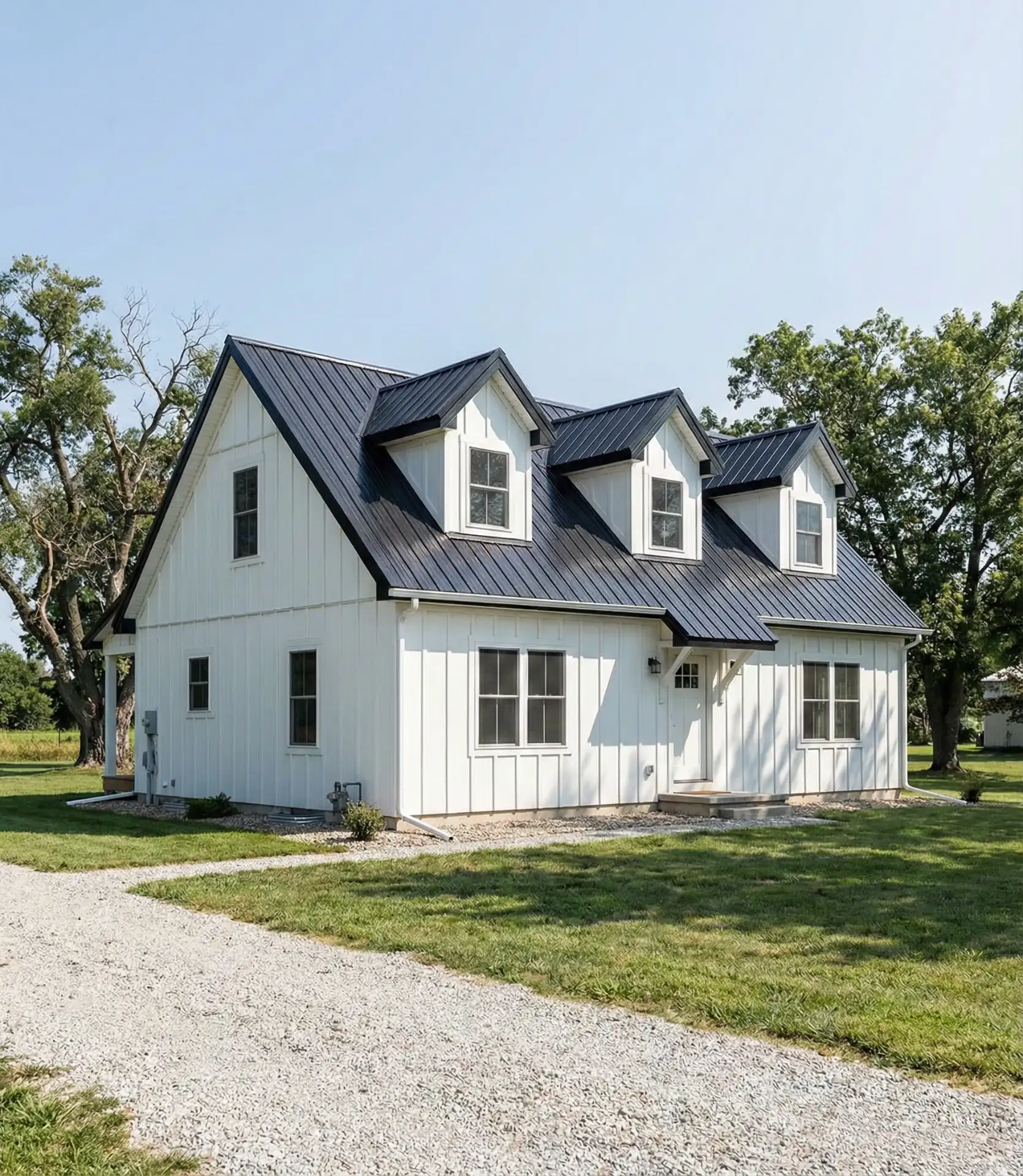
The story-and-a-half farmhouse with shed or gabled dormers maximizes volume under the roofline while maintaining a modest footprint, appealing to those wanting generous interior space without the imposing scale of full two-story construction. Dormers bring natural light deep into upper-level spaces that would otherwise feel cave-like, while their varied rooflines create architectural interest that distinguishes these homes from simpler gabled boxes. This form has deep roots in American vernacular architectural designs for house plans, from Cape Cod cottages to Midwestern farmsteads, giving contemporary interpretations instant familiarity and cultural resonance.
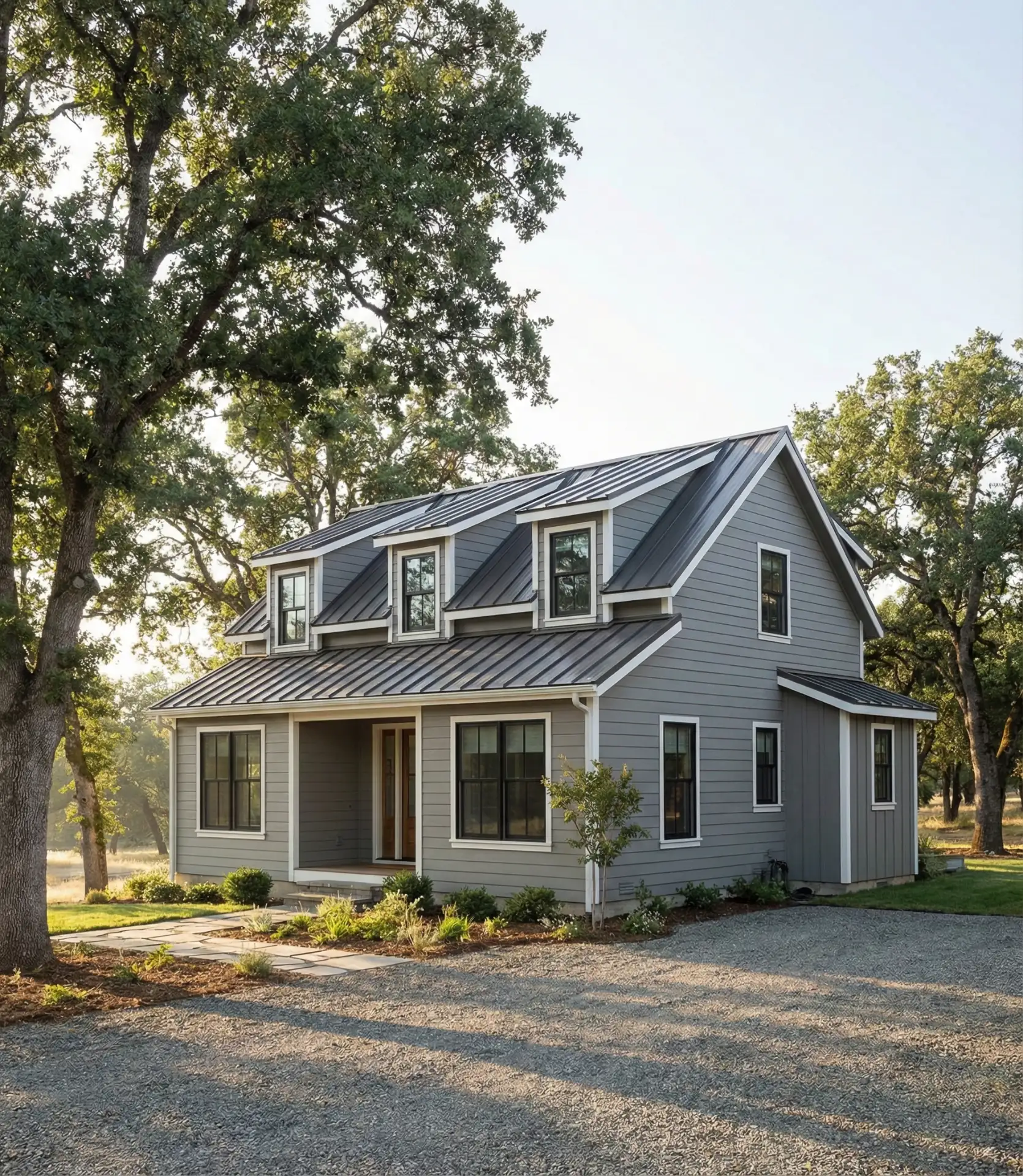
Common mistakes include undersizing dormers, which fail to deliver meaningful interior impact, or oversizing them so they dominate the roofline and make the house look top-heavy. Dormers should generally be one-third to one-half the width of the roof face they occupy, tall enough to allow standing near the interior walls, and detailed with trim proportions that match the main house. Budget an extra $8,000-15,000 per dormer compared to simple roof slopes—they’re costly but transform unusable attic space into premium bedrooms or studies that command full market value.
24. Multi-Tone Color Blocking
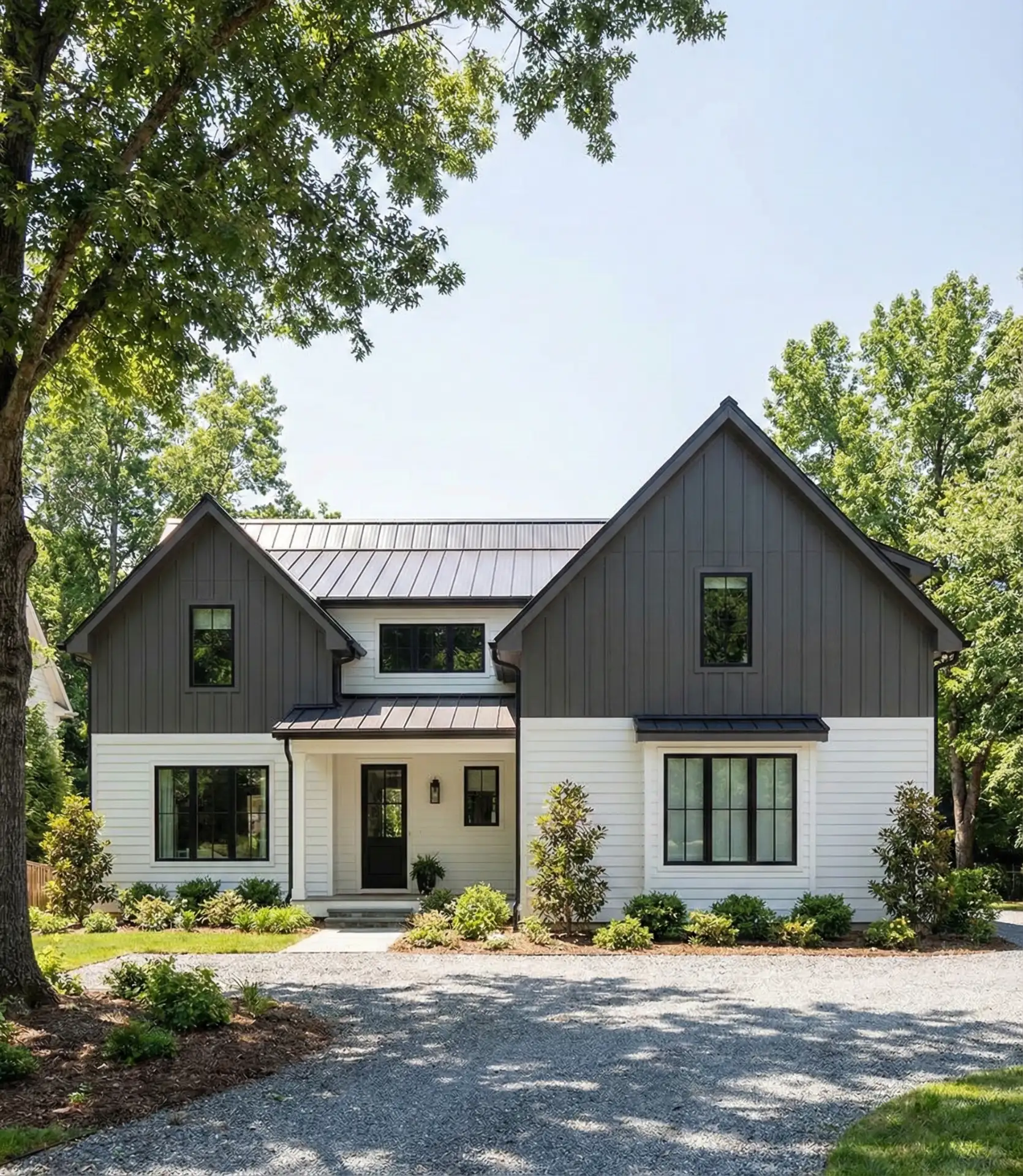
Using three coordinating colors in distinct zones—say, a white body, gray trim, and black accents—creates sophisticated depth that single-color schemes cannot achieve while remaining firmly within modern farmhouse aesthetics. This approach requires careful planning to avoid chaos: establish a hierarchy where one color dominates (60-70% of surfaces), another supports (20-30%), and the third provides punctuation (10%), maintaining clear delineation between zones through thoughtful trim placement. The technique works particularly well on complex forms with multiple gables, varied wall planes, or attached structures where color can help organize and clarify the architecture.
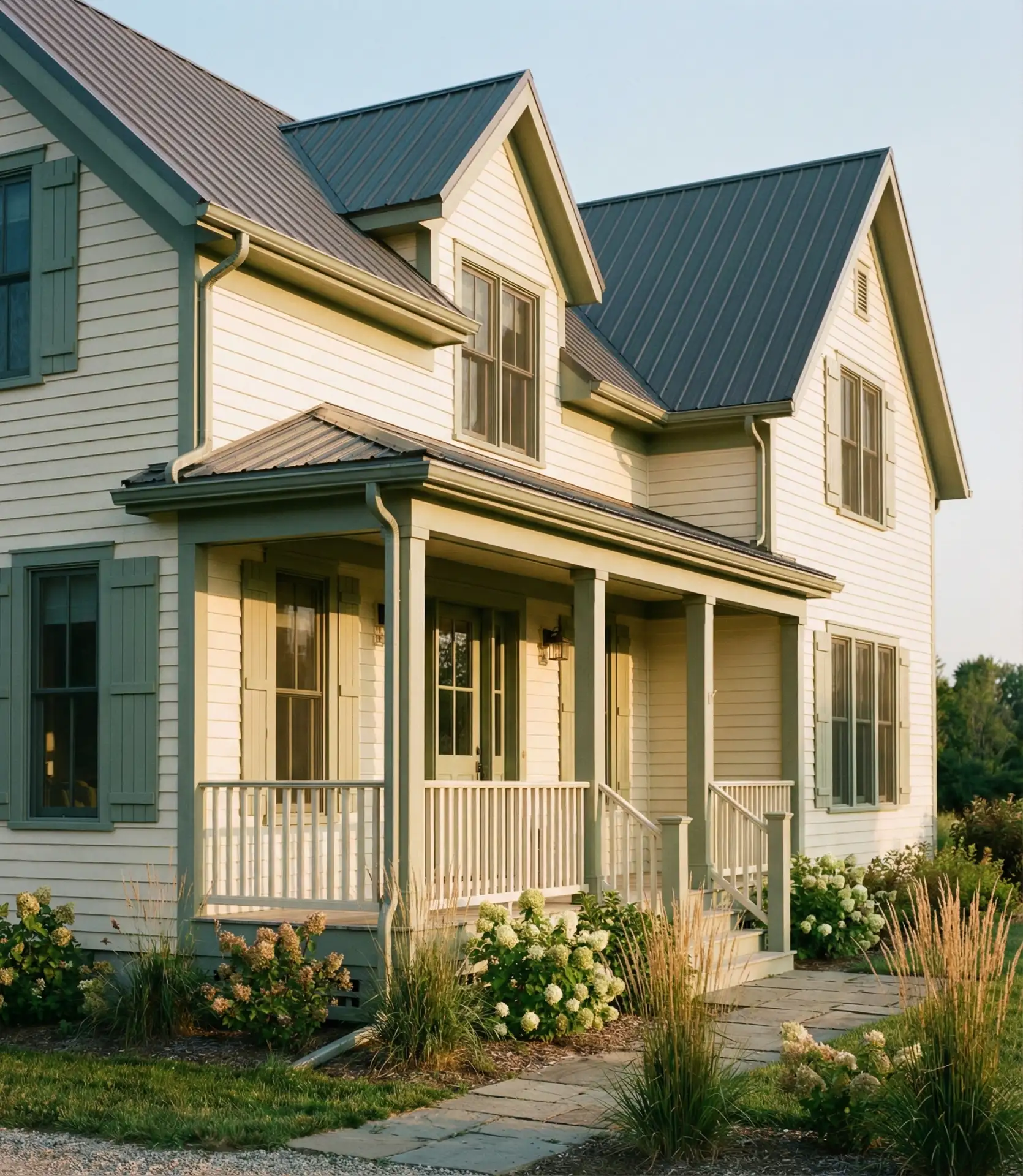
Expert commentary: Successful multi-tone exteriors follow the same principles as excellent interior design—colors should relate through undertone (all warm or all cool), and transitions should occur at logical architectural breaks rather than arbitrary heights or locations. Test your scheme on a small elevation drawing before committing to thousands of dollars in paint, and remember that colors interact with the surrounding landscape and adjacent homes—what worked beautifully in a portfolio image might clash with your red brick neighbor or burgundy-leaved landscaping, so context always matters more than isolated beauty.
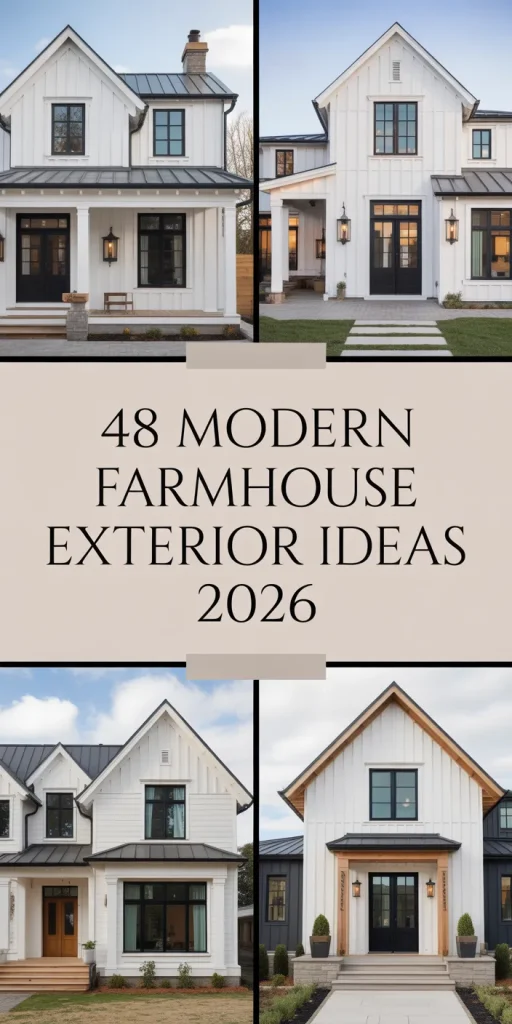
These modern farmhouse exterior ideas demonstrate the style’s remarkable adaptability across regions, budgets, and personal aesthetics. Whether you’re drawn to classic black and white contrasts, earthy organic tones, or unexpected fusions with coastal or mid-century influences, the modern farmhouse framework accommodates personal expression while maintaining its core values of simplicity, authenticity, and warmth. As you plan your own exterior transformation, consider which elements resonate most with your home’s architecture and your region’s context—the best modern farmhouse exteriors feel both distinctly individual and comfortably rooted in their surroundings. Share your favorite ideas or your own modern farmhouse projects in the comments below.