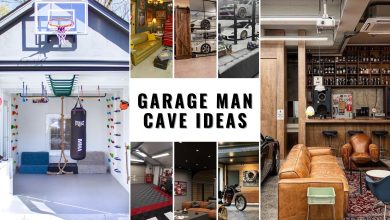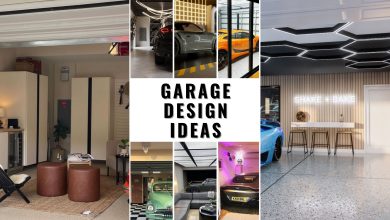

Garage doors have quietly become one of the most talked-about exterior upgrades in American home design—and it’s not hard to see why. In 2026, homeowners are pushing past the plain white panel door and exploring options that genuinely transform a home’s personality. Whether you’re hunting for curb appeal inspiration on Pinterest or planning a full exterior renovation, the possibilities this year are bolder, smarter, and more beautiful than ever. This article walks you through fresh garage door ideas that span every style, budget, and home type—so you can find the look that truly fits your space.
1. Bold Black Garage Doors for Maximum Curb Appeal
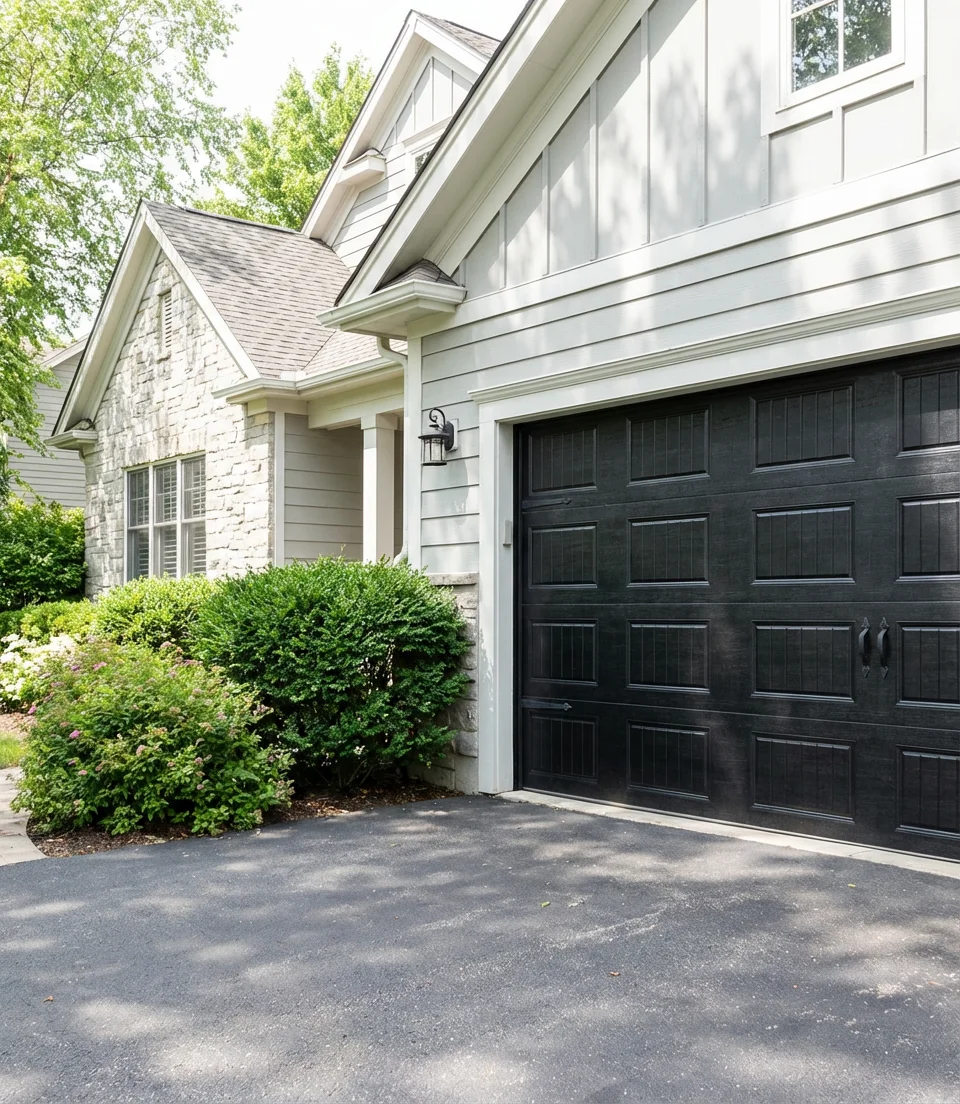
There’s a reason black garage doors keep dominating Pinterest boards—they work on nearly every house style, from farmhouse to craftsman to modern. A double black door on a light-colored home creates a graphic contrast that reads as intentional and polished, not accidental. Whether you go with a flat steel panel or add window inserts at the top, the effect is consistently striking. It looks pricey, even if it isn’t, and it photographs well, which is why it spreads so fast on visual platforms.
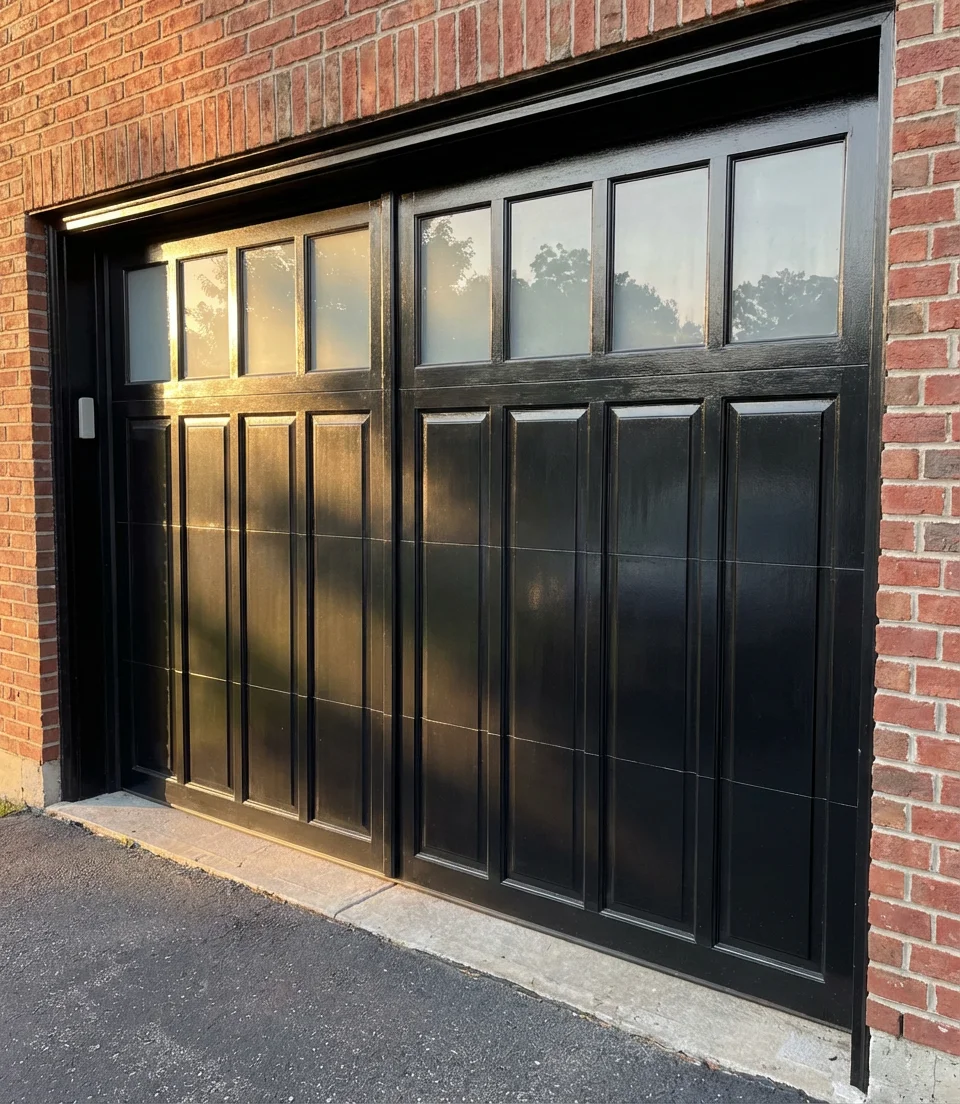
If you’re worried about heat absorption in warmer climates like Texas or Arizona, opt for an insulated steel door with a black powder-coat finish—it handles sun exposure better than you’d expect. Many homeowners in the South have made the switch and report minimal issues with heat transfer into the garage. Pair the door with black house numbers and a matte black light fixture, and suddenly your whole facade feels curated. The investment is modest, but the visual payoff is enormous.
2. Warm Wooden Garage Doors That Feel Like Home
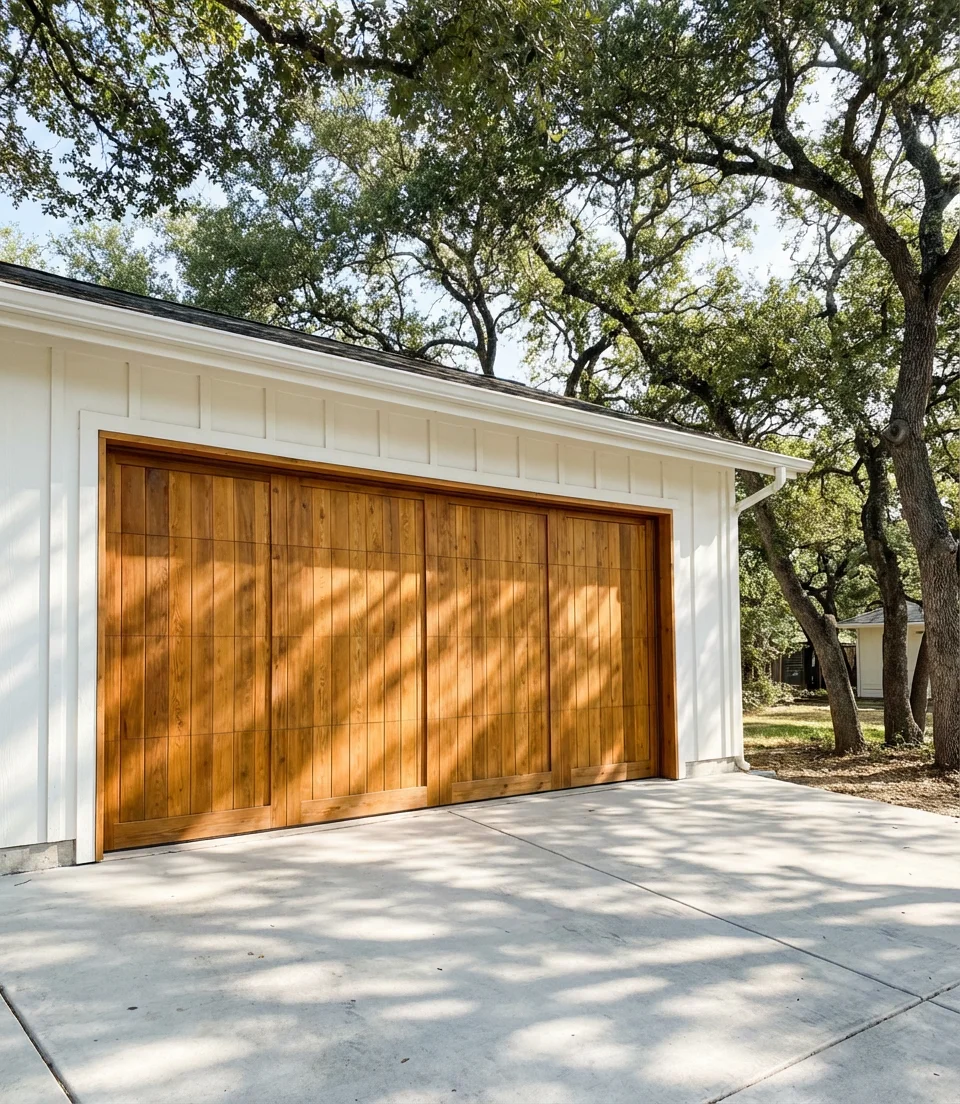
Nothing brings warmth and texture to a facade quite like a wooden garage door. In 2026, designers are increasingly gravitating towards rich cedar, reclaimed oak, and walnut-stained panels, which imbue a home with a sense of groundedness and lived-inness, as opposed to a generic aesthetic. The natural grain variation means no two doors are exactly alike, which appeals to homeowners who want something genuinely personal. Combine a wooden door with stone accents or brick, and you get a layered, organic look that feels rooted in the landscape rather than dropped on top of it.
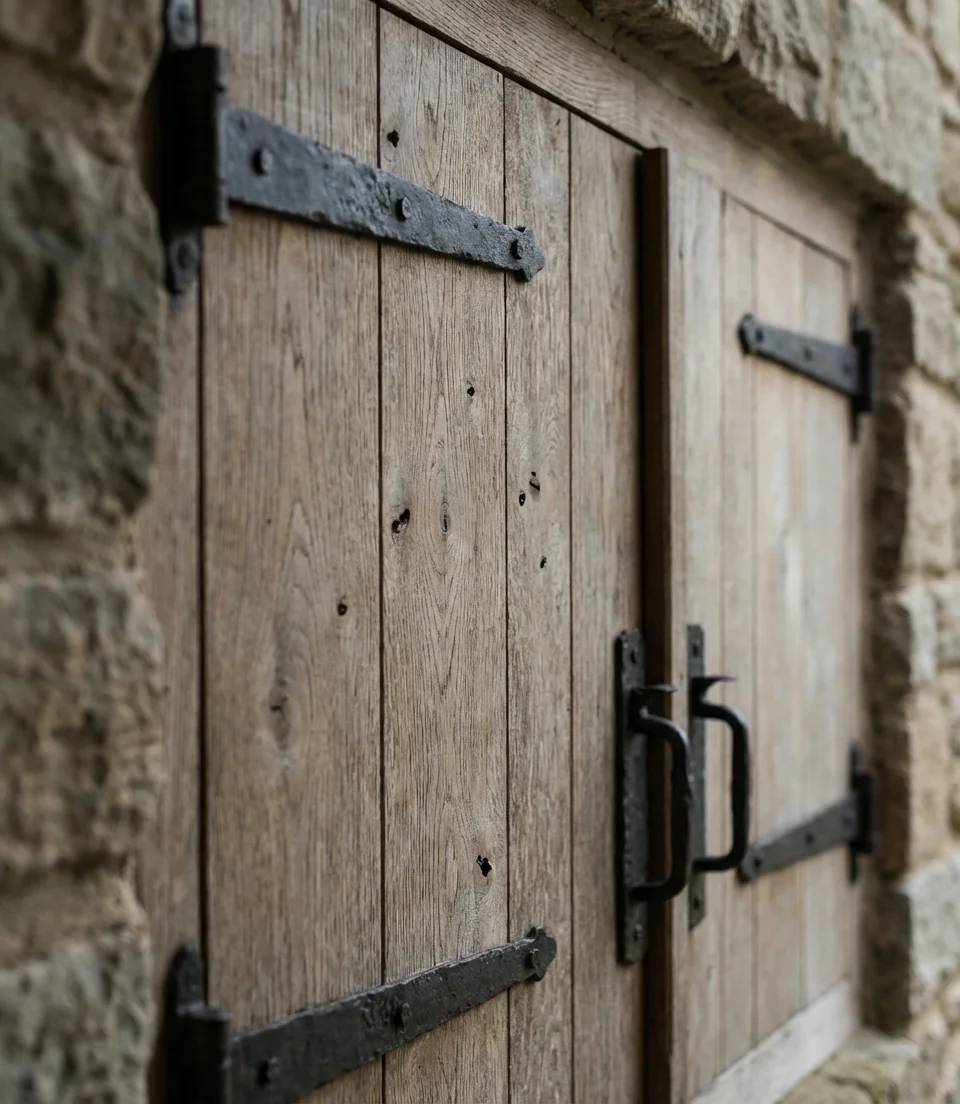
Real wood doors require more maintenance than steel or fiberglass—plan on sealing or staining every two to three years depending on your climate. A common mistake is skipping that first protective coat after installation, which leads to warping in humid regions like the Southeast. If upkeep feels like too much, wood-look composite or fiberglass doors now mimic the grain convincingly while holding up against moisture. Either way, the warmth a wooden door brings to the front of a home is hard to replicate with any other material.
3. Glass Panel Garage Doors for a Modern Statement
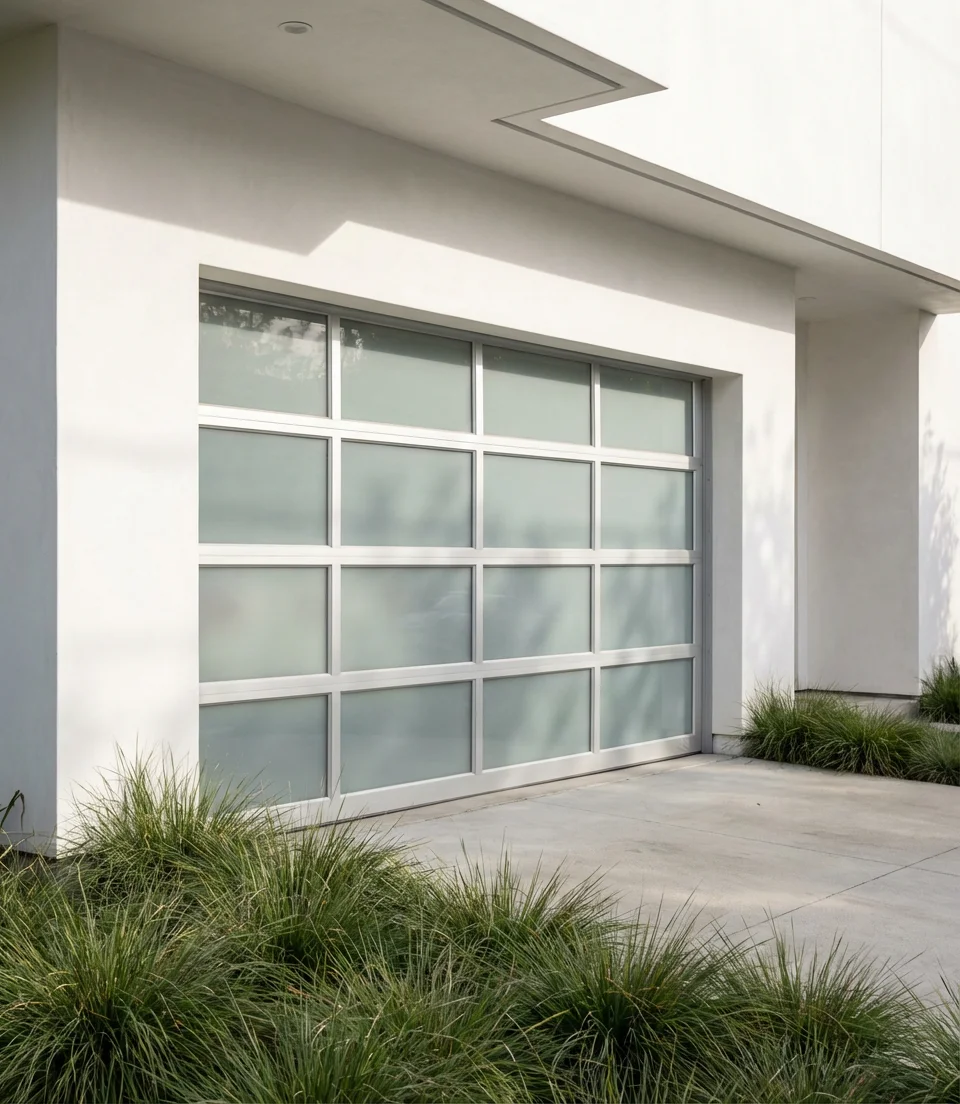
If you want your garage to look like it belongs on an architectural tour, a glass panel door is your move. Full-view aluminum-framed doors with frosted, tempered, or clear glass panels are showing up everywhere in contemporary home design—and they make an especially powerful statement on single-car garages where the door becomes almost like a sculptural element. The light play throughout the day changes the entire feel of the facade, and at night, a warm glow from inside makes the whole house feel alive and welcoming.
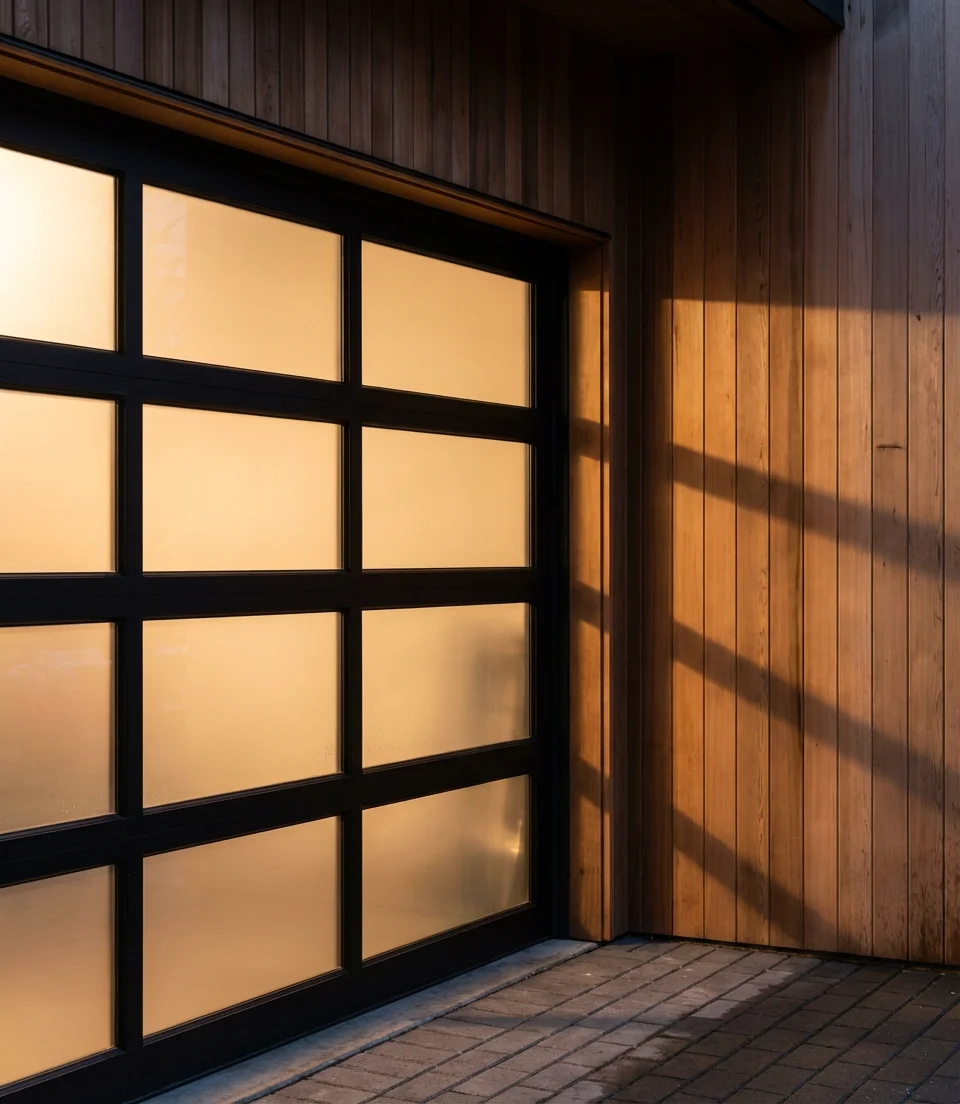
These doors work best in climates where extreme temperature swings aren’t a daily reality—think California, the Pacific Northwest, or coastal areas. Frosted or tinted glass is the smarter choice if privacy matters to you, since clear panels let neighbors and passersby see directly into the garage. Pricing starts around $2,000 for a basic aluminum-and-glass unit and can climb to $6,000+ for custom configurations. It’s a real investment, but for the right home, it’s the kind of upgrade that genuinely changes how people perceive the entire property.
4. Mid-Century Modern Garage Doors With Vintage Character
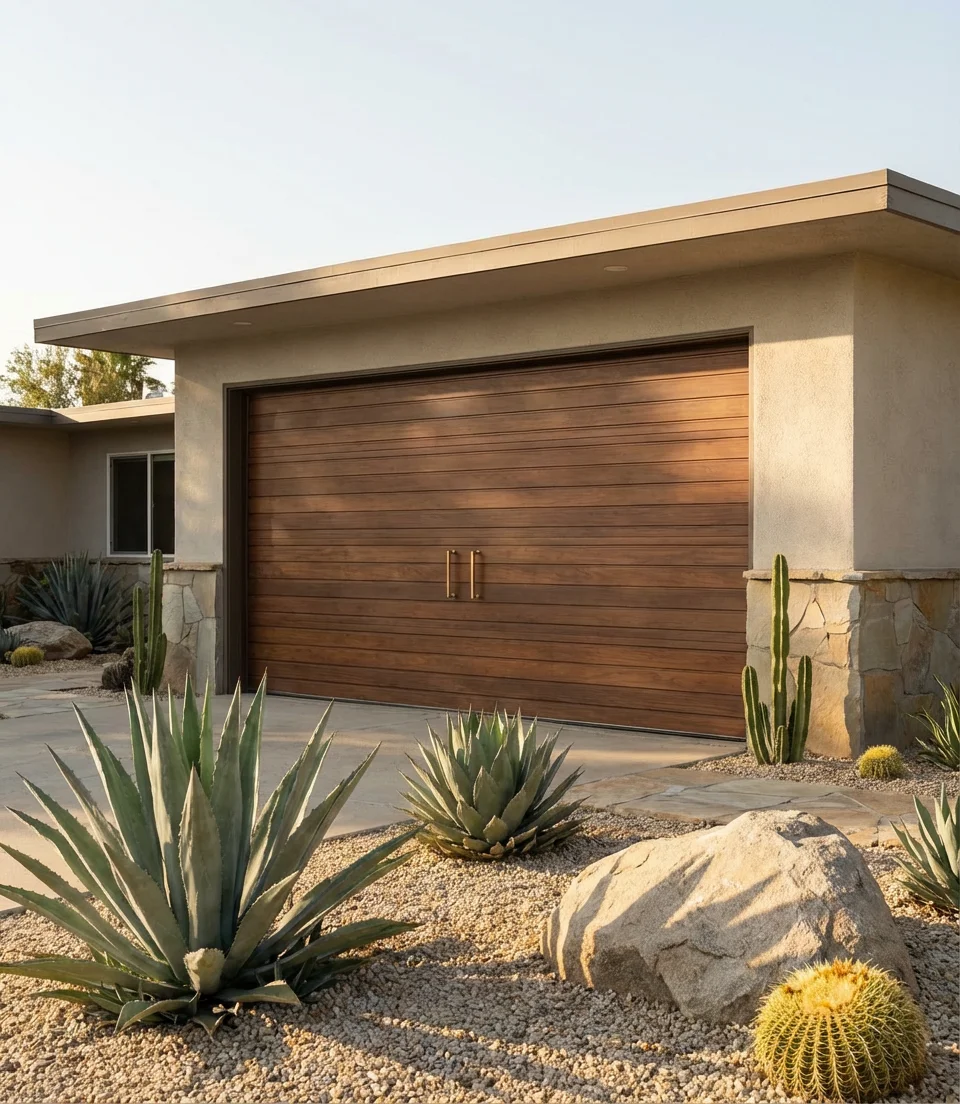
Garage doors are embracing the mid-century modern revival, which shows no signs of slowing down. Consider incorporating clean horizontal lines, flat panels, warm wood-tone finishes, and a subtle touch of metal hardware in brushed brass or matte black. These doors honor the original mid-century aesthetic—functional, unfussy, and quietly beautiful—without feeling like a museum piece. They suit ranch homes, split-levels, and post-war bungalows especially well, where the architecture already has that low-profile, elongated character built right in.
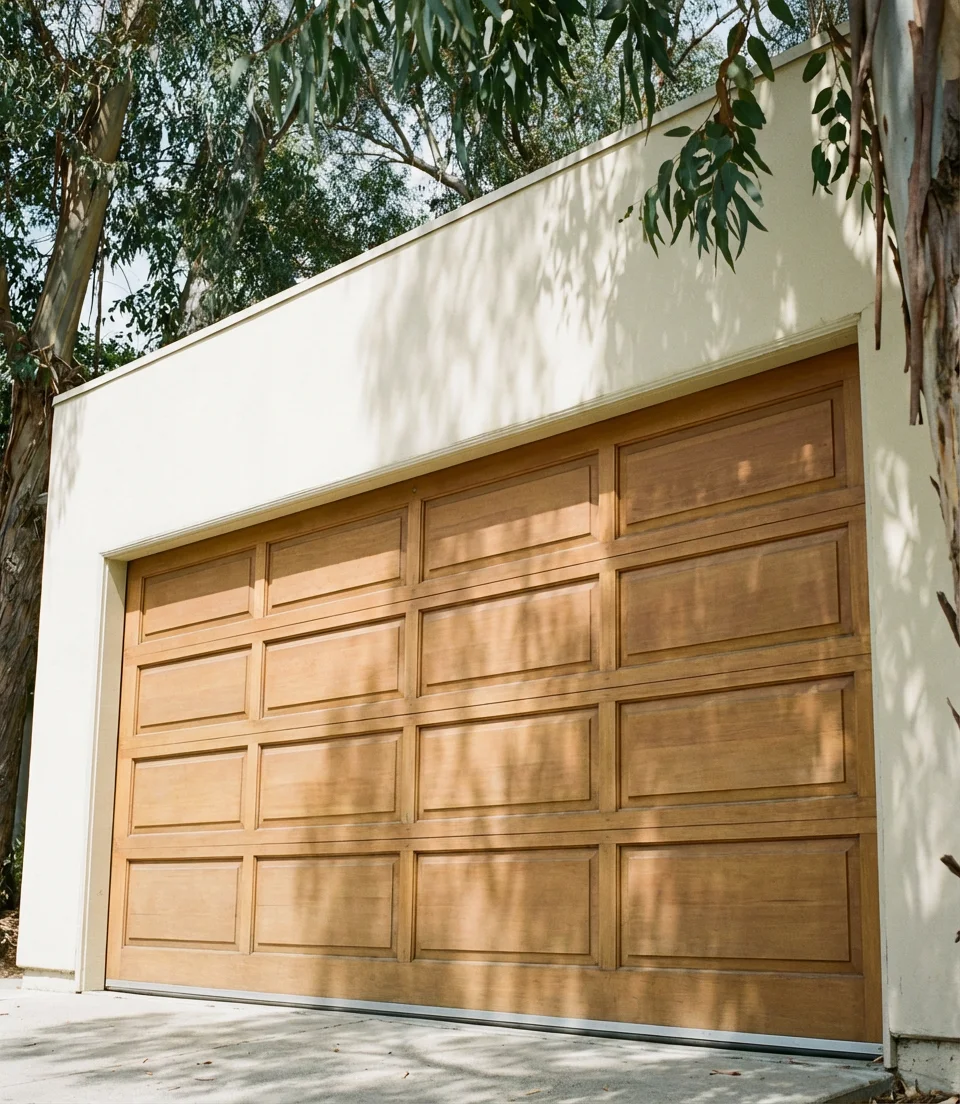
When homeowners restore mid-century properties, they often view the garage door as the final component. By replacing the original aluminum door with a panel design that fits the period, the entire exterior becomes cohesive. One designer in Palm Springs put it simply: the garage door is the punctuation mark on the sentence of your home’s architecture. Get it right and everything else clicks. Look for manufacturers who specialize in flush or recessed panel doors with horizontal emphasis—that’s the detail that reads as authentically mid-century rather than just “modern.”
5. White Garage Doors That Never Go Out of Style
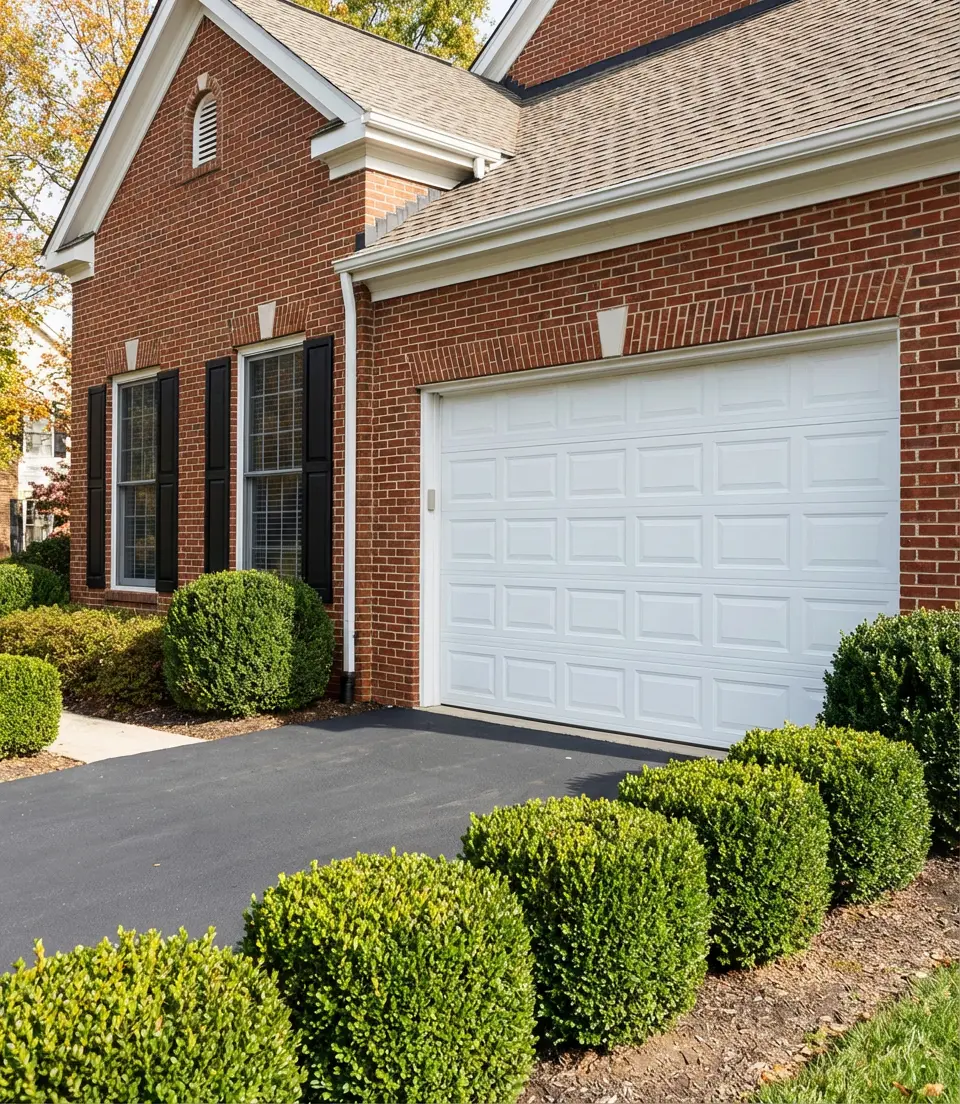
There’s a reason white remains the most popular garage door color in America—it’s clean, versatile, and works with virtually every exterior palette. But in 2026, the conversation around white doors has shifted from “safe” to “intentional.” Homeowners are pairing crisp white doors with bold front door colors—deep navy, forest green, and terracotta—to create a facade that feels fresh and considered. A double white car door with raised-panel detail on a colonial or craftsman home is a classic that genuinely holds its value both aesthetically and on the real estate market.
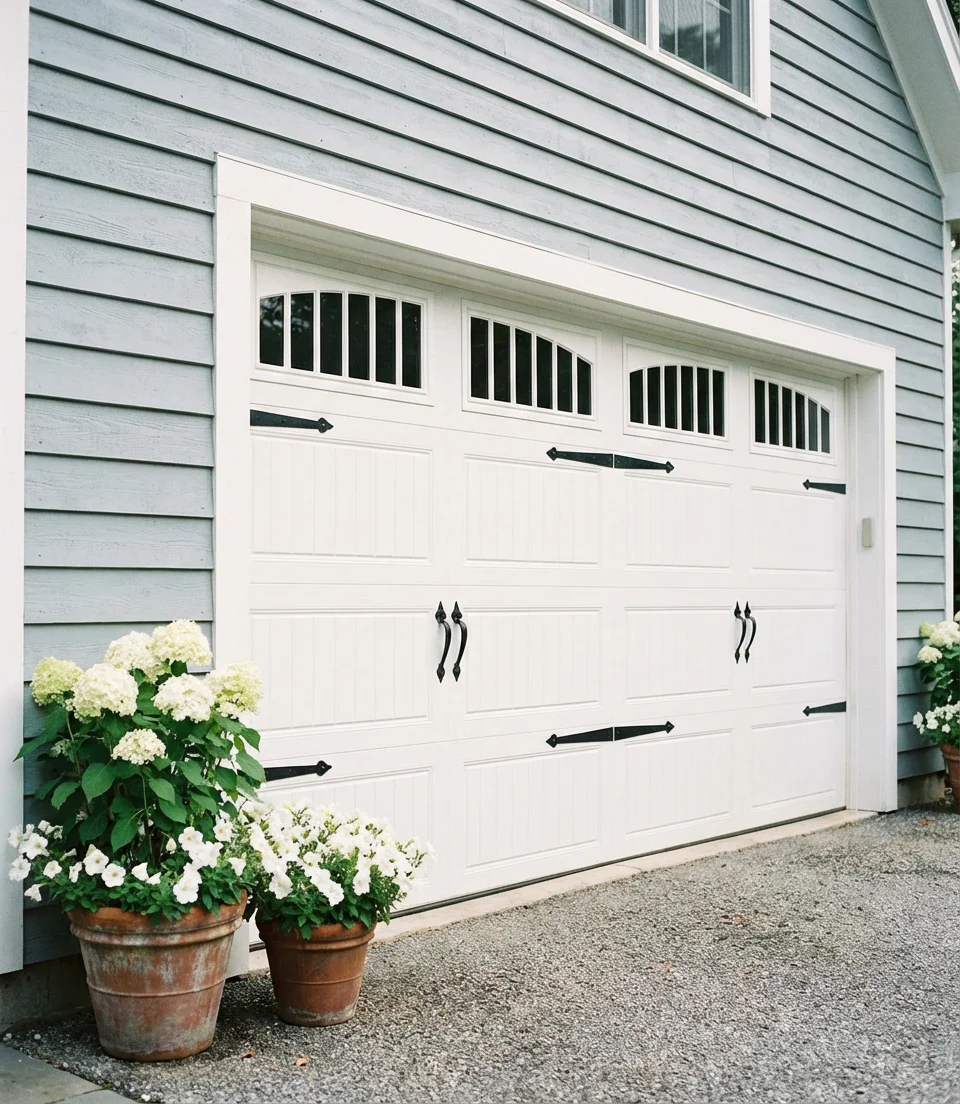
White doors do show dirt and road grime faster than darker tones—especially in regions with muddy springs or dusty summers. A quick rinse with a garden hose every month or so keeps them looking sharp without much effort. For the most durable finish, look for factory-painted steel doors with a baked-on powder coat rather than a brushed-on exterior paint; they hold color longer and resist chalking. Doing some research before making a purchase can significantly reduce the need for future repainting.
6. Brown Garage Doors for an Earthy, Grounded Look
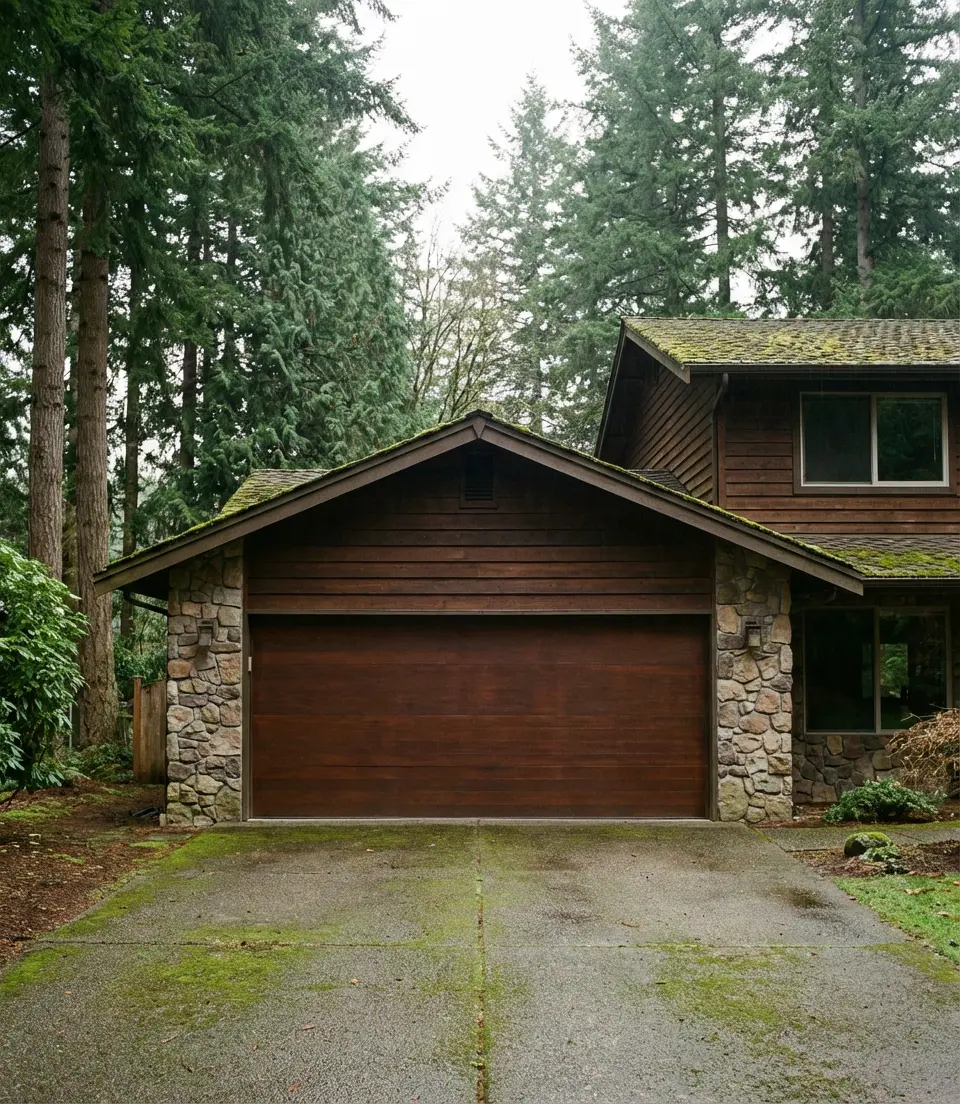
In 2026, brown garage doors are experiencing a significant surge in popularity, which is entirely understandable. As interior and exterior design embrace earthy, nature-inspired palettes, a rich chocolate, walnut, or espresso garage door effortlessly blends in. It’s especially effective on homes with stone, brick, or natural wood siding—the tones echo each other and create a warm, cohesive exterior. Unlike black, which reads as bold and graphic, brown reads as grounded and organic, the kind of choice that makes a home look like it was designed by someone who actually thought about it.
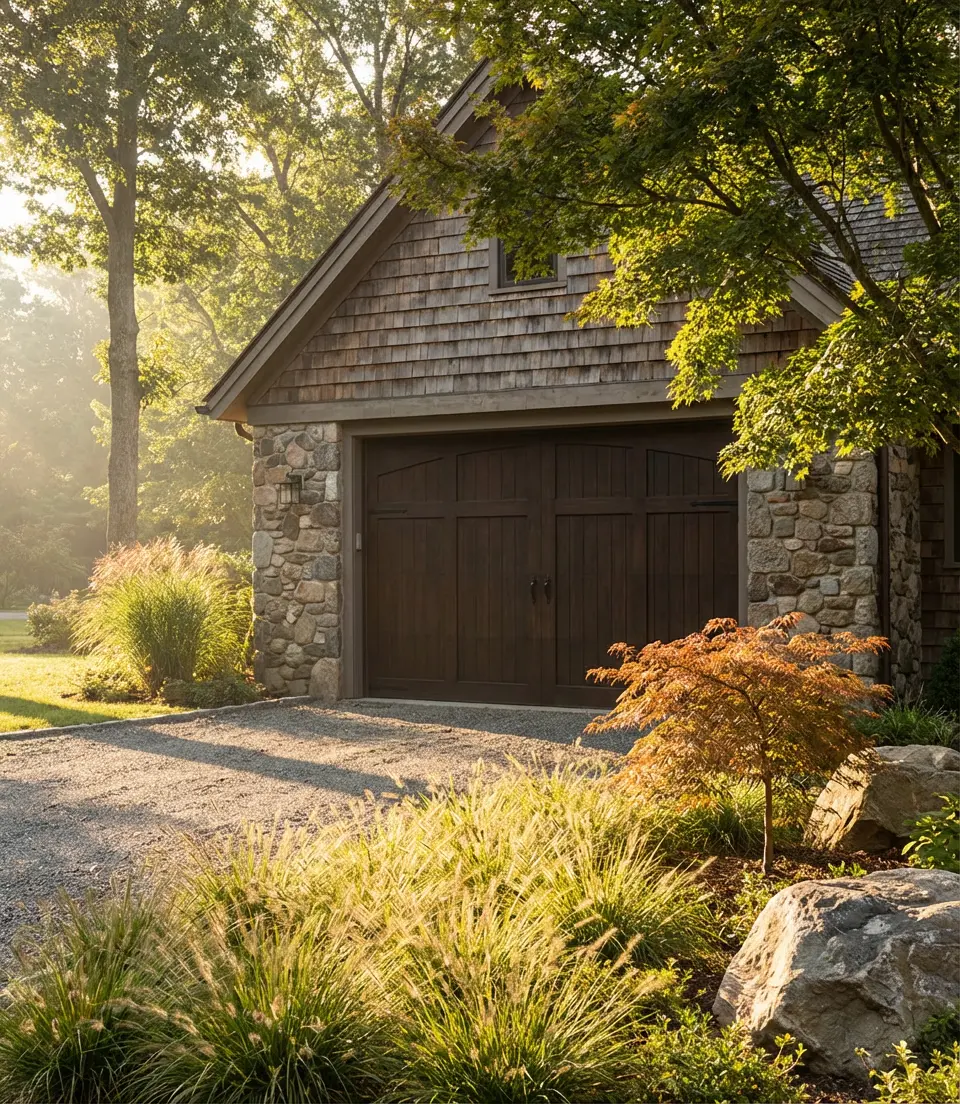
Trees and natural landscapes often surround homes in the Mountain West and Pacific Northwest, where brown works particularly well. It’s a color that recedes slightly, letting the landscaping and architecture do the talking rather than the door itself. If you’re in a neighborhood with homeowners’ association guidelines, a warm brown is often easier to get approved than a stark black—it reads as “natural” rather than “dramatic.” Either way, it’s a color that ages gracefully and looks better, not worse, as the surrounding landscaping matures.
7. Roll-Up Garage Doors for a Clean Industrial Edge
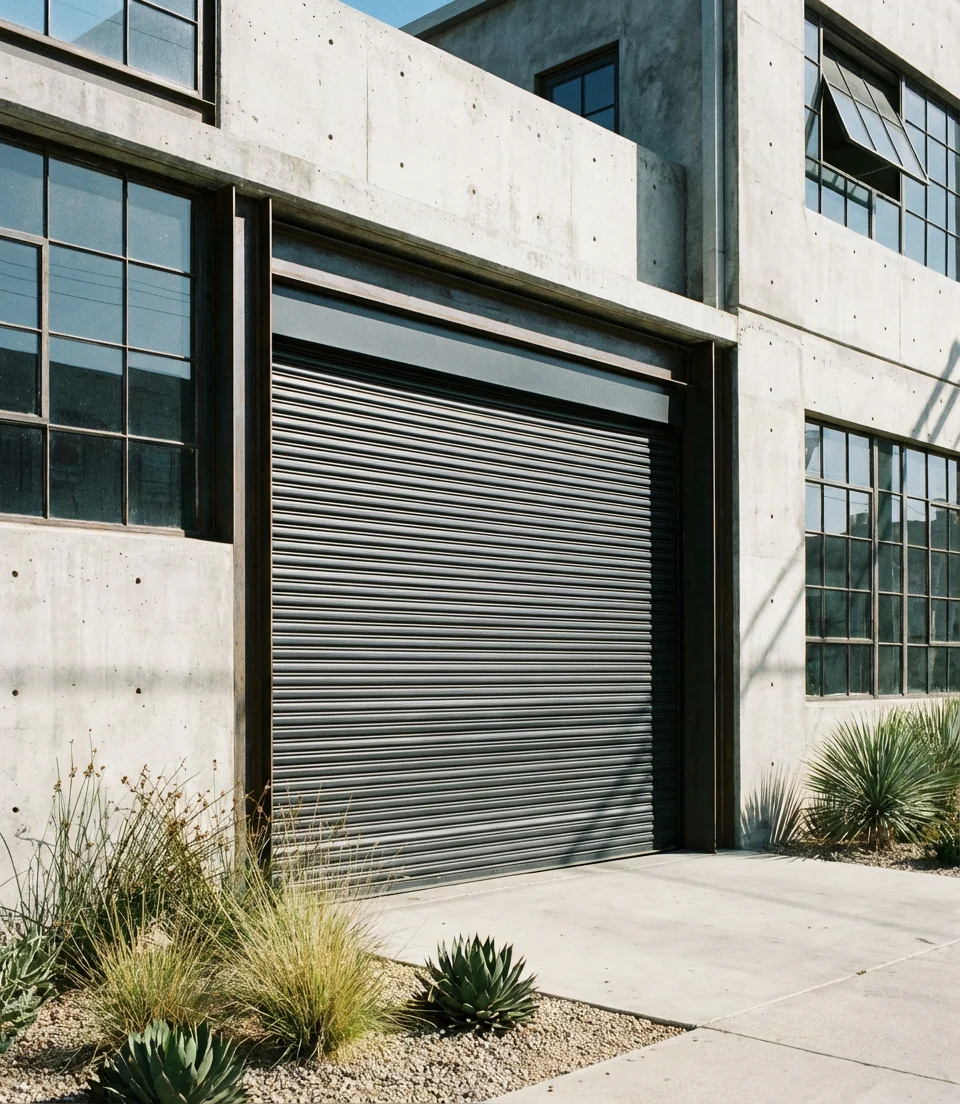
Originally designed for commercial use, roll-up garage doors have crossed over into residential designs with serious momentum. Their corrugated steel profile and utilitarian aesthetic fit perfectly with the industrial-modern, loft-style, and contemporary barn homes trending across the country right now. They’re also genuinely practical—roll-up doors don’t require the overhead track clearance that sectional doors need, which means more usable ceiling space inside the garage. For converted outbuildings, accessory dwelling units (ADUs), or garage workshops, they’re arguably the most functional door you can choose.
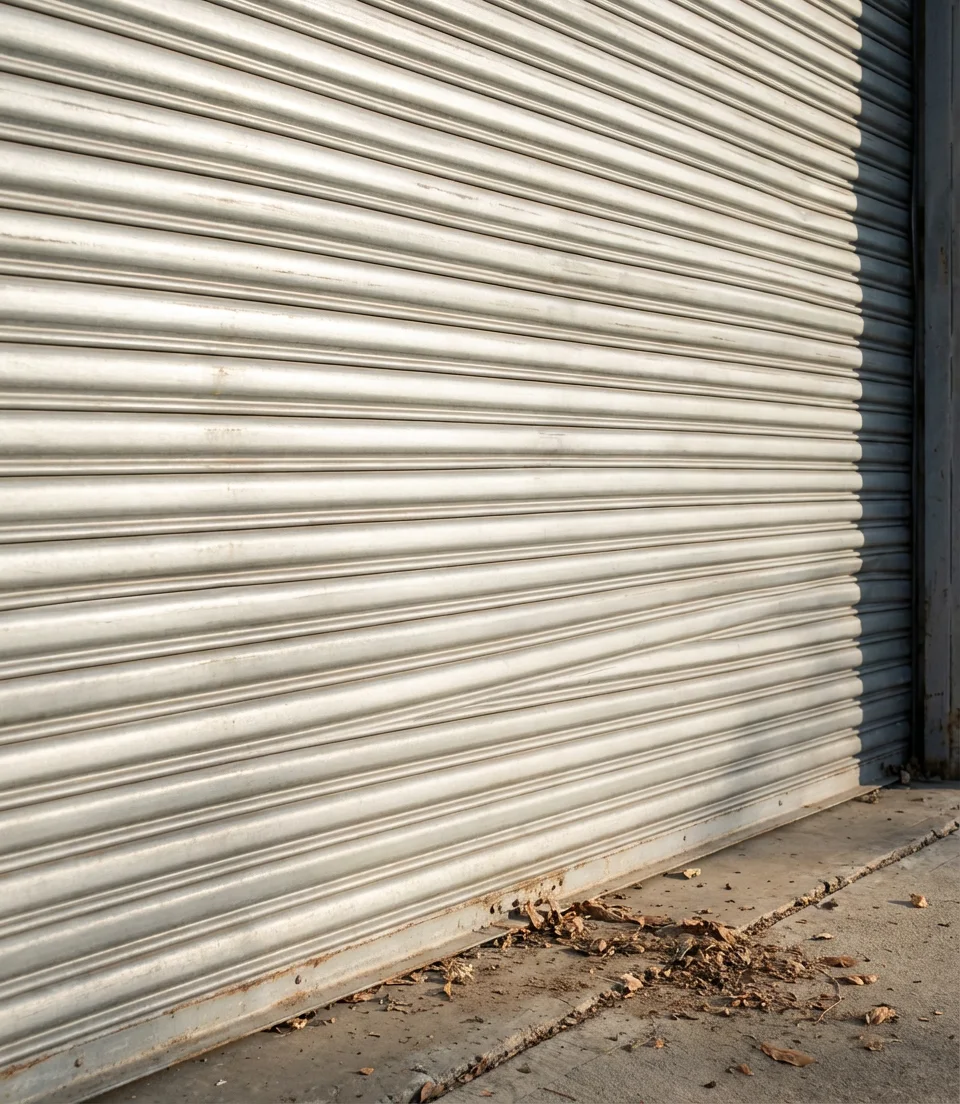
From a pricing standpoint, commercial-grade roll-up doors are actually quite competitive—a standard residential unit can cost less than a premium sectional door, which surprises many homeowners. The trade-off is insulation: standard corrugated roll-ups don’t offer the same thermal performance as insulated sectionals, so in climates with cold winters, you’ll want to spec an insulated version or add an interior liner. However, in a moderate climate, they are an excellent choice for both budget and style in a garage workshop.
8. Carport Enclosures That Double as Garage Doors
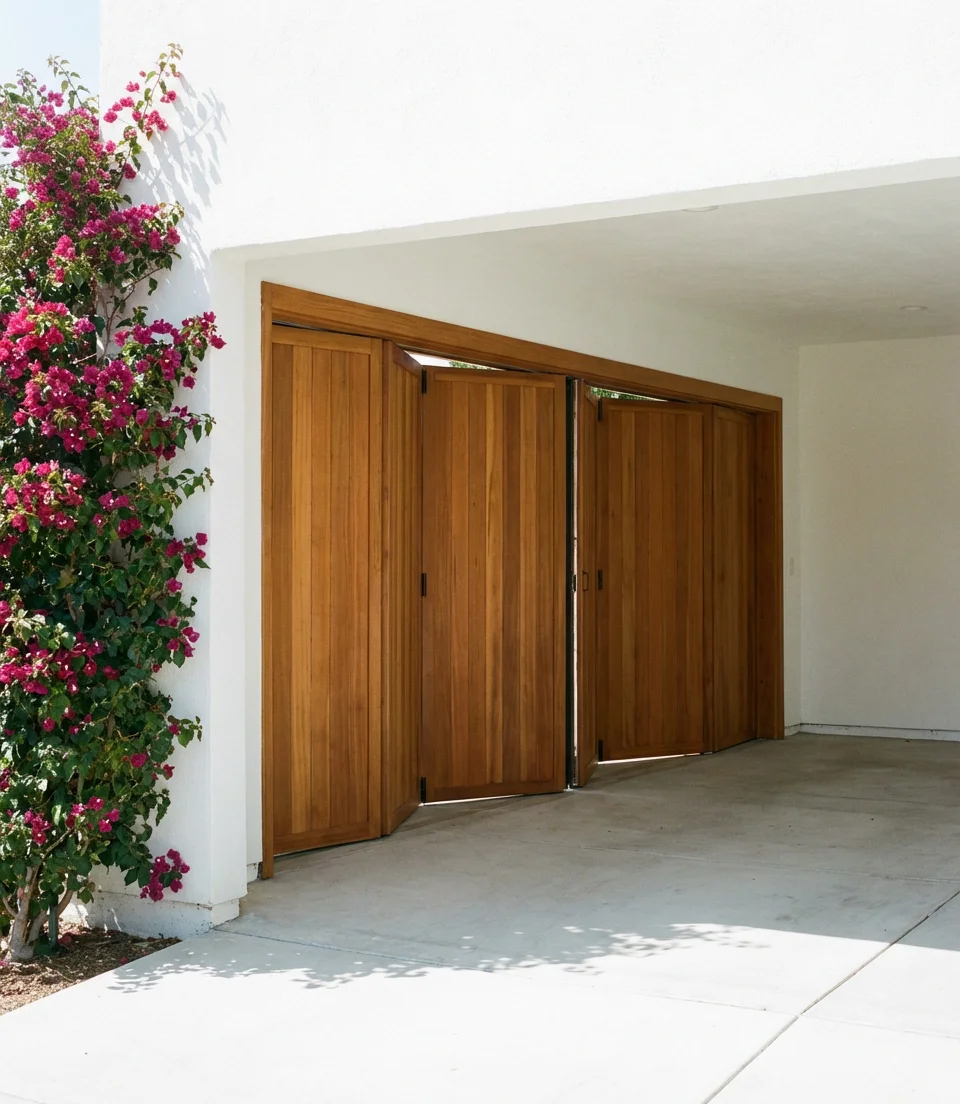
One of the most creative trends of 2026 is closing in an existing carport to create a proper enclosed garage—and the door you choose becomes the defining design decision. Because carport conversions often have non-standard dimensions, many homeowners are turning to custom doors: oversized single panels, bi-fold designs, or even barn-style swing-out doors that add character while solving the structural puzzle. This approach allows homeowners to achieve covered, lockable storage without the need to construct a new structure, thereby significantly reducing costs.
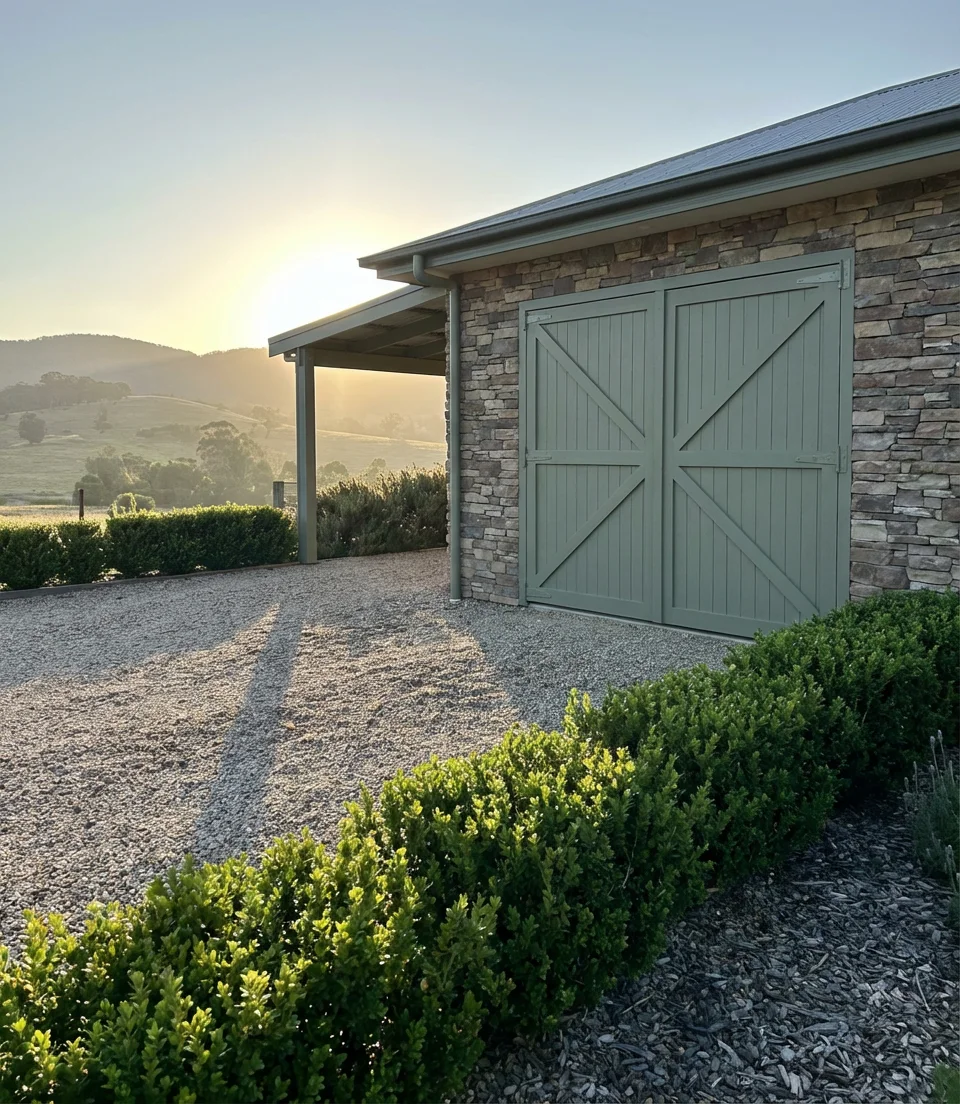
Across the Sun Belt—from Georgia to Southern California—carport-to-garage conversions are booming partly because of the added security they offer and partly because enclosed garages add measurable square footage to a home’s appraised value. A real estate agent in Nashville recently noted that a properly enclosed carport with a quality door can return close to its full cost at resale. Getting permits and ensuring the new structure meets local building codes is essential, but the payoff—both functional and financial—makes it worth navigating that process carefully.
9. Fake Wood Garage Doors That Look Surprisingly Real
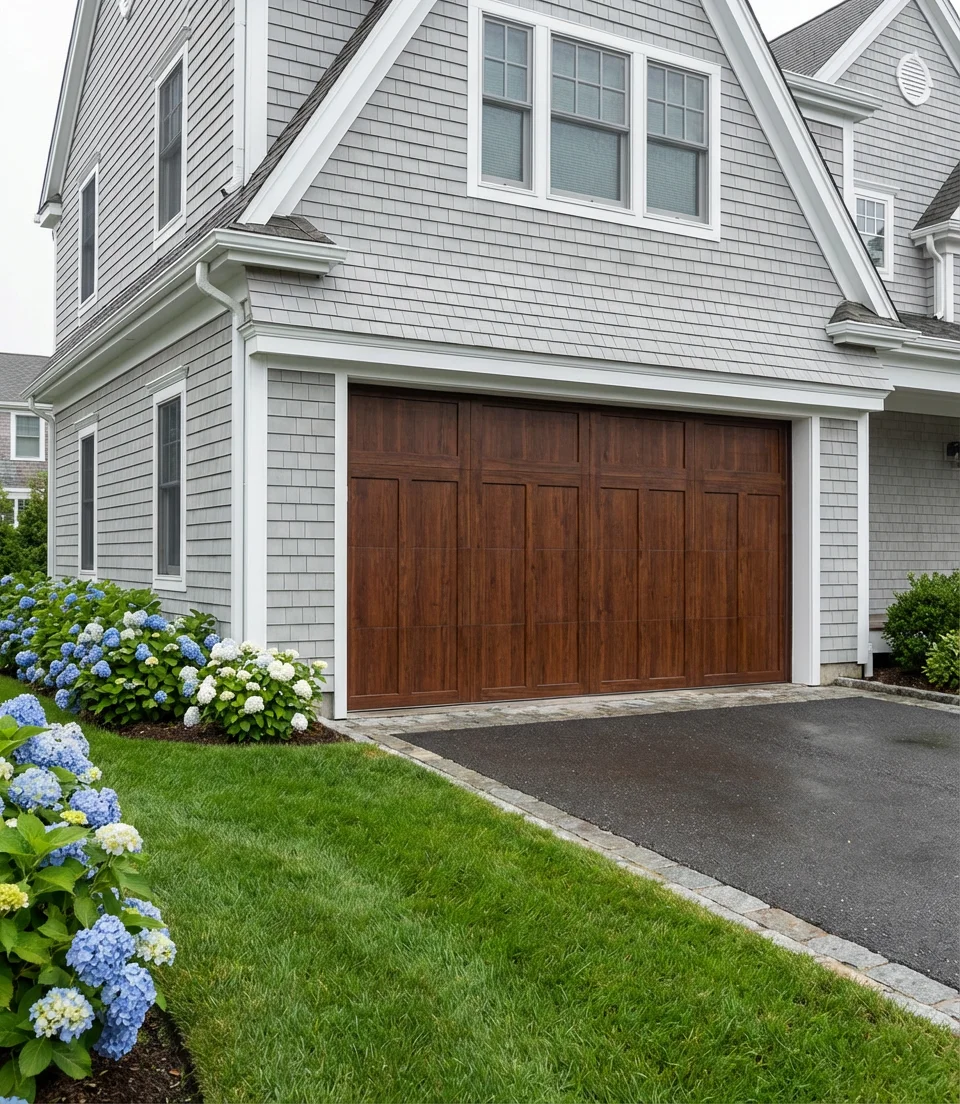
The technology behind fake wood garage doors—technically called faux wood or wood-grain embossed steel and fiberglass—has gotten remarkably convincing. At a conversational distance, a quality faux-wood door is nearly indistinguishable from real cedar or redwood, especially when paired with matching trim and stained to mimic natural grain. It captures the warmth of a wooden door without the maintenance burden, which makes it an especially appealing choice for homeowners who want the look but live in humid, wet, or extreme-climate regions where real wood would demand constant attention.
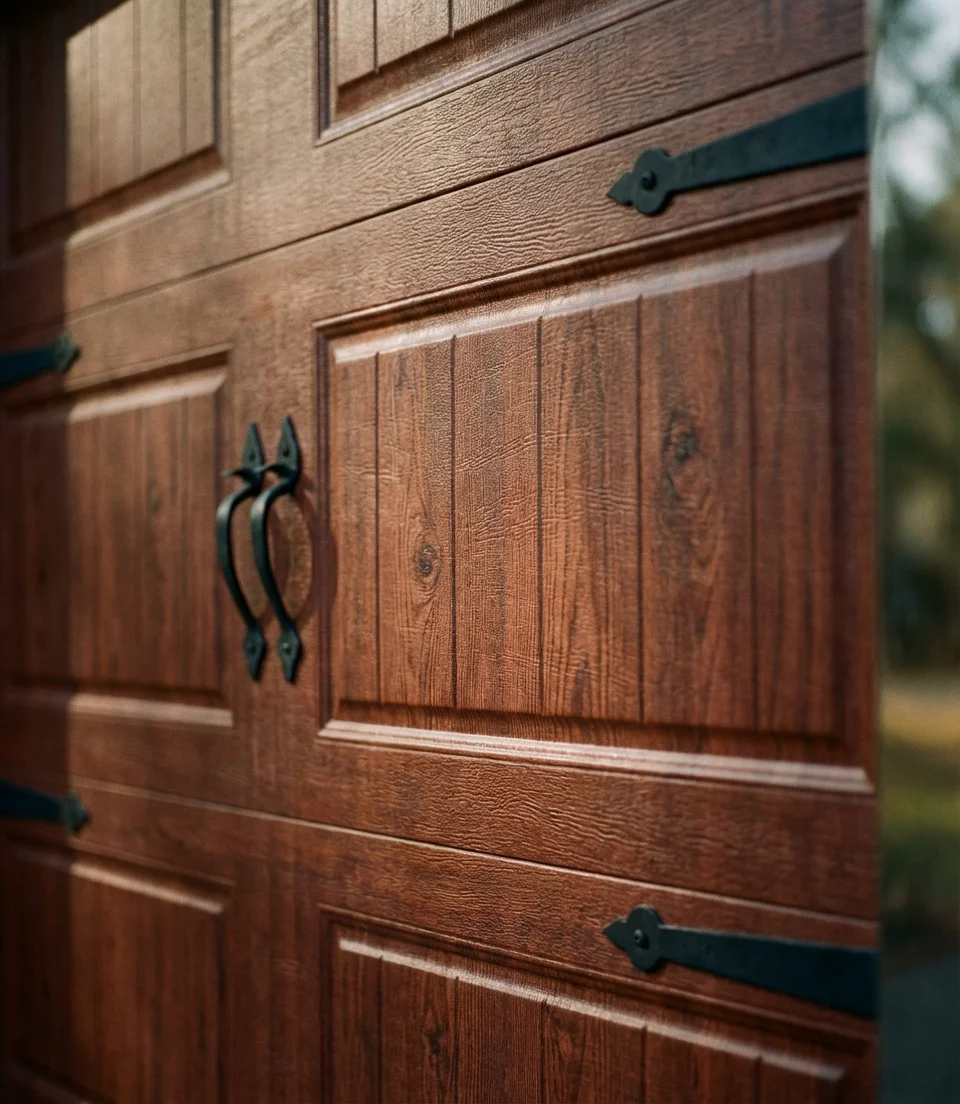
The honest word from homeowners who’ve made the switch: most guests and neighbors never know the difference, and that’s exactly the point. Fiberglass faux-wood doors tend to outperform steel versions in coastal climates because they don’t rust—an important consideration within a few miles of salt air. They also hold paint and stain finishes exceptionally well, so if you decide to update the color in five years, it’s a straightforward project. For the value-conscious homeowner, this category delivers a premium visual result at a fraction of the real-wood price.
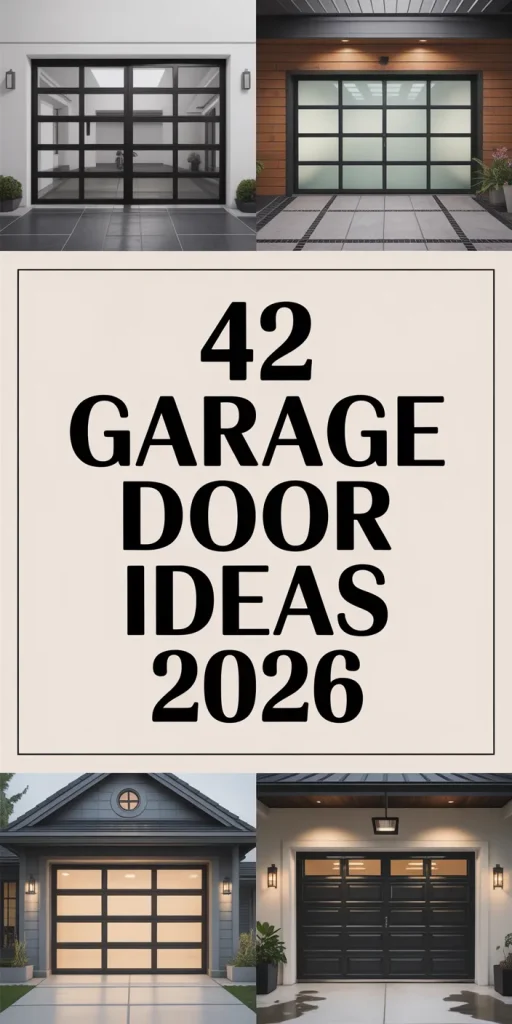
10. Interior Garage Conversions That Blend Into the Home
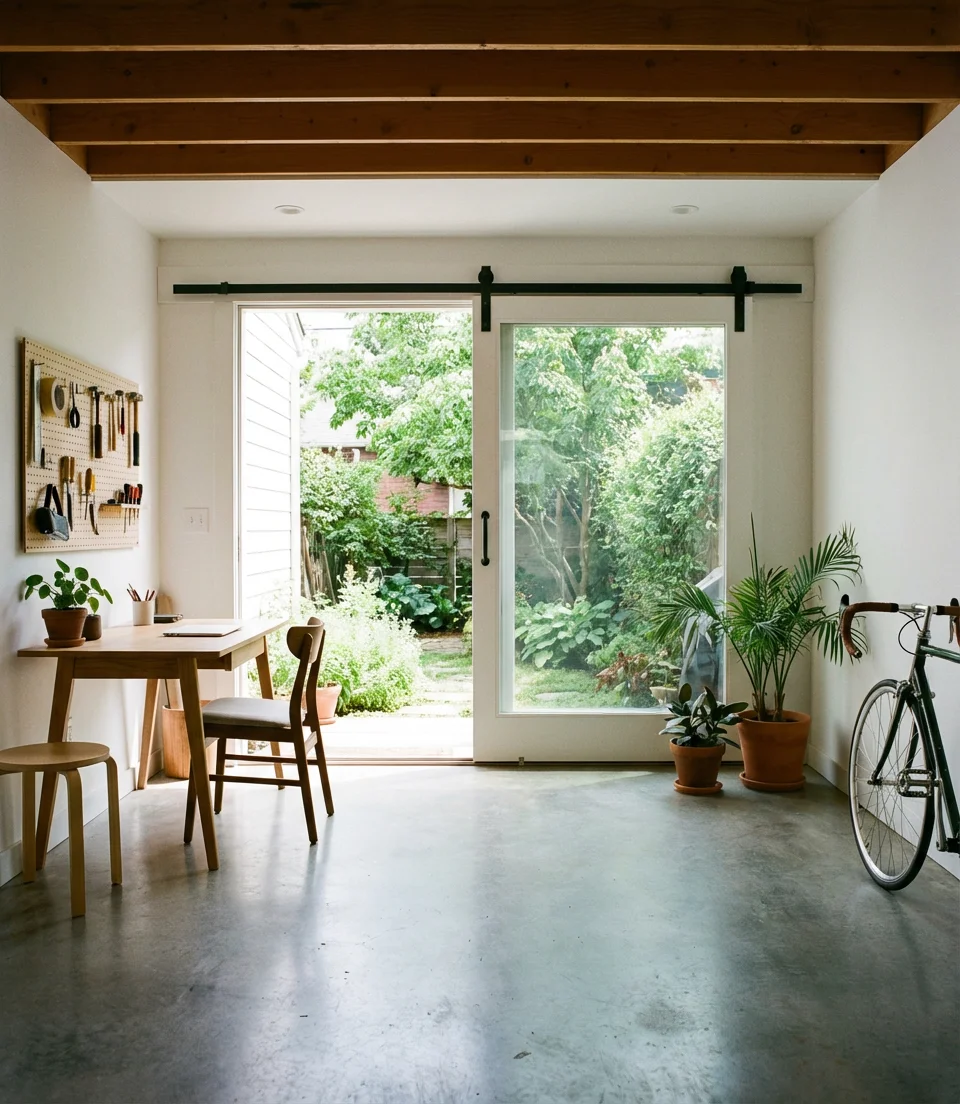
When a garage is converted into living space, the question of what to do with the opening—or the interior—becomes fascinating. Some homeowners opt to close off the original door entirely and frame in a wall with windows; others keep a decorative panel door that signals the space’s original life while functioning as a design element. For homes where the garage faces the backyard or a courtyard, installing a glass-panel or barn-style door that opens the converted space to the outdoors creates an effortless indoor-outdoor flow that feels incredibly current.
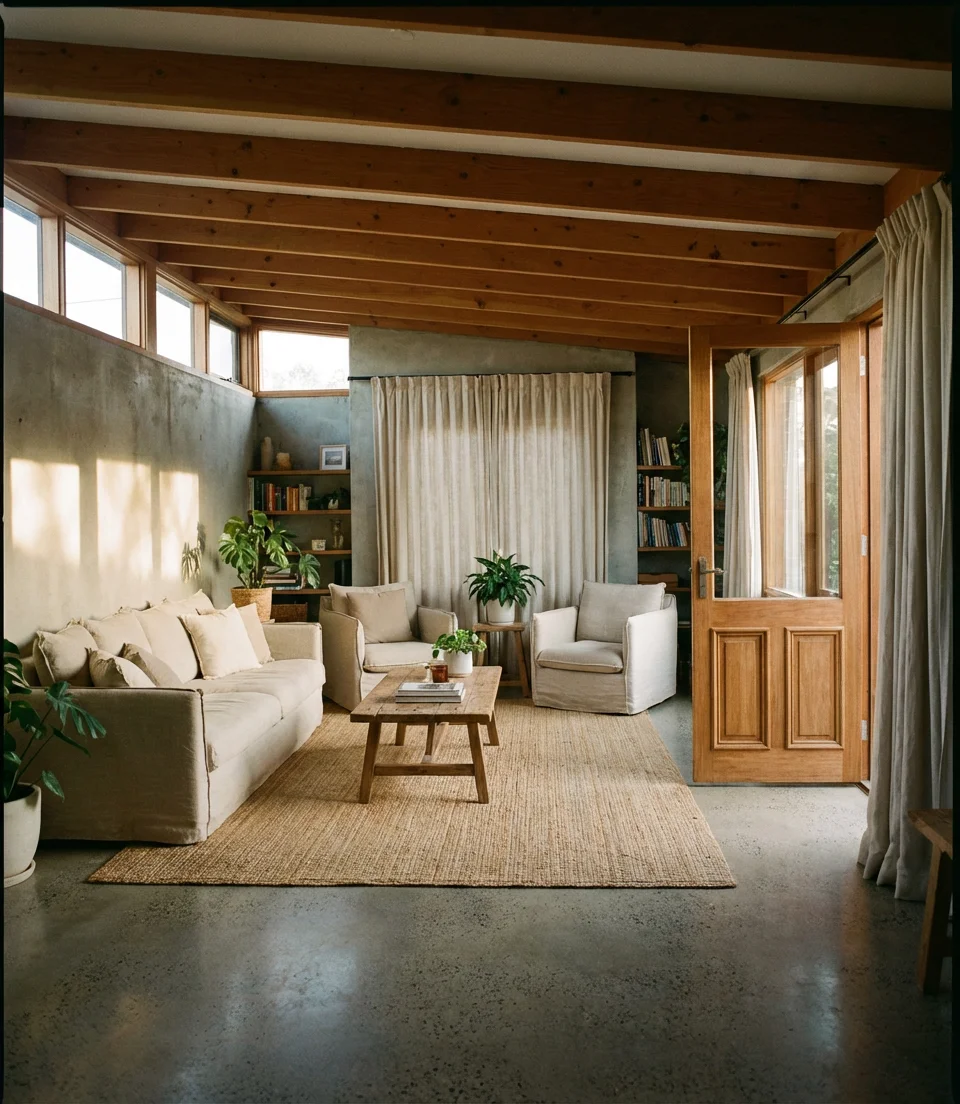
In high-cost housing markets like Los Angeles, San Francisco, and New York City suburbs, garage conversions into offices, studios, or ADUs (Accessory Dwelling Units) are a pragmatic response to cramped square footage. A sliding barn door on an interior converted garage can make the space feel intentionally designed, rather than improvised. Think about how the converted space connects to the rest of the house, and let that relationship guide your door choice. The best conversions read as original to the architecture, not as afterthoughts.
11. Garage Doors as Front Door Focal Points
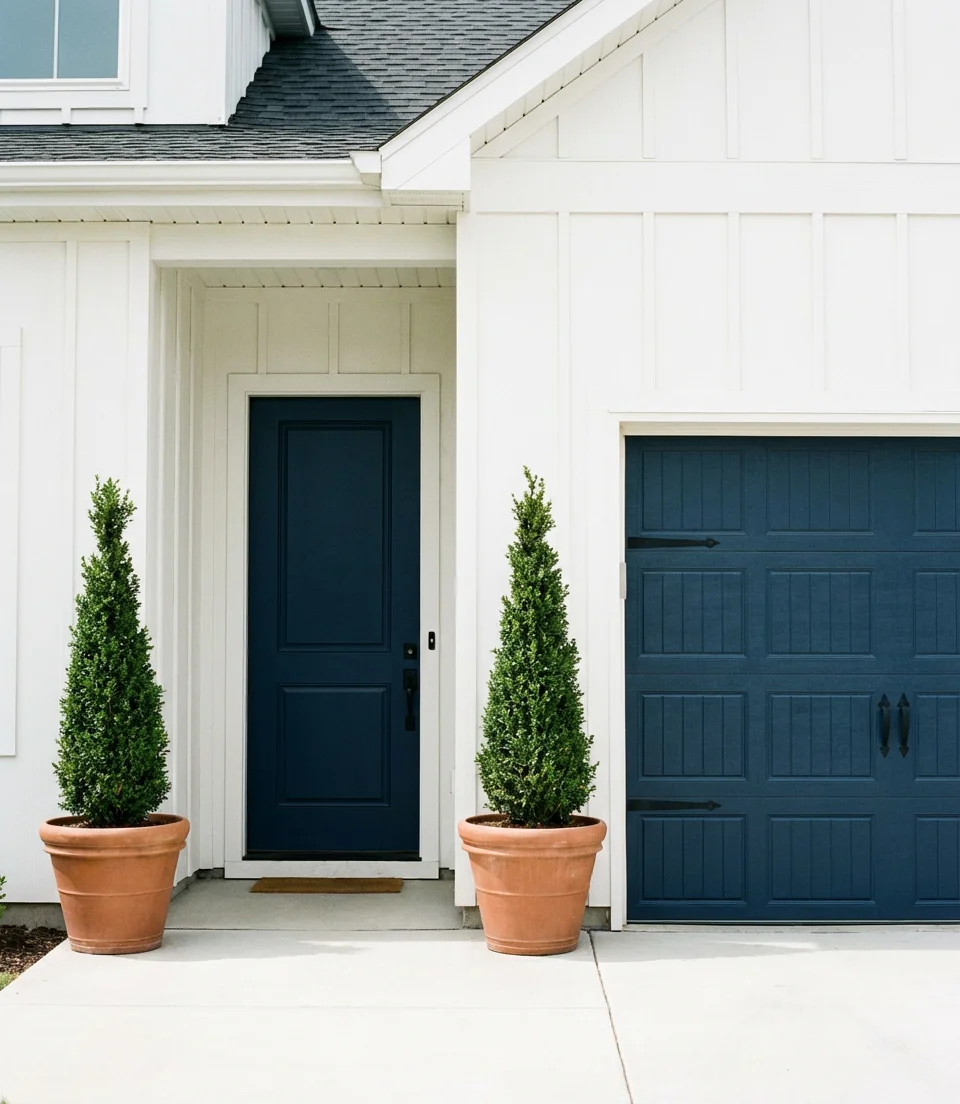
On many American homes, the garage door actually dominates more of the facade than the front door—and forward-thinking homeowners are finally designing around that reality. Coordinating the garage door color, material, or hardware with the entry door creates a facade that feels deliberately composed rather than assembled piecemeal. A deep navy front door paired with a navy-accented or matching garage door, for instance, creates a visual through-line that pulls the whole exterior together. It’s a simple design principle—repetition creates harmony—and it works every time.
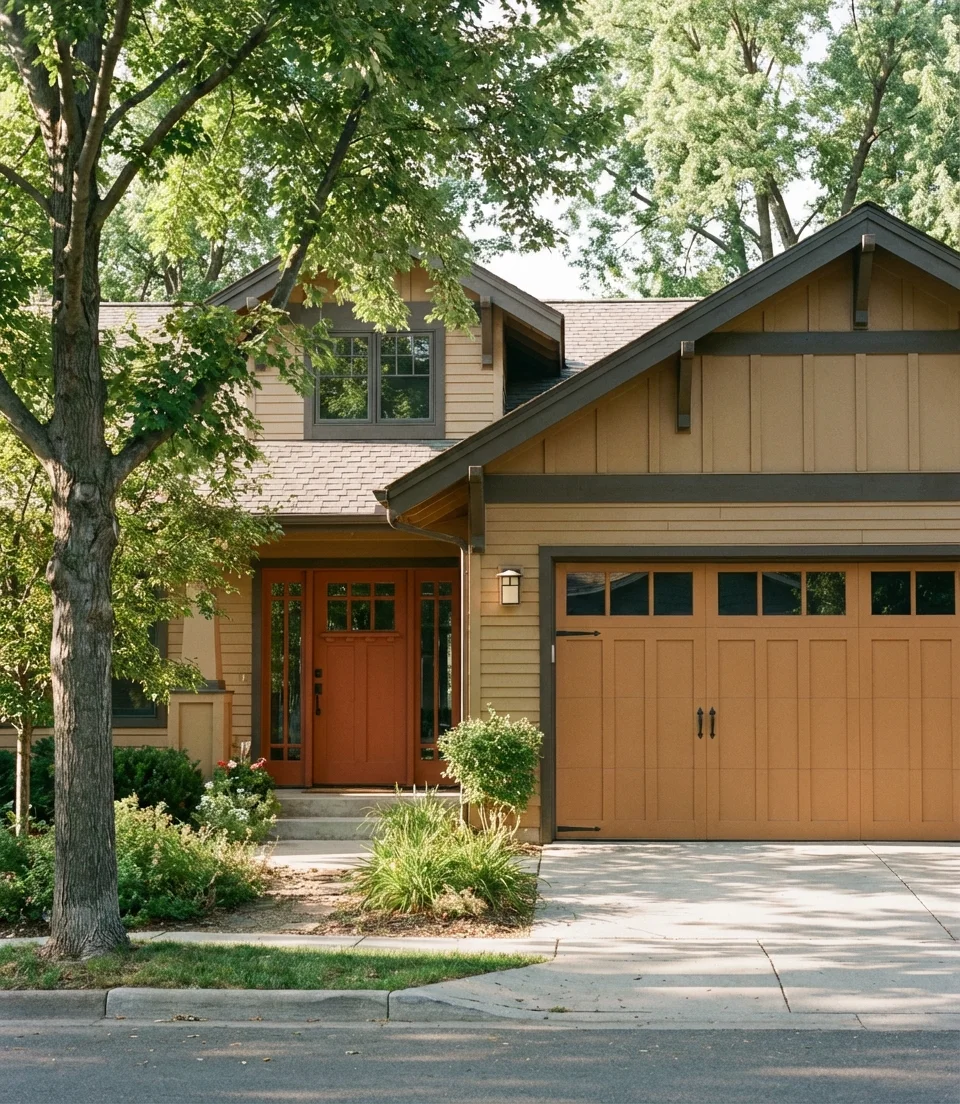
A surprisingly common mistake is treating the garage door and front door as completely independent decisions—buying them years apart with no color coordination—and then wondering why the facade feels a bit off. If you’re replacing just one of them, bring a photo of the existing door to the showroom and look for complementary tones and finishes. You don’t need to match exactly; in fact, a slight tonal variation often looks more sophisticated than an exact match. The goal is cohesion, not uniformity.
12. Alternative Garage Door Styles Beyond the Standard Panel
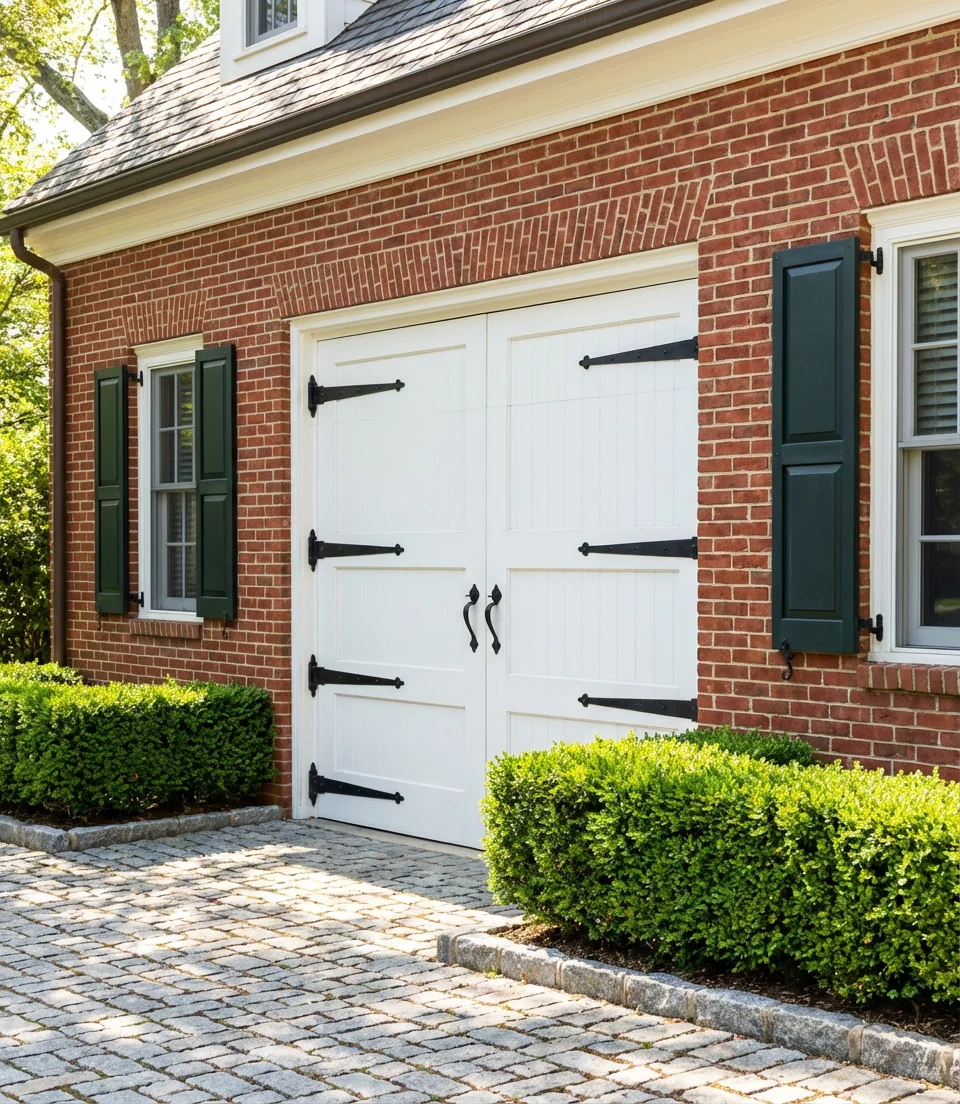
The standard raised-panel sectional door has served American homeowners for decades, but alternative styles are gaining serious ground in 2026. Swing-out carriage doors, bi-fold doors that stack neatly to one side, vertical-lift doors, and even sliding barn-style doors are all appearing in residential applications. Each offers a different spatial experience and aesthetic—carriage doors bring vintage charm, bi-folds work brilliantly in tight driveways where a standard door’s swing-out clearance would be a problem, and vertical-lift doors are a dream for anyone with limited overhead space inside.
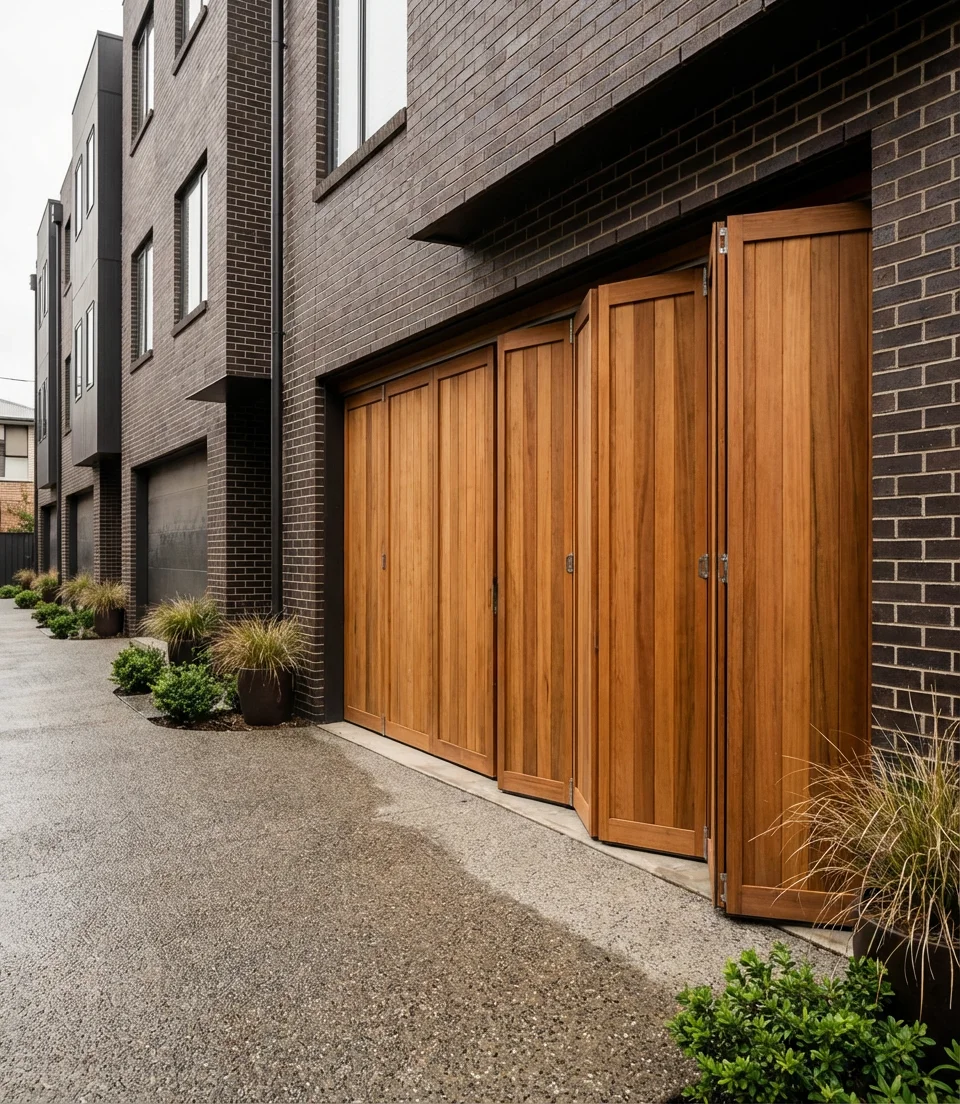
Exploring alternative garage door styles usually begins with a constraints conversation: how deep is the garage, how wide is the opening, and how much overhead space is available? Answering these practical questions significantly expands the creative options. Carriage-style swing-out doors, for example, are having a revival in suburban neighborhoods where homeowners want period-appropriate detailing without sacrificing modern convenience—many are now available with automated swing operators so you still get the ease of a remote-controlled door.
13. Closing Off Garage Space for a Finished Interior Look
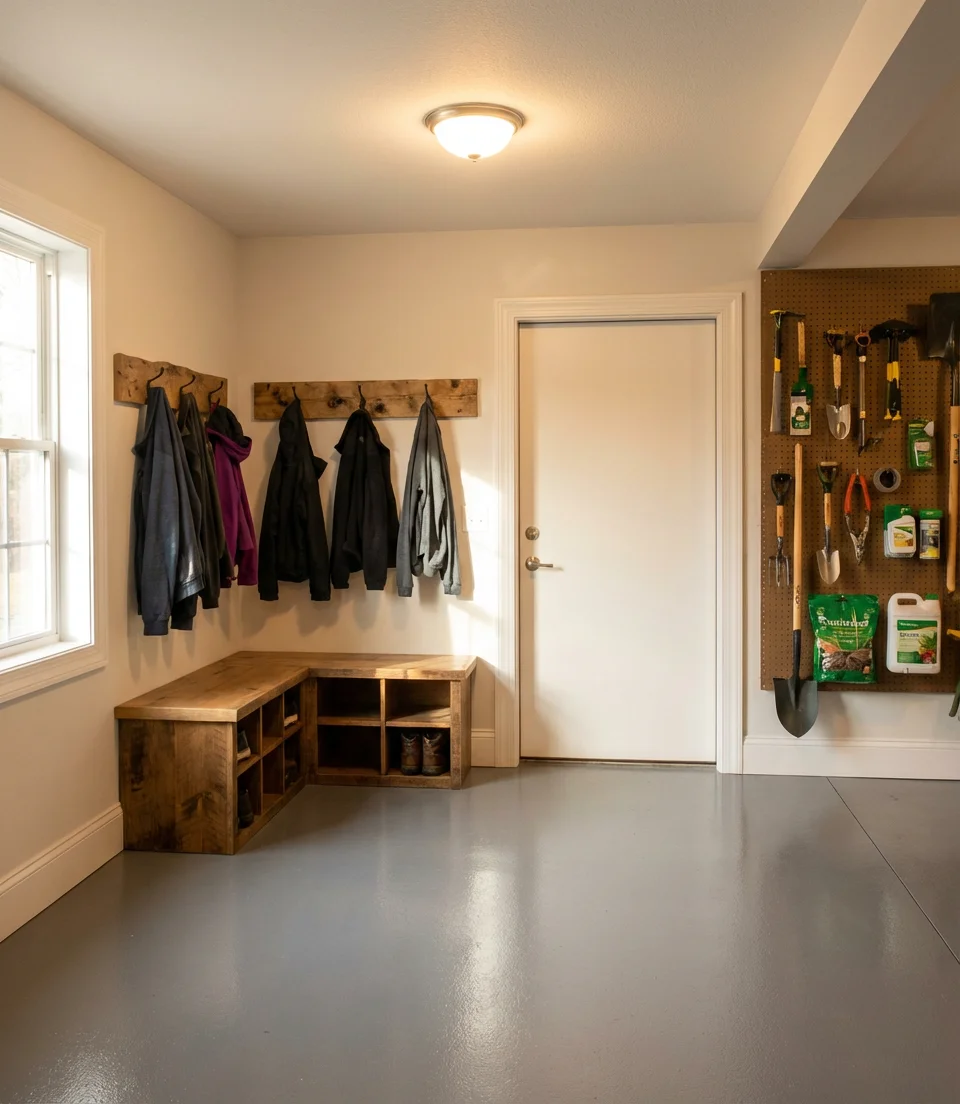
Closing off part of a garage—whether to create a utility room, a mudroom, or just a more organized storage area—is a practical project that often starts with rethinking the door situation entirely. An interior partition wall with a proper door connecting the garage to the home’s living area transforms the feel of both spaces: the garage becomes a cleaner, more purposeful zone, and the home gains a dedicated transition point where muddy boots and wet coats can be shed before entering. It’s the kind of functional upgrade that changes daily life in ways homeowners immediately appreciate.
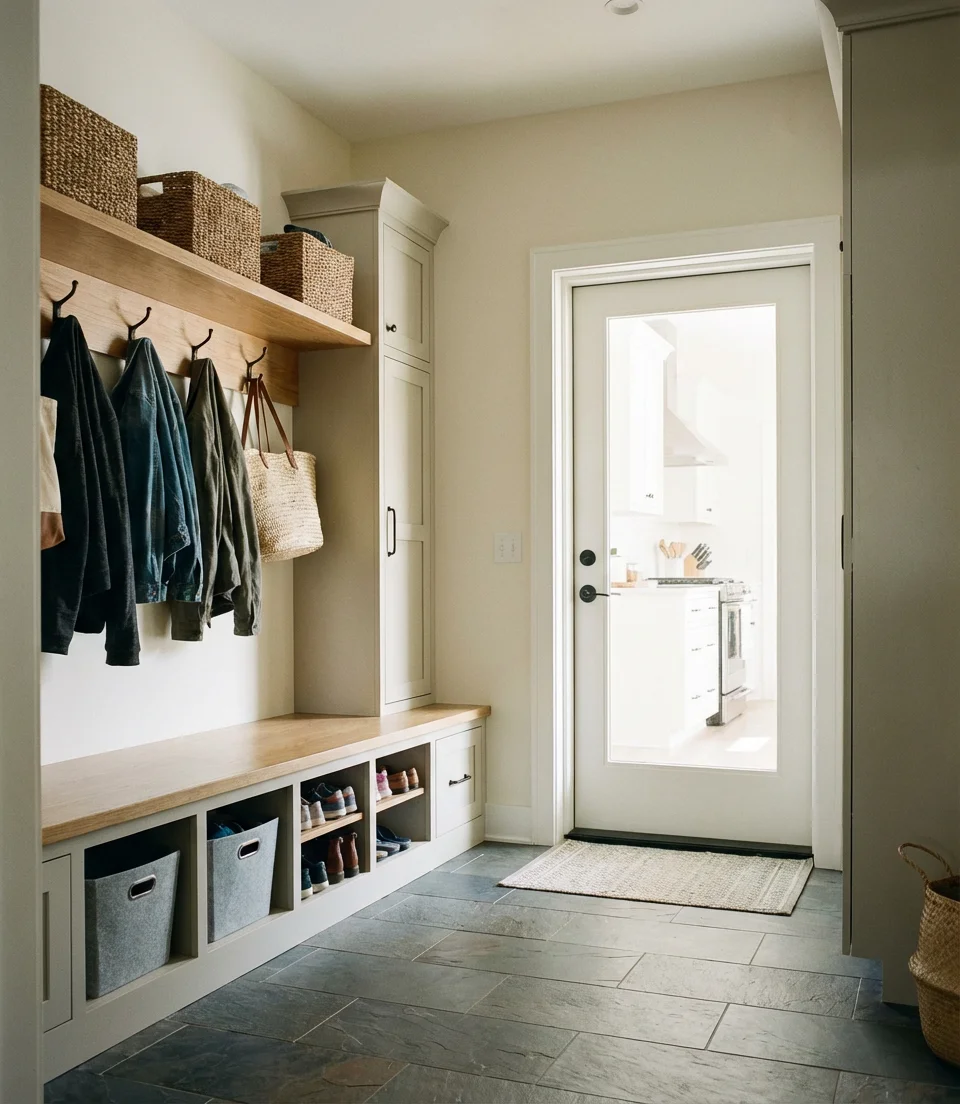
Families with young kids consistently rate the garage-to-home transition door as one of the most-used entryways in the house—which means it deserves the same thought you’d give a front door. Fire-rated doors, which are designed to withstand high temperatures and prevent the spread of fire, are required by code between attached garages and living spaces in most jurisdictions, so that’s non-negotiable. Within those constraints, though, you have real options: a solid-core door with a traditional panel profile, a sleek flush door for a modern feel, or even a half-lite door that borrows natural light from the garage. Choose the option that fits both your safety requirements and your interior style.
14. Kitchen-to-Garage Pass-Through Design Ideas
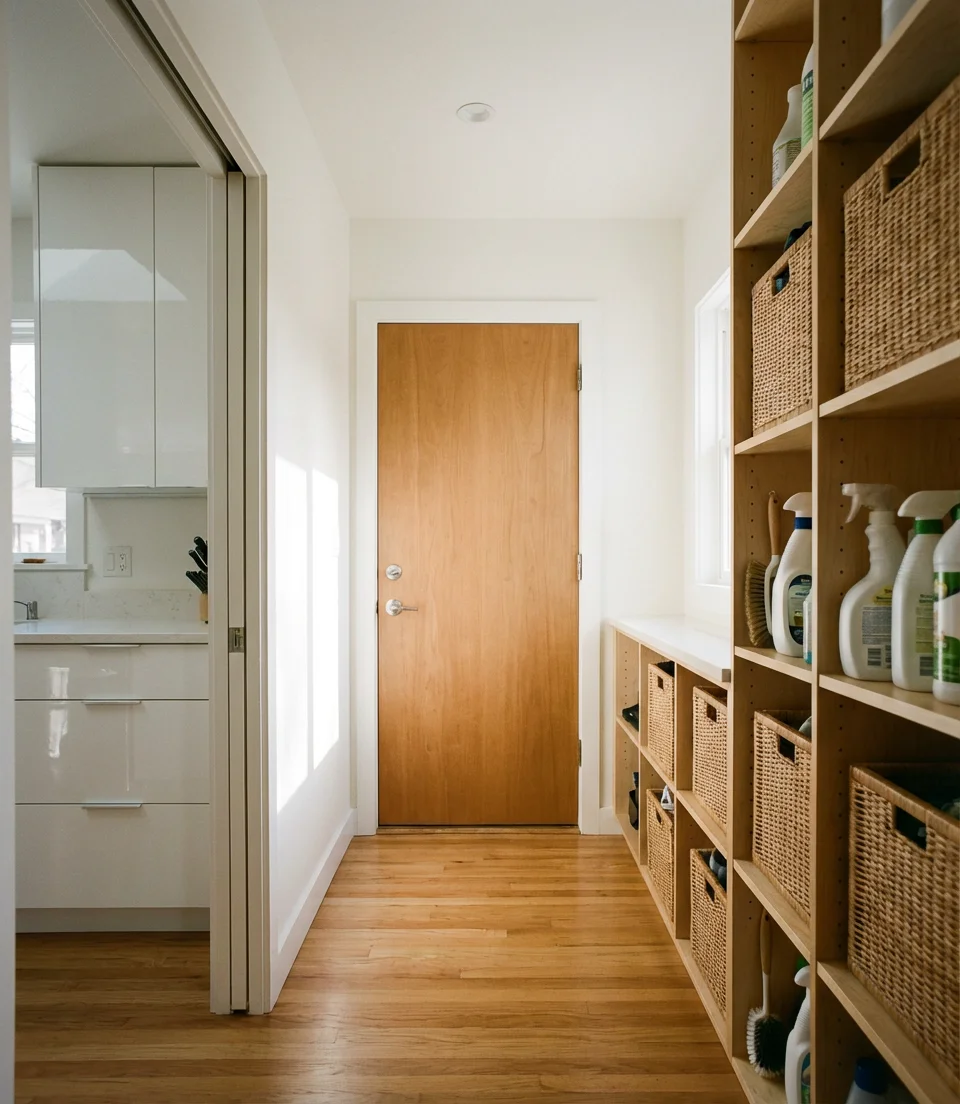
The kitchen-garage connection is one of the most underdesigned transitions in American homes, but that’s changing. Savvy homeowners are treating this doorway as an opportunity—installing a proper mudroom buffer, a pantry pass-through, or even a mini-laundry station in the garage corridor that streamlines grocery hauls, trash disposal, and daily logistics. When you design the garage door opening off the kitchen with the same attention you’d give a kitchen cabinet layout, the whole workflow of the home improves dramatically. It’s a small design decision with an outsized impact on daily comfort.
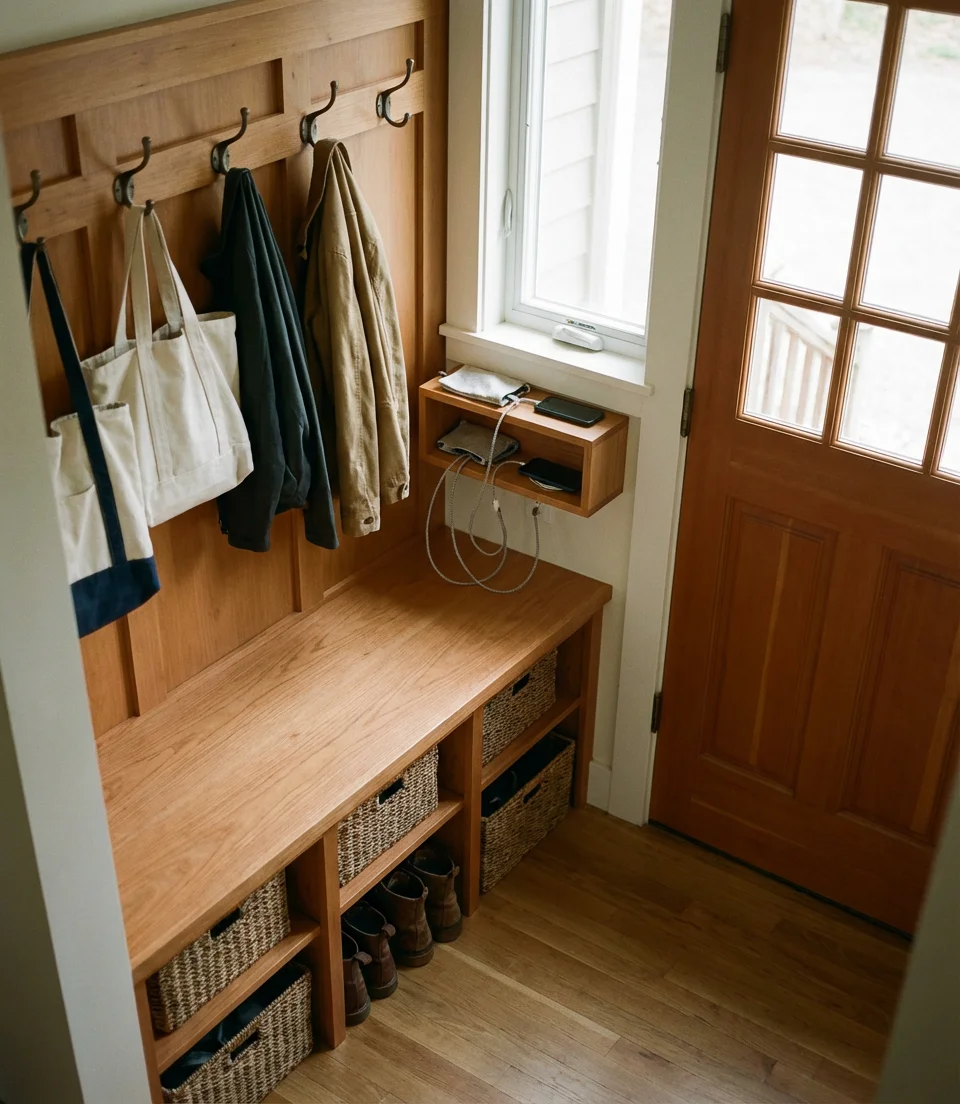
One approach gaining traction in new construction and remodels alike is treating the garage entry as an extension of the kitchen’s organizational logic. Hooks, a charging station, a small bench, and a dedicated spot for reusable grocery bags right at the garage door mean everything is in reach when you’re unloading the car. It sounds minor, but homeowners who’ve intentionally designed this zone almost universally say it’s one of the changes they appreciate most. Good design isn’t always about what people see from the street—sometimes it’s about what makes Tuesday evening easier.
15. Halloween and Seasonal Garage Door Decorating Ideas
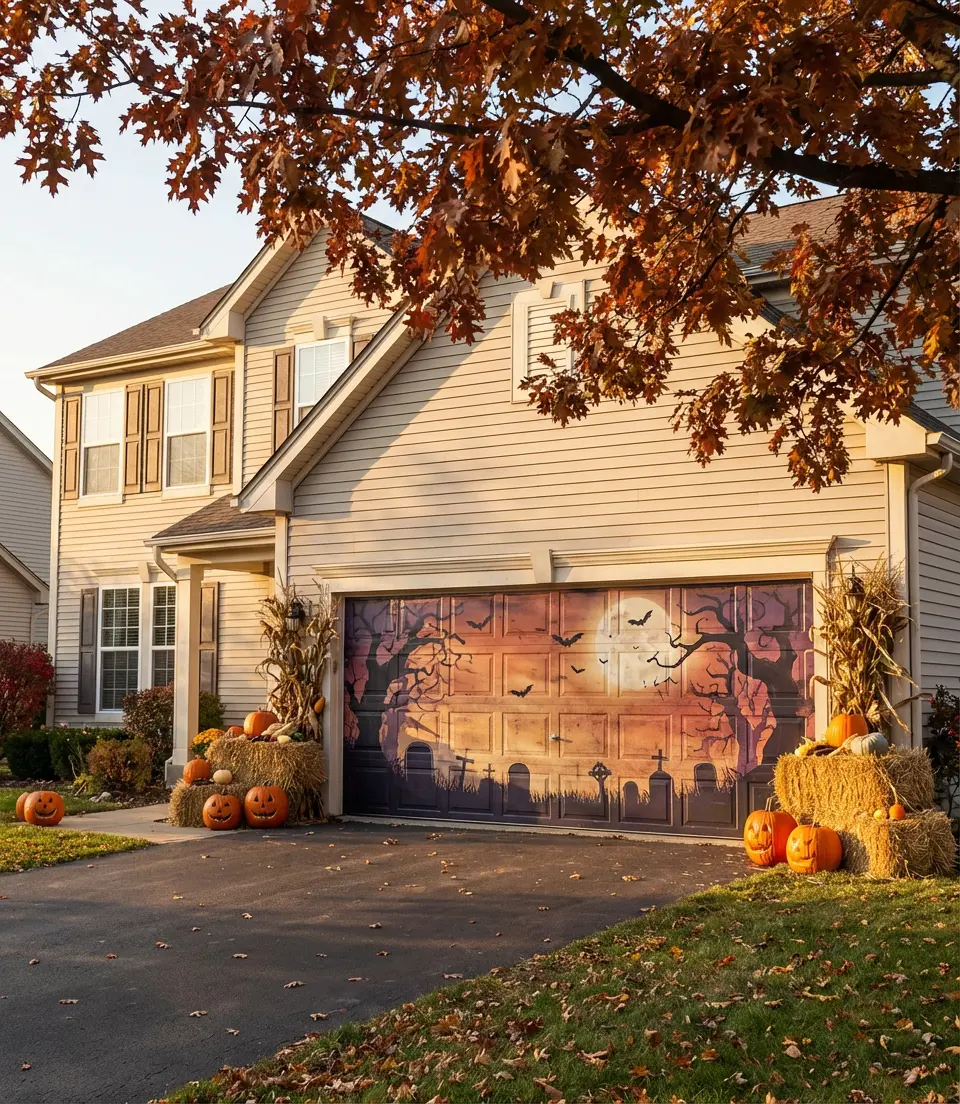
The garage door is arguably the largest canvas on your home’s exterior, and Americans have fully embraced its potential as a seasonal decorating surface—especially for Halloween and Christmas. Giant inflatable characters flanking the door, magnetic decorations designed specifically for steel doors, printed vinyl overlays that transform a plain panel into a haunted scene or a holiday display—these are all trending hard on Pinterest every fall and winter. Because the door is so prominent from the street, even a simple garland or a pair of well-placed wreaths reads as festive and welcoming from a distance.
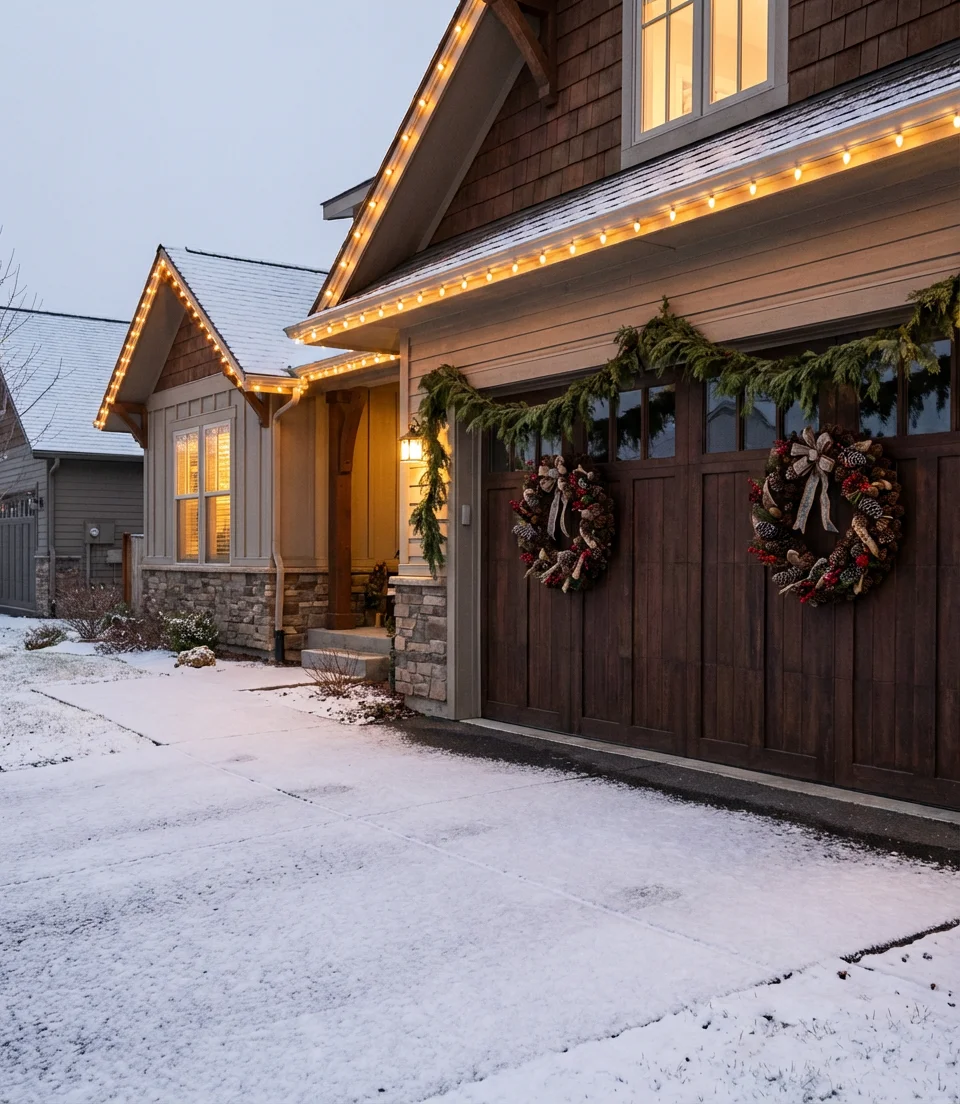
Magnetic garage door decorations have exploded in popularity because they attach cleanly to steel doors without drilling, adhesive residue, or damage—a real advantage for homeowners who want maximum seasonal impact with minimal commitment. Full-door vinyl wraps printed with holiday scenes (a wrapped gift facade for Christmas, a spider web for Halloween) are simple to apply and remove, and they’re reusable for several seasons when stored carefully. For families who love going all-out for the holidays, the garage door is now just as much a part of the decor plan as the front porch.
16. Curb Appeal Upgrades Starting With the Garage Door
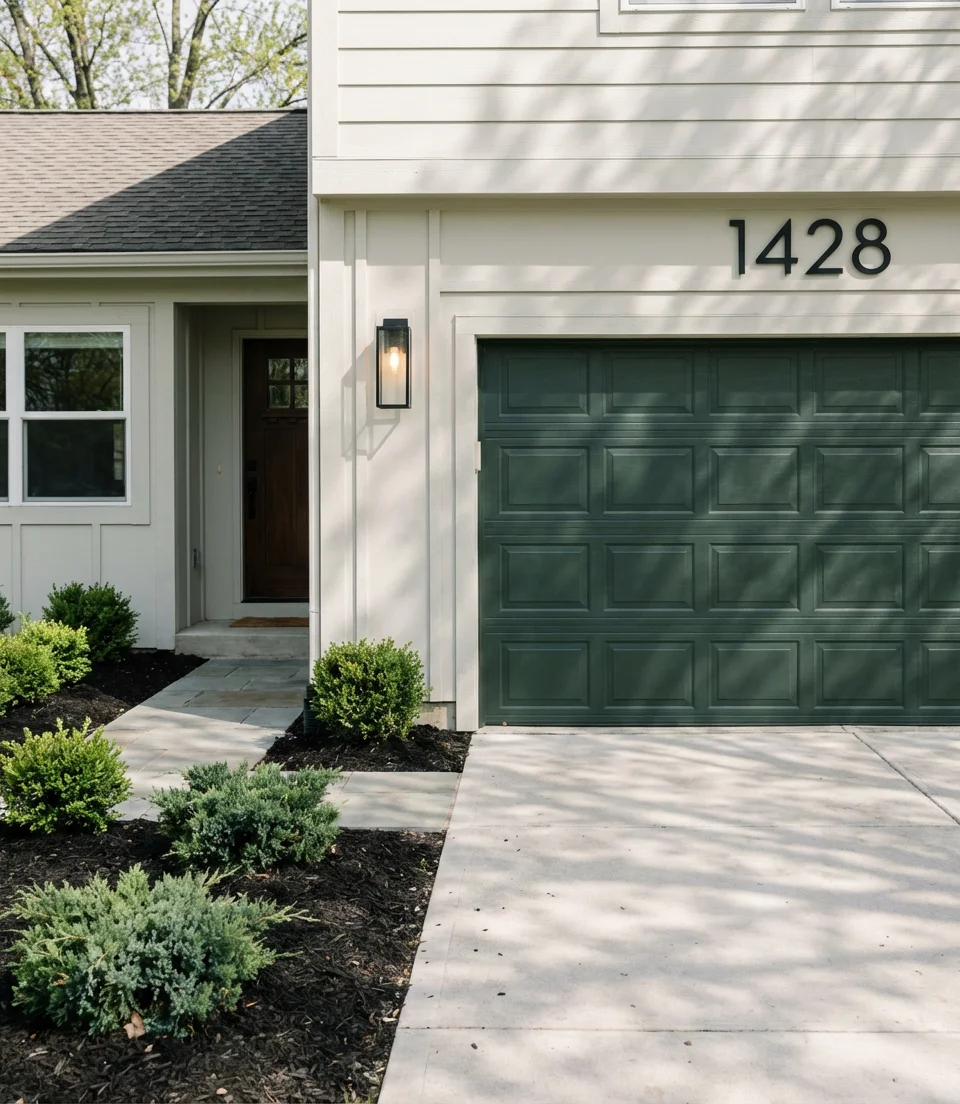
If you’re looking for the single highest-impact exterior upgrade you can make, most real estate professionals and designers will tell you the same thing: replace or refresh the garage door. Curb appeal starts here, especially on homes where the garage faces the street. A fresh door—even just a repaint of the existing one in a more current color—can change the entire energy of a facade in a weekend. Combine that with updated house numbers, a new light fixture, and some simple landscaping, and you have a home that reads as significantly better maintained and more design-conscious than it did before.
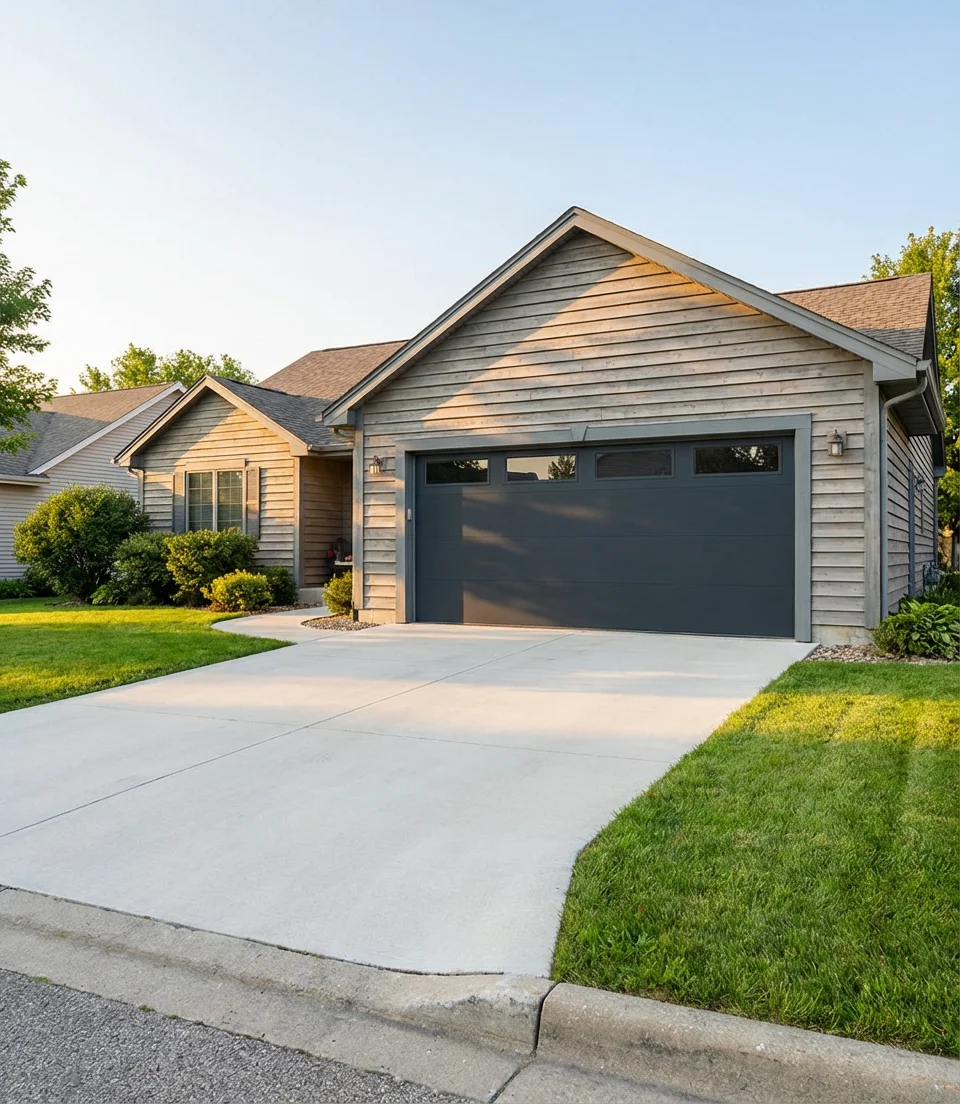
Realtors consistently rank garage door replacement among the top five exterior improvements for return on investment, often citing cost-recoup rates of 90% or higher at resale. That makes it an unusually smart upgrade—one that improves your daily experience of your home while also making financial sense. If a full door replacement isn’t in the budget right now, even replacing the hardware (handles, hinges, and decorative straps on a panel door) with a higher-quality or more stylish option can make a meaningful visual difference. Small changes in the right place have a compounding effect on how a home looks.
17. Double Car Garage Doors That Make a Wide Wall Work
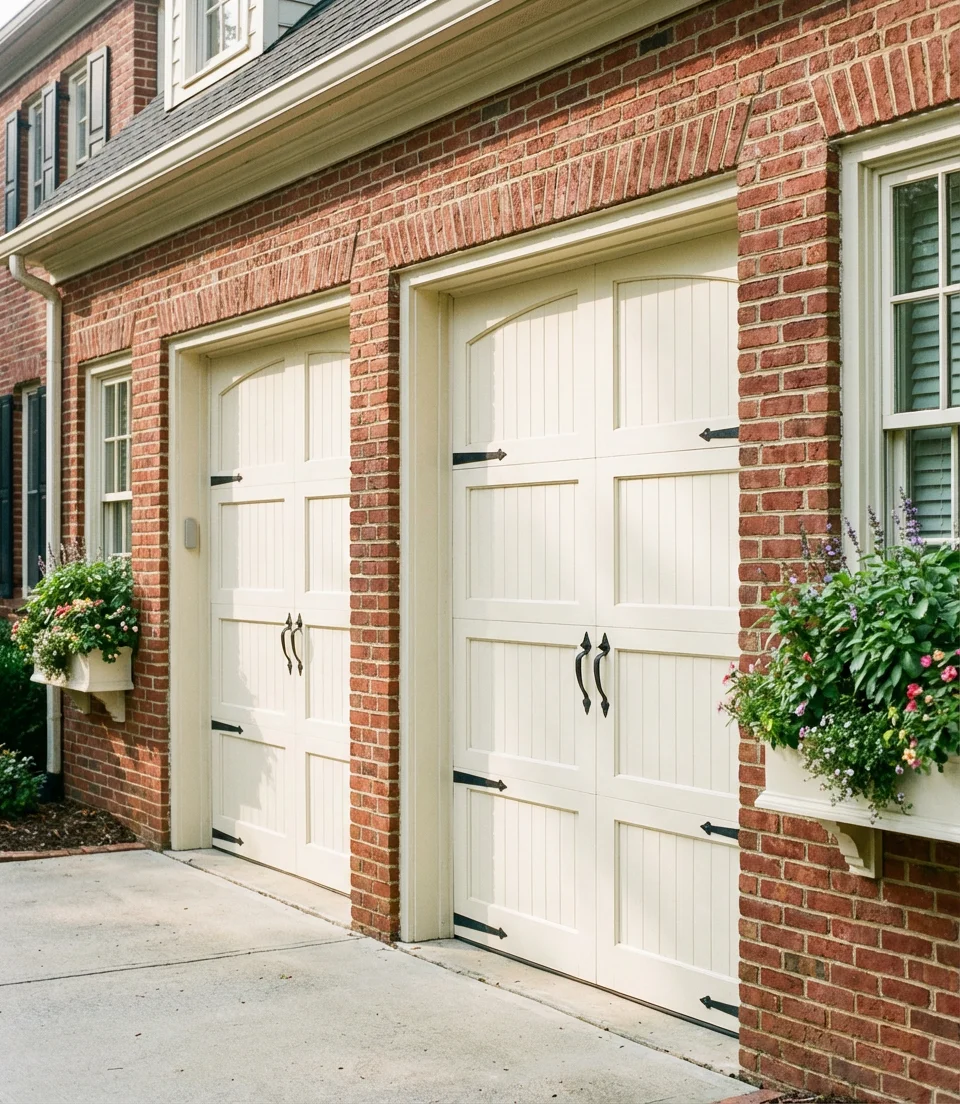
A double-car garage presents a design challenge: how do you handle a wide expanse of door without it overwhelming the facade? The answer usually lies in breaking up the surface—through window inserts, panel patterns, or a combination of materials. A double carriage-style door with decorative hardware and a pair of upper window panels, for instance, reads as far more architecturally intriguing than a flat two-car slab. The goal is to give the eye something to travel across, so the garage enhances the facade rather than dominating it by sheer mass.
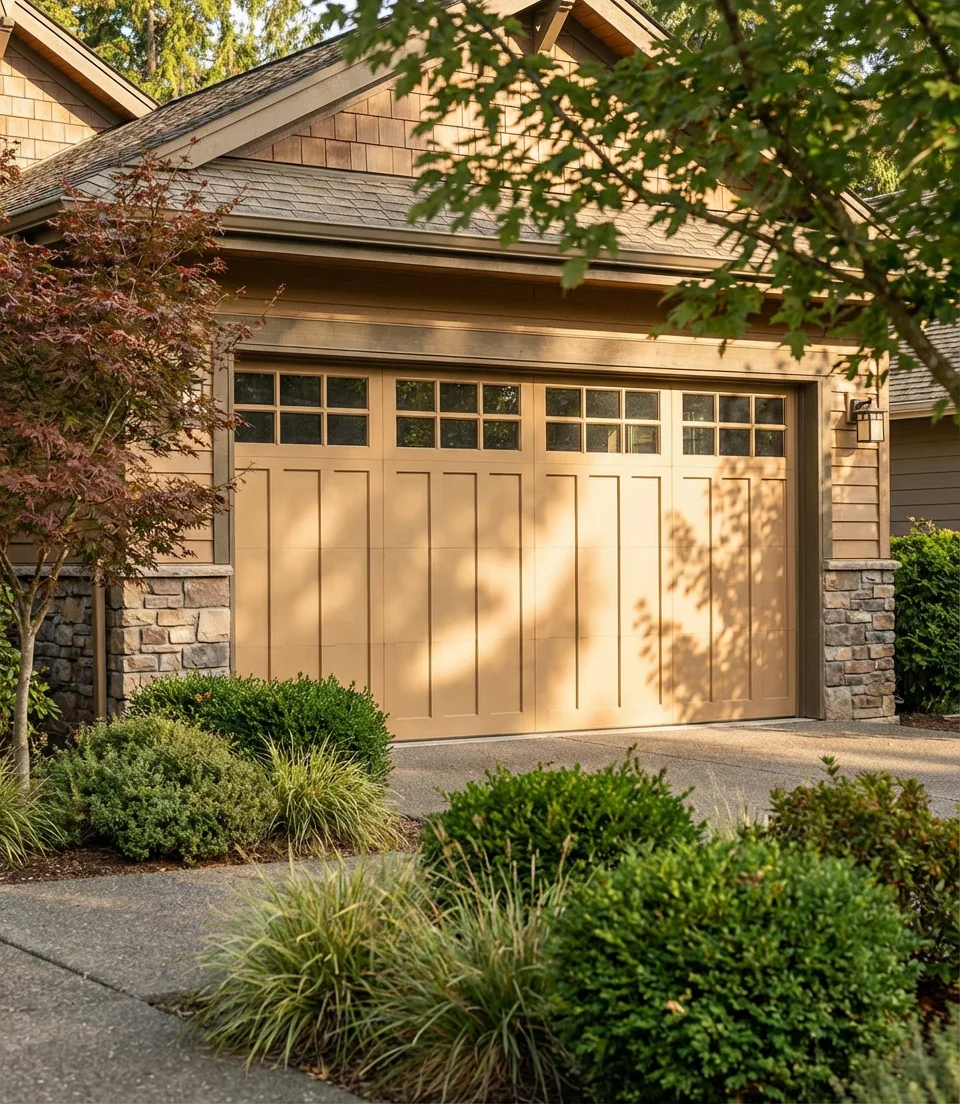
One design move that’s quietly brilliant is installing two single doors instead of one double door. Two separate doors allow for more visual articulation of the facade, can each be operated independently (useful if one car leaves before the other), and tend to look more intentional and architectural on homes with traditional styling. It does cost slightly more than a single double door, but the design benefit is usually worth it. Please request your installer to present both options side by side before making a decision, as the difference on a facade this prominent is genuinely significant.
18. Appliance Garage Doors in the Kitchen—A Tiny But Mighty Idea
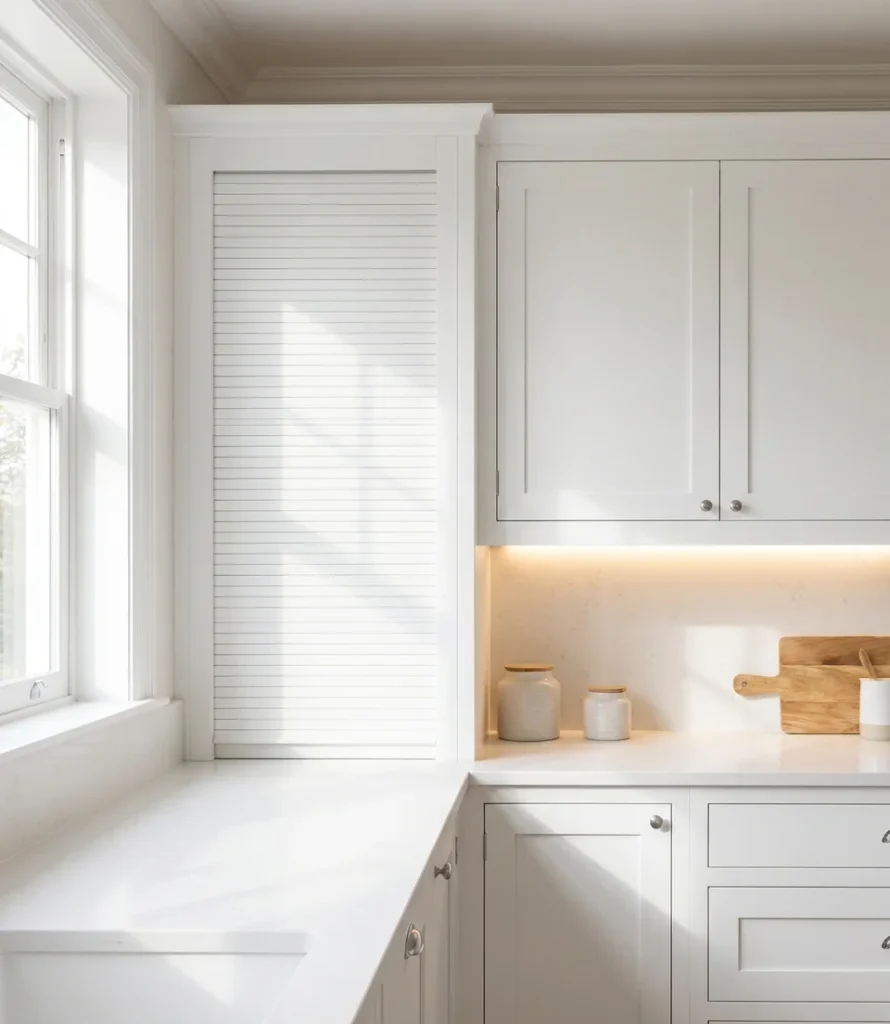
Not every garage door belongs outside—the appliance garage, a beloved kitchen cabinet feature, is making a significant comeback in 2026 kitchen design. These small roll-up or tambour doors hide countertop appliances—such astoasters, coffee makers, and stand mixers—behind a seamless cabinet facade when not in use, keeping the kitchen looking clean and uncluttered. They’re especially popular in open-plan homes where the kitchen is visible from the living area, because visual noise from appliances genuinely disrupts the sense of order that makes a space feel calm and designed.
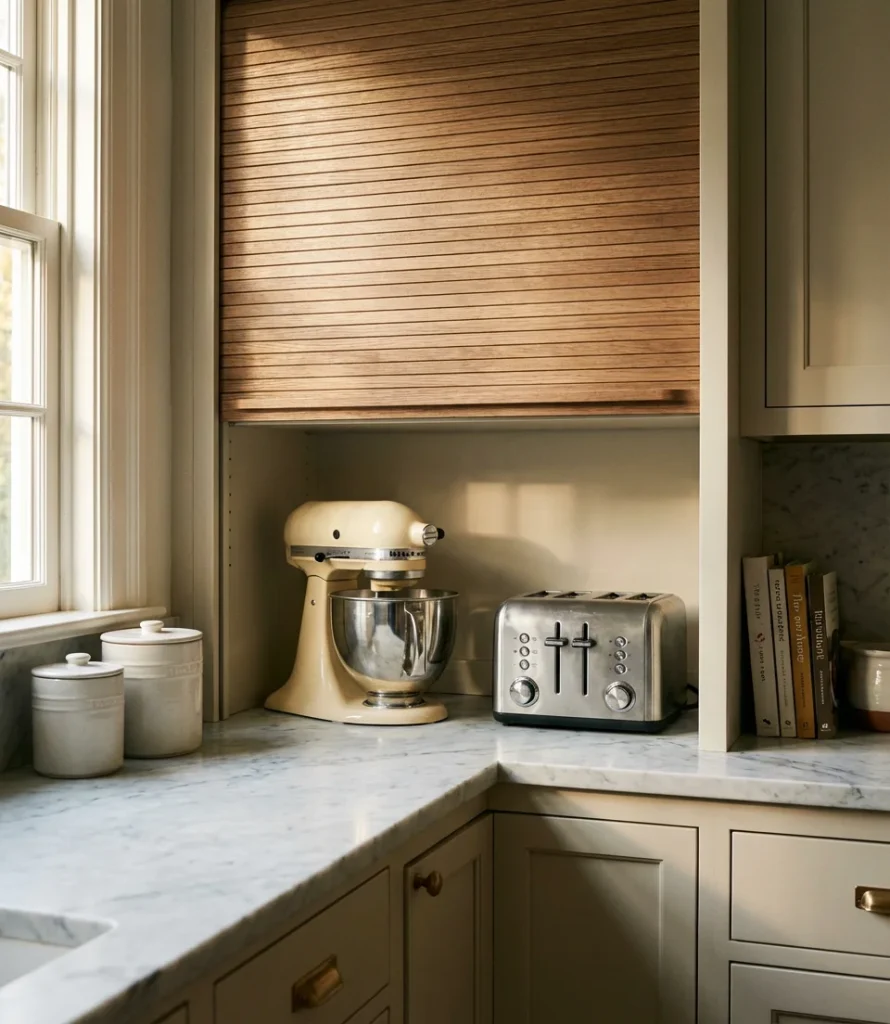
The tambour door mechanism—a series of thin slats that roll up or to the side on a track—is the most popular option because it requires no swing clearance, making it ideal for tight kitchen layouts. They can be finished in wood veneer to match cabinetry, painted to blend seamlessly, or left in a contrasting material as a subtle design detail. Adding appliance garages to a kitchen renovation budget of approximately $15,000–$25,000 is a relatively modest expenditure that significantly enhances daily tidiness. It’s one of those features that people don’t know they love until they have it.
19. Single Car Garage Doors That Punch Above Their Weight
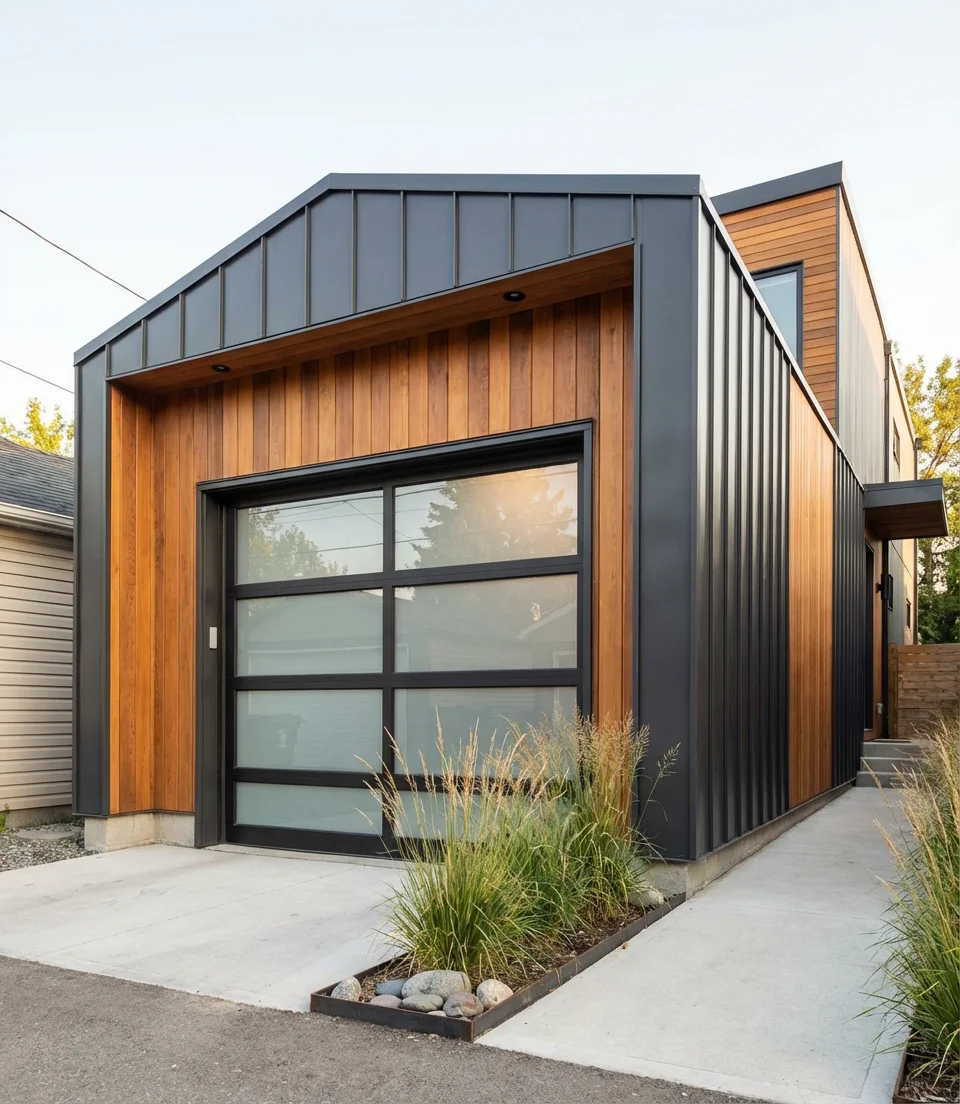
A single-car garage door has an inherent design advantage over its double counterpart: it’s compact enough to function almost like a piece of art on the facade. Here, you have the opportunity to experiment with bold design elements such as a full-glass door, a custom wood panel with geometric detailing, a vibrant color, or an unusual material choice, all of which complement a single opening without overwhelming the entire front of the house. For urban infill homes, townhouses, and smaller cottages, the single garage door is often the most visible design decision on the exterior, so it deserves real thought.
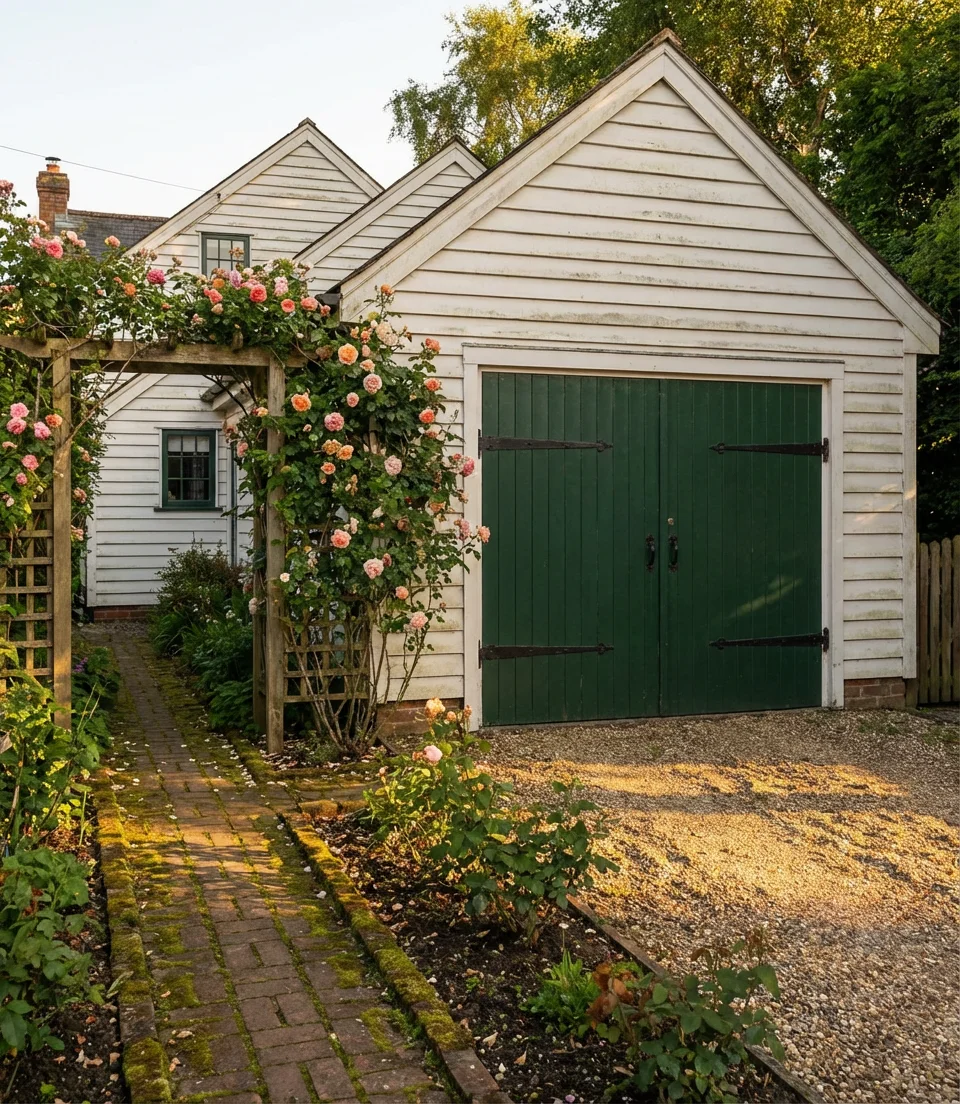
One approach that works beautifully is treating the single garage door as part of a coordinated trio with the front door and a side gate or fence—matching the material, finish, or color across all three elements creates a sophisticated, gallery-like exterior composition. It’s a move you see a lot in design-forward cities like Portland, Austin, and Denver, where homeowners are investing in exterior design with the same seriousness previously reserved for interiors. The garage door, when chosen thoughtfully, stops being an afterthought and starts being a signature.
20. Closing In an Open Bay With a Custom Garage Door
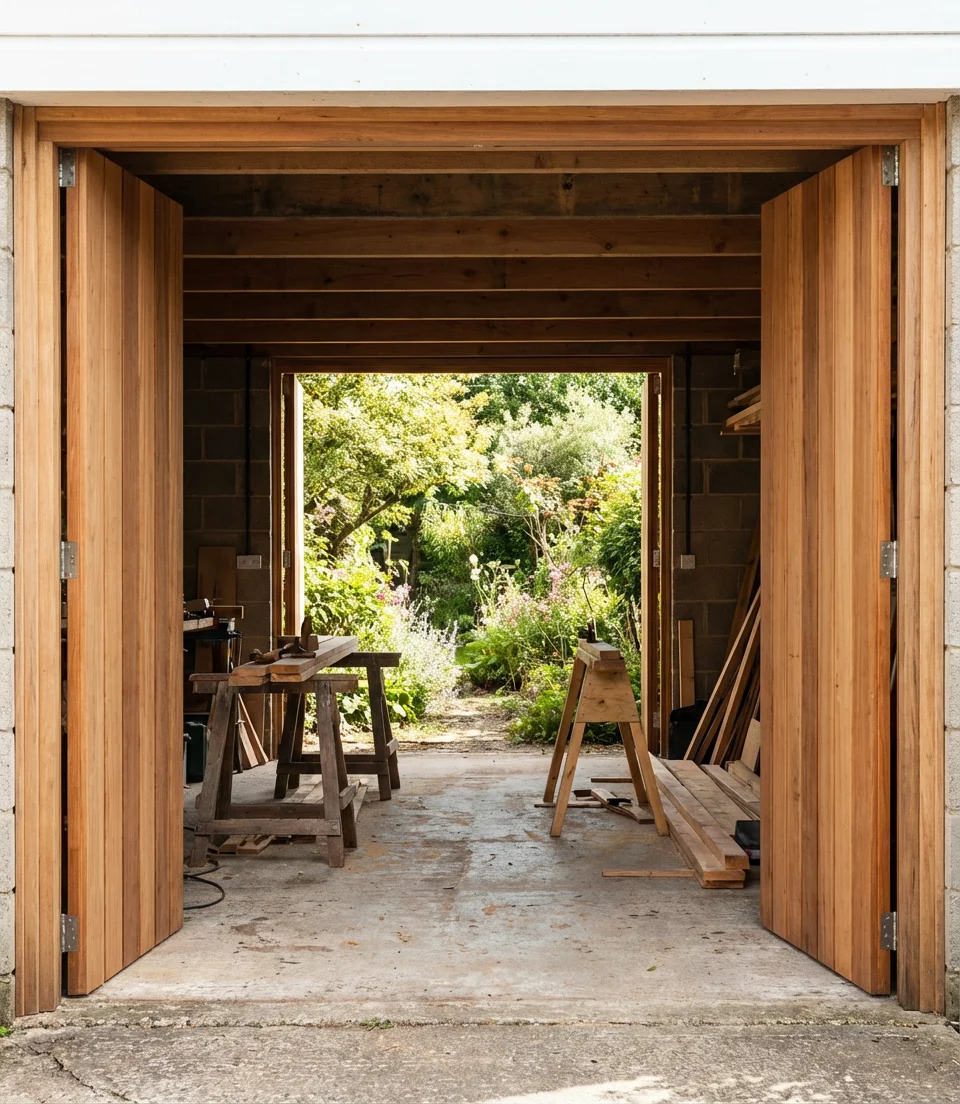
Closing in an open bay—whether it’s a covered parking area, a breezeway, or an open workshop space—with a well-chosen door is one of the most transformative things you can do to a property with underutilized covered space. The right door doesn’t just secure the space; it defines it. A bi-fold wood door makes a covered outdoor kitchen feel like a proper pavilion. A glass-panel door on a studio space makes it feel like a professional creative workspace. An insulated steel door on a workshop signals that serious work happens here. The door choice shapes how the space feels to everyone who sees it and uses it.
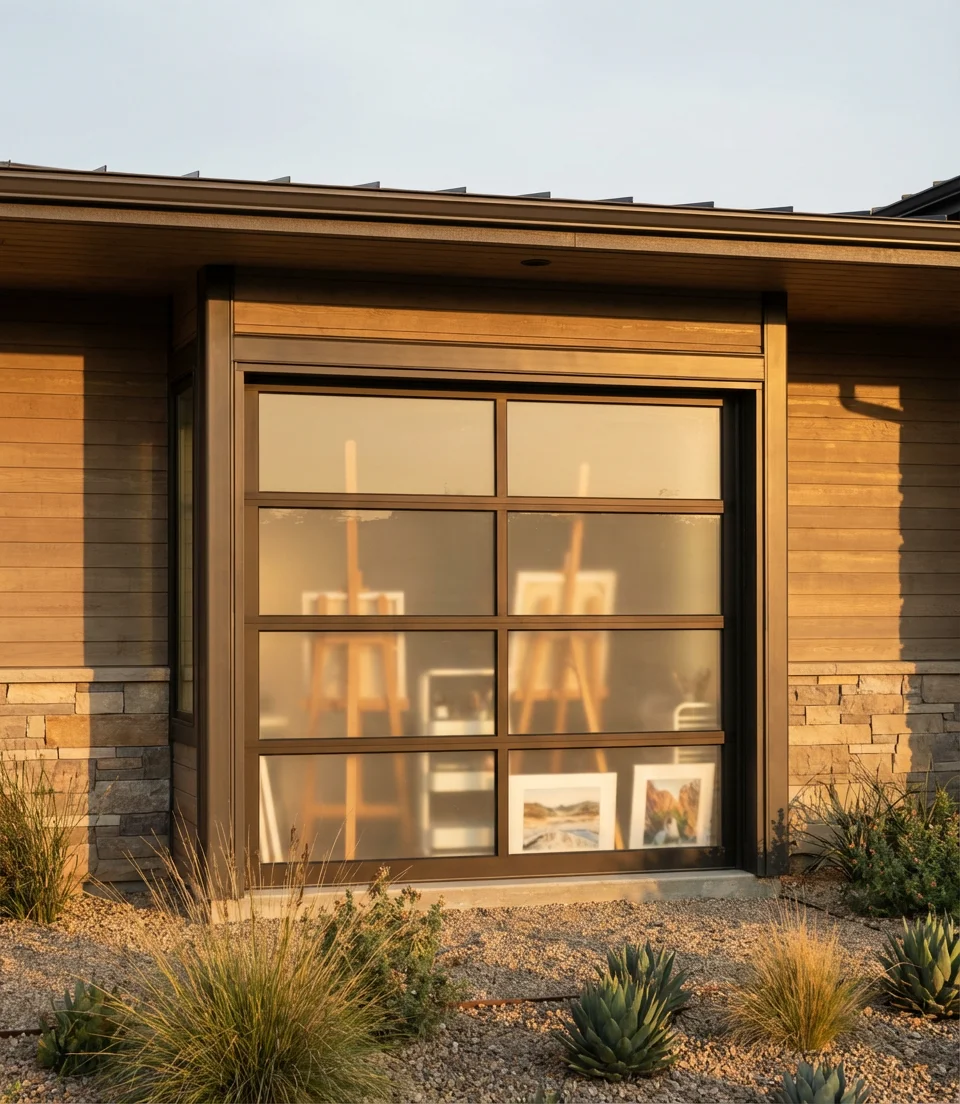
Custom doors for non-standard openings have become significantly more accessible recently as more manufacturers offer semi-custom sizing and online configuration tools. What once required a specialty fabricator and a long lead time can now often be specified and ordered in a matter of days. The key is getting the opening dimensions precisely right before ordering—a common mistake is measuring the opening at a single point rather than at multiple heights and widths, which can reveal out-of-square framing that needs addressing before a new door can be installed properly. Measure twice, order once.
21. Garage Doors That Coordinate With the Whole Exterior Palette
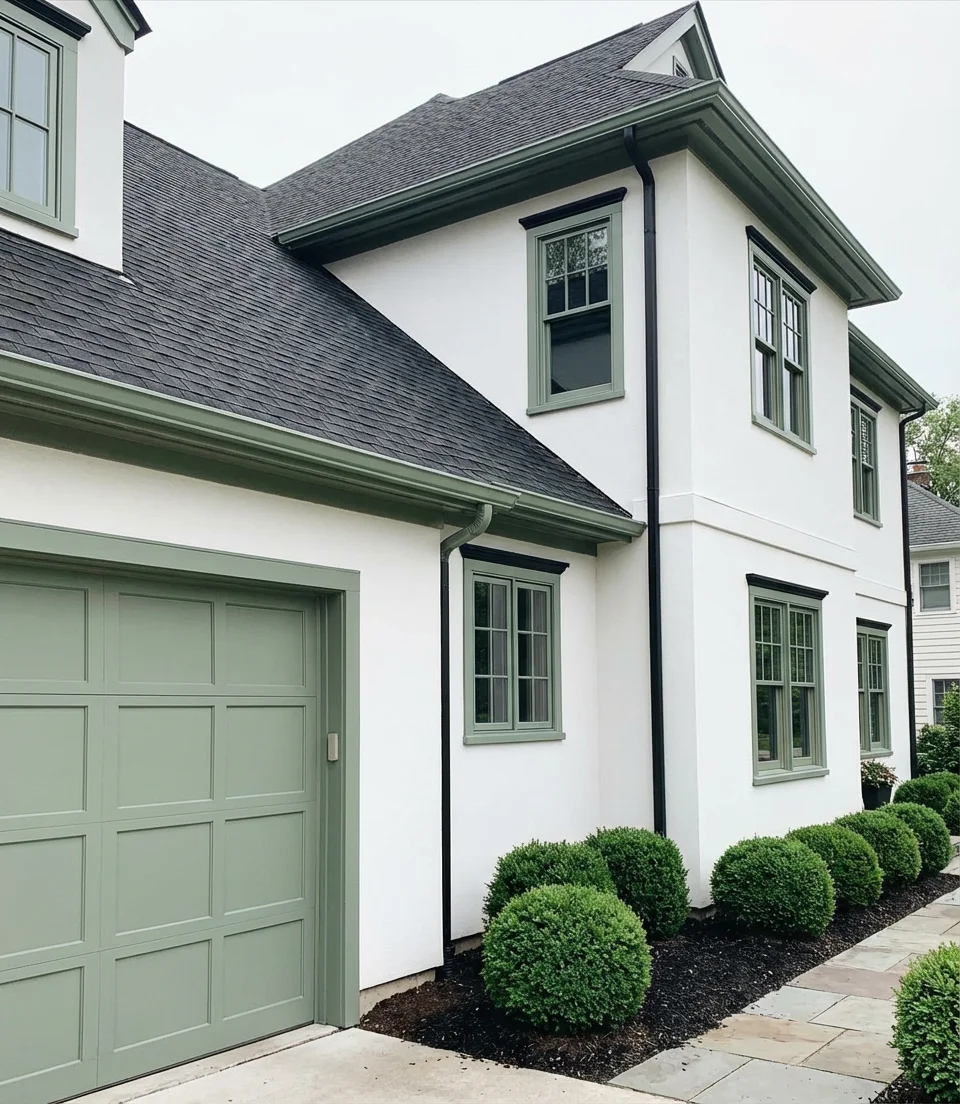
The most sophisticated garage door upgrades of 2026 aren’t about any single style or material—they’re about the relationship between the door and the entire exterior palette. A roll-up steel door in a custom color that precisely matches the window frames and gutters, for instance, reads as far more designed than a door chosen in isolation. Curb appeal at the highest level is always a system, not a collection of individual decisions. Every element—siding, trim, door, hardware, landscaping—either contributes to a coherent whole or introduces visual noise that dilutes the impact of every other element around it.
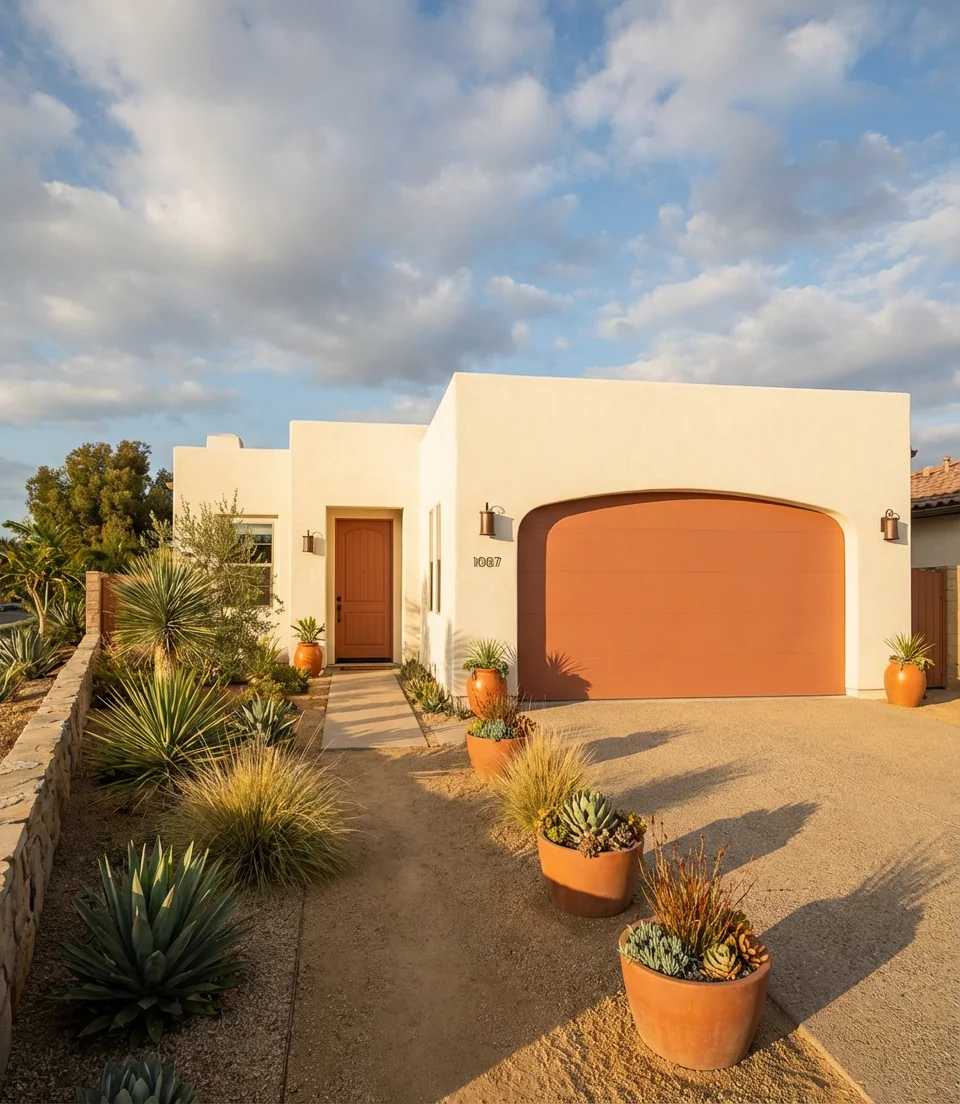
Start with a whole-exterior photo—either a current snapshot or a rendering—and map out your color strategy before committing to a door. Most door manufacturers now offer physical color samples that you can hold up against your siding and trim in natural light, which is infinitely more accurate than comparing swatches on a screen. If you can only afford one designer consultation in your entire home renovation, spend it on the exterior color palette: those decisions are the ones every single person who drives past your house will form an impression of, every single day.
Garage doors in 2026 are no longer just a functional necessity—they’re one of the most exciting design decisions you can make for your home’s exterior, and the options have never been more varied or more beautiful. Whether you’re drawn to the drama of a full-glass panel door, the warmth of faux wood, or the seasonal joy of a well-decorated steel door at Halloween, there’s an option that fits your home, your budget, and your personality. We’d love to hear which idea sparked something for you—drop your thoughts, questions, or photos of your garage door transformation in the comments below. Your experience might be exactly the inspiration someone else is searching for.